 Podit
Podit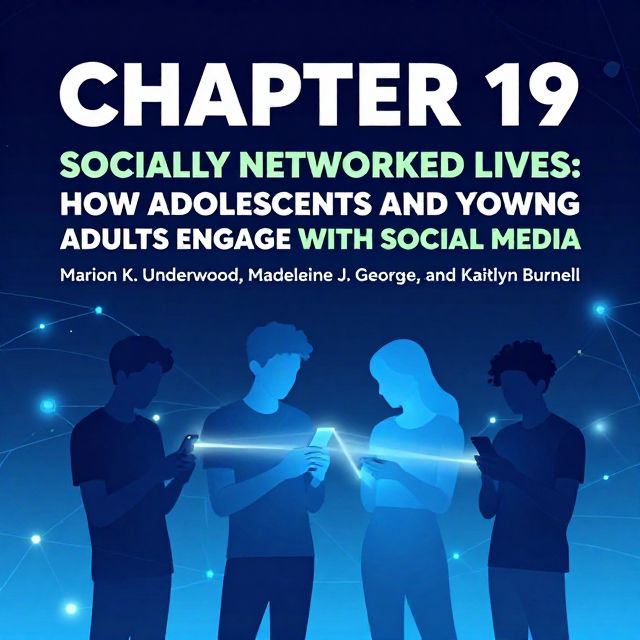
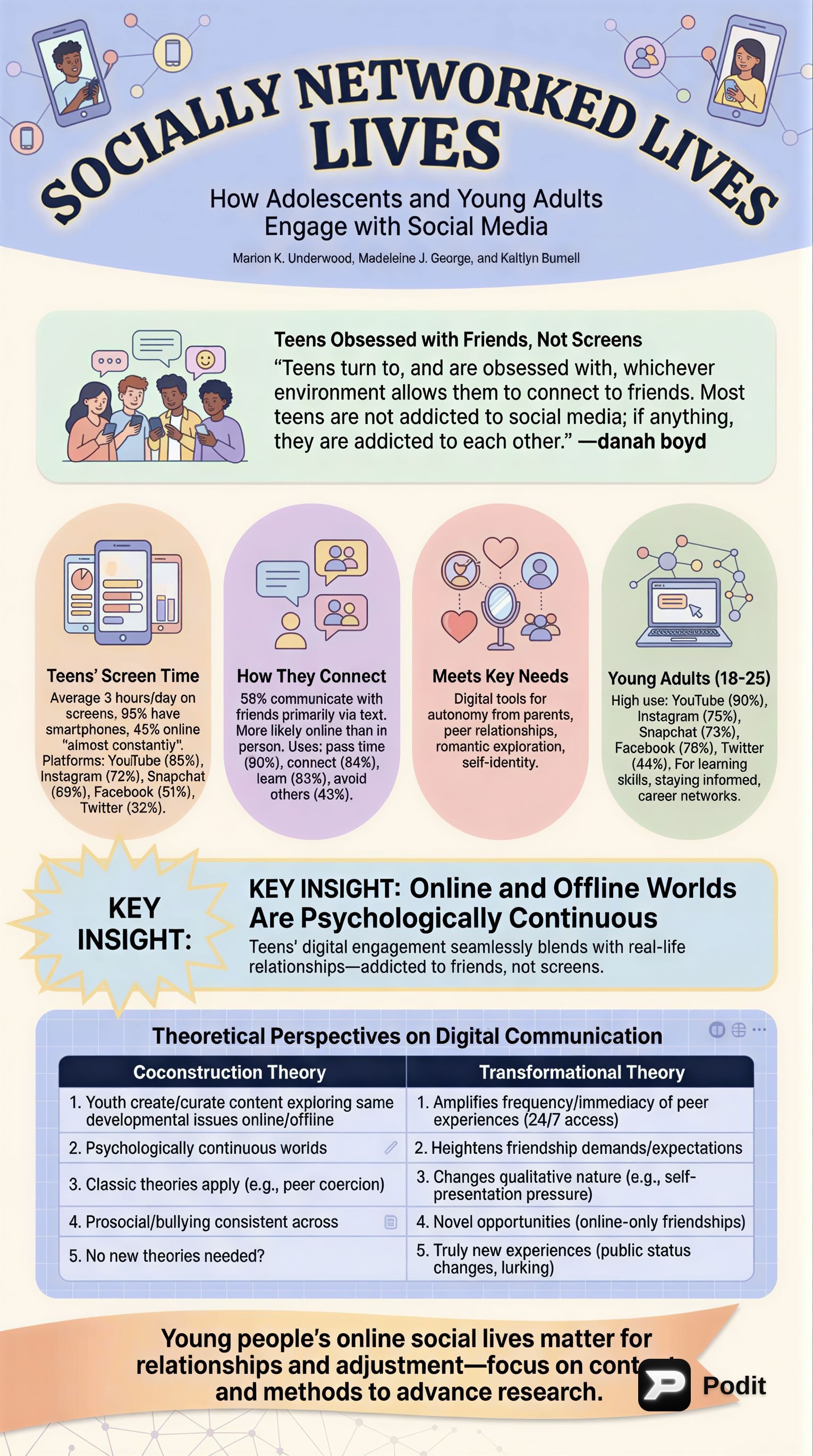
📚 Socially Networked Lives: Adolescents and Young Adults in the Digital Age
Source Information: This study material is compiled from a lecture audio transcript and a copy-pasted text, likely a chapter from an academic handbook titled "CH A P T E R 19 SOCIALLY NETWORKED LIVES: HOW ADOLESCENTS AND YOUNG ADULTS ENGAGE WITH SOCIAL MEDIA" by Marion K. Underwood, Madeleine J. George, and Kaitlyn Burnell.
🌐 Introduction: The Blurring Lines of Online and Offline Lives
Adolescents and young adults today live a significant portion of their social lives online, making digital communication an integral part of their development. This material explores how young people engage with social media, the theoretical frameworks explaining this engagement, the ongoing debate surrounding screen time, and the nuanced factors influencing its impact on well-being.
📊 Key Statistics on Youth Social Media Use:
- Adolescents (US): Average 3 hours/day on screens (social media, gaming, web-surfing, videos).
- Smartphone Access: 95% of teens own or have access to smartphones.
- Constant Online Presence: 45% of teens are online "almost constantly."
- Platform Popularity (Teens): YouTube (85%), Instagram (72%), Snapchat (69%), Facebook (51%), Twitter (32%).
- Primary Communication: 58% of teens primarily use text messaging to communicate with friends.
- Reasons for Use: Pass time (90%), connect with others (84%), learn new things (83%), avoid interacting with people (43%).
- Developmental Challenges: Digital communication helps navigate establishing autonomy, forming peer relationships, exploring romantic partnerships, and developing self-identity.
- Young Adults (18-24 years): Similar high usage on YouTube (90%), Instagram (75%), Snapchat (73%), Facebook (76%), Twitter (44%). Their use often aligns with learning new skills, staying informed, and building professional networks.
The distinction between online and offline social relationships is increasingly blurred for young people, suggesting a seamless integration of their digital and physical worlds.
🧠 Theoretical Perspectives on Digital Communication
Two main theoretical perspectives help understand how adolescents and young adults engage with digital communication:
1️⃣ Coconstruction Theory
📚 Definition: This theory proposes that young people actively create and curate their online content while simultaneously exploring the same fundamental developmental issues (e.g., identity, relationships) in both their online and offline interactions. ✅ Key Idea: Online and offline social worlds are "psychologically continuous." 💡 Implication: Classic developmental theories that explain in-person social processes can often be applied to digital communication.
- Example: Youth involved in cyberbullying are often also involved in face-to-face bullying. Prosocial behavior offline tends to extend online.
2️⃣ Transformational Theories
📚 Definition: These theories suggest that the unique features (affordances) of social media amplify and transform aspects of young people's friendships and peer relations in five key ways:
- Frequency & Immediacy: Friends are accessible 24/7 via text, and large networks can be contacted instantly. This offers both social support and potential for negative peer influence (e.g., co-rumination).
- Amplified Experiences: Digital communication heightens expectations for immediate responses and can accelerate peer socialization, for better or worse.
- Qualitative Change: The nature of peer experiences can change. Texting might offer different types of social support or conflict management. Social media can increase pressure for positive self-presentation and make peer victimization more painful.
- Novel Opportunities: Digital platforms offer interactions not possible offline, such as forming online-only friendships, finding communities for marginalized groups, or expanding professional networks.
- Truly Novel Experiences: Public announcements of relationship status changes or "lurking" to observe high-status peers are unique digital phenomena.
⚖️ The Screen Time Debate: Harmful or Helpful?
The impact of screen time on young people's well-being is a hotly debated topic.
⚠️ The Displacement Hypothesis
📚 Definition: This hypothesis argues that time spent on digital devices displaces offline social activities, leading to negative mental health outcomes.
- Arguments: Constant online interaction may prevent real-life presence, hinder social skill development, and lead to loneliness, social isolation, and depression.
- Supporting Evidence: Some large cross-sectional studies show correlations between increased digital technology use and rises in depression, loneliness, and suicidal behavior. Experimental studies have also linked Facebook use to declines in well-being.
✅ Counterarguments and Nuanced Findings
- Weak Associations: Many studies find weak or null associations between social media use and mental health symptoms. Some reanalyses suggest digital technology explains a very small percentage (e.g., 0.04%) of variance in adolescent well-being.
- Mixed Longitudinal Results: Longitudinal and daily studies often show mixed or no significant effects. For example, some found no daily associations between social media time and depressive symptoms, or that social media use did not predict increased depression or anxiety over time.
- Conclusion: While an association between more social media time and greater mental health symptoms may exist, it is often small, and strong evidence for direct causal processes is limited. The type of engagement and individual characteristics are more critical than simply the amount of time spent online.
📱 Types of Social Media Use and Their Effects
The impact of social media largely depends on what an individual is doing online. Three main types of use are identified:
1. Passive Use
📚 Definition: Scrolling through content without direct interaction (e.g., browsing posts, watching stories without commenting).
- Potential Negative Effects:
- Upward Social Comparison: Viewing highly positive or idealized content can lead to feelings that others are better off, causing envy, negative mood, and decreased self-esteem.
- Body Image Concerns: Exposure to "fitspiration" or idealized images can increase body dissatisfaction, especially for young women.
- Potential Positive Effects:
- Self-Focus: Viewing or editing one's own social media content (e.g., Instagram profile) can boost self-esteem and positive affect.
2. Active Public Use
📚 Definition: Posting content to a broader social media audience (e.g., Facebook statuses, tweets).
- Potential Effects:
- Social Connectedness: Can foster feelings of connection, potentially leading to lower depressive symptoms.
- Mixed Results: Some studies show positive boosts in affect after posting, while others find no relation to well-being or even a curvilinear relationship with loneliness (low/moderate use linked to lower loneliness, high use to greater loneliness).
3. Active Private Use
📚 Definition: Direct communication with specific individuals or groups (e.g., direct messages, private chats).
- Potential Positive Effects:
- Increased Closeness & Support: Strongly associated with positive well-being, increased closeness to friends, and immediate social support.
- Beneficial for Distressed Youth: Can help reduce emotional distress and improve perceived well-being after social exclusion.
🧑🤝🧑 Individual Differences: What and Who Matters
The effects of social media are not uniform and are moderated by individual characteristics.
📊 Demographic Differences
- Gender: Some studies suggest social media use may be more strongly linked to poorer well-being in girls, though meta-analyses show mixed results.
- Age: Younger adolescents, who highly value peer relationships, may be more susceptible to social media's peer processes.
- Socioeconomic Factors: Less advantaged adolescents may experience more technology-related problems. Higher-income families may engage in more active media use, while lower-income families spend more passive time online.
- Marginalized Groups:
- Sexual Minority Youth: Online platforms can be vital for validation, connection, and identity exploration, but also expose them to bullying and discrimination.
- Racial Minority Youth: Higher screen time may involve adaptive activities (identity exploration) or maladaptive ones (encounters with racism). The permanence of online content can exacerbate the harm of racism.
- Cultural Differences: Influence self-presentation styles and perceptions of online cues (e.g., emojis).
🧠 Dispositional Characteristics
- Personality Traits:
- Rich-Get-Richer Hypothesis: Extroverted individuals may benefit more from social media due to more online friends and rewarding interactions.
- Social Comparison Tendency: Can exacerbate negative links between passive browsing and poorer adjustment.
- Fear of Missing Out (FOMO): Strengthens the negative link between passive browsing and well-being.
- Mental Health & Social Skills:
- Depressive Symptoms: Individuals with higher depressive symptoms may be more adversely affected by browsing social media due to increased envy.
- Social Compensation Hypothesis: Youth with perceived skill deficits or poor social connections may use digital technologies to practice or improve social skills, potentially benefiting from social media.
- Content Matters: Whether social media exacerbates or mitigates mental health problems depends on individual factors and the content consumed (e.g., using technology to escape vs. for communicative purposes).
📈 Advancing Research Methods
To better understand the complex relationship between social media and youth development, more sophisticated research methods are needed.
1. Platform-Specific Effects
- Different platforms (Instagram, Twitter, Snapchat, Facebook) have unique features that may differentially relate to psychosocial adjustment.
- Example: Instagram's visual nature may evoke more body image concerns than text-oriented Twitter. More research is needed to understand these distinctions.
2. Objective Measurement of Screen Time
- Challenge: Self-reported screen time estimates are often inaccurate.
- Solution: Future research should rely on objective data from the technologies themselves (e.g., phone unlock data, app usage logs) to provide more accurate estimates.
3. Content Analysis
- Focus: What young people are doing online is more important than how much time they spend.
- Methods: Observational coding of digital content (text messages, social media posts) can reveal insights into psychosocial adjustment (e.g., sexting, antisocial messages, prosocial content). Tools like Linguistic Inquiry and Word Count (LIWC) can aid text analysis.
4. Cognitive and Behavioral Assessments
- Neuroimaging: Studies show brain activation in reward processing regions when viewing posts with more likes, indicating the neurological impact of social media.
- Eye-Tracking: Can reveal visual attention patterns to social media content, such as how social cues (comments) influence engagement or how visual attention differs based on target characteristics.
5. Exploring Constructive Uses
- Research should examine how young people use online platforms for positive purposes:
- Seeking health information.
- Engaging in mental health interventions.
- Civic and political engagement (e.g., mobilizing for social causes).
💡 Conclusion: Harnessing Technology for Positive Development
It is crucial for researchers to move beyond assumptions that digital communication is inherently negative. Instead, the focus should be on understanding the precise content and context of young people's digital engagement. By using sophisticated methods to measure what adolescents and young adults are doing and saying online, we can:
- Identify how different types of engagement promote or hinder positive psychological adjustment.
- Understand how individual characteristics shape these outcomes.
- Harness the power of technology to promote health, well-being, leadership, social activism, and career development.
Social media is a powerful tool for social change, and understanding its constructive, creative uses can guide the development of attractive, high-impact, and positive interventions for youth.