 Podit
Podit
This content is based on a YouTube video.
📚 IELTS Academic Writing Task 1: A Beginner's Guide for 2026
Introduction to IELTS Academic Writing Task 1 📝
The International English Language Testing System (IELTS) is a globally recognized assessment of English language proficiency. For individuals aiming for higher education or professional registration in English-speaking countries, the Academic Writing module is crucial. Specifically, Task 1 evaluates your ability to describe, summarize, or explain visual information objectively and formally. This guide is designed for beginners preparing for IELTS Academic Writing Task 1 in 2026, providing a structured approach to understanding and mastering this essential component.
Understanding Task 1 Requirements and Assessment Criteria ✅
IELTS Academic Writing Task 1 presents candidates with a visual representation that needs to be described, summarized, or explained. The core objective is to report on the information without introducing personal opinions or external knowledge.
📊 Common Visual Types:
You will encounter one of the following:
- Line Graphs: Illustrate trends and changes over time.
- Bar Charts: Used for comparing quantities across different categories.
- Pie Charts: Represent proportions or percentages of a whole.
- Tables: Provide detailed numerical data.
- Process Diagrams: Depict stages of a procedure or how something works.
- Maps: Show changes in a location over time.
⏱️ Key Requirements:
- Word Count: Minimum of 150 words.
- Time Limit: Recommended 20 minutes (out of 60 minutes for both writing tasks).
- Language: Must be formal and objective.
📈 Assessment Criteria (Each 25% of your score):
Understanding these four criteria is fundamental for effective preparation:
-
Task Achievement:
- Evaluates how well you address the task.
- Checks if you identify and describe the key features of the visual.
- Ensures data supports your description accurately.
- Confirms you meet the minimum word count.
-
Coherence and Cohesion:
- Focuses on the logical organization of your ideas.
- Assesses appropriate paragraphing.
- Examines the effective use of linking devices (e.g., 'however,' 'therefore,' 'in contrast').
-
Lexical Resource:
- Measures the range and accuracy of your vocabulary.
- Looks for appropriate word choice, collocations (words that naturally go together), and the ability to paraphrase.
- Assesses your ability to avoid repetition.
-
Grammatical Range and Accuracy:
- Examines the variety and correctness of grammatical structures you employ.
- Checks for sentence complexity (simple, compound, complex sentences).
- Evaluates accuracy in grammar, punctuation, and spelling.
Strategic Preparation and Execution for Beginners 💡
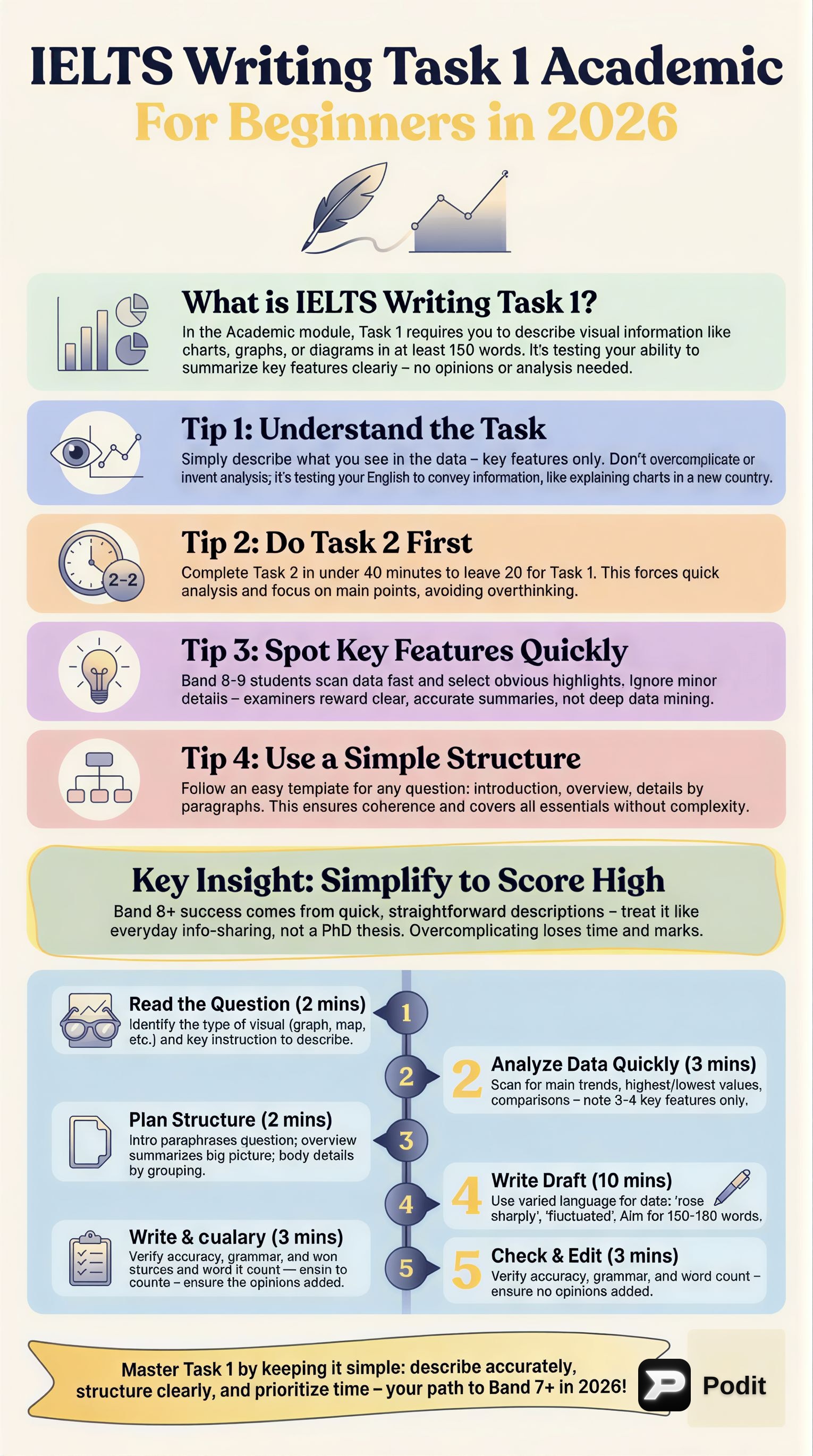
A systematic approach is crucial for success in Task 1. Break down the process into distinct stages:
1️⃣ Stage 1: Analyze the Visual (Approx. 5 minutes)
- Identify: What type of visual is it? (e.g., line graph, bar chart).
- Understand: What does it represent? What are the labels, units of measurement, and timeframes?
- Note: Identify key categories or variables.
- Crucially, identify: The most significant features, overarching trends, or salient comparisons. These are the main points you will report.
- Example: For a line graph, identify the highest/lowest points, periods of significant increase/decrease, or points where lines cross.
2️⃣ Stage 2: Plan the Structure (Approx. 5 minutes)
A standard structure ensures clarity and logical flow:
-
Introduction (1-2 sentences):
- Paraphrase the prompt to state what the visual illustrates. Do not copy the prompt directly.
- Example: "The provided bar chart illustrates the percentage of male and female students enrolled in various university courses from 2000 to 2010."
-
Overview (1-2 sentences):
- Summarize the main trends or most striking features without providing specific data points. This is vital for Task Achievement.
- Example: "Overall, it is evident that while female enrollment generally increased across most courses, male enrollment showed a more varied pattern, with a notable decline in arts subjects."
-
Body Paragraphs (2-3 paragraphs):
- Group related information logically.
- Provide specific data to support the overview and main points identified in Stage 1.
- Do not list every data point. Select and report only the most relevant figures.
- Employ comparative language where appropriate (e.g., 'significantly higher than,' 'in contrast to,' 'whereas').
- Example (Body Paragraph 1): "Looking at engineering, male student numbers consistently remained higher than female students throughout the period, peaking at 60% in 2005. Conversely, female enrollment in engineering, though lower, saw a steady rise from 10% to 25%."
3️⃣ Stage 3: Write the Report (Approx. 15 minutes)
- Tone: Maintain a formal, academic tone.
- Vocabulary: Utilize a variety of sentence structures and a broad range of vocabulary relevant to describing data and trends (e.g., 'fluctuated,' 'plummeted,' 'soared,' 'remained stable').
- Linking Words: Employ appropriate linking words and phrases for smooth transitions (e.g., 'in contrast,' 'subsequently,' 'furthermore,' 'however,' 'meanwhile').
- Grammar: Ensure grammatical accuracy. Avoid contractions (e.g., 'don't'), informal language, and personal pronouns (e.g., 'I think').
4️⃣ Stage 4: Review and Edit (Approx. 5 minutes)
This final stage is critical for polishing your response:
- Check for: Grammatical errors, spelling mistakes, and punctuation inaccuracies.
- Verify: That the word count meets the minimum 150 words.
- Ensure: All key features identified during planning have been adequately addressed.
- Confirm: The report is clear, coherent, and easy to understand.
Key Takeaways for Success in 2026 🎯
Success in IELTS Academic Writing Task 1 for beginners hinges on a structured and disciplined approach.
- Understand Requirements: Master the specific requirements, visual types, and the four assessment criteria.
- Strategic Preparation: Meticulously analyze visuals, plan your report's structure, and execute your writing precisely.
- Objective Reporting: Emphasize formal language, objective reporting, and accurate data interpretation.
- Consistent Practice: Regularly practice with diverse visual representations.
- Vocabulary Enhancement: Focus on expanding your vocabulary for describing trends and making comparisons.
By adhering to these principles, beginners can systematically develop the necessary skills to excel in this critical component of the IELTS examination and achieve a high band score.