Podit
Podit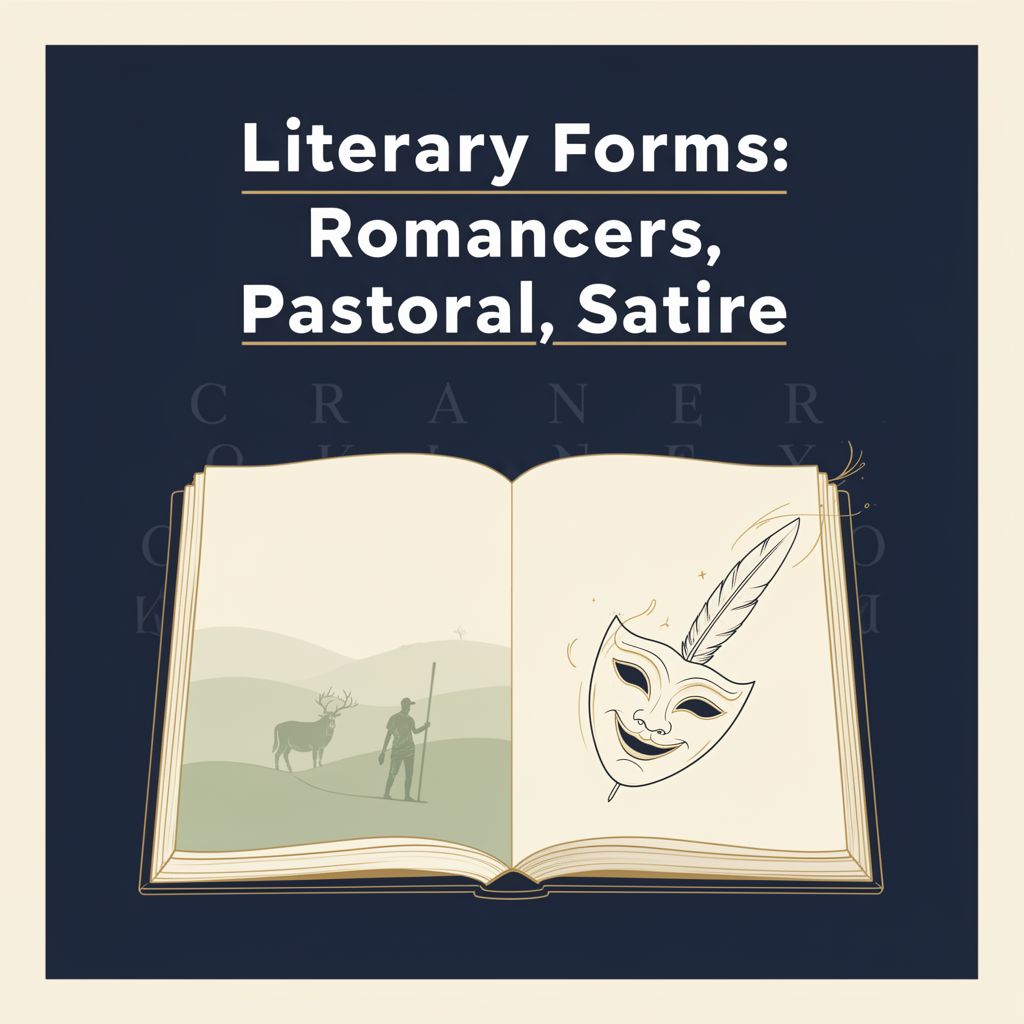
Literary Forms: A Comprehensive Study Guide
This study material has been compiled from a lecture audio transcript and copy-pasted text, providing an organized overview of various literary forms.
📚 Introduction to Literary Forms
This guide explores several distinct literary concepts, offering definitions, historical context, and illustrative examples. We will delve into the world of romancers, the idealized landscapes of pastoral literature, the specific structure of eclogues, the clever wordplay of acrostics, and the critical lens of satire. Understanding these forms enriches our appreciation of literature and its diverse ways of expressing human experience and societal commentary.
1. Romancers: Weaving Extraordinary Tales 📖
Romancers are authors renowned for their ability to craft extraordinary and often improbable tales of adventure. Their narratives frequently transcend the ordinary, focusing on dramatic events and profound human experiences.
Key Characteristics:
- ✅ Extraordinary Narratives: Stories that go beyond everyday reality.
- ✅ Improbable Adventures: Plots often involve grand escapades and unexpected twists.
- ✅ Focus on Experience: Emphasize deep human emotions and dramatic situations.
Notable Romancers:
- Sir Walter Scott
- Nathaniel Hawthorne
- George Meredith
- Joseph Conrad: Considered a supreme romancer, particularly for his ability to immerse readers in worlds of grand adventure.
- Examples:
- Lord Jim (1900)
- Romance (1903)
- Shadow Line (1917)
- Examples:
2. Pastoral Literature: The Idealized Countryside 🏞️
Pastoral literature is a genre that idealizes country life, creating an image of peaceful and uncorrupted existence. It deliberately detaches from the daily working life of actual shepherds, presenting a romanticized view of rural tranquility.
Key Characteristics:
- ✅ Idealized Rural Life: Portrays the countryside as a haven of peace and innocence.
- ✅ Detached from Labor: Shepherds in pastoral works are not engaged in arduous work but rather compose poetry, sing songs, engage in romantic pursuits, and play musical instruments.
- ✅ Perpetual Summer: The setting is often characterized by trees, flowers, and meadows, where it is always summer.
- ✅ Focus on Love and Art: Elegant shepherds and shepherdesses are primarily concerned with love affairs and artistic expression.
Historical Context:
- Origin: Established in the 3rd century B.C. by the Greek poet Theocritus, whose writings about Sicilian shepherds (or "pastors") laid the foundational conventions of this literary world.
- Social Critique: Beyond its idyllic portrayal, pastoral literature has historically served as a medium to criticize the corruption, sterility, and falseness often associated with city or court life.
- Classical Examples: Virgil's Bucolics and Georgics.
English Pastoral Examples:
- Edmund Spenser's The Shepheardes Calendar
- John Milton’s Lycidas
- Percy Bysshe Shelley’s Adonais
- Matthew Arnold’s Thyrsis
💡 Example: Christopher Marlowe's "The Passionate Shepherd to His Love"
This poem beautifully encapsulates the mood of the pastoral, inviting the beloved to "Come live with me and be my Love" and promising a life filled with nature's pleasures:
- Sitting on rocks, watching flocks.
- Listening to melodious birds singing madrigals by shallow rivers.
- Receiving gifts crafted from nature: beds of roses, fragrant posies, a cap of flowers, airtle embroidered with myrtle leaves, a gown of fine wool, fair-lined slippers, and a belt with coral clasps and amber studs.
- The promise of dancing and singing shepherd swains for delight each May morning. This poem perfectly conveys the romanticized, carefree spirit of the pastoral.
3. The Romantic Movement: A New Emphasis on Nature and Emotion 💖
The Romantic movement, which gained prominence in the late 18th and early 19th centuries, brought a renewed emphasis to themes often found in pastoral literature, such as the idealization of nature and a critique of urban life. However, Romanticism expanded these ideas to focus more broadly on emotion, individualism, the sublime, and the glorification of the ordinary.
Key Characteristics of Romanticism:
- ✅ Emphasis on Emotion and Individualism: Prioritized feelings, intuition, and the unique experience of the individual over rationalism.
- ✅ Glorification of Nature: Nature was seen as a source of spiritual truth, inspiration, and solace, often contrasted with the corrupting influence of industrial society.
- ✅ Interest in the Commonplace: Elevated everyday life and ordinary people to subjects of profound artistic expression.
- ✅ Supernatural and Mystical Elements: Explored the mysterious, the sublime, and the visionary.
🌟 William Wordsworth (1770–1850): Poet of Nature and the Common Man
Wordsworth is a central figure of English Romanticism, often called the "poet of nature." He revolutionized poetry by advocating for the use of common language and focusing on the experiences of ordinary people and the beauty of the natural world.
- Key Ideas:
- Nature as a Teacher: Believed nature held profound moral and spiritual lessons.
- "Spontaneous Overflow of Powerful Feelings": Defined poetry as originating from deep emotion recollected in tranquility.
- Common Language: Advocated for poetry written in the language "really used by men," rejecting artificial poetic diction.
- Major Works:
- Lyrical Ballads (1798, with Samuel Taylor Coleridge): A foundational text of English Romanticism, featuring poems like "Tintern Abbey" and "Lines Written in Early Spring," which explore the relationship between humanity and nature.
- The Prelude: An epic autobiographical poem detailing the growth of a poet's mind.
- Connection to Pastoral: Wordsworth's deep reverence for nature and his focus on rural life and its inhabitants echo pastoral themes, but with a greater psychological depth and philosophical inquiry into the human condition within nature.
🌟 William Blake (1757–1827): Visionary Poet and Artist
Blake was a unique and visionary figure of the Romantic era, known for his profound symbolism, mystical insights, and fierce critique of societal injustices. He often combined his poetry with intricate engravings.
- Key Ideas:
- "Two Contrary States of the Human Soul": Explored the duality of innocence and experience, good and evil, freedom and repression.
- Critique of Industrialization and Oppression: Strongly condemned the dehumanizing effects of the Industrial Revolution, child labor, and institutionalized religion.
- Visionary Imagination: Believed in the power of imagination as a divine faculty, capable of perceiving spiritual truths beyond the material world.
- Major Works:
- Songs of Innocence and of Experience (1794): A collection of illustrated poems that contrasts the innocent, joyful aspects of life with the corrupting forces of society and experience. Poems like "The Lamb" (Innocence) and "The Tyger" (Experience) are iconic examples.
- The Marriage of Heaven and Hell: A philosophical work challenging conventional morality and religious dogma.
- Connection to Pastoral: While not strictly pastoral, Blake's celebration of natural innocence and his critique of urban/industrial corruption (e.g., "London") resonate with the pastoral's underlying social commentary, albeit with a more radical and symbolic approach.
4. Eclogue: A Specialized Pastoral Form 📜
An eclogue is a specific type of pastoral poem, typically presented as a dialogue or a soliloquy.
Key Aspects:
- ✅ Form: A short poem or a section within a longer work, often in dialogue.
- ✅ Association: The term became particularly associated with the bucolic or pastoral poems of Virgil.
- ✅ "Bucolic": A related term characterizing pastoral writing, derived from the Greek word "boukolos" (herdsman). In its plural form, "bucolics" collectively refers to the pastoral literature of writers like Theocritus and Virgil.
- ✅ Modern Evolution: In modern poetry, eclogues have evolved to become a vehicle for poets to express political and social ideas.
- Modern Examples:
- Robert Frost's Build Soil
- Louis MacNeice's Eclogue from Ireland
- W.H. Auden's Age of Anxiety
- Modern Examples:
5. Acrostic: The Hidden Message 🧩
An acrostic is a literary device found in either verse or prose where the initial (or sometimes the second or third) letters of consecutive lines or sentences form a word or a message.
Example:
Consider the following lines:
- Chains are but outward show;
- And confinement is within, we know.
- Relief will be far from Prometheus
- Even if he is pardoned by Zeus. In this example, the initial letters spell out the word "CARE."
6. Satire: Ridicule for Correction 🎭
Satire is a powerful and often critical literary form designed to hold up to ridicule the vices and follies of an individual, a society, or even humankind in general. It functions as a form of protest, frequently aiming to achieve correction through the use of ridicule and censure.
Two Main Types of Satire:
6.1. Horatian Satire: Gentle Critique 😊
- Practitioner: Horace (Roman poet, 1st century B.C.).
- Characteristics: Gentle, urbane, smiling, and tolerant.
- Purpose: Aims to correct societal flaws through gentle and broadly sympathetic laughter, often employing wit and mild amusement rather than harsh condemnation.
- Horace's Observations:
- Men often fail to find the "golden mean," running from one extreme to another (e.g., sensual indulgence, adultery).
- Avoiding one vice can lead to its opposite (e.g., Maltinus with trailing garments vs. a man with tucked-up clothes; Rufillus smelling of scent vs. Gargonius smelling like a goat).
- Advocated for "Mutual Forbearance," suggesting indulgence towards friends' weaknesses, similar to a lover's blindness to a beloved's defects or a father's tenderness towards a child's deformities.
6.2. Juvenalian Satire: Harsh Indignation 😠
- Practitioner: Juvenal (Roman poet, late 1st and early 2nd centuries B.C.).
- Characteristics: Bitter, angry, and misanthropic.
- Purpose: Points with contempt and indignation to the profound corruption and evil found within humanity and its institutions, often employing harsh irony and biting criticism.
This study guide provides a foundational understanding of these diverse literary forms, highlighting their definitions, historical significance, and enduring impact on literature.