Podit
Podit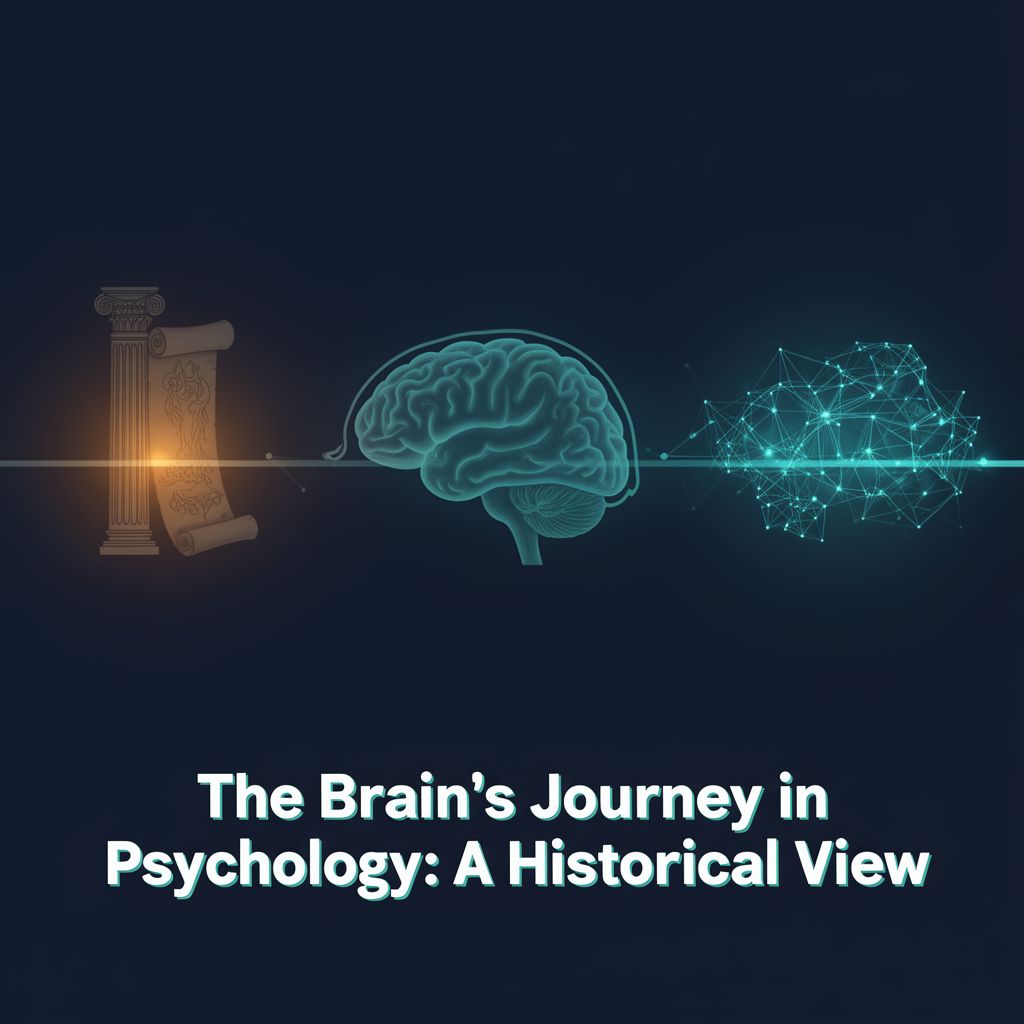
A History of the Brain in Psychology: From Ancient Views to Modern Neuroscience
Source Information: This study material is compiled from a lecture audio transcript on the history of the brain's understanding in psychology.
🧠 Introduction: Tracing the Mind's Physical Seat
For centuries, humanity has sought to understand the origins of thought, emotion, and memory. This study guide explores the fascinating evolution of our understanding of the brain's role in psychology, from ancient philosophical musings to cutting-edge neuroscience. We will journey through different historical periods, examining how various cultures and thinkers grappled with the mind-body problem and how scientific advancements gradually unveiled the brain's intricate functions.
1️⃣ Ancient Roots: From Soul to Organ 🏺
Initially, the brain was not considered the primary seat of mental processes.
1.1. Ancient Egypt (c. 3000 BCE - 30 CE)
- Heart-Centric View: The heart was believed to be the center of intelligence, emotion, and the soul.
- Brain's Role: Often discarded during mummification, viewed as mere "packing material" or a "snot factory."
- 💡 Insight: This highlights a stark contrast with modern understanding, showing how fundamental beliefs can change dramatically.
1.2. Ancient Greece (c. 800 BCE - 600 CE)
- Hippocrates (5th Century BCE):
- ✅ Pioneering Idea: Challenged the heart-centric view, proposing the brain as the seat of intelligence, sensation, and emotion.
- 📚 Observation: Noted that head injuries could affect speech or movement, linking the brain directly to cognitive and motor functions.
- Aristotle (4th Century BCE):
- Heart-Centric View: Maintained that the heart was the center of mental processes.
- Brain's Role: Believed the brain served primarily as a cooling system for the blood, which was heated by the heart.
- ⚠️ Note: Even brilliant minds can hold incorrect views without empirical tools.
1.3. Roman Empire (c. 27 BCE - 476 CE)
- Galen (2nd Century CE):
- ✅ Anatomical Insights: Conducted extensive dissections (mostly on animals), making influential observations.
- 📚 Cerebrum vs. Cerebellum: Theorized that the soft cerebrum processed sensations and memories, while the harder cerebellum controlled muscles.
- 💡 Ventricular Theory: Observed fluid-filled cavities (ventricles) in the brain and proposed that "animal spirits" flowed through them, carrying messages. This theory dominated scientific thought for over a millennium.
2️⃣ The Renaissance and the Rise of Localization 🎨🔬
This era marked a shift towards systematic anatomical studies and the idea that specific brain regions have specialized functions.
2.1. Renaissance Contributions (14th - 17th Centuries)
- Leonardo da Vinci: His detailed anatomical drawings contributed to a more accurate understanding of brain structure.
2.2. René Descartes and Mind-Body Dualism (17th Century)
- 📚 Mind-Body Dualism: Proposed that the mind (non-physical, immortal soul) and body (physical machine) are distinct entities.
- Interaction Point: Believed they interacted in the pineal gland, a small, unpaired structure deep within the brain.
- 💡 Impact: Descartes' ideas provided a framework for understanding how non-physical and physical entities could interact, influencing philosophical and scientific debate for centuries.
2.3. Localization of Function (18th - 19th Centuries)
The idea that different parts of the brain are responsible for different mental abilities gained traction.
- Franz Joseph Gall (Late 18th - Early 19th Centuries):
- 📚 Phrenology: Proposed that specific mental faculties were located in distinct brain regions, and the size of these regions could be inferred from bumps on the skull.
- ⚠️ Note: While phrenology was largely discredited as pseudoscience, Gall's core idea of functional localization was prescient and laid groundwork for future research.
- Paul Broca (Mid-19th Century):
- ✅ Broca's Area: Studied a patient ("Tan") with severe speech production difficulties. Post-mortem examination revealed damage to a specific area in the left frontal lobe.
- 📈 Discovery: Linked this area (now Broca's Area) to speech production. This was monumental evidence for functional localization.
- Carl Wernicke (Mid-19th Century):
- ✅ Wernicke's Area: Identified another area in the temporal lobe, now Wernicke's Area, linked to language comprehension.
- 📈 Discovery: Patients with damage here could speak fluently but their speech was nonsensical, and they struggled to understand others.
- 💡 Significance: Broca's and Wernicke's discoveries moved brain study from speculation to empirical observation, directly integrating the brain into psychological study.
3️⃣ The 20th Century and the Cognitive Revolution 🚀
The 20th century saw significant shifts in psychological thought and technological advancements that revolutionized brain study.
3.1. Early 20th Century Psychology
- Wilhelm Wundt (Late 19th Century):
- ✅ Established the first psychology lab (1879), bringing scientific rigor to mental processes through introspection.
- Behaviorism (Early to Mid-20th Century):
- Proponents: John B. Watson, B.F. Skinner.
- Core Idea: Psychology should only study observable behavior, dismissing internal mental states and the brain as a "black box."
- ⚠️ Impact: While yielding insights into learning, behaviorism temporarily sidelined the brain in mainstream psychological research.
3.2. Neuroscience Advances
- Santiago Ramón y Cajal (Late 19th - Early 20th Century):
- ✅ Father of Modern Neuroscience: Meticulously mapped neuron structures.
- 📚 Neuron Doctrine: Demonstrated that the brain is composed of discrete cells (neurons), not a continuous network. This was fundamental to understanding brain communication.
3.3. The Cognitive Revolution (Mid-20th Century)
- Shift in Focus: Psychology returned to studying internal mental processes (e.g., language, memory, problem-solving), recognizing behaviorism's limitations.
- Donald Hebb:
- 📚 Hebb's Rule: Proposed that "neurons that fire together, wire together," explaining how learning and memory might be physically encoded in the brain.
3.4. Technological Revolution & Neuroimaging (Late 20th Century)
The development of advanced technologies transformed our ability to study the living brain.
- Electroencephalography (EEG): Measures electrical activity in the brain.
- Computed Tomography (CT) scans: Provides structural images of the brain.
- Magnetic Resonance Imaging (MRI): Offers detailed structural images.
- Functional MRI (fMRI): Shows brain activity by detecting changes in blood flow.
- Positron Emission Tomography (PET) scans: Visualizes metabolic processes and blood flow in the brain.
- 📈 Impact: These tools provided unprecedented insights into the neural correlates of perception, attention, memory, emotion, and consciousness, bridging the gap between mind and brain.
- 💡 Cognitive Neuroscience: The integration of psychology and neuroscience, where much of today's exciting research takes place.
4️⃣ The Brain's Enduring Mystery and Future 🌌
Our understanding of the brain has evolved from ancient dismissal to precise empirical investigation.
- Current Understanding: The brain is a highly specialized and interconnected network, with different regions contributing to various aspects of mental life.
- Technological Impact: Technology has been crucial, moving from post-mortem examinations to observing the living brain in action.
- Remaining Mysteries: Despite advancements, the brain remains one of the greatest mysteries. We are still unraveling how billions of neurons and trillions of connections give rise to consciousness, self-awareness, and the complexities of human experience.
- Future Outlook: The journey to fully understand the brain is far from over, promising continued discoveries and insights.