Podit
Podit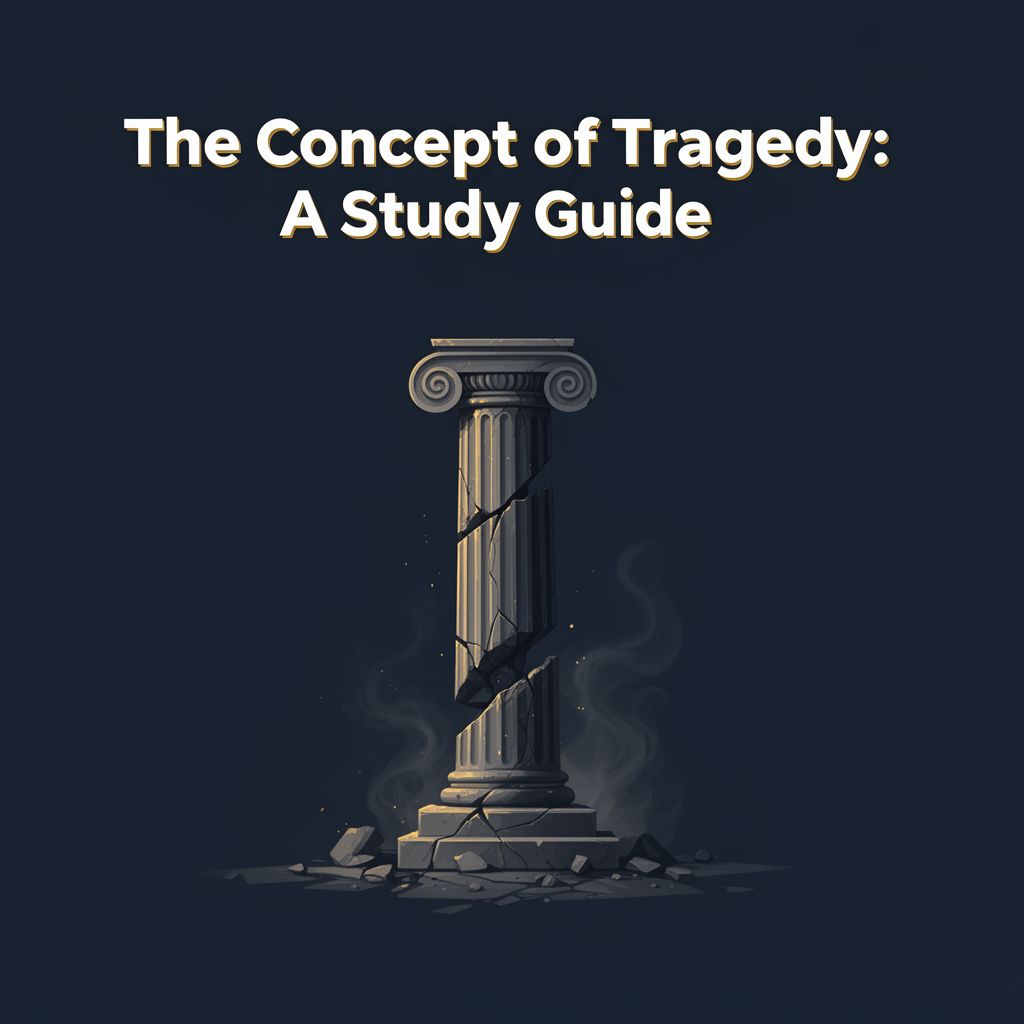
This study material is compiled from a copy-pasted text and a lecture audio transcript.
📚 The Concept of Tragedy: A Study Guide
1. Introduction: Beyond "Very Sad" 🌍
The term "tragedy" is often used casually in everyday language to denote something "very sad" or an unfortunate event. However, its historical and philosophical roots reveal a much deeper, more complex concept. This study guide explores the evolving definitions, critical debates, and philosophical implications of tragedy, distinguishing its common usage from its artistic and academic understanding.
2. Defining Tragedy: A Shifting Landscape 📈
2.1. Everyday vs. Artistic/Academic Understanding
- Everyday Usage: "Very sad" (e.g., a car crash).
- Ancient Greek Context: Used for dramas depicting the downfall of kings, implying a profound depth beyond simple sorrow.
- Core Elements (Traditional View): Fate, catastrophe, calamitous reversals of fortune, flawed high-born heroes, vindictive gods, pollution, purgation, deplorable endings, cosmic order and its transgression, suffering that chastens and transfigures.
- Emotional Impact: Not just poignant, but also fearful, horrific, shocking, stunning, and traumatic.
- Distinction from "Pathetic": Tragedy is often seen as cleansing, bracing, and life-affirming, unlike the merely pathetic.
2.2. Critiques of Simplistic Definitions
- Susanne K. Langer's View: French classical drama (e.g., Racine, Corneille) is "sad but non-tragic" because it deals with misfortune rather than destiny, lacks rich individual personality, and is overly rational. She calls them "heroic comedies."
- "Tragic" as a Stronger Term: Unlike "sad," "tragic" is a powerful word, difficult to synonymize, carrying a peculiar charge.
- "Sad but not tragic": This distinction is not like "erratic but not psychotic"; an event can be tragic for one person (e.g., a spouse's "very very sad" experience of a peaceful death) but merely sad for others.
- R. P. Draper: Notes an "immense difference between the educated and un-educated intuitions" of tragedy's meaning, though "educated" isn't always more reliable.
- Paul Allen's Definition: "A story with an unhappy ending that is memorably and upliftingly moving rather than simply sad."
- Critiques: Not all tragedies end unhappily; "simply sad" is ambiguous; works like Blasted or Endgame might not be "upliftingly moving" but are considered tragic. Aristotle did not emphasize "edification."
2.3. Essentialism vs. Nominalism
- Essentialists (e.g., Paul Ricoeur): Believe in a core "essence" of tragedy, rooted in Greek phenomena, through which all other tragedies are understood (e.g., A Streetcar Named Desire illuminated by Agamemnon).
- Nominalists (e.g., Leo Aylen): Argue "there is no such thing as tragedy," only plays that have been called such.
- Critique: This merely pushes the question back: why are certain plays consistently called tragedies and not, for example, pastoral or pantomime?
- Raymond Williams: Tragedy is "not a single and permanent kind of fact, but a series of experiences and conventions and institutions."
- Wittgenstein's "Family Resemblances": Tragedy is constituted by overlapping features rather than invariant forms or contents, avoiding the binary of common essence vs. nothing in common.
- Ashley Thorndike (1908): Warned that no definition beyond "all plays presenting painful or destructive actions" was possible.
2.4. Historical Interpretations 📜
- Aristotle's Poetics:
- Focuses on effects (pity and fear) rather than explicit destruction, death, or calamity.
- Mentions a "tragedy of suffering" as a species of the genre.
- A wicked person's transition from misery to prosperity cannot be tragic as it inspires neither pity nor fear.
- Schopenhauer: "The presentation of a great misfortune is alone essential." Later adds resignation and renunciation, which leads him to downgrade ancient Greeks.
- Samuel Johnson: Defines tragedy as "a dramatic representation of serious actions," emphasizing "seriousness" (from Aristotle's spoudaios).
- Medieval Understanding:
- Often considered an obsolete genre.
- Primarily understood as a serious form concerning the misfortunes of the "high and mighty."
- Theophrastus: Representing fortunes of heroes.
- Placidus (6th century): "A genre of poetry in which poets describe the grievous fall of kings and unheard of crimes, or the affairs of the gods, in high-sounding words."
- Thomas Aquinas: Thought tragedy meant "speech about war" and could be "bombastic."
- Dante: Defined it by high seriousness, noble verse, elevated construction, excellent vocabulary, and profundity (e.g., The Aeneid as tragic).
- Summary Slogan: "Horrific crimes of the great," often serving an ideological purpose to expose ruling-class corruption and teach the mutability of fortune and divine vengeance. Stressed deserved disgrace.
- Donatus: "Imposing persons, great fears, and disastrous endings."
- Boethius (6th century): Used "tremendous tragedy" for Christ's Incarnation, signifying a "fall" or "come-down" (kenosis).
- Chaucer's Monk's Tale: Reflects the lineage of prosperity to adversity.
- John of Garland (c. 1220): Grave style, shameful/criminal deeds, begins in joy, ends in tears.
- John Arderne (14th century): Called the Bible a tragedy, likely meaning a serious book.
- F. L. Lucas: Tragedy for ancients means serious drama; for the Middle Ages, a story with an unhappy ending; for moderns, a drama with an unhappy ending.
- John Orr: "The essential tragic experience is that of irreparable human loss."
- Richard Kuhns: Conflict between private/sexual/psychological and public/political/obligatory.
- Oxford English Dictionary (OED): "Extreme distress or sorrow" for tragedy; "pity or sorrow" for pathos. Notes grammatical differences (tragic denotes a condition, sad a response).
- Walter Kaufmann: Refuses to distinguish between tragic and merely pitiful, suggesting suffering must be "philosophically" interesting for classical tragedy.
- Kenneth Burke & Francis Fergusson: Emphasize tragic recognition (anagnorisis), though this doesn't apply to all (e.g., Willy Loman, Phaedra).
- David Hume: Compassion for those less sensible of their misery.
- Georg Simmel: Destructive forces spring from the deepest levels of the being itself (immanent, ironic, dialectical).
- A. C. Bradley: "Any spiritual conflict involving spiritual waste."
- Oscar Mandel: Protagonist with good will, impelled by serious purpose, inevitably meets grave suffering.
- Leo Aylen: Tragedy is largely about death, making "certain things much less important, others much more."
- Geoffrey Brereton: "A final and impressive disaster due to an unforeseen or unrealized failure involving people who command respect and sympathy." Implies unimpressive disasters are not tragic.
- Mark Harris: "The projection of personal and collective values which are potentially or actually put in jeopardy."
- John Holloway: "Every tragedy or near-tragedy is a serious play, in which the characters... are likely to speak earnestly about the world."
- Walter Kerr: "An investigation into the possibilities of human freedom." Leads to dismissing works not affirming freedom as non-tragic.
- Dorothea Krook: Universal import, flawed hero of stature, comes to grief, ends badly, shows power of gods/destiny, reveals human suffering as meaningful. (A "popular-academic" conception, but often not generally true).
- I. A. Richards: Most Greek tragedy and Elizabethan tragedy (except Shakespeare) are "pseudo-tragedy."
2.5. Etymology of "Tragedy" 🐐
- Derived from the Greek word for "goat."
- Medieval scholars speculated on the meaning:
- Goat as a prize for ancient tragedians (Horace).
- Filth of artistic subject matter.
- Goat sacrificed to poets.
- Goatskin footwear of actors.
- Francesco da Buti (14th century): Goat looks princely from front but has a filthy rear-end, symbolizing tragedy's ambivalence.
3. Tragedy in Art vs. Real Life: A Modern Conundrum 🎭↔️🌍
3.1. The Distinction
- Modern Common Usage: "Tragedy" often means an actual, calamitous event, sometimes without awareness of its artistic origins.
- OED's View: Real-life tragedy ("unhappy or fatal event") is a figurative and metaphorical derivation from the artistic sense, dating from no earlier than the 16th century.
- Academic/Critical Stance: Many argue there can be no "real-life tragedy" because tragedy is fundamentally an aesthetic term.
- W. McNeile Dixon: "In real life there are no tragedies."
- Franco Moretti: Reserves "tragedy" solely for representations of existence.
3.2. Reasons for the Art/Life Divide
- Aesthetic vs. Everyday: Tragedy is seen as an aesthetic term, distinct from everyday sadness.
- Affirmative Nature of Art: For conservative theorists, tragic art is supremely affirmative, requiring elements like courageous resistance, grandeur, and philosophical depth, which are often absent in real life.
- "Uninteresting Grief":
- C. S. Lewis: Real-life grief is "uninteresting," an "uncouth mixture of agony and littleness," lacking "grandeur or finality," and "dull and depressing."
- A. C. Bradley: A man "slowly worn to death by disease, poverty, little cares, sordid vices" is not tragic in the Shakespearian sense.
- Ulrich Simon: "Disablement, genetic malformation, crippling diseases... are not tragic." Also excludes floods, earthquakes, genocide, the Battle of the Somme, and the Holocaust.
- Core Argument: Tragedy must involve courageous resistance to fate and a revelation of value, which is assumed to flourish only in art.
3.3. Critiques of the Art/Life Divide ⚠️
- Raymond Williams: Critiques this "mandarin disdain for modernity and the common life." He highlights the absurdity of deeming a great man's death in an air-crash tragic, but not if he falls off a bicycle.
- Discrepancy between Art and Life: The argument that a drama is tragic but the playwright's real-life suicide is not, creates grotesque discrepancies.
- "Tragedy is about something else": Williams sardonically notes that traditional theory often dismisses real-world suffering (war, poverty, torture) as non-tragic because "tragedy is about something else."
- Absurdities in Theory: Many definitions lead to "extraordinarily pious waffle" (H. A. Mason, John S. Smart, Karl Jaspers, Maud Bodkin), often making grand, unprovable claims about cosmic order or immortality.
4. Philosophical and Theoretical Perspectives 💡
4.1. Nietzsche and the "Death of Tragedy"
- Socratic Rationalism: Nietzsche argues that Socratic philosophy, with its universalist claims, ruined the local pieties and rituals that nourished ancient tragic art.
- "Theoretical Man": The rise of rationalism, psychological realism, naturalism, and historical optimism led to the "death of tragedy."
- "Tragic Knowledge": Involves grasping the world's meaninglessness and the limits of knowledge, requiring art to make its appalling insights tolerable.
- Counter-Enlightenment: Tragedy, in this sense, signifies an irreducible mystery in human affairs, impenetrable to cognition.
4.2. Contemporary Critical Theories
- Michelle Gellrich (Deconstructive):
- Discrepancy: Tragic plays "resist" traditional dramatic theory rather than bearing out its principles.
- Theory as Ideology: Much tragic theory represses and excludes conflicts, neutralizing moral outrage and defusing social dissolution, acting as an "ideology."
- Artistry of Plot: Art makes the random/accidental meaningful, introducing a "deceptive necessity" into a world of randomness and contingency.
- Timothy Reiss (Foucaultian):
- New Order of Discourse: Tragedy inaugurates a new order by marking the limits of existing knowledge regimes, articulating absent significations.
- Subversion and Regulation: It shows the chaos at the core of social order but also recuperates the "inexpressible" into regulated knowledge, becoming "the art of overcoming unmeaning."
- Dialectical Formulation: Our response is "at once the fear of a lack of all order and the pleasure at seeing such lack overcome."
- Apollonian/Dionysian: Recycles this opposition, seeing both order and disorder, reason and the inexpressible, within tragic art itself.
- Conservative Corollary: His aversion to representation and rationality leads to a philosophical pessimism, aligning with the "death-of-tragedy" thesis. He opts for "discourse rather than experience," dismissing real-life tragedy.
5. The Enduring Relevance of a Contested Concept ✅
- Cultural Reflection: The philosophy of art, with its own agenda, shapes how tragedy is understood. Tragedy reflects the fundamental beliefs and tensions of any period.
- Modern Epoch: Tragedy has outgrown its theatrical origins to become a full-blown philosophy (theodicy, metaphysical humanism, critique of Enlightenment, displaced religion, political nostalgia).
- Traditional Distinctions: Many traditional distinctions (fate vs. chance, free will vs. destiny, inner flaw vs. outer circumstance) no longer hold much force.
- Ongoing Debate: The complexity and ambiguity of "tragedy" highlight a deep intellectual and cultural contradiction, prompting continuous re-evaluation of suffering, meaning, and human experience.