20th Century Britain: Historical, Social, and Literary Context - kapak
Tarih#20th century britain#world war ii#post-war britain#social reforms

20th Century Britain: Historical, Social, and Literary Context

An academic overview of 20th-century Britain's historical, social, and literary landscape, focusing on post-World War II developments and key authors like William Golding.

carpedi3mMay 8, 2026 ~27 dk toplam
01

Sesli Özet

9 dakika

Konuyu otobüste, koşarken, yolda dinleyerek öğren.

Sesli Özet

20th Century Britain: Historical, Social, and Literary Context

0:009:25
02

Görsel Özet

İnfografik

Konunun tüm parçalarını tek bakışta gör.

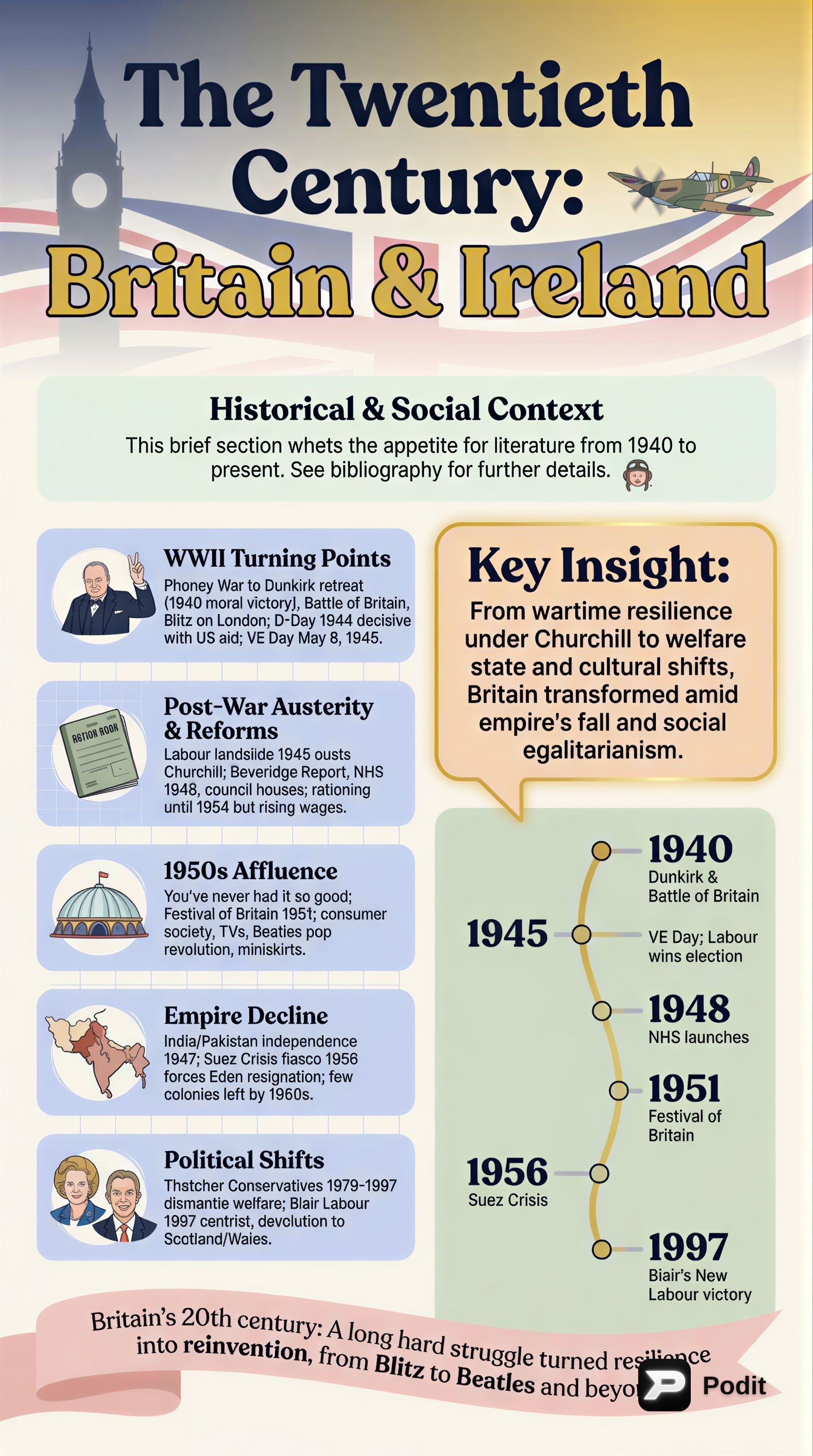
20th Century Britain: Historical, Social, and Literary Context - görsel özet infografik
Tam boyutta görüntüle →
03

Flash Kartlar

25 kart

Karta tıklayarak çevir. ← → ile gez, ⎵ ile çevir.

1 / 25
Tüm kartları metin olarak gör
  1. 1. What significant political shift occurred in Britain in the 1945 general election?

    The 1945 general election saw the Labour Party achieve a landslide victory, sweeping Winston Churchill and the Conservative Party from power. This marked a significant shift towards social reform and the establishment of the welfare state, reflecting a public desire for change after the war.

  2. 2. What was the primary objective of the 1942 Beveridge Report?

    The Beveridge Report aimed to outline a comprehensive 'cradle to the grave' social security system for Britain. Its recommendations formed the basis for the post-war welfare state, seeking to tackle the 'five giants' of Want, Disease, Ignorance, Squalor, and Idleness, and ensure a minimum standard of living for all citizens.

  3. 3. How did the 1944 Butler Education Act transform the British education system?

    The 1944 Butler Education Act introduced universal secondary education in Britain, making it free for all children. It established a tripartite system of grammar, technical, and secondary modern schools, aiming to provide educational opportunities based on ability rather than social class, significantly expanding access to schooling.

  4. 4. What is meant by 'consensus politics' in post-war Britain, and how long did it last?

    'Consensus politics' refers to the broad agreement between the Labour and Conservative parties on key policies, particularly regarding a mixed economy and the welfare state. This political approach, characterized by nationalization, the NHS, and social housing, persisted for approximately three decades after World War II.

  5. 5. Name two immediate effects of the post-war Labour government's policies.

    Two immediate effects of the post-war Labour government's policies were the nationalization of approximately 20 percent of British industry, including coal, railways, and utilities, and the establishment of the National Health Service (NHS) in 1948. These measures aimed to create a more equitable society and provide essential services to all citizens.

  6. 6. How long did austerity measures, specifically rationing, continue in Britain after World War II?

    Austerity measures, particularly rationing, continued in Britain for a significant period after World War II, lasting until 1954. Despite the end of the war, the country faced severe economic challenges, necessitating continued controls on food and other goods to manage resources and aid recovery.

  7. 7. What did the 1951 Festival of Britain symbolize for the nation?

    The 1951 Festival of Britain symbolized the nation's rehabilitation and cultural development after the devastation of World War II. It was a national exhibition designed to showcase British achievements in science, technology, industrial design, and the arts, aiming to boost morale and project a sense of optimism for the future.

  8. 8. What slogan encapsulated the period of Conservative rule from 1951 to 1964, and what did it signify?

    The slogan "You've never had it so good" encapsulated the period of Conservative rule from 1951 to 1964. It signified a shift from post-war austerity to increasing affluence and consumerism, reflecting rising living standards, full employment, and a general sense of economic prosperity for many Britons.

  9. 9. How did Britain's relationship with the United States evolve after World War II, particularly concerning NATO?

    After World War II, Britain's relationship with the United States became very close, significantly influencing its foreign policy. This was particularly evident with the foundation of NATO (North Atlantic Treaty Organization), where Britain played a crucial role alongside the US in forming a Western military alliance against the Soviet threat.

  10. 10. Why did French Premier De Gaulle veto Britain's application to the European Common Market in 1963?

    French Premier De Gaulle vetoed Britain's application to the European Common Market in 1963 due to concerns about Britain's perceived insularity and its close relationship with the United States. He believed Britain was not sufficiently committed to European integration and might act as an American Trojan horse within the community.

  11. 11. Describe two social changes that characterized Britain in the 1950s and 1960s.

    Two significant social changes in 1950s and 1960s Britain included the rise of an affluent, consumer society, driven by increased wages and the availability of new goods, and a growing permissiveness in society. This permissiveness was reflected in the pop revolution, new legislation on abortion and sexual freedom, and evolving family structures.

  12. 12. What was the CND group, and what was its primary political objective in post-war Britain?

    The CND group stands for the Campaign for Nuclear Disarmament. Its primary political objective in post-war Britain was to advocate for unilateral nuclear disarmament by the UK. The movement gained significant public support and organized large protests, reflecting widespread concerns about the Cold War and the threat of nuclear warfare.

  13. 13. What event marked the beginning of the 'troubles' in Northern Ireland?

    The 'troubles' in Northern Ireland began with civil rights marches in the late 1960s, which were met with repression. These marches, advocating for equal rights for the Catholic minority, escalated into decades of sectarian violence and political conflict between unionists and nationalists.

  14. 14. What was a significant consequence of mass immigration from former colonies in the 1950s for British society?

    A significant consequence of mass immigration from former colonies in the 1950s was the emergence of issues related to racial prejudice and discrimination within British society. While contributing to cultural diversity, these new communities often faced economic problems, poor industrial relations, and social tensions, particularly during periods of economic hardship.

  15. 15. Name two colonial possessions that gained independence from Britain between 1947 and 1949.

    Two colonial possessions that gained independence from Britain between 1947 and 1949 were India and Pakistan. This period marked a rapid acceleration of decolonization, significantly diminishing Britain's global empire and altering its international standing. Burma and Ceylon also gained independence during this time.

  16. 16. What was the outcome and significance of the 1956 Suez Crisis for Britain?

    The 1956 Suez Crisis resulted in an embarrassing withdrawal for Britain and France after their military intervention against Egypt's nationalization of the Suez Canal was met with strong international pressure, particularly from the United States. This event highlighted Britain's diminished global power and led to the resignation of the Prime Minister, Anthony Eden.

  17. 17. What were two key policies initiated by Margaret Thatcher when she came to power in 1979?

    Two key policies initiated by Margaret Thatcher when she came to power in 1979 were the dismantling of the welfare state and the denationalization of industry. She advocated for free trade, minimal government interference in the economy, and a reduction in the power of trade unions, aiming to revitalize the British economy through market-oriented reforms.

  18. 18. How did Tony Blair's Labour Party differ from traditional Labour ideology when he came to power in 1997?

    Tony Blair's Labour Party, when he came to power in 1997, shifted significantly towards centrist ideas, moving away from traditional socialist state ideology. This 'New Labour' approach embraced market-friendly policies and a more pragmatic stance, appealing to a broader electorate and securing a landslide victory.

  19. 19. What impact did television have on post-war British literature, particularly the novel?

    Television significantly influenced post-war British literature by contributing to a shift towards 'middlebrow' culture. The novel, in particular, struggled to define its audience and compete with television, leading critics to suggest that serious novels needed to address topics previously found in 'trash fiction' to remain relevant.

  20. 20. Who were the 'angry young men' in 1950s and 1960s British literature, and what was their common theme?

    The 'angry young men' were a group of British novelists and playwrights in the 1950s and 1960s, including Kingsley Amis, John Wain, and John Braine. Their common theme was a critique of social mores, class distinctions, and the perceived hypocrisy of the establishment, often expressed through protagonists who felt alienated and frustrated.

  21. 21. For what dystopian novel is Anthony Burgess renowned, and what unique feature did it introduce?

    Anthony Burgess is renowned for his dystopian novel 'A Clockwork Orange' (1962). This novel, set in the near future, introduced a unique street language called 'Nadsat,' a blend of Russian, Cockney rhyming slang, and invented words, which became a distinctive feature of the narrative.

  22. 22. What is the central theme that William Golding explores in 'Lord of the Flies'?

    The central theme William Golding explores in 'Lord of the Flies' is the intrinsic evil or corruption within human nature. Through the allegorical narrative of boys stranded on an island, he argues that without the constraints of civilization, humanity's inherent savagery and capacity for violence will emerge.

  23. 23. How did William Golding's experiences in World War II influence his view of human nature?

    William Golding's experiences in World War II profoundly altered his perception of human nature. He came to believe that no one is inherently innocent and that true human nature, with its intrinsic corruption, emerges under extreme duress, a view that heavily informed his literary works, particularly 'Lord of the Flies'.

  24. 24. In 'Lord of the Flies,' what does the "beastie" eventually become for the boys?

    In 'Lord of the Flies,' the "beastie" initially a perceived monster, eventually becomes a deified entity for the boys. It represents their primal fears and the growing savagery within them, ultimately symbolizing the inherent evil that Golding believed resides in human nature, rather than an external threat.

  25. 25. What symbolic significance does the impaled pig's head, named 'The Lord of the Flies,' hold in Golding's novel?

    The impaled pig's head, named 'The Lord of the Flies,' symbolizes the physical manifestation of the boys' inherent savagery and the devil. When Simon converses with it, the head declares, "I'm part of you... We're going to have fun on this island," revealing that the true 'beast' is not external but lies within humanity itself.

04

Bilgini Test Et

15 soru

Çoktan seçmeli sorularla öğrendiklerini ölç. Cevap + açıklama.

Soru 1 / 15Skor: 0

What significant event marked the end of the 'phoney war' period and led to Britain recognizing the real danger by 1940?

05

Detaylı Özet

8 dk okuma

Tüm konuyu derinlemesine, başlık başlık.

This study material has been compiled from a combination of copy-pasted text and a lecture audio transcript, focusing on the historical, social, and literary context of 20th-century Britain, with a particular emphasis on the post-World War II era and the works of William Golding.


🇬🇧 20th Century Britain: Historical, Social, and Literary Context

📚 Introduction

The 20th century brought profound transformations to Britain, marked by two World Wars, the decline of its vast empire, significant social reforms, and evolving cultural landscapes. This study guide explores these critical shifts, particularly from 1940 onwards, and examines how they shaped the nation's identity and its literary output, culminating in a detailed look at author William Golding.

🌍 Historical and Social Context: Post-World War II Transformations

1️⃣ The Second World War (1939-1945)

Initially perceived as a 'phoney war,' the reality of the conflict became starkly clear by 1940.

  • Leadership: Winston Churchill's Coalition government took power, his powerful rhetoric transforming the catastrophic retreat from Dunkirk into a moral victory.
  • Key Events: The Battle of Britain (airborne conflict between Luftwaffe and RAF) and the Blitz (German bombing of cities, especially London) caused immense casualties.
  • Insularity: Britain developed a sense of insularity, becoming the only major European power not under German control.
  • Empire's Role: The British Empire gradually contributed goods, troops, and became a theatre of war.
  • War's End: The war in Europe concluded on May 8, 1945. The war in the Far East ended three months later, in August 1945, following the atomic bombings of Hiroshima and Nagasaki by American allies.
  • Aftermath: Britain emerged financially and emotionally scarred, facing an uncertain future as its empire began to disintegrate. A new egalitarian spirit fostered discontent with the old order.

2️⃣ Post-War Reconstruction and the Welfare State (1945-1970s)

The immediate post-war period ushered in radical changes.

  • Political Shift: In a surprising 1945 election, the Labour Party, led by Clement Attlee, swept Churchill from power, securing a significant majority.
  • Social Reforms:
    • Beveridge Report (1942): Laid the groundwork for a comprehensive 'cradle to the grave' social security system.
    • Town Planning: New policies included green belts and new towns.
    • Employment: Commitment to full employment and improved working conditions.
    • Butler Education Act (1944): Paved the way for universal secondary education.
  • "Consensus Politics": This era established a model of 'consensus politics' based on a mixed economy and a welfare state, which endured for three decades under both Labour and Conservative administrations.
  • Key Initiatives:
    • Nationalization: Approximately 20% of British industry came under public control.
    • National Health Service (NHS): Established in 1948, providing universal healthcare.
    • Housing: Provision of large numbers of low-rent council houses.
  • Austerity and Recovery: Despite significant national debt and rationing continuing until 1954, living standards improved with rising wages. The 1951 Festival of Britain symbolized national rehabilitation and cultural development.
  • Affluence: During Conservative rule (1951-1964), austerity gradually gave way to affluence, encapsulated by the slogan "You've never had it so good."

3️⃣ International Relations and Cultural Shifts

Britain's global standing and internal culture underwent significant evolution.

  • US Alliance: A close relationship with the United States developed, especially after the foundation of NATO, influencing British foreign policy.
  • European Integration: Britain's initial insularity led to hostility towards European unity. French Premier De Gaulle vetoed Britain's application to the European Common Market in 1963.
  • Consumer Society (1950s-60s): Britain transformed into an affluent, consumer-driven society.
    • Television: Became a decisive cultural influence.
    • Permissiveness: Society became more open, marked by the pop revolution (The Beatles, The Rolling Stones), miniskirts, new legislation on abortion and sexual freedom, and changes in traditional family structures (rising divorce rates, single-parent families).
    • Education & Culture: New universities emerged, and interest in mass culture increased.
  • Political & Social Unrest:
    • Protest Movements: Rise of groups like CND (Campaign for Nuclear Disarmament) and other protest movements.
    • Nationalism: Nationalist ferment in Wales and Scotland, sometimes leading to extremist actions.
    • Northern Ireland "Troubles": Civil rights marches by Catholics in the late 1960s were brutally repressed, leading to prolonged conflict.
  • Immigration & Social Issues: Mass immigration from former colonies (West Indies, India, Pakistan) in the 1950s led to new problems of racial prejudice and discrimination, exacerbated by economic issues like rising inflation and unemployment, and poor industrial relations.

4️⃣ Decline of Empire and Political Upheaval (1947-2001)

The post-war period saw the rapid dismantling of the British Empire and significant political shifts.

  • Decolonization: India, Pakistan, Burma, and Ceylon gained independence between 1947-1949, followed by most African colonies in the 1950s. By the early 1960s, few territories remained under direct British rule.
  • Suez Crisis (1956): A symbolic moment of decline. Britain's military intervention with France against Egypt's nationalization of the Suez Canal was met with international pressure, forcing an embarrassing withdrawal and the resignation of Prime Minister Eden.
  • Thatcher Era (1979-1997): Margaret Thatcher led the Conservative Party to power.
    • Policies: Aimed to dismantle the welfare state, denationalize industries, promote free trade, and minimize government interference.
    • Economic Challenges: Despite her policies, Britain faced economic decline, with manufacturing production falling and unemployment rising significantly.
    • Electoral Success: Thatcher won three consecutive elections, a first for a 20th-century prime minister. Her successor, John Major, continued Conservative rule until 1997.
  • New Labour (1997-2001): Tony Blair led the Labour Party to a landslide victory in 1997.
    • Centrist Approach: Blair introduced more centrist ideas, moving Labour away from its century-long efforts to establish a socialist state.
    • Key Events: Hong Kong handover (1997), death of Princess Diana (1997).
    • Initiatives: Efforts for peace in Northern Ireland and devolution, establishing parliaments in Scotland and Wales.

✍️ Literary Context and Prominent Authors

Post-war British literature was profoundly influenced by the era's social and technological changes.

  • Television's Impact: Television played a crucial role in shaping national cultural tastes, leading to a shift towards 'middlebrow' culture (neither elitist nor overly popular).
  • Novel's Challenge: The novel, in particular, struggled to define its audience, with some critics suggesting it had to adopt topics previously found in "trash fiction" to compete with TV.
  • New Tendencies: Fiction focusing on the working classes emerged as a vital new literary trend.
  • Fluidity and New Labels: The societal fluidity made traditional literary classifications difficult, leading to new categories like 'women's literature' and 'commonwealth literature' to reflect the diverse literary scene.

📚 Key Literary Figures and Works:

  • "Angry Young Men" (1950s-60s): Novelists like Kingsley Amis, John Wain, and John Braine critiqued contemporary social mores.
  • Doris Lessing: Born in Southern Rhodesia, she gained prominence with African Stories (1965) and complex novels like The Golden Notebook (1962), exploring a woman writer's quest for self-understanding.
  • Anthony Burgess: Best known for the dystopian novel A Clockwork Orange (1962), which introduced a unique street language and was adapted into a film.
  • Anthony Powell: Author of A Dance to the Music of Time (1951-1975), a twelve-novel series depicting lives in arts and politics during and after WWI.
  • Iris Murdoch: Famous for serious novels that wittily portray comic and eccentric characters, such as Under the Net (1954) and The Black Prince (1973).
  • Graham Greene: Wrote many engaging novels with political themes, including The Quiet American (1955), which offered insights into America's involvement in Vietnam.

📖 Spotlight on William Golding (1911-1993)

William Golding, a Nobel laureate, is a pivotal figure in post-war British literature, whose experiences profoundly shaped his work.

  • Biography: Born in Cornwall, Golding studied English literature and physics. He worked in theatre and trained as a teacher before serving in the Royal Navy during World War II.
  • Impact of WWII: His wartime service drastically altered his view of human nature. He came to believe that no one is truly innocent and that humanity's intrinsic corruption emerges under extreme duress.

Lord of the Flies (1954)

Golding's most famous work is an allegorical novel exploring the theme of inherent human evil.

  • Plot Summary: A group of British schoolboys are stranded on a desert island after a plane crash, with no adult supervision. The novel depicts their descent from civilized order to savage chaos.
  • The "Beastie": The boys' fear of a perceived 'beastie' on the island becomes a central element, eventually transforming into a deified entity that symbolizes their own inner darkness.
  • 💡 Example 1: Jack's Initial Hesitation
    • During an early hunting attempt, Jack hesitates to kill a piglet. The text describes his internal conflict, confronted by "the enormity of the knife descending and cutting into living flesh" and the "unbearable blood." This moment highlights the initial resistance to violence.
    • However, this hesitation quickly turns into a fierce resolve: "Next time there would be no mercy." This foreshadows the boys' rapid moral decay.
  • ⚠️ Example 2: The Lord of the Flies
    • Later, a successful hunt culminates in the brutal killing of a mother sow. Her head is impaled on a stick and offered to 'The Beast.'
    • This severed head, buzzing with flies, is named "The Lord of the Flies." One of the boys, Simon, has a hallucinatory conversation with it, where it declares, "I'm part of you... We're going to have fun on this island." This chilling statement symbolizes the inherent, inescapable evil within humanity itself, rather than an external monster.
  • Themes: The novel critiques societal structures and explores the fragility of civilization when stripped of external authority, revealing the primal instincts beneath.
  • Later Works: Golding continued to explore human corruption in novels like The Inheritors (1955) and Pincher Martin (1956).
  • Recognition: He won the Booker Prize for Rites of Passage (1980) and the Nobel Prize in Literature in 1983.

📝 Conclusion

The 20th century was a period of immense change for Britain, from the devastation of war and the dissolution of empire to the creation of a welfare state and profound social shifts. These historical and social transformations were deeply reflected in the nation's literature. Authors like William Golding, shaped by the era's events, used their works to critically examine fundamental questions about human nature and societal structures, leaving an indelible mark on the literary landscape.
Kendi çalışma materyalini oluştur

PDF, YouTube videosu veya herhangi bir konuyu dakikalar içinde podcast, özet, flash kart ve quiz'e dönüştür. 1.000.000+ kullanıcı tercih ediyor.

Sıradaki Konular

Tümünü keşfet
Post-War British Social and Political Transformations

Post-War British Social and Political Transformations

An academic summary of Britain's social, cultural, and political evolution from the 1940s to the late 1970s, covering the welfare state, youth culture, liberalization, and economic crises.

6 dk Özet 25 15
British Social and Political Transformations (1950-1970s)

British Social and Political Transformations (1950-1970s)

An academic summary of major social, cultural, and political changes in Britain from the post-war era through the 1970s, covering the Welfare State, youth culture, and economic challenges.

7 dk Özet 25 15
Wartime Britain: Social Change and the Home Front

Wartime Britain: Social Change and the Home Front

Explore the profound social transformations in Britain during the World Wars, focusing on women's suffrage, their evolving roles on the Home Front, and the civilian experience of conflict.

18 12
Ottoman Empire Culture and Civilization

Ottoman Empire Culture and Civilization

An academic overview of the Ottoman Empire's culture and civilization, encompassing its administrative structure, social organization, economic systems, educational institutions, and artistic achievements.

8 dk Özet 25 15 Görsel
Turkish-Islamic Political History: Early States

Turkish-Islamic Political History: Early States

This summary explores the foundational period of Turkish-Islamic political history, focusing on the emergence and development of early Turkish-Islamic states and their profound impact on the Islamic world.

4 dk Özet 25 15 Görsel
Turkish-Islamic Political History: Early States

Turkish-Islamic Political History: Early States

An academic overview of the political history of early Turkish-Islamic states, including their formation, key empires like the Seljuks, and their lasting administrative and cultural impact.

1 dk Özet 25 15 Görsel
Ottoman Empire: Culture and Civilization (Part 3)

Ottoman Empire: Culture and Civilization (Part 3)

An academic overview of the Ottoman Empire's cultural and civilizational aspects, including social structure, education, arts, and legal systems, highlighting its unique identity and enduring legacy.

7 dk Özet 25 15 Görsel
Political History of Pre-Islamic Turkic States

Political History of Pre-Islamic Turkic States

This summary explores the political evolution of Turkic peoples before Islam, covering major empires like the Xiongnu, Göktürks, and Uyghurs, their state structures, and historical impact.

7 dk Görsel