Turkish-Islamic Political History: Early States - kapak
Tarih#turkish-islamic history#political history#early islamic states#seljuk empire

Turkish-Islamic Political History: Early States

This summary explores the foundational period of Turkish-Islamic political history, focusing on the emergence and development of early Turkish-Islamic states and their profound impact on the Islamic world.

busrasultan1_24May 5, 2026 ~19 dk toplam
01

Sesli Özet

5 dakika

Konuyu otobüste, koşarken, yolda dinleyerek öğren.

Sesli Özet

Turkish-Islamic Political History: Early States

0:004:34
02

Görsel Özet

İnfografik

Konunun tüm parçalarını tek bakışta gör.

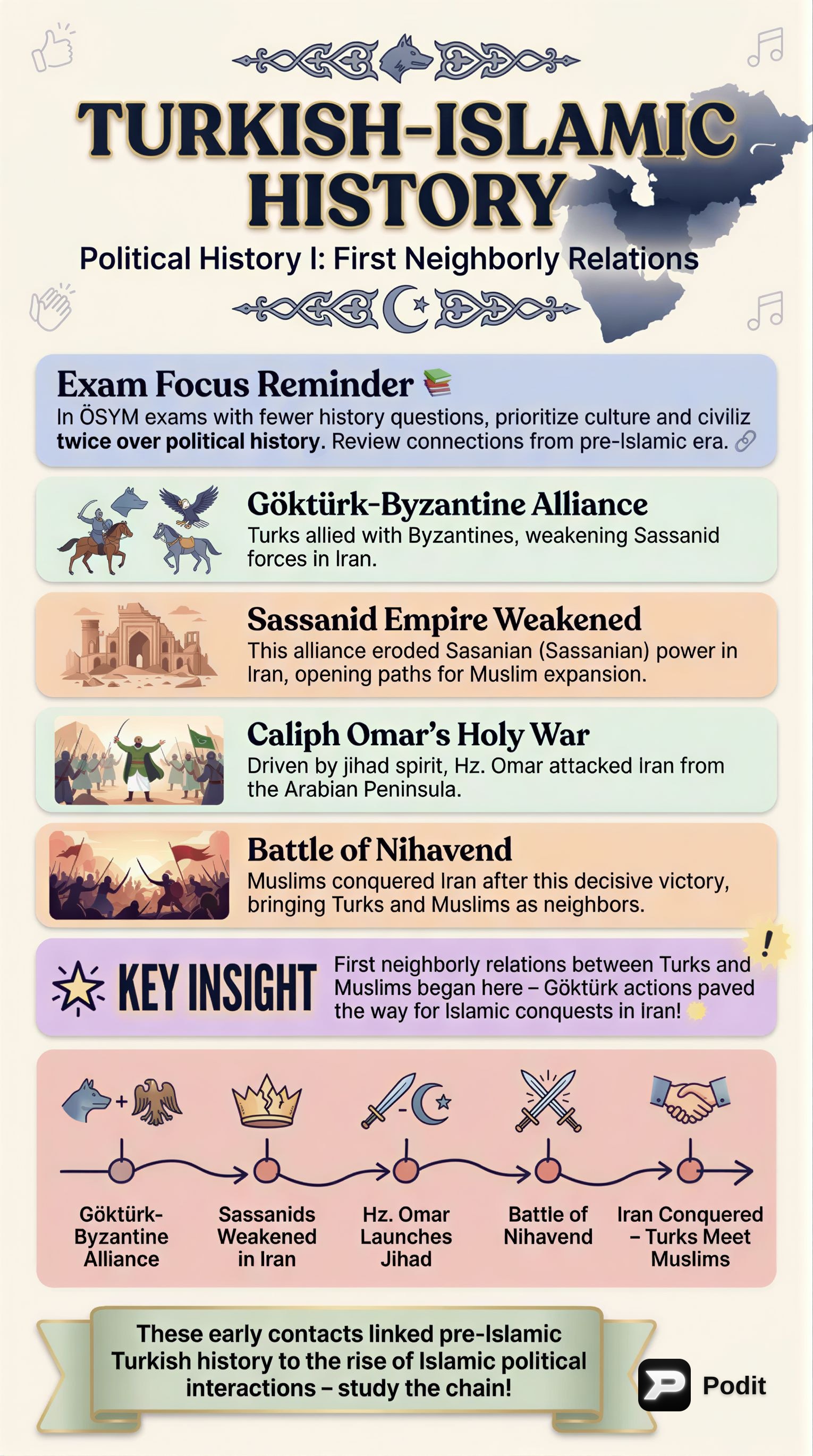
Turkish-Islamic Political History: Early States - görsel özet infografik
Tam boyutta görüntüle →
03

Flash Kartlar

25 kart

Karta tıklayarak çevir. ← → ile gez, ⎵ ile çevir.

1 / 25
Tüm kartları metin olarak gör
  1. 1. What is the primary focus of Turkish-Islamic Political History?

    Turkish-Islamic Political History primarily focuses on the processes through which Turkic peoples adopted Islam and subsequently established powerful states. This study examines how Turkic military and administrative traditions integrated with Islamic religious and legal frameworks, shaping the political, social, and cultural landscape of the Islamic world from the 8th century CE onwards. It is crucial for understanding the evolution of states like the Seljuks and Ottomans.

  2. 2. When did the period of Turkish-Islamic Political History commence?

    This pivotal period in Turkish-Islamic Political History commenced from the 8th century CE. It marks a significant transformation where Turkic peoples began to integrate their military and administrative traditions with Islamic religious and legal frameworks. This era laid the groundwork for the establishment of numerous influential states and empires.

  3. 3. Why is understanding this historical trajectory crucial?

    Understanding this historical trajectory is crucial for comprehending the evolution of numerous states and empires, including the Seljuks and later the Ottomans. These entities exerted significant influence across vast geographical regions from Central Asia to Anatolia and beyond. It helps in grasping the political, social, and cultural synthesis that defined the Islamic world for centuries.

  4. 4. How did Turkic tribes initially interact with the Islamic Caliphate?

    Turkic tribes initially interacted with the Islamic Caliphate in the 7th and 8th centuries, primarily through military encounters and trade routes in Central Asia. Many Turkic groups served as military slaves, known as Mamluks or Ghulams, within the Abbasid Caliphate. This early interaction gradually led to their rise to positions of significant power within the Islamic world.

  5. 5. What role did Mamluks or Ghulams play in the early interactions?

    Mamluks or Ghulams were Turkic military slaves who served within the Abbasid Caliphate. They played a crucial role by gradually rising to positions of significant power within the Caliphate's military and administration. This system allowed Turkic individuals to gain influence and experience in Islamic governance, paving the way for the establishment of independent Turkic-Islamic states.

  6. 6. When did the mass conversion of Turkic peoples to Islam gain momentum?

    The mass conversion of Turkic peoples to Islam gained significant momentum in the 10th century. While earlier interactions existed, this century saw a more widespread adoption of the religion. This wave of conversions was often facilitated by Sufi missionaries and the pragmatic recognition of Islam's political and economic advantages, leading to the establishment of the first independent Turkish-Islamic states.

  7. 7. What was the significance of the Battle of Talas (751 CE) in the context of Turkic Islamization?

    The Battle of Talas in 751 CE was significant because it exposed many Turkic tribes to Islamic culture and religion through direct contact with the Abbasid Caliphate. Although mass conversions occurred later, this battle marked an important early interaction point. It facilitated cultural exchange and laid some groundwork for future religious adoption among Turkic peoples in Central Asia.

  8. 8. What factors facilitated the mass conversion of Turkic peoples to Islam?

    The mass conversion of Turkic peoples to Islam was facilitated by several factors. Sufi missionaries played a crucial role in spreading the faith through their accessible teachings and spiritual guidance. Additionally, the pragmatic recognition of Islam's political and economic advantages, such as integration into the wider Islamic trade networks and administrative systems, encouraged conversions. Military encounters and trade routes also contributed to this process.

  9. 9. Name two prominent early independent Turkish-Islamic states.

    Two prominent early independent Turkish-Islamic states were the Karakhanid Khanate and the Ghaznavid Empire. The Karakhanids were one of the earliest fully Turkic states to embrace Islam as their official religion, ruling in Transoxiana and Eastern Turkestan. The Ghaznavids, founded by a Turkic Mamluk, emerged in the late 10th century and expanded into Persia, Central Asia, and northern India.

  10. 10. What was the Karakhanid Khanate known for in Turkish-Islamic history?

    The Karakhanid Khanate, established in the late 9th century, was known as one of the earliest fully Turkic states to embrace Islam as its official religion. They played a crucial role in the Islamization of Central Asian Turks and fostered a vibrant Turkic-Islamic culture. Their administration uniquely blended Islamic legal systems with traditional Turkic customary law, showcasing an early synthesis of these traditions.

  11. 11. Where did the Karakhanid Khanate primarily rule?

    The Karakhanid Khanate primarily ruled over Transoxiana and Eastern Turkestan. This geographical area was crucial for the Islamization of Central Asian Turks. Their dominion allowed them to establish a significant Turkic-Islamic culture and administrative system, influencing the region's development for centuries.

  12. 12. How did the Karakhanids blend governance principles?

    The Karakhanids blended governance principles by adopting Islamic legal systems while simultaneously retaining elements of Turkic customary law. This synthesis allowed them to integrate Islamic administrative practices with their traditional nomadic traditions. This approach helped them govern diverse populations and establish a unique Turkic-Islamic cultural and political identity in Central Asia.

  13. 13. Who founded the Ghaznavid Empire?

    The Ghaznavid Empire was founded by Sebuktigin, a Turkic Mamluk, in the late 10th century. His rise from a military slave to the founder of a powerful empire exemplifies the opportunities available to Turkic individuals within the Abbasid system. Under his leadership and that of his successors, the Ghaznavids established a significant presence in the Islamic world.

  14. 14. Where was the Ghaznavid Empire centered?

    The Ghaznavid Empire was centered in Ghazni, which is located in modern-day Afghanistan. From this strategic location, they expanded their dominion significantly. Their central position allowed them to project power into Persia, Central Asia, and northern India, making Ghazni a hub of military and cultural activity.

  15. 15. What was Mahmud of Ghazni particularly known for?

    Mahmud of Ghazni was particularly known for his formidable military campaigns into northern India. These campaigns significantly contributed to the spread of Islam in the subcontinent. Beyond his military prowess, he was also a patron of arts and sciences, fostering a rich Persianate-Islamic culture that influenced subsequent dynasties and left a lasting cultural legacy.

  16. 16. How did the Ghaznavids contribute to the spread of Islam?

    The Ghaznavids contributed significantly to the spread of Islam, most notably through their extensive military campaigns into northern India. Under rulers like Mahmud of Ghazni, these campaigns led to the establishment of Islamic rule and the introduction of Islamic culture and religion to new regions. This expansion played a crucial role in the Islamization of the Indian subcontinent.

  17. 17. What cultural aspect did the Ghaznavids foster?

    The Ghaznavids fostered a rich Persianate-Islamic culture. They were significant patrons of arts and sciences, attracting scholars, poets, and artists to their court. This cultural environment, heavily influenced by Persian traditions, left a lasting impact and influenced subsequent dynasties in the region, contributing to the broader Islamic civilization.

  18. 18. From which Turkic tribes did the Seljuks originate?

    The Seljuks originated from the Oghuz Turkic tribes. These nomadic tribes played a crucial role in the early history of Turkic peoples and their interactions with the Islamic world. Their emergence from these tribes highlights the nomadic roots of a dynasty that would go on to establish one of the most powerful empires in Islamic history.

  19. 19. Who were key leaders of the Seljuk expansion?

    Key leaders of the Seljuk expansion included figures like Tughril Beg and Alp Arslan. Tughril Beg was instrumental in the Seljuks' early victories and their entry into Baghdad, establishing their political authority. Alp Arslan, his successor, achieved the decisive victory at the Battle of Manzikert, which opened Anatolia to Turkic settlement and significantly expanded the empire's influence.

  20. 20. What was the significance of the Battle of Dandanakan (1040 CE)?

    The Battle of Dandanakan in 1040 CE was highly significant as it marked the decisive victory of the Seljuks against the Ghaznavids. This battle signaled the beginning of Seljuk ascendancy and the decline of Ghaznavid power. It paved the way for the establishment of the vast Great Seljuk Empire, fundamentally altering the geopolitical landscape of the Middle East.

  21. 21. What happened when Tughril Beg entered Baghdad in 1055?

    When Tughril Beg entered Baghdad in 1055, he effectively became the protector of the Abbasid Caliph. This event marked a new political order where Tughril Beg assumed the title of Sultan, signifying temporal power. This arrangement legitimized Seljuk rule within the Islamic world, with the Caliph retaining spiritual authority while the Seljuk Sultan wielded political and military control.

  22. 22. How did the Seljuk Sultan and Abbasid Caliph share power?

    The Seljuk Sultan and Abbasid Caliph shared power in a unique arrangement where the Seljuk Sultan held temporal power, while the Caliph retained spiritual authority. This meant the Sultan was the political and military ruler, responsible for governance and defense, while the Caliph remained the symbolic religious head of the Islamic world. This system legitimized Seljuk rule and integrated them into the existing Islamic framework.

  23. 23. What was the significance of the Battle of Manzikert (1071)?

    The Battle of Manzikert in 1071 was a pivotal moment where Alp Arslan decisively defeated the Byzantine army. This victory had immense significance as it opened Anatolia to Turkic settlement, initiating the process of Turkification and Islamization of the region. It fundamentally reshaped the geopolitical map and laid the groundwork for the future Sultanate of Rum and eventually the Ottoman Empire.

  24. 24. What was the impact of the Battle of Manzikert on Anatolia?

    The Battle of Manzikert had a profound impact on Anatolia, as it opened the region to widespread Turkic settlement. This initiated a long process of Turkification and Islamization, transforming the demographic and cultural landscape of Anatolia. This event was a crucial precursor to the establishment of the Sultanate of Rum and later the Ottoman Empire, permanently altering the region's identity.

  25. 25. How did the Seljuks contribute to Sunni Islam?

    The Seljuks were instrumental in reviving Sunni Islam, particularly against the Fatimid Shi'ite Caliphate, which posed a significant challenge to Sunni orthodoxy. They actively promoted Sunni scholarship and established institutions like the Nizamiyyah madrasas. This patronage helped consolidate Sunni doctrine and education, strengthening its position across the Islamic world.

04

Bilgini Test Et

15 soru

Çoktan seçmeli sorularla öğrendiklerini ölç. Cevap + açıklama.

Soru 1 / 15Skor: 0

Which century marked the beginning of the Turkish-Islamic political history, as described in the text?

05

Detaylı Özet

4 dk okuma

Tüm konuyu derinlemesine, başlık başlık.

This content is based on a YouTube video.

Turkish-Islamic Political History: Early States and Their Impact

📚 Introduction to Turkish-Islamic Political History

The study of Turkish-Islamic Political History delves into the profound processes through which Turkic peoples embraced Islam and subsequently established powerful states. This era, beginning in the 8th century CE, marked a pivotal transformation, integrating Turkic military and administrative traditions with Islamic religious and legal frameworks. Understanding this historical trajectory is crucial for comprehending the evolution of numerous states and empires, including the Seljuks and later the Ottomans, which significantly influenced vast geographical regions from Central Asia to Anatolia and beyond. This study material will outline the key stages, primary actors, foundational events, and enduring legacies of early Turkish-Islamic political entities.

🌍 The Emergence of Early Turkish-Islamic States

The interaction between Turkic tribes and the Islamic Caliphate began in the 7th and 8th centuries, primarily through military encounters and trade routes in Central Asia.

1️⃣ Turkic-Islamic Interaction and Conversion

  • Early Contact: Turkic groups initially served as military slaves (known as Mamluks or Ghulams) within the Abbasid Caliphate, gradually rising to positions of significant power.
  • Battle of Talas (751 CE): This battle exposed many Turkic tribes to Islamic culture and religion, though mass conversion gained momentum later.
  • Mass Conversion: The most significant wave of conversions occurred in the 10th century, often facilitated by Sufi missionaries and the pragmatic recognition of Islam's political and economic advantages.
  • Synthesis: This period saw the establishment of the first independent Turkish-Islamic states, blending Turkic nomadic traditions with Islamic governance principles.

2️⃣ The Karakhanid Khanate (Late 9th Century)

  • Foundation: One of the earliest fully Turkic states to embrace Islam as its official religion.
  • Territory: Ruled over Transoxiana and Eastern Turkestan.
  • Significance:
    • ✅ Played a crucial role in the Islamization of Central Asian Turks.
    • ✅ Fostered a vibrant Turkic-Islamic culture.
    • ✅ Administration adopted Islamic legal systems while retaining elements of Turkic customary law.

3️⃣ The Ghaznavid Empire (Late 10th Century)

  • Founder: Established by Sebuktigin, a Turkic Mamluk.
  • Center: Centered in Ghazni, Afghanistan.
  • Expansion:
    • 🗺️ Expanded dominion into Persia, Central Asia, and northern India.
    • Under rulers like Mahmud of Ghazni, they became formidable military powers.
    • Renowned for campaigns into India, significantly contributing to the spread of Islam in the subcontinent.
  • Cultural Impact:
    • ✅ Patrons of arts and sciences.
    • ✅ Fostered a rich Persianate-Islamic culture that influenced subsequent dynasties.
  • Legacy: These early states laid the groundwork for the political and cultural synthesis that would define later, larger Turkish-Islamic empires.

📈 The Great Seljuk Empire and Its Impact

The Great Seljuk Empire represents a zenith in early Turkish-Islamic political history, fundamentally altering the geopolitical landscape of the Middle East.

1️⃣ Origins and Expansion

  • Origins: Emerged from the Oghuz Turkic tribes.
  • Key Leaders: Figures like Tughril Beg and Alp Arslan led their expansion.
  • Ascendancy: Their decisive victory against the Ghaznavids at the ⚔️ Battle of Dandanakan in 1040 CE marked the beginning of their rise.
  • Vast Empire: Stretched from Central Asia to Anatolia and the Levant.

2️⃣ Key Political Shifts and Battles

  • Baghdad Entry (1055): Tughril Beg entered Baghdad, effectively becoming the protector of the Abbasid Caliph.
    • ✅ Assumed the title of Sultan, establishing a new political order.
    • Political Structure: Seljuk Sultan held temporal power, while the Caliph retained spiritual authority, legitimizing Seljuk rule.
  • Battle of Manzikert (1071): Alp Arslan decisively defeated the Byzantine army.
    • ✅ This victory opened Anatolia to Turkic settlement.
    • ✅ Initiated the process of Turkification and Islamization of the region.
    • 💡 Paved the way for the establishment of the Sultanate of Rum and later the Ottoman Empire.

3️⃣ Seljuk Administration and Cultural Contributions

  • Religious Revival: Instrumental in reviving Sunni Islam against the Fatimid Shi'ite Caliphate.
  • Education: Promoted Islamic scholarship through institutions like the 📚 Nizamiyyah madrasas, founded by the influential vizier Nizam al-Mulk.
  • Administrative System: Their administrative structure, characterized by the Iqta system (land grants), helped consolidate their rule and integrate diverse populations.
  • Legacy: Despite internal divisions and eventual fragmentation, the Great Seljuks left an indelible legacy, shaping the political and cultural identity of the Islamic world for centuries.

💡 Conclusion: Enduring Legacy of Early Turkish-Islamic States

The early period of Turkish-Islamic political history, marked by the rise of states such as the Karakhanids, Ghaznavids, and the Great Seljuk Empire, represents a transformative era.

  • ✅ These states were pivotal in the widespread adoption of Islam among Turkic peoples.
  • ✅ They integrated Turkic military prowess and administrative acumen into the broader Islamic civilization.
  • ✅ Established new political paradigms, defended Sunni Islam, and fostered significant cultural and intellectual developments.
  • The Karakhanids contributed to the Islamization of Central Asia, while the Ghaznavids expanded Islamic influence into India.
  • Most notably, the Great Seljuks not only established a vast empire but also fundamentally reshaped the political map of the Middle East, paving the way for the Turkification of Anatolia and laying the institutional and cultural foundations for future Turkish states.

The legacy of these early Turkish-Islamic entities is evident in the enduring cultural, religious, and political structures that continue to influence the regions they once governed, underscoring their profound and lasting impact on world history.
Kendi çalışma materyalini oluştur

PDF, YouTube videosu veya herhangi bir konuyu dakikalar içinde podcast, özet, flash kart ve quiz'e dönüştür. 1.000.000+ kullanıcı tercih ediyor.

Sıradaki Konular

Tümünü keşfet
Turkish-Islamic Political History: Early States

Turkish-Islamic Political History: Early States

An academic overview of the political history of early Turkish-Islamic states, including their formation, key empires like the Seljuks, and their lasting administrative and cultural impact.

1 dk Özet 25 15 Görsel
Turkish-Islamic Political History: Foundations

Turkish-Islamic Political History: Foundations

An academic overview of Turkish-Islamic political history, covering early interactions, the emergence of key states like the Karahanids and Ghaznavids, and the transformative Seljuk era.

7 dk Özet 25 15
Pre-Islamic Turkish Political History: Early States

Pre-Islamic Turkish Political History: Early States

An academic overview of the political history of early Turkic states before the advent of Islam, focusing on the Xiongnu, Göktürk, and Uyghur Khaganates.

7 dk Özet 25 15 Görsel
Sultan Malik-Shah: A Seljuk Leader's Legacy

Sultan Malik-Shah: A Seljuk Leader's Legacy

Explore the reign of Sultan Malik-Shah, a powerful Seljuk ruler, his partnership with Nizam al-Mulk, the expansion of the Seljuk Empire, and his contributions to governance and education.

8 dk Özet 18
Ottoman Empire: Culture and Civilization (Part 3)

Ottoman Empire: Culture and Civilization (Part 3)

An academic overview of the Ottoman Empire's cultural and civilizational aspects, including social structure, education, arts, and legal systems, highlighting its unique identity and enduring legacy.

7 dk Özet 25 15 Görsel
Political History of Pre-Islamic Turkic States

Political History of Pre-Islamic Turkic States

This summary explores the political evolution of Turkic peoples before Islam, covering major empires like the Xiongnu, Göktürks, and Uyghurs, their state structures, and historical impact.

7 dk Görsel
Pre-Islamic Turkish Political History

Pre-Islamic Turkish Political History

An academic overview of the political history of Turkic states before the advent of Islam, exploring their foundational characteristics, key empires, and enduring legacies.

4 dk Özet 25 15 Görsel
Ottoman Empire in the Early 20th Century II

Ottoman Empire in the Early 20th Century II

An academic summary of the Ottoman Empire's critical period in the early 20th century, focusing on internal political shifts, major wars, and territorial losses leading up to World War I.

5 dk Özet 25 15