 Podit
Podit
This content is based on a YouTube video.
📚 Pre-Islamic Turkish Political History: Part I
🌍 Introduction to Early Turkic Statecraft
This study material explores the foundational political structures and state formations of various Turkic and proto-Turkic peoples in Central Asia. Covering a period primarily from the 3rd century BCE to the 8th century CE, understanding this era is crucial for grasping the origins of Turkic statecraft, military organization, and cultural identity. These early nomadic empires, characterized by their equestrian cultures and vast territorial control, significantly influenced the geopolitical landscape of Eurasia.
🐎 The Xiongnu Empire and Early Nomadic Formations
The Xiongnu Empire, emerging around the 3rd century BCE, is considered the earliest significant nomadic confederation in Central Asia and a precursor to later Turkic states.
Key Characteristics:
- Leadership 👑: Ruled by a supreme leader known as the Chanyu.
- Political System ✅: A highly organized tribal confederation with the Chanyu at its apex, supported by a council of tribal leaders.
- Military Prowess 🛡️: Renowned for their formidable cavalry, which allowed them to control vast territories and extract tribute, notably from the Han Dynasty of China.
- Interactions with China 🤝⚔️: Complex relationship involving periods of warfare, trade, and diplomatic marriages (known as 'heqin').
- Influence 🌐: Extended political influence over many nomadic groups, fostering a shared military and administrative culture.
- Fragmentation 📉: Internal succession disputes and external pressures from the Han Dynasty led to its division into Northern and Southern Xiongnu in the 1st century CE.
💡 While not exclusively identified as Turkic, the Xiongnu provided a critical model for large-scale nomadic empires and sophisticated political organization that influenced subsequent Turkic state formations.
Prior to the Xiongnu, groups like the Scythians (Saka) also inhabited the Eurasian steppes, demonstrating similar nomadic characteristics and equestrian skills, highlighting the deep roots of nomadic state-building in the region.
🦅 The Göktürk Khaganates: The First Turkic Empires
The Göktürk Khaganates mark a pivotal moment as they were the first to explicitly use the ethnonym 'Turk' as a political designation.
1️⃣ The First Göktürk Khaganate (552 – 659 CE)
- Foundation 🚀: Established by Bumin Khagan in 552 CE.
- Territorial Extent 🗺️: Rapidly expanded to create an empire stretching from Manchuria to the Black Sea.
- Administration ⚖️: Typically managed through a dual system, with an Eastern Khaganate and a Western Khaganate, often ruled by brothers or close relatives, reflecting traditional Turkic political division.
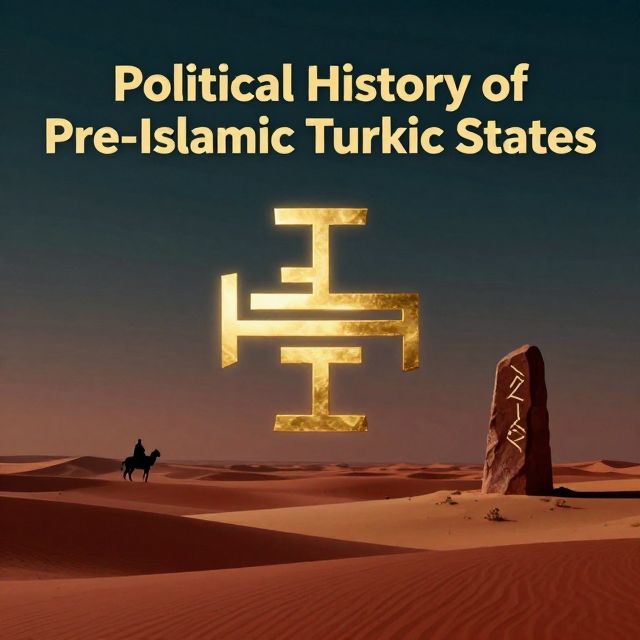
- Legacy: Orkhon Inscriptions 📜:
- Dating from the early 8th century, these are the earliest known written records in the Turkic language.
- Monumental steles erected in honor of figures like Bilge Khagan, Kul Tigin, and the statesman Tonyukuk.
- Provide invaluable insights into Göktürk political ideology, history, and culture, emphasizing Turkic identity, independence, and unity.
- Collapse 💥: Succumbed to internal strife and Chinese intervention in 659 CE.
2️⃣ The Second Göktürk Khaganate (Kutlug Khaganate) (682 – 744 CE)
- Resurgence 🌟: Established by Ilterish Khagan in 682 CE.
- Ideology ✊: Characterized by a renewed emphasis on Turkic nationalism and a struggle for liberation from Chinese suzerainty.
- Continuity ✅: Continued the traditions of its predecessor, further solidifying Turkic identity and statehood.
- Collapse 📉: Fell in 744 CE due to a coalition of other Turkic tribes, including the Uyghurs, Karluks, and Basmyls.
🕌 The Uyghur Khaganate and Cultural Transformation (744 – 840 CE)
Following the demise of the Second Göktürk Khaganate, the Uyghur Khaganate rose to prominence.
Key Developments:
- Rise to Power 📈: Established dominion over much of Mongolia in 744 CE.
- Inherited Traditions 🔄: As a tribal confederation previously under Göktürk rule, they inherited many political and military traditions.
- State Religion 🙏: A significant development was the adoption of Manichaeism as the state religion in 762 CE under Khagan Bögü. This marked a departure from traditional Tengrism.
- Cultural Shift 🏙️🌾:
- Led to a gradual shift towards a more settled, urbanized lifestyle.
- Involved the establishment of cities and agricultural practices.
- Writing System ✍️: Developed their own writing system, adapted from the Sogdian script, which facilitated the spread of Manichaean texts and administrative records.
- Distinguishing Feature 💡: This cultural transformation demonstrated a capacity for syncretism and adaptation, distinguishing them from earlier Turkic empires.
- Collapse 🌪️: Faced internal dissent, famine, and external pressures. The empire ultimately collapsed in 840 CE due to an invasion by the Kyrgyz.
- Dispersal ➡️: Led to the dispersal of Uyghur groups across Central Asia, with many migrating to the Tarim Basin, where they established new kingdoms and continued their cultural development.
🌟 Conclusion: Legacy of Early Turkic States
The pre-Islamic period of Turkic political history is defined by the emergence and evolution of powerful nomadic empires that profoundly shaped the Eurasian steppe.
Key Takeaways:
- Organizational Capacity ✅: From the Xiongnu to the Göktürks and Uyghurs, these states demonstrated remarkable organizational capacity and military prowess.
- Collective Identity 🤝: They fostered a developing sense of collective identity among Turkic peoples.
- Cyclical Nature 🔄: Highlighted the cyclical nature of nomadic empires, often rising and falling due to internal and external factors.
- Interaction with Sedentary Civilizations 🇨🇳: Constant interaction with sedentary civilizations, particularly China, was a defining characteristic.
- Unique Institutions 🏛️: Developed unique political and cultural institutions.
Lasting Legacy:
- Distinct Turkic Identity 🇹🇷: Established a distinct Turkic identity.
- First Turkic Written Language 📜: Created the first Turkic written language (Orkhon Inscriptions).
- Groundwork for Future States 🏗️: Laid the groundwork for future Turkic state formations and cultural expressions across a vast geographical expanse.