Pre-Islamic Turkish Political History - kapak
Tarih#turkish history#pre-islamic#turkic empires#xiongnu

Pre-Islamic Turkish Political History

An academic overview of the political history of Turkic states before the advent of Islam, exploring their foundational characteristics, key empires, and enduring legacies.

gzmuzunApril 24, 2026 ~19 dk toplam
01

Sesli Özet

5 dakika

Konuyu otobüste, koşarken, yolda dinleyerek öğren.

Sesli Özet

Pre-Islamic Turkish Political History

0:004:47
02

Görsel Özet

İnfografik

Konunun tüm parçalarını tek bakışta gör.

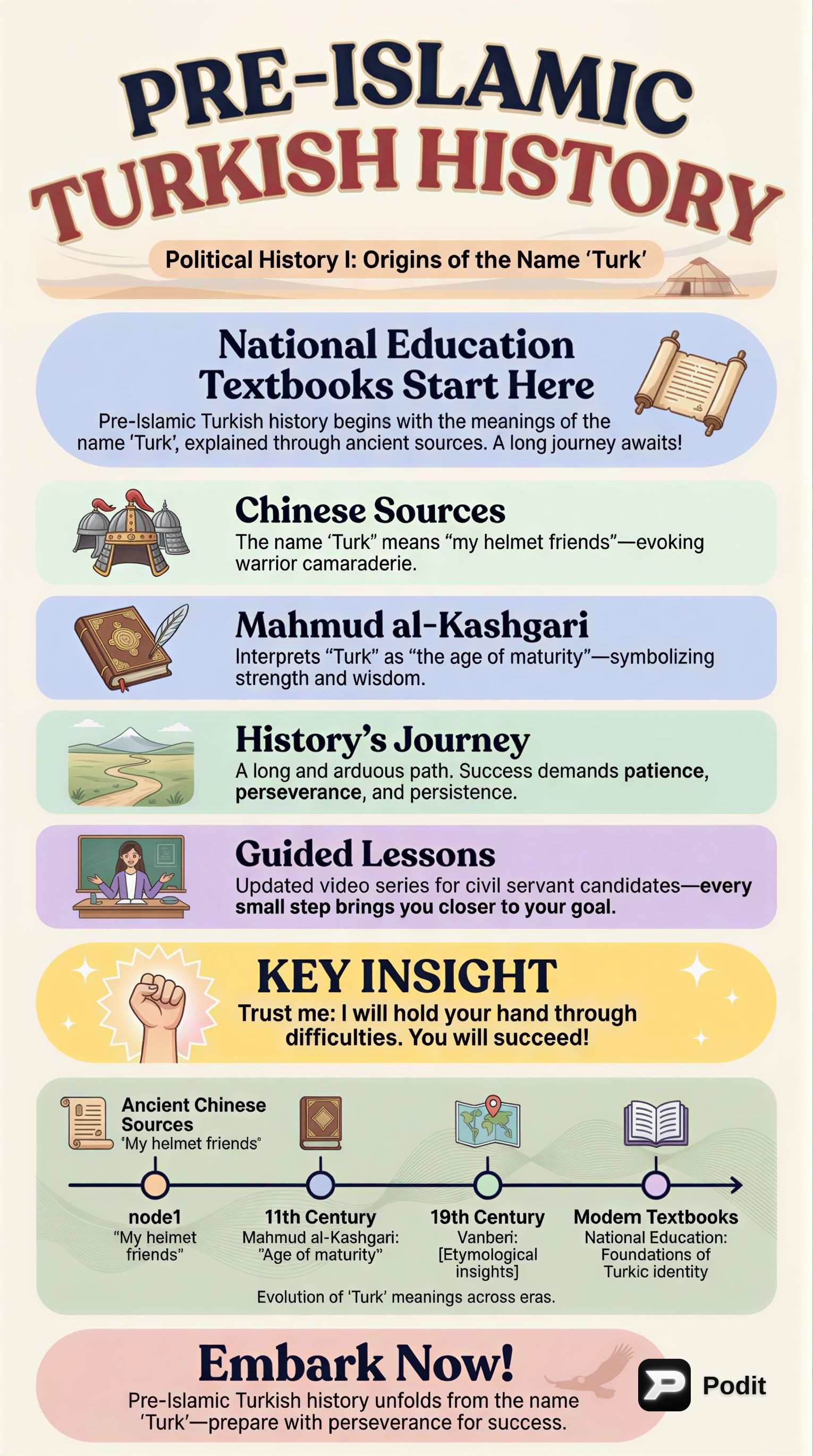
Pre-Islamic Turkish Political History - görsel özet infografik
Tam boyutta görüntüle →
03

Flash Kartlar

25 kart

Karta tıklayarak çevir. ← → ile gez, ⎵ ile çevir.

1 / 25
Tüm kartları metin olarak gör
  1. 1. What is the primary importance of studying Pre-Islamic Turkic political history?

    Studying Pre-Islamic Turkic political history is fundamental to understanding the origins and evolution of Turkic state traditions. This period provides insights into how early Turkic polities developed distinct administrative, military, and social structures. These foundational elements profoundly influenced subsequent historical developments across Central Asia, East Asia, and Eastern Europe, making it crucial for a comprehensive historical perspective.

  2. 2. What time period does Pre-Islamic Turkic political history span?

    Pre-Islamic Turkic political history spans from ancient times until the 8th to 10th centuries CE. This extensive period witnessed the rise and fall of numerous powerful nomadic and semi-nomadic empires. It covers the crucial formative years of Turkic statehood before the widespread adoption of Islam.

  3. 3. What was the predominant lifestyle characteristic of early Turkic states, and how did it influence their organization?

    Early Turkic states were predominantly characterized by a nomadic or semi-nomadic lifestyle. This mobility significantly influenced their political and social organization, leading to flexible structures like tribal confederations. Their ability to move vast distances also underpinned their military prowess and economic reliance on pastoralism.

  4. 4. How was the state structure of early Turkic polities typically organized?

    The state structure of early Turkic polities was often based on tribal confederations. Various Turkic and non-Turkic tribes would unite under a single charismatic leader, known as a Khagan or Khan. This confederate model allowed for the integration of diverse groups while maintaining a degree of tribal autonomy.

  5. 5. Who was the central charismatic leader in early Turkic states?

    The central charismatic leader in early Turkic states was known as a Khagan or Khan. This figure held supreme authority, often believed to be divinely sanctioned, and was responsible for uniting the tribal confederations. Their leadership was crucial for military campaigns and maintaining political stability across vast territories.

  6. 6. Explain the concept of 'Kut' in Turkic political legitimacy.

    'Kut' was a central concept in Turkic political legitimacy, representing a divine mandate believed to be bestowed upon the ruling dynasty by Tengri, the sky god. This divine sanction provided the Khagan with unquestionable authority. It ensured the loyalty of the tribal aristocracy and the broader population, legitimizing the ruler's power and right to govern.

  7. 7. What was the primary source of the Khagan's unquestionable authority in early Turkic states?

    The primary source of the Khagan's unquestionable authority was the concept of 'Kut,' a divine mandate from Tengri, the sky god. This divine sanction elevated the Khagan above ordinary mortals, making his rule seem preordained and sacred. It fostered loyalty among the tribal aristocracy and provided a strong ideological basis for his leadership.

  8. 8. What was the backbone of the military power of early Turkic states?

    The backbone of the military power of early Turkic states was their highly mobile cavalry forces. Their nomadic lifestyle fostered exceptional horsemanship and tactical flexibility, making them formidable opponents. This military prowess was paramount for expanding their empires, defending their territories, and extracting tribute from settled societies.

  9. 9. What was the primary economic basis of early Turkic states?

    The primary economic basis of early Turkic states was largely pastoralism, relying heavily on livestock breeding. This nomadic economy was supplemented by trade, particularly along the Silk Road, and tribute extracted from settled agricultural societies. This combination allowed them to sustain their populations and fund their military endeavors.

  10. 10. Describe the administrative structure of early Turkic states.

    The administrative structure of early Turkic states, though often decentralized at the tribal level, featured a sophisticated system for managing vast territories. A notable characteristic was a dual administrative structure, often dividing the empire into eastern and western wings. Each wing was governed by a senior and junior Khagan, allowing for effective control over diverse populations and extensive geographical areas.

  11. 11. What was the purpose of the dual administrative structure in early Turkic empires?

    The purpose of the dual administrative structure in early Turkic empires was to effectively control diverse populations and extensive geographical areas. By dividing the empire into eastern and western wings, each governed by a senior and junior Khagan, they could manage vast territories more efficiently. This model allowed for a degree of regional autonomy while maintaining overall imperial unity.

  12. 12. Which empire represents one of the earliest and most powerful nomadic confederations mentioned in the text, and when was it active?

    The Xiongnu represent one of the earliest and most powerful nomadic confederations mentioned in the text. They were active from the 3rd century BCE to the 1st century CE. Their vast empire challenged the Han Dynasty of China, demonstrating an advanced level of military and administrative organization for a nomadic people.

  13. 13. Who was the leader of the Xiongnu confederation?

    The leader of the Xiongnu confederation was known as a 'Chanyu'. This title signifies their supreme ruler, who commanded the vast nomadic empire. The Chanyu's leadership was central to the Xiongnu's military and administrative organization, enabling them to challenge powerful settled empires like the Han Dynasty.

  14. 14. Which major dynasty did the Xiongnu empire famously challenge?

    The Xiongnu empire famously challenged the Han Dynasty of China. Their conflicts were significant, leading to periods of warfare, tribute payments, and diplomatic engagements. The Xiongnu's ability to consistently challenge such a powerful settled empire highlights their military strength and sophisticated organization.

  15. 15. Which Turkic empire was the first to explicitly use the ethnonym 'Turk' in a political context?

    The First Turkic Khaganate, also known as the Göktürks, was the first entity to explicitly use the ethnonym 'Turk' in a political context. They emerged in the 6th century CE and established a vast empire. This marked a significant moment in Turkic identity and statehood, giving a name to a broad group of peoples.

  16. 16. What was the geographical span of the First Turkic Khaganate (Göktürks)?

    The First Turkic Khaganate, or Göktürks, established an empire stretching from Manchuria to the Black Sea. This vast geographical span demonstrates their immense power and influence across the Eurasian steppes. Their control over such a wide area required sophisticated military and administrative strategies.

  17. 17. What are the Orkhon Inscriptions, and why are they significant?

    The Orkhon Inscriptions are invaluable stone monuments left behind by the Göktürks. They are significant because they provide critical insights into their language, history, and political ideology. These inscriptions are among the earliest known examples of writing in a Turkic language and serve as primary sources for understanding early Turkic statehood.

  18. 18. What key aspects do the Orkhon Inscriptions detail about the Göktürk state?

    The Orkhon Inscriptions detail the Göktürk state's foundation, emphasizing the importance of unity among Turkic tribes. They also highlight the Khagan's crucial role in maintaining order and ensuring prosperity for his people. These inscriptions offer a unique window into the political thought and historical consciousness of the early Turkic empires.

  19. 19. Which empire succeeded the First Turkic Khaganate and revived Turkic power?

    The Second Turkic Khaganate, also known as the Kutlug Khaganate, succeeded the First Turkic Khaganate and later revived Turkic power. This resurgence demonstrated the resilience of Turkic state traditions after a period of decline. It continued the legacy of the Göktürks in asserting Turkic dominance in the region.

  20. 20. Which Khaganate flourished from the 8th to the 9th centuries CE and succeeded the Göktürks?

    The Uyghur Khaganate flourished from the 8th to the 9th centuries CE and succeeded the Göktürks. This empire marked a new phase in Turkic history, characterized by significant cultural and societal changes. They built upon the foundations laid by earlier Turkic states while introducing new elements.

  21. 21. What significant lifestyle change did the Uyghurs undergo during their Khaganate?

    The Uyghurs, while initially nomadic, gradually adopted a more settled lifestyle during their Khaganate. This shift led to the development of urban centers and a more agrarian economy. This transition represented a significant societal development for a Turkic people, moving away from purely pastoral nomadism.

  22. 22. What was the state religion adopted by the Uyghur Khaganate?

    The state religion adopted by the Uyghur Khaganate was Manichaeism. This was a significant cultural and religious shift from the traditional Tengrism of earlier Turkic states. The adoption of Manichaeism influenced Uyghur art, literature, and societal structure, marking a distinct period in their history.

  23. 23. What were some notable achievements of the Uyghur Khaganate?

    The Uyghur Khaganate was known for its administrative sophistication and significant cultural achievements. These included the development of a unique script, which facilitated written communication and record-keeping, and the establishment of urban centers. Their cultural advancements marked a notable shift in Turkic societal development towards a more settled and refined civilization.

  24. 24. How is Pre-Islamic Turkic political history characterized in the conclusion?

    Pre-Islamic Turkic political history is characterized by a dynamic interplay of nomadic traditions, military innovation, and evolving statecraft. It highlights how these empires, from the formidable Xiongnu to the culturally rich Uyghurs, established complex political systems. This period demonstrates a continuous adaptation and development of governance structures.

  25. 25. What fundamental concepts underpinned the complex political systems of early Turkic empires?

    The complex political systems of early Turkic empires were fundamentally rooted in concepts like 'Kut' and tribal confederations. 'Kut' provided divine legitimacy to the rulers, while tribal confederations allowed for the unification of diverse groups under a single Khagan. These concepts were crucial for maintaining order and authority across vast, mobile populations.

04

Bilgini Test Et

15 soru

Çoktan seçmeli sorularla öğrendiklerini ölç. Cevap + açıklama.

Soru 1 / 15Skor: 0

What was the primary source of political legitimacy for the ruling dynasty in early Turkic states, according to the text?

05

Detaylı Özet

4 dk okuma

Tüm konuyu derinlemesine, başlık başlık.

This content is based on a YouTube video.


📚 Pre-Islamic Turkic Political History: An Overview

Introduction

The study of Pre-Islamic Turkic political history is crucial for understanding the foundational origins and evolution of Turkic state traditions. This period, spanning from ancient times until roughly the 8th to 10th centuries CE, witnessed the rise and fall of numerous powerful nomadic and semi-nomadic empires across the vast Eurasian steppes. These early Turkic polities developed distinct administrative, military, and social structures that profoundly influenced subsequent historical developments in Central Asia, East Asia, and Eastern Europe. This study material will provide a comprehensive overview of their foundational characteristics, political organization, and the significant empires that shaped this era, highlighting their contributions to political thought and governance.

1️⃣ Characteristics of Early Turkic States

Early Turkic states were predominantly shaped by a nomadic or semi-nomadic lifestyle, which deeply influenced their political and social organization.

✅ Key Features:

  • Nomadic/Semi-Nomadic Lifestyle: This lifestyle was central to their societal and political structure.
  • Tribal Confederations: States were often formed by various Turkic and non-Turkic tribes uniting under a single charismatic leader.
  • Leadership: The supreme leader was known as a Khagan or Khan.

💡 The Concept of 'Kut'

  • Divine Mandate: 'Kut' was a central concept in Turkic political legitimacy. It referred to a divine mandate believed to be bestowed upon the ruling dynasty by Tengri, the sky god.
  • Authority: This divine sanction provided the Khagan with unquestionable authority and ensured the loyalty of the tribal aristocracy.

⚔️ Military and Economy:

  • Military Prowess: Highly mobile cavalry forces formed the backbone of their power, making military strength paramount.
  • Pastoral Economy: The economy was largely pastoral, relying on livestock breeding. This was supplemented by trade and tribute extracted from settled agricultural societies.

📊 Administrative Structure:

  • Decentralization: Administration was often decentralized at the tribal level.
  • Sophisticated Management: Despite decentralization, they developed a sophisticated system for managing vast territories.
  • Dual Administrative Structure: A common model involved dividing the empire into eastern and western wings. Each wing was governed by a senior and a junior Khagan, allowing for effective control over diverse populations and extensive geographical areas.

2️⃣ Major Pre-Islamic Turkic Empires

Several prominent empires dominated the Pre-Islamic Turkic political landscape, each leaving a significant mark.

🏹 The Xiongnu (3rd Century BCE - 1st Century CE)

  • Pioneering Nomadic Empire: Represent one of the earliest and most powerful nomadic confederations.
  • Rivalry with China: Established a vast empire that frequently challenged the Han Dynasty of China.
  • Leadership: Led by a 'Chanyu'.
  • Organization: Demonstrated an advanced level of military and administrative organization for a nomadic people.

🦅 The First Turkic Khaganate (Göktürks) (6th Century CE)

  • Ethnonym 'Turk': This was the first entity to explicitly use the ethnonym 'Turk' in a political context.
  • Vast Empire: Established an empire stretching from Manchuria to the Black Sea.
  • Orkhon Inscriptions: Left behind invaluable Orkhon Inscriptions. These provide critical insights into their language, history, and political ideology, detailing the state's foundation, the importance of unity, and the Khagan's role in maintaining order and prosperity.

🔄 The Second Turkic Khaganate (Kutlug Khaganate)

  • Revival of Power: Later revived Turkic power after the decline of the First Khaganate.

🌙 The Uyghur Khaganate (8th - 9th Centuries CE)

  • Successors: Succeeded the Göktürks.
  • Settled Lifestyle: Initially nomadic, the Uyghurs gradually adopted a more settled lifestyle.
  • State Religion: Embraced Manichaeism as their state religion.
  • Cultural Achievements: Known for administrative sophistication and significant cultural achievements, including the development of a unique script and urban centers. This marked a significant shift in Turkic societal development towards a more sedentary and culturally rich existence.

3️⃣ Legacy and Enduring Influence

The Pre-Islamic Turkic political history is characterized by a dynamic interplay of nomadic traditions, military innovation, and evolving statecraft.

✅ Key Contributions:

  • Complex Political Systems: From the formidable Xiongnu to the culturally rich Uyghurs, these empires established complex political systems rooted in concepts like 'Kut' and tribal confederations.
  • Impact on Eurasia: Their administrative models, military strategies, and diplomatic engagements with neighboring powers, particularly China, left an indelible mark on Eurasian history.
  • Cultural and Political Identity: The legacy of these early Turkic states includes not only the establishment of vast empires but also the development of distinct cultural and political identities. These identities continued to influence subsequent Turkic and non-Turkic polities for centuries.

Understanding this period is essential for appreciating the long-standing traditions of statehood, governance, and cultural resilience that have defined Turkic peoples throughout history.

Kendi çalışma materyalini oluştur

PDF, YouTube videosu veya herhangi bir konuyu dakikalar içinde podcast, özet, flash kart ve quiz'e dönüştür. 1.000.000+ kullanıcı tercih ediyor.

Sıradaki Konular

Tümünü keşfet
Pre-Islamic Turkish History

Pre-Islamic Turkish History

An academic overview of the foundational period of Turkic peoples, exploring their origins, early migrations, and the significant empires and cultural developments before the advent of Islam.

5 dk Özet 25 15
Pre-Islamic Turkish History

Pre-Islamic Turkish History

An academic overview of Pre-Islamic Turkish history, exploring early origins, nomadic empires, and key cultural developments in Central Asia before the advent of Islam.

5 dk Özet 25 15
Pre-Islamic Turkish Political History: Early States

Pre-Islamic Turkish Political History: Early States

An academic overview of the political history of early Turkic states before the advent of Islam, focusing on the Xiongnu, Göktürk, and Uyghur Khaganates.

7 dk Özet 25 15 Görsel
The First Turkic States: Origins and Xiongnu

The First Turkic States: Origins and Xiongnu

Explore the origins of the earliest Turkic states in Central Asia, their nomadic lifestyle, key societal concepts like Kut and Töre, and delve into the foundational Xiongnu Empire.

Özet 15
Turkish-Islamic Political History: Foundations

Turkish-Islamic Political History: Foundations

An academic overview of Turkish-Islamic political history, covering early interactions, the emergence of key states like the Karahanids and Ghaznavids, and the transformative Seljuk era.

7 dk Özet 25 15
The Genesis and Early Development of Turkish States

The Genesis and Early Development of Turkish States

This academic summary explores the foundational period of early Turkish states, focusing on their Central Asian origins, nomadic characteristics, political structures, and the emergence of significant entities like the Xiongnu.

5 dk Özet 25 15
The Battle of Talas and Turks' Acceptance of Islam

The Battle of Talas and Turks' Acceptance of Islam

Explore the pivotal Battle of Talas in 751 AD, its impact on the Abbasid Caliphate and Tang Dynasty, and how it catalyzed the widespread acceptance of Islam among Turkic peoples, shaping history.

Özet 15
Ottoman Empire: Early 20th Century Challenges

Ottoman Empire: Early 20th Century Challenges

Explore the critical internal and external challenges faced by the Ottoman Empire in the early 20th century, leading to its eventual decline and dissolution.

Özet 15 Görsel