 Podit
Podit
This content is based on a YouTube video.
The Ottoman Empire in the Early 20th Century: A Period of Decline and Transformation
📚 Introduction
The early 20th century marked a critical and ultimately terminal period for the Ottoman Empire, once a formidable power spanning three continents. This era was characterized by intense internal strife, the rise of nationalist movements, and devastating external conflicts that collectively led to its rapid decline and eventual dissolution. Understanding this period is crucial for grasping the geopolitical landscape of the modern Middle East and the formation of the Turkish Republic.
🌍 The Ottoman Empire: "The Sick Man of Europe"
By the early 1900s, the Ottoman Empire was widely referred to as the "Sick Man of Europe." ⚠️ This metaphor highlighted its severe internal weaknesses, economic stagnation, and inability to resist the territorial ambitions of European powers. It was a vast, multi-ethnic empire struggling to maintain cohesion and control over its diverse populations.
💥 Internal Upheavals: Young Turks and Rising Nationalism
The empire's internal stability was severely undermined by two major forces: the burgeoning nationalist sentiments among its non-Turkish communities and the reformist movement of the Young Turks.
1️⃣ Rise of Nationalism
Across the empire, various ethnic and religious groups began to assert their distinct identities and demand greater autonomy or outright independence.
- Diverse Groups: Arabs, Albanians, Armenians, and other communities increasingly sought self-determination.
- Weakening Cohesion: This growing nationalism fractured the empire's unity, making it difficult for the central government to maintain control and loyalty.
2️⃣ The Young Turks Movement
A significant internal force for change was the Young Turks, a powerful reformist movement.
- Who they were: A coalition of intellectuals, military officers, and students who opposed the autocratic rule of Sultan Abdul Hamid II.
- Their Aims: They advocated for a constitutional government, modernization, and the restoration of the 1876 Ottoman Constitution. They believed that constitutionalism and parliamentary rule were essential to strengthen the empire and prevent its collapse.
✅ Key Events Involving the Young Turks:
-
1908 Young Turk Revolution:
- Action: The Young Turks, primarily through the Committee of Union and Progress (CUP), launched a successful revolution.
- Outcome: They forced Sultan Abdul Hamid II to restore the 1876 Constitution and reconvene the Ottoman Parliament. This marked a significant, albeit brief, shift towards parliamentary rule and a more liberal political environment.
- Significance for KPSS: This event is a high-probability exam question. Remember the year (1908), the key demand (restoration of the 1876 Constitution), and the immediate outcome (parliamentary rule).
-
1909 Counter-Revolution (31 March Incident):
- Event: A conservative backlash against the Young Turk reforms and constitutional rule.
- Outcome: The Young Turks, particularly the CUP, suppressed this counter-revolution.
- Consequence: Sultan Abdul Hamid II was deposed and replaced by his brother, Mehmed V. The CUP effectively consolidated its power, becoming the dominant political force in the empire.
- Significance for KPSS: The deposition of Abdul Hamid II and the rise of the CUP are crucial points. The "31 March Incident" is a common exam term.
-
Committee of Union and Progress (CUP):
- Role: After 1909, the CUP became the de facto ruling party.
- Policies: While aiming to strengthen the empire through modernization and centralization, their policies often intensified Turkish nationalism, which ironically further alienated non-Turkish communities and exacerbated fragmentation. 💡 This paradox is an important insight into the complexities of the era.
⚔️ External Pressures and Devastating Wars
Beyond internal strife, the Ottoman Empire faced relentless external aggression from European powers eager to expand their influence and carve up Ottoman territories.
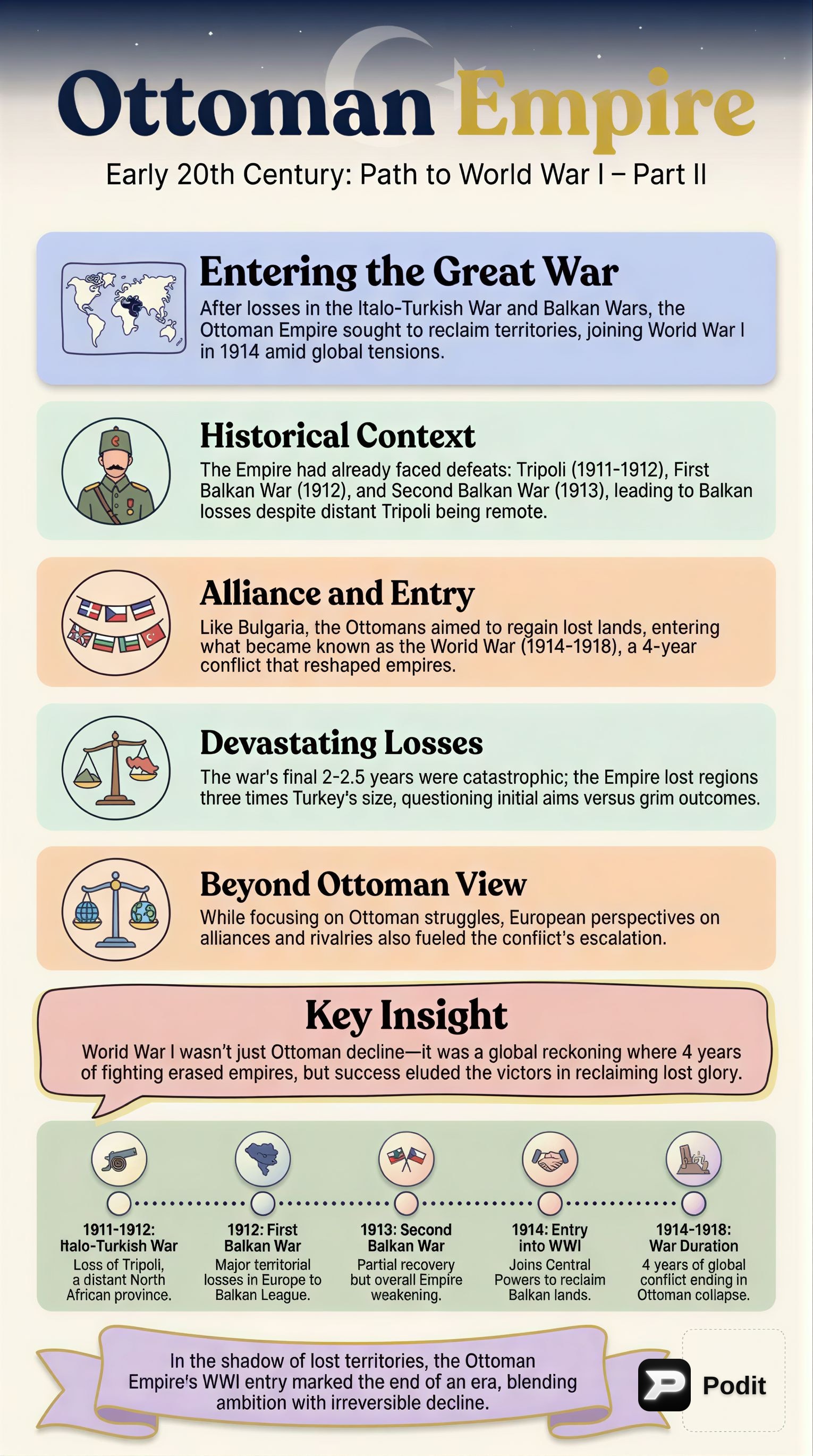
1️⃣ Italo-Turkish War (1911-1912)
- Aggressor: Italy, seeking colonial expansion, attacked the Ottoman provinces in North Africa.
- Territories at Stake: Tripolitania and Cyrenaica (modern-day Libya).
- Outcome: The Ottomans, militarily weak and unable to effectively defend distant territories, lost these provinces to Italy.
- Significance for KPSS: This war is a key indicator of the empire's military decline and territorial losses just before the Balkan Wars. The loss of Libya is a frequently tested fact.
2️⃣ Balkan Wars (1912-1913)
These wars were catastrophic for the Ottoman Empire, leading to the loss of almost all its remaining European territories.
✅ First Balkan War (1912)
- Participants: A coalition of Balkan states (Bulgaria, Serbia, Greece, and Montenegro) attacked the Ottoman Empire.
- Objective: To reclaim territories in the Balkans that were historically under Ottoman rule.
- Outcome: The Ottoman Empire suffered a decisive defeat, losing vast lands in Europe.
- Major Losses: Almost all of its remaining European territories, including Albania and Macedonia, gained independence or were annexed by the Balkan states.
- Significance for KPSS: This war is extremely important. Remember the year (1912), the participating Balkan states, and the major territorial losses (Albania, Macedonia, and most of Rumelia).
✅ Second Balkan War (1913)
- Nature: Primarily fought among the Balkan states themselves over the division of the spoils from the First Balkan War.
- Ottoman Involvement: The Ottomans managed to regain a small amount of territory (Edirne) during this conflict, but the overall territorial losses from the Balkan Wars remained immense.
- Significance for KPSS: While less directly about Ottoman defeat, it solidified the new borders and further diminished Ottoman presence in Europe.
3️⃣ Entry into World War I (1914)
- Context: Weakened by internal conflicts and devastating wars, the Ottoman Empire made the fateful decision to enter World War I.
- Alignment: It aligned with the Central Powers (Germany and Austria-Hungary).
- Consequence: This decision ultimately sealed the empire's fate, leading to its final defeat and dissolution at the war's end.
- Significance for KPSS: The Ottoman Empire's entry into WWI on the side of the Central Powers is a critical historical turning point.
📈 Legacy of the Early 20th Century
The early 20th century was a period of desperate struggle for survival for the Ottoman Empire.
- Key Factors in Decline: A combination of internal nationalist movements, the political reforms and struggles initiated by the Young Turks, and a series of devastating external wars.
- Outcome: Rapid shrinking, weakening, and significant territorial losses.
- End of an Era: These challenges culminated in the empire's entry into World War I, which proved to be its final chapter.
- Birth of New States: The events of these years were not just the end of an empire but also the crucible from which modern Turkey and many other nation-states in the Middle East would eventually emerge. 💡 This period fundamentally reshaped the geopolitical map of the region.