Ottoman Empire in the Early 20th Century II - kapak
Tarih#ottoman empire#early 20th century#young turks#committee of union and progress

Ottoman Empire in the Early 20th Century II

An academic summary of the Ottoman Empire's critical period in the early 20th century, focusing on internal political shifts, major wars, and territorial losses leading up to World War I.

psychoFebruary 19, 2026 ~21 dk toplam
01

Sesli Özet

5 dakika

Konuyu otobüste, koşarken, yolda dinleyerek öğren.

Sesli Özet

Ottoman Empire in the Early 20th Century II

0:005:01
02

Flash Kartlar

25 kart

Karta tıklayarak çevir. ← → ile gez, ⎵ ile çevir.

1 / 25
Tüm kartları metin olarak gör
  1. 1. What characterized the Ottoman Empire in the early 20th century?

    The early 20th century for the Ottoman Empire was marked by a period of profound crisis and accelerating decline. This era was characterized by intense internal political struggles, significant territorial losses, and increasing external pressures, all contributing to its eventual dissolution.

  2. 2. What was the primary goal of the Young Turk Revolution of 1908?

    The primary goal of the Young Turk Revolution of 1908 was to force Sultan Abdülhamid II to restore the 1876 Constitution and reconvene Parliament. This action aimed to usher in the Second Constitutional Era, shifting towards a more parliamentary system and modernizing the empire.

  3. 3. Who initiated the Young Turk Revolution?

    The Young Turk Revolution was initiated by the Committee of Union and Progress (CUP). This group played a pivotal role in challenging the absolute monarchy and advocating for constitutional rule, ultimately leading to significant political changes within the empire.

  4. 4. What was the "Second Constitutional Era" in the Ottoman Empire?

    The Second Constitutional Era began after the Young Turk Revolution of 1908, when Sultan Abdülhamid II was forced to restore the 1876 Constitution and reconvene Parliament. This period aimed for a more parliamentary system, though the CUP quickly consolidated power, often through authoritarian means, amidst internal and external challenges.

  5. 5. What was the Committee of Union and Progress (CUP)?

    The Committee of Union and Progress (CUP) was the political organization that initiated the Young Turk Revolution of 1908. It quickly consolidated power during the Second Constitutional Era, aiming for Ottomanization and centralization, despite facing internal divisions and external pressures.

  6. 6. Describe the 31 March Incident and its outcome.

    The 31 March Incident in 1909 was a counter-revolutionary uprising that attempted to restore absolute monarchy in the Ottoman Empire. It was swiftly suppressed by the 'Action Army' from Thessaloniki, which solidified the CUP's control and led to the deposition of Sultan Abdülhamid II, who was replaced by Mehmed V.

  7. 7. Who replaced Sultan Abdülhamid II after the 31 March Incident?

    Following the suppression of the 31 March Incident and the solidification of CUP's control, Sultan Abdülhamid II was deposed. He was replaced by Mehmed V, who became the new Sultan, marking a further shift in power dynamics within the empire.

  8. 8. What were the main policies pursued by the CUP during their dominance?

    The CUP's policies primarily aimed at Ottomanization and centralization. While they sought to modernize the empire, these policies often alienated non-Turkish ethnic groups, exacerbating nationalist sentiments and contributing to internal instability.

  9. 9. How did the CUP's policies affect non-Turkish ethnic groups within the empire?

    The CUP's policies of Ottomanization and centralization often alienated non-Turkish ethnic groups. These policies, intended to strengthen the empire, inadvertently exacerbated nationalist sentiments among diverse populations, contributing to internal divisions and unrest.

  10. 10. What was the Italo-Turkish War, and when did it occur?

    The Italo-Turkish War, also known as the Tripolitanian War, erupted in 1911 when Italy invaded Ottoman Libya. This conflict demonstrated the Ottoman Empire's inability to defend its distant provinces, leading to significant territorial losses.

  11. 11. Which territories did the Ottoman Empire lose as a result of the Italo-Turkish War?

    As a result of the Italo-Turkish War, the Ottoman Empire was forced to cede Tripolitania and Cyrenaica (modern-day Libya) to Italy. This loss was formalized by the Treaty of Ouchy in 1912, marking a major blow to the empire's remaining North African territories.

  12. 12. What was the Treaty of Ouchy (1912) significant for?

    The Treaty of Ouchy, signed in 1912, was significant because it formalized the Ottoman Empire's cession of Tripolitania and Cyrenaica (Libya) to Italy. This treaty concluded the Italo-Turkish War and highlighted the empire's weakening military and political standing.

  13. 13. What was Mustafa Kemal's role in the Italo-Turkish War?

    Mustafa Kemal, later known as Atatürk, was an Ottoman officer who participated in resisting the Italian invasion during the Italo-Turkish War. Despite fierce resistance from local forces and officers like Kemal, the empire was ultimately unable to retain its North African territories.

  14. 14. When did the Balkan Wars commence, and what was their immediate cause?

    The Balkan Wars commenced immediately following the Italo-Turkish War in 1912. Their immediate cause was a coordinated attack on the Ottoman Empire by a coalition of Balkan states, aiming to seize remaining Ottoman territories in Europe.

  15. 15. Which countries formed the coalition against the Ottoman Empire in the First Balkan War?

    The coalition against the Ottoman Empire in the First Balkan War consisted of Bulgaria, Serbia, Greece, and Montenegro. These Balkan states launched a coordinated attack, seeking to expand their territories at the expense of the weakening Ottoman Empire.

  16. 16. What were the major territorial losses for the Ottoman Empire in the First Balkan War?

    In the First Balkan War, the Ottoman Empire suffered devastating territorial losses, losing nearly all its remaining European territories. This included Macedonia, Albania, and most of Thrace, drastically shrinking its presence on the European continent.

  17. 17. What was the state of the Ottoman army during the First Balkan War?

    During the First Balkan War, the Ottoman army was still undergoing reorganization and suffered from internal political purges. This weakened state contributed significantly to its decisive defeat against the coalition of Balkan states, leading to massive territorial losses.

  18. 18. What was the outcome of the Second Balkan War for the Ottoman Empire?

    The Second Balkan War, fought in 1913 among the former allies over the spoils of the First Balkan War, allowed the Ottomans to regain a small portion of Eastern Thrace, including Edirne. However, the overall outcome of the Balkan Wars remained catastrophic for the empire.

  19. 19. What was the overall impact of the Balkan Wars on the Ottoman Empire?

    The overall impact of the Balkan Wars was catastrophic for the Ottoman Empire, drastically shrinking its European landmass and displacing millions of Muslims. These wars exposed the empire's profound military and administrative weaknesses, further fueling nationalist sentiments and setting the stage for future conflicts.

  20. 20. How did the territorial losses from the Balkan Wars affect the Ottoman Empire's population?

    The territorial losses from the Balkan Wars led to the displacement of millions of Muslims from the lost European territories. This mass displacement further fueled nationalist sentiments within the empire and added to its internal social and political challenges.

  21. 21. What did the Italo-Turkish War and Balkan Wars expose about the Ottoman Empire?

    The Italo-Turkish War and, more significantly, the Balkan Wars exposed the Ottoman Empire's profound military and administrative weaknesses. These conflicts demonstrated its inability to defend its territories effectively and manage internal dissent, accelerating its decline.

  22. 22. What was the "path to World War I" for the Ottoman Empire, as described in the text?

    The path to World War I for the Ottoman Empire was characterized by a rapid succession of political upheavals and military defeats, leading to vulnerability and isolation. The cumulative effect of these crises intensified its search for powerful allies, ultimately propelling it towards an alliance with the Central Powers.

  23. 23. What was the ultimate consequence of the Ottoman Empire's crises in the early 20th century regarding alliances?

    The ultimate consequence of the Ottoman Empire's crises in the early 20th century was its intensified search for powerful allies due to its vulnerability and isolation. This eventually propelled it towards an alliance with the Central Powers, leading to its fateful entry into World War I.

  24. 24. What event marked the final chapter of the Ottoman Empire's history?

    The Ottoman Empire's entry into World War I, allied with the Central Powers, marked the final chapter of its six-century-long history. The cumulative effect of internal instability, territorial losses, and military weaknesses led to its eventual dissolution after the war.

  25. 25. How did the Young Turk Revolution contribute to the empire's eventual dissolution?

    The Young Turk Revolution, while attempting modernization, led to the CUP's authoritarian consolidation of power and policies of Ottomanization that alienated non-Turkish groups. This exacerbated internal divisions and nationalist sentiments, weakening the empire from within and contributing to its eventual dissolution.

03

Bilgini Test Et

15 soru

Çoktan seçmeli sorularla öğrendiklerini ölç. Cevap + açıklama.

Soru 1 / 15Skor: 0

Which event marked the beginning of the Second Constitutional Era in the Ottoman Empire?

04

Detaylı Özet

6 dk okuma

Tüm konuyu derinlemesine, başlık başlık.

This content is based on a YouTube video.


The Ottoman Empire in the Early 20th Century: Crisis and Transformation (Part II) 📚

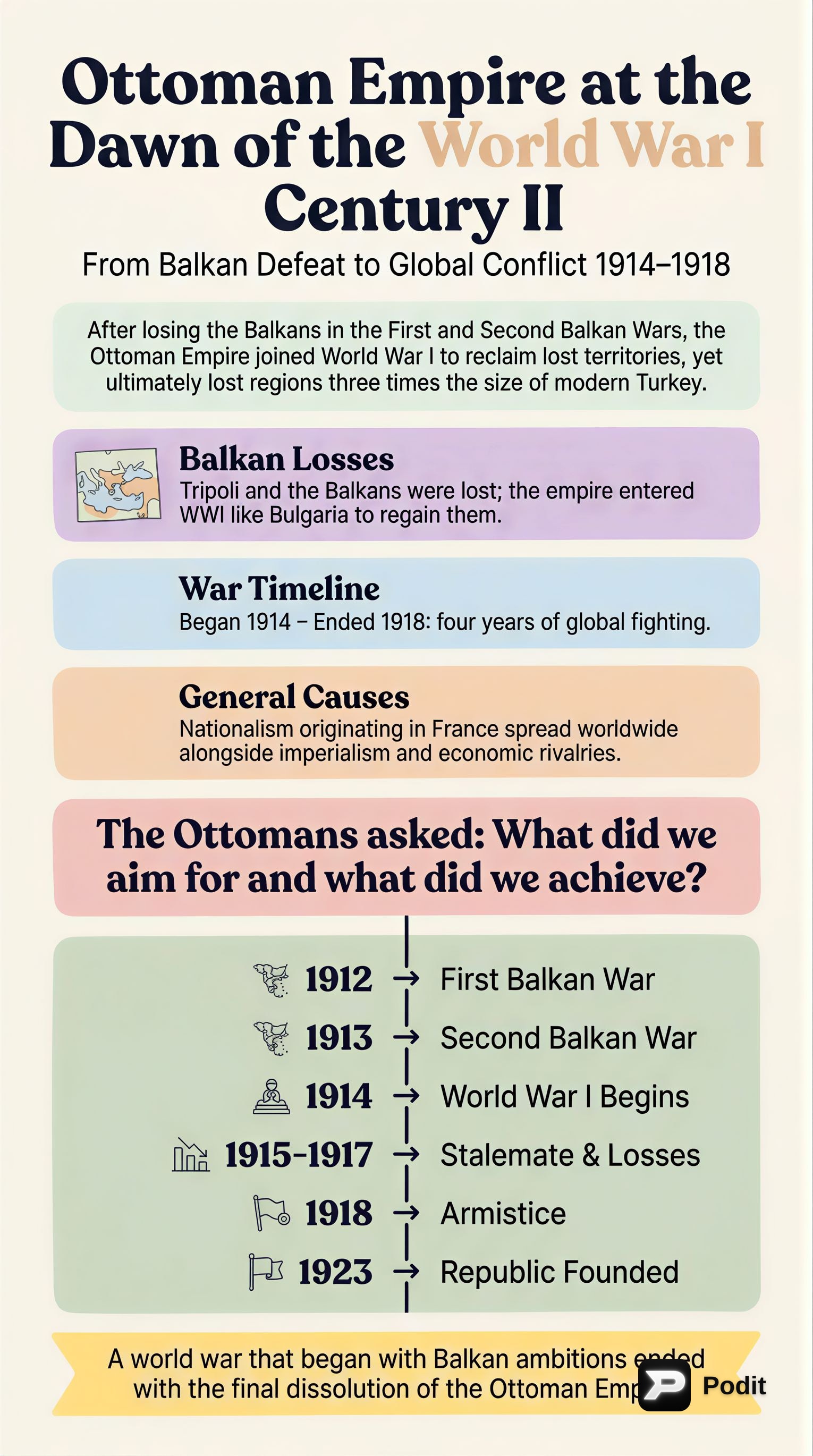
The early 20th century marked a pivotal and tumultuous period for the Ottoman Empire, characterized by rapid decline, internal strife, and significant territorial losses. This era laid the groundwork for the empire's eventual dissolution, highlighting the complex interplay of nationalism, imperial ambitions, and military weakness. This study material will delve into the critical internal political dynamics and devastating external pressures that shaped the Ottoman Empire's final decades.


1. Overview of the Era: A Period of Profound Crisis 📉

The beginning of the 20th century saw the Ottoman Empire grappling with intense internal political struggles, accelerating decline, and increasing external pressures. Despite attempts at modernization and centralization following the Young Turk Revolution of 1908, the empire faced a series of devastating wars that irrevocably altered its geopolitical standing.


2. Internal Political Dynamics and the Young Turk Era 🏛️

The internal landscape of the Ottoman Empire was dominated by political upheaval and the rise of new ideologies.

2.1. The Young Turk Revolution (1908) ✅

  • Initiators: The Committee of Union and Progress (CUP).
  • Outcome: Forced Sultan Abdülhamid II to restore the 1876 Constitution.
  • Impact: Ushered in the Second Constitutional Era, aiming for a more parliamentary system.
  • CUP's Role: The CUP quickly consolidated its power, often employing authoritarian methods, leading to a short-lived initial euphoria of constitutionalism.

2.2. The 31 March Incident (1909) ⚠️

  • Nature: A counter-revolutionary uprising.
  • Goal: To restore absolute monarchy.
  • Suppression: Swiftly put down by the 'Action Army' marching from Thessaloniki.
  • Consequences:
    • Solidified the CUP's control over the government.
    • Led to the deposition of Sultan Abdülhamid II.
    • Sultan Mehmed V ascended to the throne.

2.3. CUP Policies and Their Impact 💡

  • Key Policies:
    • Ottomanization: An attempt to forge a unified Ottoman identity, often at the expense of non-Turkish ethnic groups.
    • Centralization: Efforts to strengthen central government control over the vast empire.
  • Challenges: These policies often alienated non-Turkish ethnic groups, exacerbating nationalist sentiments within the empire.
  • Overall Instability: Despite efforts at military and administrative reform, political instability persisted, marked by frequent government changes and power struggles.

3. External Pressures and Devastating Territorial Losses 🌍

The internal turmoil was severely compounded by external aggression, leading to significant and irreversible territorial losses.

3.1. The Italo-Turkish War (1911-1912) 🇮🇹🇹🇷

  • Cause: Italy's invasion of Ottoman Libya (Tripolitania and Cyrenaica).
  • Ottoman Resistance: Fierce resistance from local forces and Ottoman officers, including the future leader Mustafa Kemal.
  • Outcome: The Ottoman Empire, weakened and unable to reinforce its distant province effectively, was forced to cede Tripolitania and Cyrenaica to Italy.
  • Treaty: The Treaty of Ouchy (1912) formalized this loss.
  • Significance: A major blow, demonstrating the empire's inability to defend its remaining North African territories.

3.2. The Balkan Wars (1912-1913) ⚔️

Immediately following the Italo-Turkish War, the empire faced an even greater challenge in the Balkans.

3.2.1. First Balkan War (1912) 📉

  • Combatants: A coalition of Balkan states (Bulgaria, Serbia, Greece, and Montenegro) against the Ottoman Empire.
  • Ottoman Weakness: The Ottoman army was still undergoing reorganization and suffered from internal political purges.
  • Outcome: Decisive defeat for the Ottomans.
  • Territorial Losses: Within months, the empire lost nearly all its remaining European territories, including:
    • Macedonia
    • Albania
    • Most of Thrace

3.2.2. Second Balkan War (1913) 📈

  • Cause: Fought among the former Balkan allies over the spoils of the First Balkan War.
  • Ottoman Gains: The Ottomans managed to regain a small portion of Eastern Thrace, including the strategically important city of Edirne.
  • Overall Impact: Despite regaining Edirne, the overall outcome of the Balkan Wars was catastrophic, drastically shrinking the empire's European landmass and displacing millions of Muslims. This further fueled nationalist sentiments and set the stage for future conflicts.

4. Conclusion: The Path to World War I ⏳

The early 20th century was a critical juncture for the Ottoman Empire, marked by a rapid succession of political upheavals and military defeats. The Young Turk Revolution and subsequent CUP dominance brought about attempted modernization and centralization, but these efforts were largely undermined by persistent internal instability and the rise of ethnic nationalism. The Italo-Turkish War and the Balkan Wars resulted in the loss of vast territories and populations, severely diminishing the empire's strategic depth and economic resources. These events exposed the Ottoman Empire's profound military and administrative weaknesses, intensifying its search for powerful allies. The cumulative effect of these crises left the empire vulnerable and isolated, ultimately propelling it towards an alliance with the Central Powers and its fateful entry into World War I, which would mark the final chapter of its six-century-long history.


5. Exam Preparation Strategy: Mastering OSYM-Style Questions 📝

To excel in exams like KPSS, it's crucial not just to memorize facts but to understand the context and implications of historical events. OSYM-style questions often require analytical thinking and the ability to connect different pieces of information.

5.1. How to Approach History Questions 🧠

  1. Read Carefully: Understand exactly what the question is asking. Identify keywords and the specific period or event it refers to.
  2. Recall Context: Access your knowledge about the historical period, causes, effects, and key figures related to the question.
  3. Analyze Options: Evaluate each option critically.
    • Eliminate Obvious Incorrects: Rule out choices that are clearly wrong or unrelated.
    • Identify Distractors: Be aware of options that seem plausible but are factually incorrect or only partially true.
    • Confirm Correctness: For the remaining options, verify their accuracy against your knowledge.
  4. Connect to Concepts: Ensure your chosen answer directly addresses the question and aligns with the broader historical narrative.

5.2. Example Question and Detailed Solution 📊

Let's apply this strategy to a question based on the content we just covered:

Question: Which of the following events led to the deposition of Sultan Abdülhamid II and solidified the Committee of Union and Progress's (CUP) control over the Ottoman government?

A) The Italo-Turkish War B) The First Balkan War C) The Young Turk Revolution D) The 31 March Incident E) The Treaty of Ouchy

Detailed Solution:

  1. Analyze the Question: The question asks for a specific event that had two key outcomes:

    • Deposition of Sultan Abdülhamid II.
    • Solidification of CUP control.
  2. Recall Content:

    • The Young Turk Revolution (C) forced Abdülhamid II to restore the constitution, but it didn't immediately depose him. It initiated the Second Constitutional Era.
    • The Italo-Turkish War (A) and Treaty of Ouchy (E) were about territorial losses in North Africa and occurred after Abdülhamid II's deposition. They are unrelated to his deposition or CUP's internal power consolidation in this specific manner.
    • The First Balkan War (B) was a major military defeat that happened after the events concerning Abdülhamid II's deposition.
    • The 31 March Incident (D) was a counter-revolutionary uprising. The text states it "solidified the CUP's control and led to the deposition of Sultan Abdülhamid II." This perfectly matches both criteria in the question.
  3. Evaluate Options:

    • A) Incorrect. Related to external conflict, not internal power shift leading to deposition.
    • B) Incorrect. Occurred later, a military defeat, not the cause of Abdülhamid II's deposition.
    • C) Partially correct in terms of CUP's rise, but it didn't depose Abdülhamid II; it forced him to restore the constitution. His deposition came later.
    • D) Correct. This event directly led to his deposition and confirmed CUP's dominance.
    • E) Incorrect. A treaty ending a war, not an internal political event leading to deposition.
  4. Conclusion: The correct answer is D) The 31 March Incident. This event was a critical turning point where the CUP decisively crushed opposition and cemented its power, leading directly to the removal of the Sultan.

Kendi çalışma materyalini oluştur

PDF, YouTube videosu veya herhangi bir konuyu dakikalar içinde podcast, özet, flash kart ve quiz'e dönüştür. 1.000.000+ kullanıcı tercih ediyor.

Sıradaki Konular

Tümünü keşfet
Ottoman Empire: Early 20th Century Challenges

Ottoman Empire: Early 20th Century Challenges

Explore the critical internal and external challenges faced by the Ottoman Empire in the early 20th century, leading to its eventual decline and dissolution.

Özet 15 Görsel
The Ottoman Empire's 18th-Century Decline

The Ottoman Empire's 18th-Century Decline

An academic overview of the Ottoman Empire's period of decline during the 18th century, examining its political, military, and economic challenges and the factors contributing to its weakening.

6 dk Özet 25 15
Napoleon Bonaparte: Rise, Wars, and Legacy

Napoleon Bonaparte: Rise, Wars, and Legacy

This podcast offers a detailed examination of Napoleon Bonaparte's life, his pivotal role in the French Revolution, the extensive Coalition Wars, and the lasting impact of his reign on Europe, including the Congress of Vienna.

22 dk Özet 25
Modern Turkish History: From Ottoman Reforms to Independence

Modern Turkish History: From Ottoman Reforms to Independence

Explore the pivotal terms, modernization efforts, constitutional eras, and the War of Independence that shaped modern Turkey from the late Ottoman Empire.

20 dk Özet 25 15
Ottoman Constitutionalism and Key Thinkers

Ottoman Constitutionalism and Key Thinkers

Explore the 1876 Ottoman Constitution, specifically Article 113, and delve into the influential ideas of Namık Kemal, Mithat Pasha, Ahmet Rıza, Prince Sabahattin, and Mizancı Murad.

Özet 25 15
1876 Ottoman Constitution: Absolutism and Rights

1876 Ottoman Constitution: Absolutism and Rights

An in-depth analysis of the 1876 Ottoman Constitution, focusing on Articles 4, 7, 12, and 113, their impact on power and rights, and the vision of Namık Kemal.

24 15
The 1876 Ottoman Constitution: Articles and Key Figures

The 1876 Ottoman Constitution: Articles and Key Figures

Explore the 1876 Ottoman Constitution's pivotal articles and the influential figures who shaped or reacted to its complex framework, revealing its blend of reform and absolutism.

25 15
Pre-Islamic Turkish Political History: Early States

Pre-Islamic Turkish Political History: Early States

An academic overview of the political history of early Turkic states before the advent of Islam, focusing on the Xiongnu, Göktürk, and Uyghur Khaganates.

7 dk Özet 25 15 Görsel