 Podit
Podit
This content is based on a YouTube video.
📚 Pre-Islamic Turkish History: An Introduction
This study material provides a comprehensive overview of Pre-Islamic Turkish History, focusing on the period spanning millennia before the 8th century CE. This foundational era is crucial for understanding the development of Turkic civilizations, their interactions with neighboring cultures, and their lasting impact on world history. Our exploration will cover the geographical context, the characteristics of early Turkic societies, and the major political entities that defined this epoch.
🌍 Early Origins and the Nomadic Lifestyle
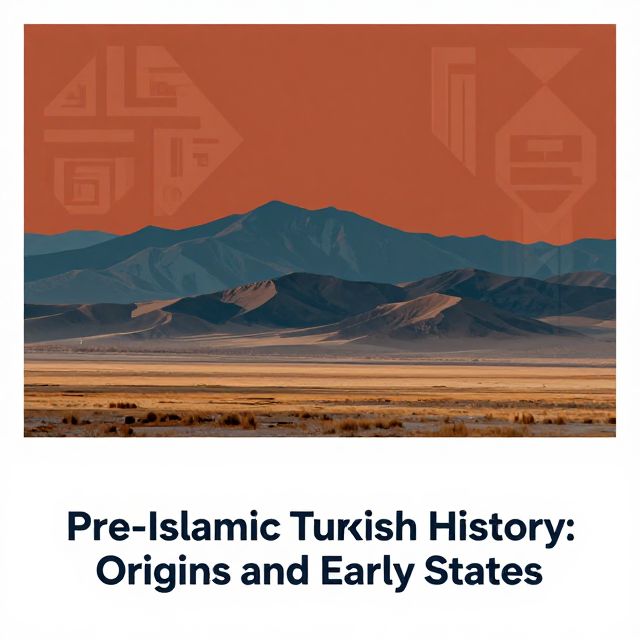
The earliest evidence of Turkic peoples points to Central Asia, a vast region characterized by its diverse geography of expansive steppes, towering mountains, and arid deserts. This unique environment played a pivotal role in shaping the distinct way of life adopted by early Turkic societies.
🏞️ Geographical Context and Environmental Influence
Central Asia's varied landscape, particularly the vast steppes, was not conducive to large-scale sedentary agriculture in many areas. This environmental reality necessitated a different economic model, leading to the widespread adoption of nomadic pastoralism.
🐎 Nomadic Pastoralist Economy and Society
The core of early Turkic life revolved around a nomadic pastoralist economy.
- Animal Husbandry: This lifestyle was centered on raising livestock, primarily horses, sheep, goats, and cattle. These animals provided sustenance (meat, milk), materials (wool, hides), and transportation.
- Seasonal Migrations: The need to find fresh pastures for their herds dictated a pattern of seasonal migrations. This constant movement fostered a highly mobile and adaptable society, capable of quickly relocating and adjusting to new environments.
- Adaptability: This inherent mobility was not just a survival strategy but also a source of strength, allowing for rapid military deployment and extensive trade networks across Eurasia.
🐴 The Pivotal Role of the Horse
The horse was more than just an animal; it was central to every aspect of early Turkic life and culture.
- Transportation: Essential for daily life and long-distance travel across the vast steppes.
- Warfare: Turkic warriors were renowned for their equestrian skills, making cavalry a formidable military force. The ability to fight from horseback provided a significant tactical advantage.
- Economic Sustenance: Horses were a source of food (meat, milk for kumis) and their hides were used for various purposes.
- Cultural Identity: The horse was deeply embedded in their cultural identity, symbolism, and spiritual beliefs.
👨👩👧👦 Social Structures and Leadership
Early Turkic societies were typically organized around tribal structures.
- Clans and Confederations: These tribes were composed of various clans, often forming larger confederations for mutual defense, economic cooperation, or military campaigns.
- Leadership: Leadership was frequently determined by an individual's martial prowess, strategic acumen, and ability to unite disparate groups. This often led to a meritocratic system where strong leaders could rise to power.
🔍 Challenges in Historical Reconstruction
Reconstructing the history of these early nomadic peoples presents significant challenges:
- Fragmented Archaeological Evidence: Their mobile lifestyle left fewer permanent settlements and artifacts compared to sedentary civilizations, making archaeological findings often scarce and dispersed.
- Linguistic Analysis: Insights are gained through the study of proto-Turkic linguistic elements, tracing the evolution of their language.
- External Accounts: Much of our understanding comes from often biased accounts written by neighboring sedentary civilizations, particularly Chinese historical records, which viewed nomadic groups through their own cultural lens.
🏛️ Major Early Turkic States and Empires
The Pre-Islamic period witnessed the emergence and decline of several powerful Turkic states that profoundly shaped the Eurasian landscape.
🏹 The Xiongnu (Hunnu) Confederation (3rd Century BCE - 1st Century CE)
One of the earliest and most influential nomadic empires, the Xiongnu confederation dominated the Mongolian Plateau.
- Sophisticated Organization: They established a highly sophisticated political and military organization, which allowed them to unite various nomadic tribes under a centralized leadership. This structure enabled them to project power effectively.
- Challenge to Han China: The Xiongnu posed a formidable and persistent challenge to the mighty Han Dynasty of China, often engaging in raids and warfare, and forcing the Han to adopt defensive strategies like building the Great Wall.
- Legacy: Their innovations in cavalry warfare set a precedent for future nomadic empires. They also developed a complex system of vassalage, where conquered or allied tribes paid tribute and provided military support in exchange for protection and recognition.
🦅 The Göktürk (Kök-Turk) Khaganate (6th Century CE)
Following the decline of the Xiongnu, various Turkic groups emerged, culminating in the establishment of the Göktürk Khaganate.
- First Explicitly Turkic Empire: The Göktürks created the first empire explicitly identified as Turkic, signifying a distinct Turkic identity and political entity. Their empire stretched from the Black Sea to Manchuria, demonstrating immense territorial control.
- Orkhon Inscriptions: These are monumental stone stelae inscribed with the earliest known examples of written Turkic language.
- Invaluable Insights: The inscriptions provide crucial primary source information about Göktürk history, culture, political ideology, and their worldview. They detail military campaigns, state administration, and the wisdom of their rulers.
- Linguistic Significance: They represent a foundational moment in Turkic literacy and language development.
- Dual Administrative System: The Göktürk Empire often operated with a dual administrative system, typically divided into Eastern and Western Khaganates. This structure allowed for effective governance over vast territories but also sometimes led to internal divisions.
- Silk Road Role: The Göktürks played a crucial role in controlling and facilitating trade along the Silk Road, benefiting economically and culturally from the exchange of goods and ideas between East and West.
🕌 The Uyghur Khaganate (8th Century CE)
After the Göktürks, the Uyghur Khaganate rose to prominence in Central Asia.
- Shift to Settled Lifestyle: While initially maintaining nomadic traditions, the Uyghurs gradually adopted a more settled lifestyle. This transition involved the establishment of cities, development of agriculture, and a move away from purely pastoral nomadism.
- Embracing New Religions: This period marked a significant cultural shift as the Uyghurs embraced various religions, including Manichaeism (which became the state religion for a time) and Buddhism.
- Cultural Transformation: The adoption of these religions brought new artistic forms, writing systems, and philosophical ideas, leading to a rich cultural synthesis. This demonstrated their openness to external influences and their capacity for cultural adaptation.
✅ Legacy of Pre-Islamic Turkish History
The Pre-Islamic period of Turkish history is a powerful testament to the resilience, adaptability, and organizational capabilities of Turkic peoples.
- Foundational Empires: From their origins as nomadic pastoralists, they forged powerful empires like the Xiongnu, Göktürks, and Uyghurs, which significantly impacted the geopolitical landscape of Eurasia.
- Sophisticated Developments: These early states developed sophisticated military strategies, complex political structures, and unique cultural expressions, including the creation of the first written Turkic language.
- Enduring Influence: The foundations laid during this era—encompassing military traditions, principles of statecraft, and cultural values—profoundly influenced subsequent Turkic civilizations and their interactions with the wider world, long before the widespread adoption of Islam.
- Vital Field of Study: This period remains a vital field of study for understanding the deep historical roots of Turkic identity and its enduring contributions to global heritage.