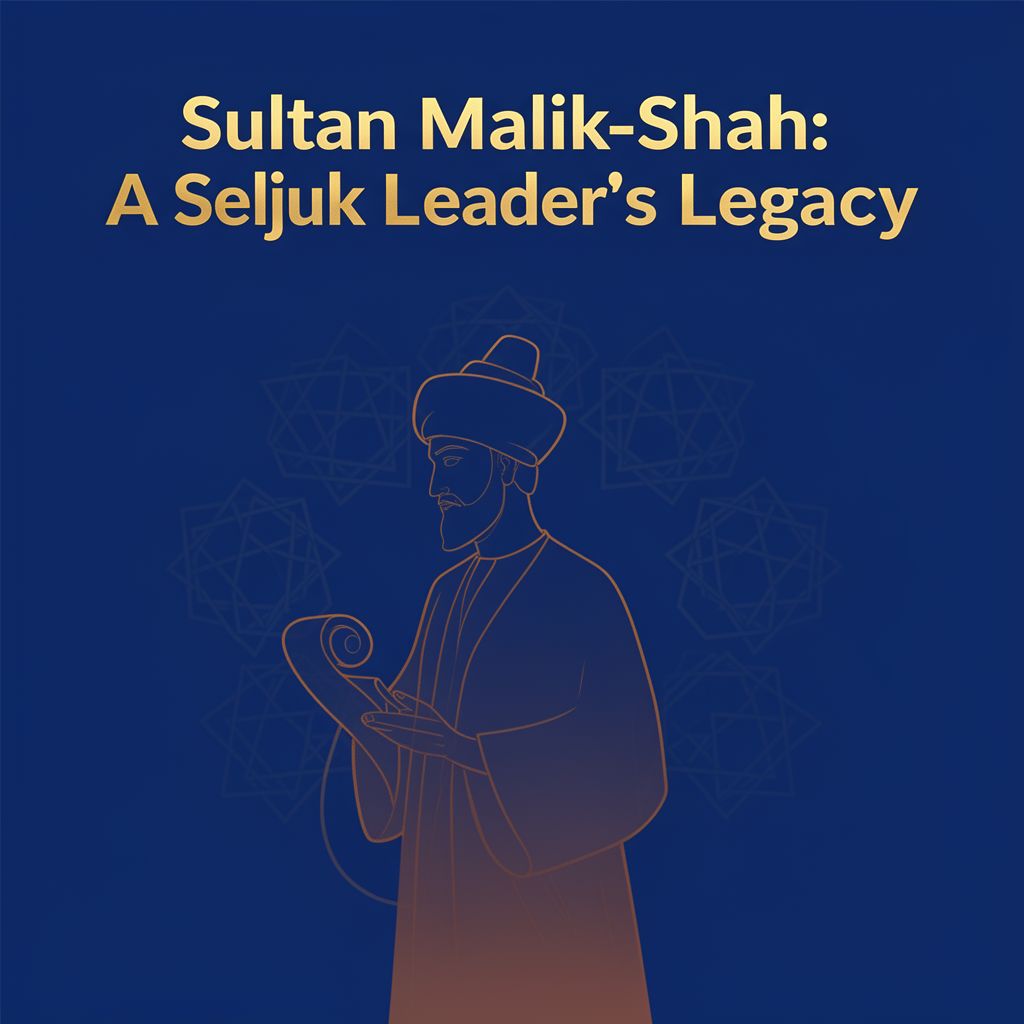
Sultan Malik-Shah: A Seljuk Leader's Legacy - kapak
Tarih#seljuk empire#sultan malik-shah#nizam al-mulk#medieval history

Sultan Malik-Shah: A Seljuk Leader's Legacy

Explore the reign of Sultan Malik-Shah, a powerful Seljuk ruler, his partnership with Nizam al-Mulk, the expansion of the Seljuk Empire, and his contributions to governance and education.

thinkFebruary 10, 2026 ~16 dk toplam
01

Sesli Özet

9 dakika

Konuyu otobüste, koşarken, yolda dinleyerek öğren.

Sesli Özet

Sultan Malik-Shah: A Seljuk Leader's Legacy

0:008:51
02

Flash Kartlar

18 kart

Karta tıklayarak çevir. ← → ile gez, ⎵ ile çevir.

1 / 18
Tüm kartları metin olarak gör
  1. 1. Who was Sultan Malik-Shah and when did he ascend to the Seljuk throne?

    Sultan Malik-Shah was a pivotal figure in Seljuk history, son of Alp Arslan. He ascended to the throne in 1072. His reign is often considered a golden age for the Seljuks, marked by significant expansion and reforms.

  2. 2. What were the primary objectives of Sultan Malik-Shah at the beginning of his reign?

    Malik-Shah's primary objectives were to forge a strong and unified state, establish and maintain order throughout his vast territories, and ensure the safety and security of his subjects. This ambition laid the groundwork for a period of unprecedented stability and prosperity under his leadership.

  3. 3. Describe the general characterization of the Seljuk era under Sultan Malik-Shah.

    Malik-Shah's era is often regarded as a golden age for the Seljuks. It was marked by significant territorial expansion, comprehensive administrative reforms, and a flourishing of culture and knowledge. His reign became synonymous with the peak of Seljuk power and influence.

  4. 4. Who was Nizam al-Mulk and what was his role during Malik-Shah's reign?

    Nizam al-Mulk was the grand vizier to Sultan Malik-Shah, often described as the 'strong brain' behind the state's operations. He was an advisor of extraordinary intellect and administrative skill. His partnership with Malik-Shah was foundational to the successes of the reign.

  5. 5. Explain the significance of the partnership between Sultan Malik-Shah and Nizam al-Mulk.

    The partnership between Malik-Shah and Nizam al-Mulk was exceptionally significant because it combined Malik-Shah's vision for a strong state with Nizam al-Mulk's practical administrative genius. This collaboration was foundational to the successes of the reign, leading to comprehensive governmental improvements and long-term stability.

  6. 6. What administrative reforms were implemented by Malik-Shah and Nizam al-Mulk?

    Together, they embarked on a comprehensive program to improve and refine the governmental structure of the Seljuk Empire. They enhanced existing administrative systems, introduced new rules and regulations for greater efficiency and fairness, and meticulously organized people and work. This involved streamlining bureaucratic processes and establishing clear hierarchies.

  7. 7. What was the ultimate aim of the administrative reforms carried out during Malik-Shah's reign?

    The aim of these reforms was to create a robust and resilient state apparatus that could manage the diverse territories and populations under Seljuk rule. This systematic approach led to a more centralized and effective administration, crucial for maintaining control over an expanding empire and consolidating power.

  8. 8. How did the Seljuk Empire's territorial extent and political influence change under Malik-Shah?

    Under Malik-Shah's leadership, the Seljuk Empire experienced remarkable growth and consolidation, reaching its zenith in terms of territorial extent and political influence. The empire expanded significantly, encompassing vast new regions and solidifying control over existing ones, becoming a formidable force.

  9. 9. What internal developments contributed to prosperity during Malik-Shah's reign?

    Internal developments included cities growing stronger as vibrant centers of commerce and culture. Trade routes became safer, encouraging merchants and stimulating economic activity, leading to bustling markets. Improved security on roads and in urban centers also facilitated safer travel, economic exchange, and cultural interaction.

  10. 10. Describe Sultan Malik-Shah's commitment to knowledge and education.

    Malik-Shah had a profound commitment to knowledge and education, understanding that a powerful empire needed an educated populace. He actively supported learning and demonstrated a deep appreciation for it. This commitment manifested in the establishment of numerous schools throughout the empire.

  11. 11. What were the Nizamiyya schools and what was their significance?

    Nizamiyya schools were educational institutions established during Malik-Shah's reign, closely associated with Nizam al-Mulk. They were groundbreaking for their time, offering a comprehensive curriculum that extended beyond religious studies to include law, science, and various other disciplines. They ensured a supply of skilled administrators and scholars.

  12. 12. Why did Malik-Shah believe that a strong empire necessitated strong education?

    Malik-Shah firmly believed that a strong empire required not only military might but also an educated populace and a flourishing intellectual environment. He recognized the critical need for trained, educated individuals and accomplished scholars to serve the state and contribute to society, viewing intellectual investment as a long-term benefit.

  13. 13. What characterized Sultan Malik-Shah's leadership style?

    Malik-Shah's leadership style was characterized by a profound understanding of sustained governance and societal well-being. He was a strong leader, but his strength was tempered by a deep-seated desire for stability, control, and the establishment of a functional, enduring system.

  14. 14. Explain Malik-Shah's philosophy regarding effective governmental systems.

    His philosophy was that when the governmental system functions effectively, the country remains calm and stable. This tranquility, in turn, allows its people to engage in productive work, leading to an overall improvement in the quality of life for everyone. He believed true power lay in maintaining internal peace and order.

  15. 15. How is Malik-Shah's reign generally remembered in Seljuk history?

    Malik-Shah's reign is widely remembered as a golden period for the Seljuk state. It was a time when the empire reached its highest point of prosperity and influence, marked by stability, growth, and significant advancements in administration and education.

  16. 16. What significant event occurred in 1092 and what were its immediate consequences for the Seljuk Empire?

    Sultan Malik-Shah died in 1092, marking a significant turning point for the Seljuk Empire. His passing ushered in a period of considerable instability, as the strong centralized authority he had built began to fracture, leading to intense power struggles and disagreements over succession.

  17. 17. What was the long-term impact of Malik-Shah's death on the Seljuk Empire?

    The long-term impact of Malik-Shah's death was a weakening of the state due to internal strife. The strong, unifying leadership was gone, leading to fragmentation and decline. This demonstrated how the demise of a powerful leader could precipitate instability and challenges for an empire.

  18. 18. Summarize Sultan Malik-Shah's enduring legacy.

    Sultan Malik-Shah's legacy endures as an exceptionally important Seljuk sultan, a powerful and effective ruler who presided over a vast and prosperous empire. His contributions to state organization, unwavering commitment to education through Nizamiyya schools, and vision for a stable society are recognized as cornerstones of his remarkable reign.

03

Detaylı Özet

2 dk okuma

Tüm konuyu derinlemesine, başlık başlık.

📚 Sultan Malik-Shah: A Golden Age of the Seljuk Empire

This study material is compiled from a lecture audio transcript and copy-pasted text, providing a concise overview of Sultan Malik-Shah's reign.


Introduction to Sultan Malik-Shah

Sultan Malik-Shah was a pivotal figure and a powerful ruler of the Seljuk Empire, whose reign is often considered a "golden age." He ascended to the throne in 1072, following his father, Alp Arslan, another formidable Seljuk sultan. Despite his youth, Malik-Shah was serious and resolute, driven by a clear vision for a strong, unified, and orderly state.

🤝 Strategic Partnership: Malik-Shah and Nizam al-Mulk

Malik-Shah's success was significantly bolstered by his collaboration with Nizam al-Mulk, an exceptionally intelligent and skilled Grand Vizier. Nizam al-Mulk is often described as the "strong brain" behind the state's operations.

  • Governmental Reforms: Together, they improved and refined the Seljuk governmental structure.
  • Administrative Efficiency: They introduced new rules, streamlined bureaucratic processes, and established clear hierarchies to ensure the empire functioned smoothly.
  • Centralized Control: Their efforts led to a more centralized and effective administration, crucial for managing vast territories.

📈 Zenith of the Seljuk Empire

Under Malik-Shah's leadership, the Seljuk Empire reached its peak in terms of territorial extent, power, and influence.

  • Expansion & Prestige: The empire expanded significantly, becoming a respected and formidable force.
  • Economic Prosperity:
    • Cities grew stronger and became vibrant centers of commerce.
    • Trade routes became safer, boosting economic activity.
    • Markets were active, reflecting a thriving economy.
    • Improved security facilitated safer travel for people and goods.

📚 Commitment to Education and Knowledge

Malik-Shah understood that a strong empire required not only military might but also an educated populace and a flourishing intellectual environment.

  • Support for Learning: He actively supported education and appreciated learning.
  • Nizamiyya Schools: Numerous schools, famously known as Nizamiyya schools (associated with Nizam al-Mulk), were established.
  • Comprehensive Curriculum: These institutions offered diverse studies, including religion, law, and science, beyond traditional religious education.
  • 💡 Visionary Insight: Malik-Shah believed a strong empire needed strong education, trained individuals, and accomplished scholars to serve the state.

💡 Leadership Philosophy and Legacy

Malik-Shah's leadership focused on stability, control, and a functional system. He believed that an effective government leads to a calm country, allowing people to work and improve their lives.

  • Strong but Stable: He was a strong leader who prioritized internal peace and order.
  • Golden Period: His reign is remembered as a golden period for the Seljuk state, reaching its highest point of prosperity.

⚠️ Death and Aftermath

Malik-Shah's death in 1092 marked a significant turning point for the Seljuk Empire.

  • Instability: His passing led to a period of considerable instability.
  • Power Struggles: The centralized authority fractured, resulting in intense power struggles and disagreements over succession.
  • Weakening Empire: This internal strife inevitably weakened the state, demonstrating how the loss of a strong leader can lead to fragmentation.

Despite the challenges that followed, Sultan Malik-Shah is remembered as an exceptionally important Seljuk sultan, a powerful ruler known for his contributions to state organization, education, and his vision for a stable and thriving society.
Kendi çalışma materyalini oluştur

PDF, YouTube videosu veya herhangi bir konuyu dakikalar içinde podcast, özet, flash kart ve quiz'e dönüştür. 1.000.000+ kullanıcı tercih ediyor.

Sıradaki Konular

Tümünü keşfet
Turkish-Islamic Political History: Foundations

Turkish-Islamic Political History: Foundations

An academic overview of Turkish-Islamic political history, covering early interactions, the emergence of key states like the Karahanids and Ghaznavids, and the transformative Seljuk era.

7 dk Özet 25 15
Ottoman Empire: Culture and Civilization

Ottoman Empire: Culture and Civilization

An academic overview of the Ottoman Empire's culture and civilization, covering its administrative structure, social organization, legal system, educational institutions, scientific advancements, and artistic expressions.

6 dk 25 15
Pre-Islamic Turkish Political History: Early States

Pre-Islamic Turkish Political History: Early States

An academic overview of the political history of early Turkic states before the advent of Islam, focusing on the Xiongnu, Göktürk, and Uyghur Khaganates.

7 dk Özet 25 15 Görsel
Pre-Islamic Turkish Political History

Pre-Islamic Turkish Political History

An academic overview of the political history of Turkic states before the advent of Islam, exploring their foundational characteristics, key empires, and enduring legacies.

4 dk Özet 25 15 Görsel
The Battle of Talas and Turks' Acceptance of Islam

The Battle of Talas and Turks' Acceptance of Islam

Explore the pivotal Battle of Talas in 751 AD, its impact on the Abbasid Caliphate and Tang Dynasty, and how it catalyzed the widespread acceptance of Islam among Turkic peoples, shaping history.

Özet 15
The Talas War and Turkic Acceptance of Islam

The Talas War and Turkic Acceptance of Islam

An academic summary exploring the pivotal Talas War of 751 AD and its profound impact on the widespread adoption of Islam by Turkic peoples in Central Asia, shaping subsequent historical developments.

6 dk Özet 25 15
Ottoman Empire in the Early 20th Century II

Ottoman Empire in the Early 20th Century II

An academic summary of the Ottoman Empire's critical period in the early 20th century, focusing on internal political shifts, major wars, and territorial losses leading up to World War I.

5 dk Özet 25 15
The Ottoman Empire's 18th-Century Decline

The Ottoman Empire's 18th-Century Decline

An academic overview of the Ottoman Empire's period of decline during the 18th century, examining its political, military, and economic challenges and the factors contributing to its weakening.

6 dk Özet 25 15