Podit
Podit
📚 20th-Century British Poetry: A Study Guide
Source Information: This study material is compiled from a lecture audio transcript and copy-pasted text provided by the user.
🎯 Introduction to 20th-Century British Poetry
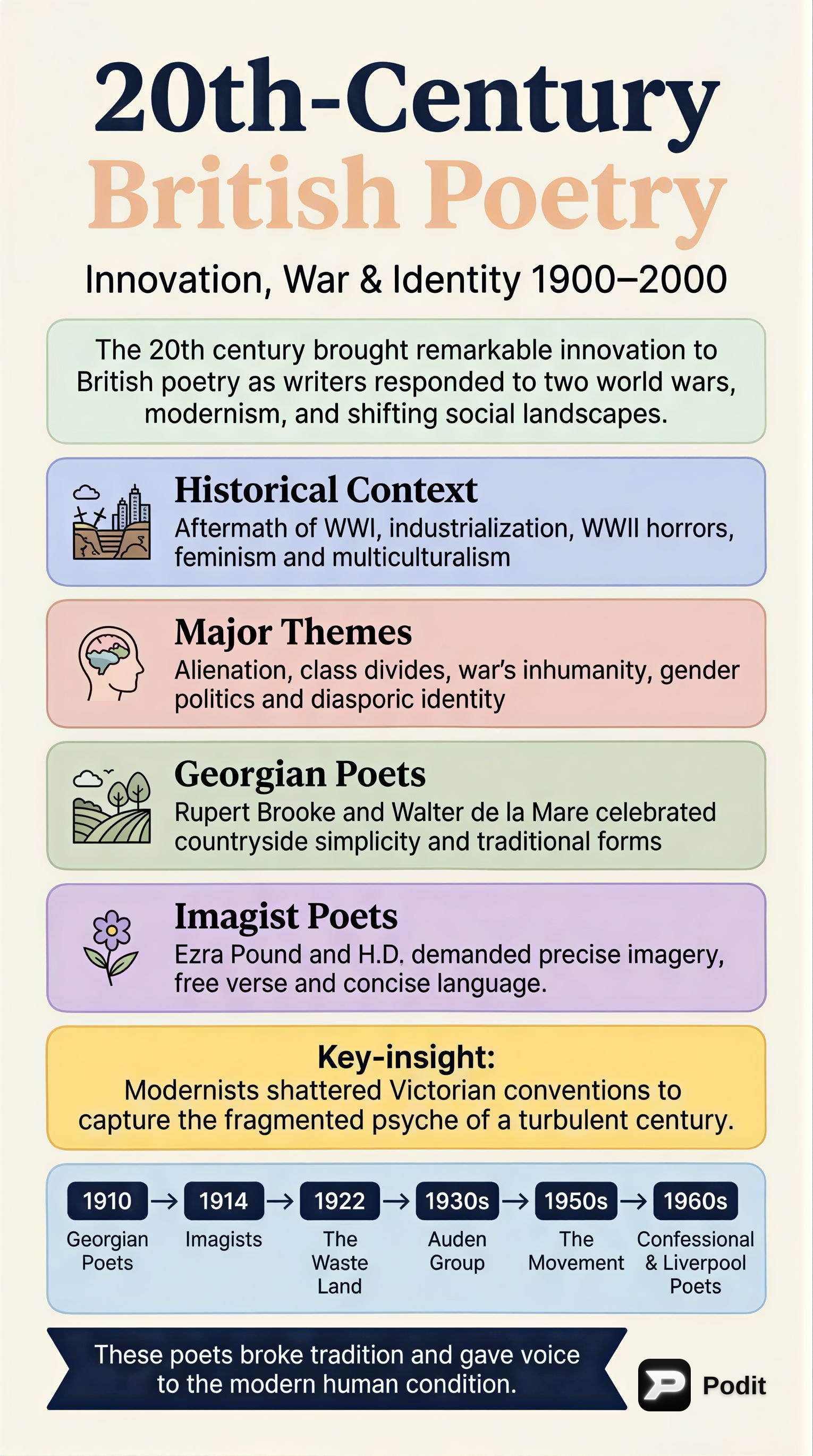
The 20th century marked a period of profound innovation and transformation in British poetry. Poets grappled with the immense upheavals of two world wars, the rise of modernism, and the rapidly changing social and cultural landscape. This era was characterized by immense experimentation, innovation, and upheaval, reflecting the turbulent times in which poets lived, with various cross-currents and movements challenging and reinventing traditional verse.
🌍 Historical Context & Influences
The poetry of the 20th century was deeply shaped by significant global and societal shifts:
- Post-WWI Disillusionment: The aftermath of World War I brought widespread disillusionment and a questioning of traditional values.
- Industrialization & Urbanization: The rise of industrial societies and growing urban centers transformed daily life and social structures.
- WWII Impact: The horrors of World War II and its global scale further intensified feelings of anxiety and existential questioning.
- Emergence of New Movements: 📈 New political and social movements, including feminism and civil rights, gained prominence, influencing thematic concerns.
- Multiculturalism & Identity: The impact of immigration, multiculturalism, and the exploration of diasporic and racial identity became increasingly significant.
📝 Major Themes in 20th-Century British Poetry
Poets explored a diverse range of themes, reflecting the complexities of their age:
- Alienation & Disillusionment: The search for meaning in a fast-changing, industrialized world.
- Human Psyche: 🧠 The complexities of the human mind and inner life (e.g., psychological poetry).
- Social Injustice: Class divides and the plight of the working class.
- War & Violence: The brutal realities of conflict and man's inhumanity.
- Feminism & Gender Politics: Exploration of gender roles, sexuality, and women's experiences.
- Cultural Identity: The influence of other cultures and the exploration of diasporic/racial identity.
📜 Key Literary Movements & Poets
The 20th century saw a succession of influential poetic movements, each reacting to or building upon its predecessors.
1. The Georgian Poets (Early 20th Century)
- Named After: King George V (reigned 1910-1936).
- Prominent Poets: Rupert Brooke, Walter de la Mare.
- Characteristics:
- ✅ Reaction against Victorian romanticism and highly metaphorical poetry.
- ✅ Favored simplicity, directness, and accessibility in style and language.
- ✅ Focus on the beauty of the natural world and rural life.
- ✅ Used traditional verse forms (sonnets, quatrains, ballads).
- ✅ Avoided experimentation with new poetic techniques.
- Themes: Celebration of the English countryside, simple pleasures, nostalgia for a pre-industrial age, the temporary nature of human life contrasted with nature's permanence.
- Example: Rupert Brooke's "The Old Vicarage, Grantchester" evokes idyllic English rural scenes.
- Impact: Provided comfort during WWI by revisiting rural England, though criticized for being overly nostalgic and lacking engagement with modern realities.
2. Imagist Poets (c. 1912-1917)
- Founders: T.E. Hulme, Ezra Pound, H.D. (Hilda Doolittle).
- Principles:
- 1️⃣ Use clear, precise imagery over vague generalizations.
- 2️⃣ Employ free verse and avoid excessive rhyme.
- 3️⃣ Present concrete subjects instead of abstract concepts.
- 4️⃣ Produce concise, compressed poetry devoid of superfluous words.
- 5️⃣ Maintain an impersonal and objective poetic voice.
- Style Characteristics: Short, unrhymed free verse lines; focus on single, bold images; description of ordinary objects from unique perspectives; incorporation of everyday language; juxtaposition of contrasting images.
- Example: Ezra Pound's "In a Station of the Metro" – "The apparition of these faces in the crowd: / Petals on a black bough."
- Impact: Reacted against Victorian Romanticism and Georgian poets by stripping language to its essentials, heavily influencing Modernist poetry.
3. Modernist Poetry (Early 20th Century)
Modernism was a broad movement characterized by a radical break from traditional forms and a desire to reflect the fragmented reality of the modern world.
- Key Characteristics:
- ✅ Break from Traditional Formats: Rejection of strict rhyme schemes, meters, and structured verse; use of free verse.
- ✅ Fragmentation & Discontinuity: Lack of coherent narrative; juxtaposition of contrasting images to depict fragmented modern experience.
- ✅ Mythic Parallels & Symbolism: References to myths, legends, and archetypal symbols; complex symbolism.
- ✅ Allusions & Intertextuality: Incorporation of allusions to other literary works, historical figures, and layering of multiple texts.
- ✅ Alienation & Existentialism: Themes of disillusionment, loss of identity, anguish, and meaninglessness.
- ✅ Objective Correlative: 💡 Representing abstractions through concrete objects/imagery, expressing emotions indirectly.
- Example: T.S. Eliot's "Let us go then, you and I, / When the evening is spread out against the sky / Like a patient etherized upon a table;" uses the image of an "etherized patient" to convey numbness.
- ✅ Dramatic Monologues & Multiple Voices: Use of personas and shifting perspectives.
- ✅ New Techniques: Innovations in diction, syntax, typography, and form.
Major Modernist Poets:
- T.S. Eliot (1888-1965):
- Considered one of the most influential modernist poets.
- "The Waste Land" (1922): A landmark masterpiece employing fragmentation, allusions, and shifting voices to depict the spiritual and moral decadence of post-WWI Western civilization.
- "The Love Song of J. Alfred Prufrock" (1915): A dramatic monologue expressing alienation and existential angst, pioneering casual speech rhythms.
- W.B. Yeats (1865-1939):
- A key figure in the Irish Literary Revival, his later poetry embraced modernist styles.
- "The Second Coming" (1919): Uses apocalyptic imagery and symbolic metaphors (like the "rough beast") reflecting post-WWI anxiety.
- Explored Irish folklore, myth, and transcendent themes (e.g., "Among School Children," "Sailing to Byzantium").
- Impact: Both Eliot and Yeats revolutionized English poetry, shaping the Modernist movement by breaking from tradition and tackling universal human truths through fresh, psychologically acute perspectives. Eliot depicted the fragmented, alienated self, while Yeats sought meaning in ancient Irish roots and mysticism.
4. War Poets of World War I
These poets profoundly shaped how poetry depicted the realities of modern warfare.
- Wilfred Owen (1893-1918):
- Wrote influential poems like "Dulce et Decorum Est" and "Anthem for Doomed Youth."
- Used graphic imagery to strip away romantic notions of war's glory, portraying the trauma of trench warfare.
- Siegfried Sassoon (1886-1967):
- Initially patriotic, his later poems like "Counter-Attack" exposed the brutal disillusionment of the trenches.
- Wrote satirical works condemning politicians and warmongering.
- Impact: Shattered ideals about the nobility of war, debunked patriotic propaganda with gruesome first-hand experiences, and demonstrated poetry's power as a venue for protest and social commentary.
5. The Bloomsbury Group (Early 20th Century)
- An influential group of writers, intellectuals, and artists (Virginia Woolf, E.M. Forster) who promoted modernist experimentation in novels and criticism, influencing contemporary poets.
6. The Poets of the 1930s
- Prominent Poets: W.H. Auden, Stephen Spender, Cecil Day-Lewis, Louis MacNeice.
- Characteristics: Embraced social and political themes, often with left-wing views, reacting against the detachment of modernist poets to write more accessible, engaged poetry on current events.
7. The Movement (1950s)
- Prominent Poets: Philip Larkin, Kingsley Amis.
- Characteristics:
- ✅ Clarity & Simplicity: Emphasized clear, straightforward language over complexity and obscurity.
- ✅ Traditional Forms: Favored traditional structures like regular stanzas and rhyme schemes.
- ✅ Everyday & Ordinary: Focused on mundane experiences and ordinary subjects, often with irony or skepticism.
- ✅ Skepticism & Irony: Maintained a skeptical, ironic, and anti-Romantic tone, critical of grand, sentimental language.
- Impact: Reacted against modernism, favoring more restrained, traditional forms.
8. The Poets of the 1950s & Confessional Poetry
- Ted Hughes (1930-1998) & Sylvia Plath (1932-1963): Considered pioneers of confessional poetry.
- Confessional Poetry: Uses very personal subject matter and intimate disclosures about inner lives and relationships.
- Sylvia Plath: Poems like "Daddy" and "Lady Lazarus" shattered taboos with unsparing explorations of depression, anger, and marital tensions, using visceral imagery and searing emotion.
- Ted Hughes: Animal poems like "The Thought-Fox" and "View of a Pig" used nature metaphors to explore themes of violence, sexuality, and regeneration. His "Crow" sequence experimented with myth and archetypal symbolism.
9. The Liverpool Poets (1960s)
- Prominent Poets: Roger McGough, Brian Patten, Adrian Henri.
- Characteristics: Drew inspiration from the energy and wit of 1960s Merseyside culture, using vivid everyday imagery and simple diction to capture working-class experiences, pop culture, and anti-establishment attitudes.
- Impact: Live poetry readings brought their irreverent, accessible poems to wider audiences, legitimizing performance as a poetic medium.
10. The Poets of the 1960s
- Seamus Heaney (1939-2013): Began publishing influential volumes like "Death of a Naturalist," drawing on his rural Irish upbringing and Catholic heritage, revitalizing nature poetry with rich metaphors.
- Ted Hughes: Explored more personal themes like family life and his relationship with Sylvia Plath in "Birthday Letters."
- Philip Larkin (1922-1985): Continued producing his trademark poems meditating on mortality, loneliness, and emotional detachment.
11. The Poets of the 1970s and Beyond
The 1970s brought new diversity and social commentary to British poetry.
- Carol Ann Duffy (b. 1955):
- One of the most renowned contemporary poets, the first woman Poet Laureate (2009).
- Early poems (e.g., "Selling Manhattan") gave voice to women's experiences and feminism.
- "The World's Wife" offered modern feminist revisionings of myths and history.
- Tony Harrison (b. 1937):
- Working-class roots fueled his socially critical poetry, often expressing anger at elite culture.
- "V" used contrasting diction to highlight class divides, exploring themes of racism, oppression, and his outsider status.
- Benjamin Zephaniah (1958-2023):
- Pioneered dub poetry, bringing Jamaican/Caribbean performance styles to Britain.
- Poetry collections (e.g., "Pen Rover") legitimized Black British vernacular speech.
- Dealt frankly with racism, injustice, and street life in an uncompromising voice, influencing the legitimization of spoken word/performance poetry.
✅ Conclusion
The 20th century was a dynamic and transformative period for British poetry. From the traditional forms of the Georgians to the radical experimentation of the Modernists, and from the raw honesty of the War Poets to the diverse voices of later decades, poets continually adapted their craft to reflect and critique the turbulent world around them. This era laid the groundwork for contemporary poetry, expanding its thematic and stylistic boundaries significantly.