 Podit
Podit
📚 Modernism and Postmodernism: A Comprehensive Study Guide
Source Information: This study material has been compiled and organized from a lecture audio transcript and copy-pasted text provided by the user.
1. Introduction: The Literary Shift of the 20th Century 🌍
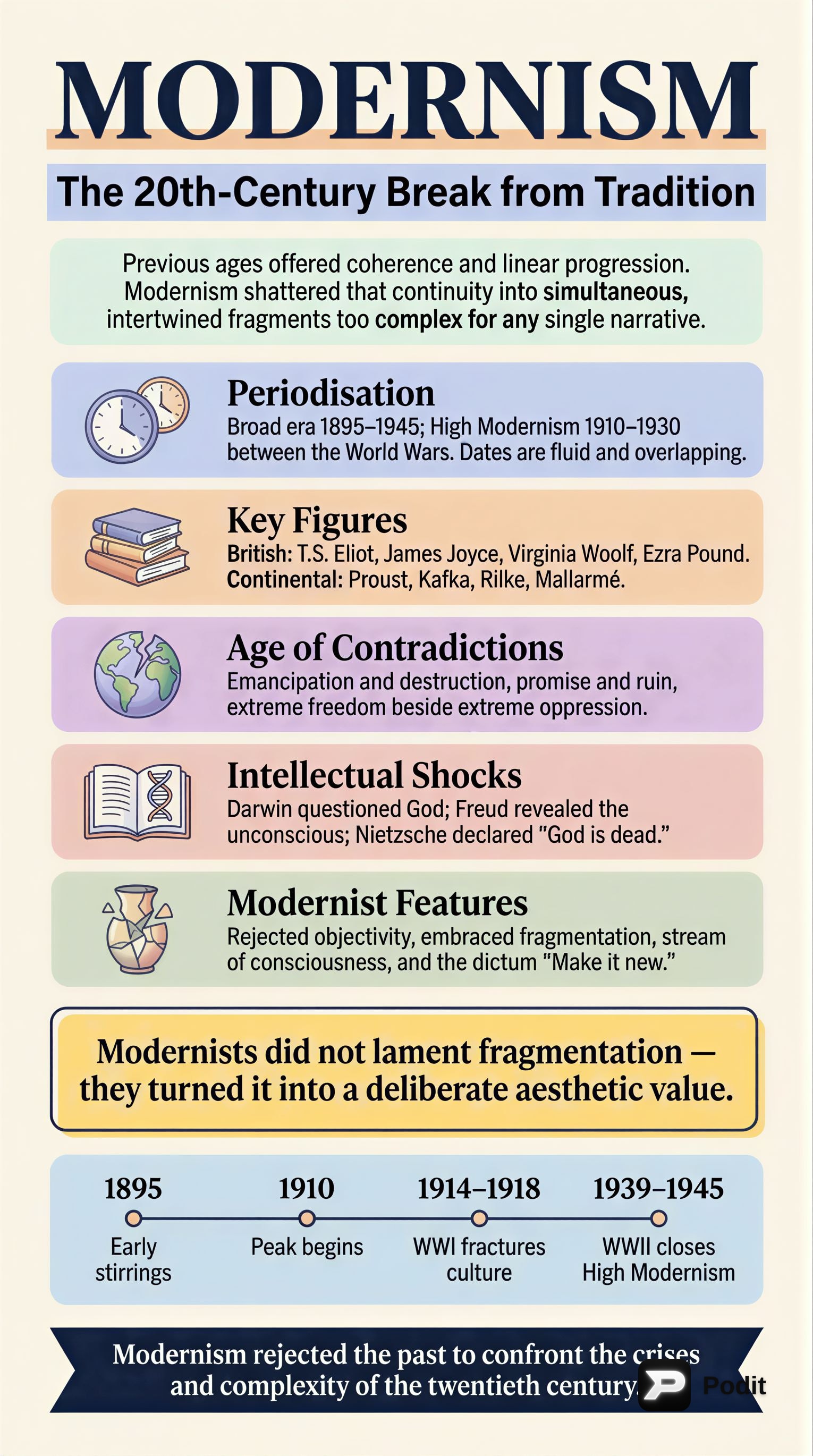
The early 20th century marked a profound transformation in literary history, moving away from the coherence and linear progression characteristic of previous eras. This period, known as Modernism, became increasingly complex and difficult to define, encompassing a vast array of simultaneous influences and artistic expressions. It was an age where traditional continuity broke down, paving the way for new forms of thought and creation.
2. Modernism: Context and Characteristics 🕰️
2.1. Periodisation of Modernism
- Broad Period: Generally accepted as 1895 – 1945.
- High Modernism: Peaked between the two World Wars (1910 – 1930).
- Note: These dates are flexible and involve overlaps, requiring a fluid understanding of the timeline.
2.2. Key Figures of Modernism
- British/Anglophone: T.S. Eliot, James Joyce, Ezra Pound, Virginia Woolf, Wallace Stevens, Gertrude Stein.
- Continental: Marcel Proust, Stéphane Mallarmé, Franz Kafka, Rainer Maria Rilke.
2.3. General Background of the Early 20th Century
This era was an "Age of Contradictions," marked by simultaneous emancipation and destruction.
- Science & Technology: Rapid advancements (DNA, radio waves, Theory of Relativity) intensified, making science a "master discipline" redefining human existence.
- Urbanisation: Large-scale migration to city centers, shifting from agrarian to technology-based economies.
- Economic Downturn: The 1930s saw a worldwide economic depression.
- Trauma of War: Constant conflicts, especially the World Wars, revealed humanity's capacity for destruction and the inherent fragility of existence. Wars no longer brought national accomplishment but an "inherent sense of loss."
- Cultural Shifts:
- Literature of Escape: Artists explored the mind rather than a real world too difficult to comprehend.
- Entertainment Industry: Flourished with radio and cinema.
- Publishing Boom: Low-price editions and paperbacks made books widely available, and libraries became points of national pride.
- Ideological Conflicts: The world divided between Capitalism and Communism, leading to the Cold War and movements towards decolonisation in Africa and Asia.
2.4. Intellectual Foundations of Modernism 💡
Key thinkers profoundly challenged existing worldviews:
- Charles Darwin: On the Origin of Species questioned the existence of God, making Modernism a post-Darwinian phenomenon.
- Sigmund Freud: Psychological works suggested culture is driven by the unconscious, making humans seem passive observers.
- Sir James Frazer: The Golden Bough influenced the understanding of culture and mankind.
- Friedrich Nietzsche: Declared "God is dead," fostering growing interest in atheism. These intellectual challenges, combined with the World Wars, created an exceptionally difficult context.
2.5. Defining Modernism 📚
- Etymology: From Latin modo, meaning "current."
- Modernity vs. Modernism:
- Modernity: A long-standing, abstract period (late 18th/early 19th century) characterized by secularism, mechanization, industrial capitalism, and discourses of emancipation.
- Modernism: A specific historical period/state of mind at the beginning of the 20th century.
- Two Understandings:
- Historical Period: A radical re-examination of Western culture, where "Things fall apart; the centre cannot hold" (W.B. Yeats).
- State of Mind: A radical rejection of tradition, a "craving for the new," and a deliberate decision to "make it new." It marked a break in continuity, leading to fragmentation across ideological, cultural, moral, and philosophical traditions.
- Resulting Movements: Aestheticism, Cubism, Imagism, Symbolism, Dadaism, Surrealism, Vorticism, Impressionism, Expressionism.
2.6. Critical Definitions of Modernism
- Malcolm Bradbury: Described it as a "cluster of international movements" marked by discontinuation with the past, awareness of the "corroding effects of the modern metropolis," and the "failure of Western civilisation."
- Peter Barry: Famously used the "Earthquake Analogy," stating Modernism was an "earthquake in the arts" (epicentre: Vienna, 1890-1910) that brought down pre-20th-century structures across all art forms.
3. The Modernist Aesthetic: Embracing Fragmentation ✅
Modernist writers and artists embraced fragmentation as an aesthetic value, creating works that defied convention.
- Visual Art Examples:
- Pablo Picasso's Cubism: Deliberate move away from realistic depictions, experimenting with abstract forms.
- Marcel Duchamp's Fountain (1917): A urinal presented as art, dramatically rejecting convention and challenging the very notion of art.
- Core Features in Literature:
- Rejection of Objectivity: Moved away from omniscient narration, fixed viewpoints, and clear moral positions.
- Blurring of Genres: Novels became lyrical, poems became prose-like.
- Fragmentation & Discontinuous Narrative: Often appeared as a "random-seeming collage," but with an inherent coherence (e.g., T.S. Eliot's "objective correlative").
- Reflexivity: Literature became self-conscious, questioning its own nature and role.
- Asceticism & Minimalism: Rejected elaborate 19th-century art forms (e.g., "less is more" in architecture).
- Avant-Garde: Challenged the status quo and middle-class values.
- High/Low Art Distinction: Cemented a divide, especially during High Modernism.
- Author's Attitude: Works were often difficult and inaccessible, showing indifference to the reader ("make it new, make it different, and make it difficult"), leading to a boom in critical commentary.
4. Modernist Literary Forms 📝
4.1. Fiction
- Dominant Genre: Surpassed poetry and drama.
- Experimentation: Vivid experimentation with form and language, influenced by Freudian psychology.
- Political Consciousness: Responded to the decline of the British Empire and nationalist forces.
- New Interests: Science fiction and fantasy flourished, complemented by cinema.
- Narrative Techniques: Extensive use of stream of consciousness and fragmentary forms.
- Representative Novelists:
- James Joyce: Revolutionized narrative (e.g., Ulysses, Finnegans Wake), using stream of consciousness to narrate mundane events.
- Virginia Woolf: Perfected stream of consciousness and fragmented narratives (e.g., Mrs Dalloway, To the Lighthouse), also a noted feminist.
- George Orwell: Political allegories and indictments of social order (e.g., Nineteen Eighty-Four, Animal Farm).
- D.H. Lawrence: Explored psychological tendencies and sexuality, influenced by Freud (e.g., Sons and Lovers, Lady Chatterley’s Lover).
- J.R.R. Tolkien: Influenced fantasy writing, reviving Old English texts (e.g., The Lord of the Rings).
- Popular Fiction: Agatha Christie became one of the most translated authors globally.
4.2. Drama
- Irish Influence: Irish playwrights like Bernard Shaw (e.g., Pygmalion) significantly contributed to British drama, offering outsider perspectives.
4.3. Nonfiction and Literary Criticism
- Emergence of Criticism: Became a distinctive, respectable genre. Eliot and Pound produced manifestoes.
- Polemical Writings: On race, class, empire, and gender flourished.
- Key Critics:
- I.A. Richards: Principles of Literary Criticism (foundational text).
- T.S. Eliot: Articulated historical consciousness in Tradition and Individual Talent, popularized the "objective correlative."
- F.R. Leavis: Laid the foundation of modernist literary criticism.
- New Criticism: Treated texts as self-contained units (Cleanth Brooks, William Wimsatt).
- Virginia Woolf: Questioned the literary canon from a feminist perspective.
5. Post-1945 and the Postmodern Age 📈
The period after 1945 is often termed "Postmodern," signifying "after" and reflecting an age that, like Modernism, defied easy definition.
5.1. Historical Context and Conditions
- End of WWII: Did not bring stability but further fragmentation, leading to a sense of absurdity and existential futility (e.g., the Atomic Age).
- Geopolitical Shifts: End of British influence, rise of the USA, and the Cold War (communist vs. capitalist blocs).
- Socio-Cultural Changes in England: Decades of austerity (1950s), youth celebration (1960s), anxiety (1970s), materialism (1980s), recession (1990s).
- Increasing Polarities: Divisions within England (North vs. South, rich vs. poor).
- Growth of Other Media: Literature became one among many forms of artistic expression.
5.2. Defining the Postmodern Age
- Core Meaning: Celebrates diversity, eclecticism, and parody across all art forms.
- Shift in Literature: From a singular "English literature" to "literatures in English," reflecting a transnational phenomenon influenced by decolonisation and Commonwealth nations.
- Key Literary Features:
- No More Heroes: Breakdown of the single hero concept.
- Individual Responsibility: Emphasis on individual destiny.
- Identity as Central Theme: Contested and takes multiple forms (sexual, local, national, racial, spiritual, intellectual).
5.3. Differences from the Modern Age: Author and Reader ⚠️
- Modernism: Author is the supreme creator, master of the text and its interpretation.
- Postmodernism: Text is highly unstable, yielding to plural interpretations. Power shifts from author to reader, who becomes another creator. "The author is already dead" (Roland Barthes) – the text transforms with each reader's engagement. Postmodern writers celebrate this multiplicity of access.
5.4. Shifting Worldviews
- Premodern: Theocentric, dictated by Church/monarchy.
- Modern: Focus on individual growth, "upwards and onwards."
- Postmodern: Chaotic, celebrates anarchy and freedom, no single center or truth. This fostered secular practices and foregrounded marginalized voices (Black writers, women writers, Dalit writings) by moving away from hierarchy.
5.5. Modernism vs. Postmodernism: Key Distinctions
| Feature | Modernism | Postmodernism | | :------------------ | :------------------------------------------ | :-------------------------------------------------- | | Form | Rigid, despite chaos | Anti-form, open, playful | | Purpose | Purpose for every element | Celebrates chance | | Hierarchy | Strict sense of hierarchy | Celebrates anarchy, dispersal | | Focus | Finished art product, presence | Process/performance, absence (forgotten voices) | | Boundaries | Genres, disciplinary boundaries | Text/intertext, interdisciplinary | | Understanding | Depth/root of things | Rhizomatic understanding |
6. Conclusion: A Journey Through Literary Evolution 📚
This journey through Modernism and Postmodernism highlights how literature reflects and shapes socio-political and historical trends. From the breakdown of continuity in Modernism to the celebration of fragmentation and the radical redefinition of the author-reader relationship in Postmodernism, these periods offer a foundational understanding for critically engaging with texts and culture. The shift from a singular "English literature" to diverse "literatures in English" underscores the ongoing evolution of literary expression.