 Podit
Podit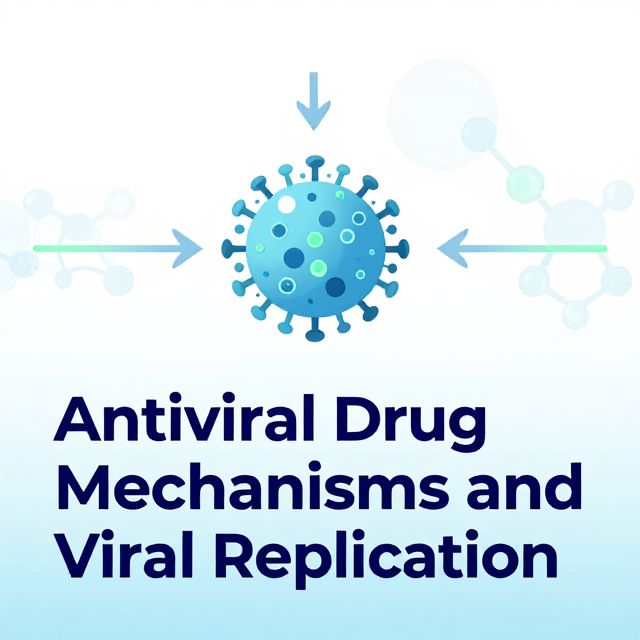
Antiviral Drug Mechanisms and Viral Replication: A Study Guide
Source Information: This study material has been compiled from a lecture audio transcript and copy-pasted text provided by the user.
📚 Introduction and Learning Objectives
This guide explores the fascinating world of antiviral drugs, focusing on how they combat viral infections by targeting specific stages of the viral replication cycle. Understanding these mechanisms is crucial for appreciating the therapeutic effects and challenges associated with antiviral treatments.
Upon completing this study material, you should be able to: ✅ Briefly describe the process of viral replication. ✅ Identify the mechanisms of action of various antiviral agents. ✅ Select an example drug for each identified viral target.
Note: This material will not cover prevention strategies like vaccination in detail, nor will it extensively discuss host immune responses or general anti-inflammatory treatments.
🦠 Overview of Viruses
Viruses are diverse infectious agents, primarily categorized by their genetic material:
- RNA Viruses: Influenza A, B, C; Measles; Mumps; RSV; Rabies; Polio; Rhinovirus; Rubella; Hepatitis; Coronavirus. HIV is also an RNA retrovirus.
- DNA Viruses: Adenovirus; HSV (Herpes Simplex Virus); Varicella; CMV (Cytomegalovirus); Papilloma virus; Smallpox.
For many of these, vaccination is a primary preventive measure, while for others, specific drug treatments are available, or both.
🧬 Viral Replication Cycle: Key Antiviral Targets
Antiviral therapy fundamentally aims to disrupt the viral replication cycle at various critical stages. These stages serve as prime targets for drug development:
- Fusion/Entry: The virus binds to and enters the host cell.
- Nucleic Acid Replication: The viral genetic material (DNA or RNA) is copied.
- Protein Processing/Function: Viral proteins are synthesized and processed.
- Release: New viral particles exit the host cell to infect others.
1️⃣ Targeting Viral Entry: Fusion Inhibitors
Process: Many viruses, notably HIV, rely on specific envelope proteins to bind to and fuse with target host cells, initiating infection. For HIV, the gp41 protein is essential for this membrane fusion.
Mechanism of Action: Fusion inhibitors block this initial entry step.
- Example Drug: Enfuvirtide (for HIV)
- Mechanism: This 36-amino acid peptide binds to the HIV gp41 protein, preventing the conformational change necessary for the viral and host cell membranes to fuse. This effectively stops the virus from entering the cell.
- Side Effects: ⚠️ Injection-site reactions, hypersensitivity, pancreatitis, gastro-oesophageal reflux, neuropathy, diabetes mellitus.
- Clinical Use: Typically reserved for cases of resistance or intolerance to other HIV treatments.
2️⃣ Targeting Nucleic Acid Replication
This stage is a major focus for antiviral drugs because many viruses use unique enzymes for nucleic acid synthesis that are absent in human cells, offering high specificity.
2.1. Reverse Transcriptase Inhibitors (for HIV / Hepatitis B)
Process: HIV (a retrovirus) and Hepatitis B virus use reverse transcriptase to convert their RNA (or RNA template for HBV) into DNA, which can then integrate into the host genome. This enzyme is not found in humans.
-
Nucleoside Reverse Transcriptase Inhibitors (NRTIs):
- Mechanism: NRTIs are nucleoside analogues that act as defective substrates. They have a high affinity for viral reverse transcriptase, competing with natural nucleosides and leading to chain termination during viral DNA synthesis.
- Example Drugs:
- Tenofovir: An adenosine analogue, used for HIV and Hepatitis B.
- Emtricitabine: A cytosine analogue, used for HIV (often in PrEP - Pre-exposure prophylaxis).
- Side Effects: ⚠️ Sickness, diarrhea, headache, rash. Tenofovir: abdominal distention, rare proximal renal tubulopathy. Emtricitabine: abnormal dreams, dyspepsia, hyperglycemia, hypersensitivity.
-
Non-Nucleoside Reverse Transcriptase Inhibitors (NNRTIs):
- Mechanism: NNRTIs inhibit reverse transcriptase by binding to a non-catalytic site on the enzyme, altering its structure and function.
- Example Drug: Efavirenz (for HIV)
- Side Effects: ⚠️ CNS effects (impaired concentration, vivid dreams, insomnia, suicidal thoughts), nausea, vomiting, dyslipidemia. Caution in patients with psychiatric disorders or risk of QT interval prolongation.
2.2. Integrase Inhibitors (for HIV)
Process: After reverse transcription, the newly synthesized viral DNA must be integrated into the host cell's genome by the viral integrase enzyme. This step is crucial for establishing a persistent infection.
- Example Drug: Raltegravir (for HIV)
- Mechanism: Inhibits the active site of HIV-1 integrase protein, preventing the integration of the viral genome into the human genome.
- Side Effects: ⚠️ Gastrointestinal disorders, headache, movement disorders. Caution in individuals with psychiatric illness.
2.3. RNA-dependent RNA Polymerase Inhibitors (for Hepatitis C)
Process: Hepatitis C virus uses a viral RNA-dependent RNA polymerase to replicate its RNA genome.
- Example Drug: Sofosbuvir (for Hepatitis C)
- Mechanism: A uridine nucleoside analogue that acts as a defective substrate for the viral RNA-dependent RNA polymerase, leading to chain termination during RNA synthesis. Often used in combination with Ribavirin.
- Side Effects: ⚠️ Alopecia, anemia, anxiety, arthralgia, Stevens-Johnson Syndrome, Hepatitis B reactivation.
2.4. DNA Polymerase Inhibitors (for Herpes Viruses)
Process: Herpes viruses replicate their DNA genome using a viral DNA polymerase.
- Example Drug: Aciclovir (for Herpes)
- Mechanism: A guanosine nucleoside analogue. It inhibits viral DNA polymerase with approximately 100 times greater affinity for the viral enzyme than for human DNA polymerase, leading to chain termination. It requires activation by viral thymidine kinase, increasing its specificity for infected cells.
- Side Effects: ⚠️ Nausea, vomiting, headache.
3️⃣ Targeting Viral Protein Processing and Function
Viruses rely on specific proteins for assembly and function. Targeting these proteins can disrupt the formation of new infectious particles.
3.1. Protease Inhibitors (for HIV)
Process: Viral proteases are enzymes that cleave newly synthesized viral proteins into their functional components, which are essential for the formation and assembly of the viral coat.
- Example Drug: Atazanavir (for HIV)
- Mechanism: Binds to the active site of HIV protease, preventing the cleavage of viral proteins. This results in the production of immature, non-infectious viral particles.
- Side Effects: ⚠️ Kidney stones, hyperlipidemia. Requires precise dosing and dietary considerations.
3.2. NS5A Inhibitors (for Hepatitis C)
Process: The NS5A protein plays a crucial role in both viral RNA replication and the packaging of new Hepatitis C virions.
- Example Drug: Ledipasvir (for Hepatitis C)
- Mechanism: Interferes with the formation of the viral replication complex by inhibiting NS5A. This slows or blocks viral repackaging, preventing the production of new infectious particles. Often used in combination with Sofosbuvir.
- Side Effects: ⚠️ Fatigue, headache (common); angioedema, arrhythmia (less common). Contraindicated with certain PPIs and H2 antihistamines.
4️⃣ Targeting Viral Release
Process: After replication and assembly, new viral particles must be released from the host cell to infect other cells. For influenza, the neuraminidase enzyme cleaves sialic acid residues, allowing virions to detach.
- Example Drug: Oseltamivir (for Influenza)
- Mechanism: Inhibits neuraminidase activity, blocking the release of new influenza virions from infected cells and limiting the spread of infection.
- Side Effects: ⚠️ Nausea, vomiting, diarrhea, headache, possible neurological effects (delirium, hallucinations, confusion).
📈 Drug Resistance: The Challenge
A significant challenge in antiviral therapy is the development of drug resistance.
- Cause: Viral replication is inherently "error-prone," leading to frequent mutations in the viral genome.
- Impact: These mutations can alter viral proteins targeted by drugs, rendering the drugs ineffective.
- Example 1 (HIV RT Inhibitors): Mutations in the drug binding site of reverse transcriptase can prevent nucleoside analogues from being incorporated or non-nucleoside inhibitors from binding.
- Example 2 (HIV Protease Inhibitors): Mutations in the HIV target protein can lead to resistance, sometimes requiring multiple mutations for high-level resistance.
💡 Combating Resistance: Combined Antiretroviral Therapy (cART)
To overcome drug resistance, the primary strategy is Combined Antiretroviral Therapy (cART).
- Principle: Involves using multiple drugs with different mechanisms of action simultaneously.
- Benefit: By targeting different stages or enzymes in the viral replication cycle, cART significantly reduces the chance of resistance developing to any single drug. If resistance emerges against one drug, others in the combination can still suppress replication.
- Example (HIV): Recommended treatment typically includes a combination of two NRTIs plus one of the following: an integrase inhibitor, an NNRTI, or a protease inhibitor.
📚 Nucleoside Analogues: A Common Antiviral Class
Many antiviral drugs are nucleoside analogues, mimicking natural nucleosides to interfere with viral nucleic acid synthesis:
- Guanosine Analogues: Aciclovir (Herpes), Ribavirin (Hepatitis)
- Cytidine Analogues: Emtricitabine (HIV)
- Adenosine Analogues: Tenofovir (HIV, Hepatitis)
- Uridine Analogues: Sofosbuvir (Hepatitis)
✅ Conclusion and Key Takeaways
Antiviral drugs are designed to target various parts of the viral infection cycle, primarily interfering with viral replication. This field is continuously developing, offering hope for managing viral diseases. However, challenges remain, including:
- ⚠️ Serious side effects associated with many antiviral therapies.
- ⚠️ The persistent threat of viral resistance due to the error-prone nature of viral replication.
To address these challenges, antivirals are often used in combination (e.g., cART), especially for immunocompromised patients, to enhance efficacy and prevent resistance. Understanding these mechanisms is fundamental to the effective management and treatment of viral diseases.
❓ Self-Assessment / Review Questions
- What is the mechanism of action of Aciclovir?
- Name a drug that blocks virus entry.
- Name a drug that prevents influenza virus release.
- What treatment strategy can be used to prevent the development of resistance?