 Podit
Podit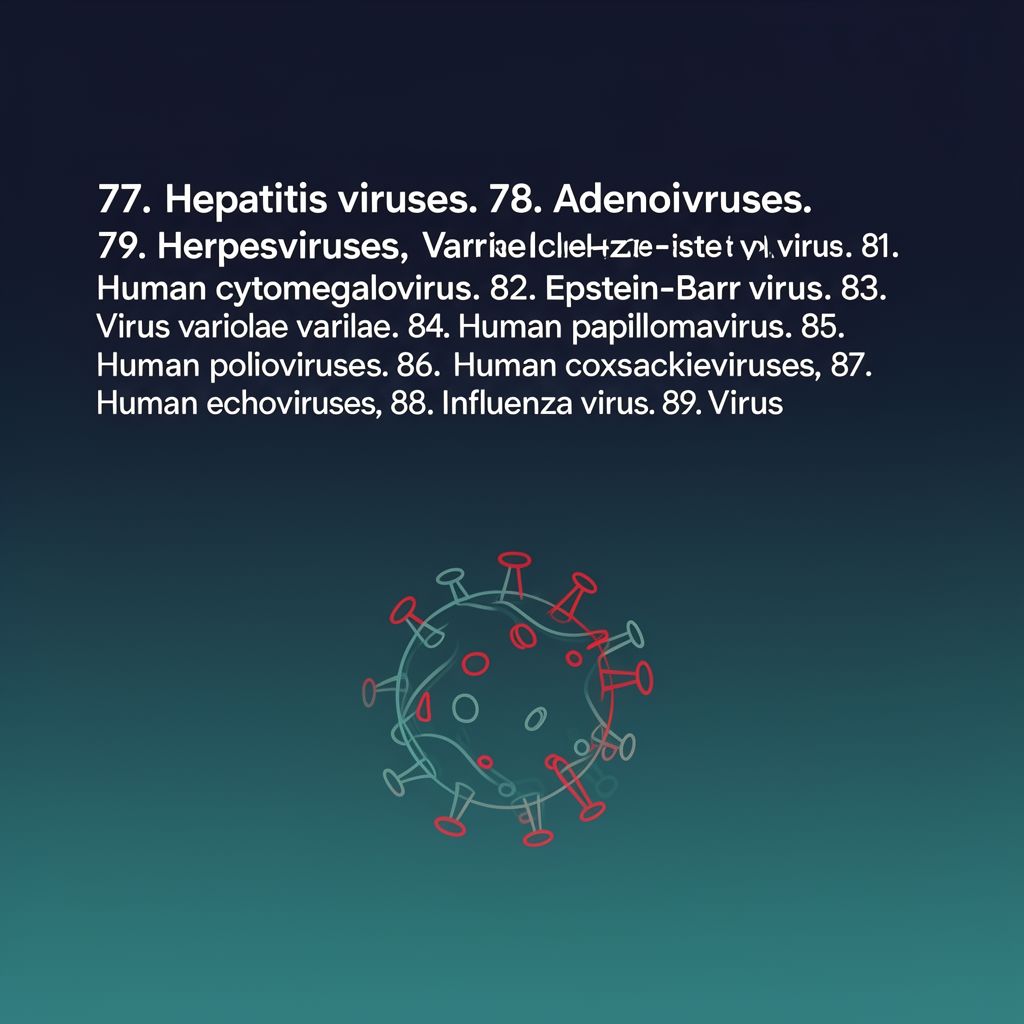
🦠 Human Viruses: An Overview
This study material provides a comprehensive overview of human viruses, covering their fundamental nature, classification, and specific examples of significant viral pathogens. It integrates key concepts such as viral replication, latency, mutation, and their impact on human health, including disease mechanisms, prevention, and treatment strategies.
1. What Are Viruses? 📚
Viruses are microscopic biological agents that are obligate intracellular parasites. They are not considered "alive" in the traditional sense because they lack the cellular machinery necessary for self-reproduction and metabolism.
- Nature: Extremely small biological entities, invisible to the naked eye.
- Reproduction: Cannot reproduce independently. They must infect a host cell and hijack its cellular machinery to create new viral particles.
- Mechanism: Act as "hijackers," inserting their genetic material into host cells and forcing the cell to produce more viruses.
2. Classification of Viruses 🧬
Viruses are broadly classified based on their genetic material, which can be either DNA or RNA. This fundamental difference influences their replication strategies, stability, and interaction with the host immune system.
2.1. DNA Viruses: The Long-Term Residents 🏡
DNA viruses typically have a more stable genome and often integrate into the host cell's DNA or persist for extended periods.
- Characteristics:
- ✅ Genetic material is DNA (double-stranded or single-stranded).
- ✅ Often integrate into the host cell's genome or maintain a persistent presence.
- ✅ Tend to be more stable than RNA viruses.
2.1.1. Herpesvirus Family 🦠
A significant family of DNA viruses known for their ability to establish latency.
-
Key Feature: Latency 😴
- After initial infection, the virus does not disappear but enters a dormant state, often hiding in nerve cells.
- Can reactivate later, especially during periods of stress or weakened immune function.
- 💡 Analogy: A houseguest who never truly leaves, just sleeps in the spare room, waiting for a chance to wake up.
-
Specific Herpesviruses:
- Herpes Simplex Virus (HSV):
- HSV-1: Commonly causes oral herpes (cold sores, fever blisters).
- HSV-2: Primarily causes genital herpes.
- Varicella-Zoster Virus (VZV):
- Causes chickenpox (varicella) during primary infection, typically in childhood.
- Can reactivate later in life to cause shingles (herpes zoster), a painful rash.
- Human Cytomegalovirus (CMV):
- Often asymptomatic in healthy individuals.
- Can cause serious complications in immunocompromised individuals (e.g., transplant recipients, HIV patients) and newborns (congenital CMV).
- Epstein-Barr Virus (EBV):
- Causes infectious mononucleosis ("mono" or "glandular fever").
- Associated with certain cancers (e.g., Burkitt lymphoma, nasopharyngeal carcinoma) and autoimmune diseases.
- Herpes Simplex Virus (HSV):
2.1.2. Human Papillomavirus (HPV) 🦠
A very common group of DNA viruses with significant health implications.
- Characteristics:
- ✅ Causes warts (papillomas) on various parts of the body.
- ⚠️ Certain types are strongly linked to various cancers, particularly cervical cancer, but also anal, oral, and throat cancers.
- Prevention:
- 💉 The HPV vaccine is highly effective in preventing infection by the cancer-causing strains of HPV.
2.1.3. Virus Variolae (Smallpox Virus) 🦠
A historical DNA virus responsible for one of the most devastating diseases in human history.
- Characteristics:
- ✅ Caused smallpox, a severe and often fatal disease characterized by a distinctive rash.
- ✅ Unique in that it is the only human infectious disease to have been globally eradicated through widespread vaccination efforts.
2.1.4. Adenoviruses 🦠
A group of DNA viruses that commonly cause respiratory, gastrointestinal, and ocular infections.
- Characteristics:
- ✅ Can cause a range of illnesses, including the common cold, bronchitis, pneumonia, conjunctivitis (pink eye), and gastroenteritis.
- ✅ Often responsible for outbreaks in crowded settings like military barracks.
2.1.5. Hepatitis Viruses (DNA types) 🦠
While several hepatitis viruses exist, Hepatitis B is a DNA virus.
- Hepatitis B Virus (HBV):
- ✅ A DNA virus that primarily infects the liver.
- ✅ Can cause acute or chronic liver infection, leading to cirrhosis, liver failure, and liver cancer.
- 💉 Preventable by vaccine.
2.2. RNA Viruses: The Rapid Mutators and Global Threats 🌍
RNA viruses tend to have a higher mutation rate due to the nature of RNA replication, making them masters of adaptation and often challenging for vaccine development.
- Characteristics:
- ✅ Genetic material is RNA (single-stranded or double-stranded).
- ✅ Tend to be less stable and mutate more frequently than DNA viruses.
- ✅ High mutation rates can lead to challenges in vaccine development and drug resistance.
2.2.1. Influenza Virus 🦠
A classic example of a rapidly mutating RNA virus.
- Characteristics:
- ✅ Causes influenza (the flu), a respiratory illness.
- ✅ High mutation rate means the virus constantly changes its surface proteins.
- ⚠️ This constant change necessitates a new flu vaccine every year, as previous vaccines may not protect against new strains.
2.2.2. Polioviruses 🦠
An RNA virus that was historically a major public health threat.
- Characteristics:
- ✅ Causes poliomyelitis (polio), a disease that can lead to paralysis and death.
- ✅ Primarily affects the nervous system.
- Public Health Success:
- 💉 Thanks to widespread vaccination efforts, polio is now almost globally eradicated, representing a monumental achievement in public health.
2.2.3. Retroviruses (e.g., HIV) 🦠
A unique family of RNA viruses known for their reverse transcription mechanism.
- Human Immunodeficiency Virus (HIV):
- Unique Mechanism: HIV is an RNA virus that uses an enzyme called reverse transcriptase 🧬 to convert its RNA into DNA.
- Integration: This newly synthesized viral DNA then integrates into the host cell's DNA, becoming a permanent part of the host's genetic material.
- Target Cells: Primarily targets immune cells (CD4+ T cells), progressively weakening the body's ability to fight off infections.
- Disease Progression: Leads to Acquired Immunodeficiency Syndrome (AIDS), the final stage of HIV infection, characterized by severe immune deficiency.
- Treatment: Advances in antiviral medications (Antiretroviral Therapy - ART) allow people with HIV to live long, healthy lives, effectively managing the virus and preventing progression to AIDS.
2.2.4. Human Coxsackieviruses 🦠
A group of RNA viruses belonging to the enterovirus genus.
- Characteristics:
- ✅ Can cause a variety of illnesses, including hand, foot, and mouth disease, herpangina, aseptic meningitis, and myocarditis.
- ✅ Often spread through the fecal-oral route.
2.2.5. Human Echoviruses 🦠
Another group of RNA viruses in the enterovirus genus.
- Characteristics:
- ✅ Commonly cause mild respiratory illnesses, gastroenteritis, and aseptic meningitis.
- ✅ Can also cause rashes and febrile illnesses.
2.2.6. Virus Parotitidis (Mumps Virus) 🦠
An RNA virus that causes mumps.
- Characteristics:
- ✅ Causes mumps, characterized by painful swelling of the salivary glands (parotitis).
- ✅ Can lead to complications like orchitis (testicular inflammation), pancreatitis, and meningitis.
- 💉 Preventable by the MMR vaccine (Measles, Mumps, Rubella).
2.2.7. Virus Morbillorum (Measles Virus) 🦠
An RNA virus responsible for measles.
- Characteristics:
- ✅ Causes measles, a highly contagious disease characterized by fever, cough, runny nose, conjunctivitis, and a widespread rash.
- ✅ Can lead to serious complications including pneumonia, encephalitis, and subacute sclerosing panencephalitis (SSPE).
- 💉 Preventable by the MMR vaccine.
2.2.8. Rubella Virus 🦠
An RNA virus that causes rubella (German measles).
- Characteristics:
- ✅ Causes rubella, a milder disease than measles, with a characteristic rash and swollen lymph nodes.
- ⚠️ Congenital Rubella Syndrome (CRS): If a pregnant woman contracts rubella, it can cause severe birth defects in the fetus.
- 💉 Preventable by the MMR vaccine.
2.2.9. Rotaviruses 🦠
A common cause of severe diarrhea in infants and young children.
- Characteristics:
- ✅ An RNA virus that causes severe gastroenteritis, leading to vomiting, watery diarrhea, and dehydration.
- ✅ Highly contagious.
- 💉 Vaccines are available and highly effective in preventing severe rotavirus disease.
2.2.10. Arboviruses 🦠
A diverse group of RNA viruses transmitted by arthropod vectors (e.g., mosquitoes, ticks).
- Characteristics:
- ✅ Arthropod-borne viruses.
- ✅ Examples include Dengue virus, Zika virus, West Nile virus, and Yellow Fever virus.
- ✅ Can cause a range of symptoms from mild fever to severe neurological disease or hemorrhagic fever.
2.2.11. Rabies Virus 🦠
A highly dangerous RNA virus that causes rabies.
- Characteristics:
- ✅ Transmitted through the saliva of infected animals, typically via a bite.
- ✅ Causes rabies, a severe neurological disease that is almost always fatal once symptoms appear.
- 💉 Post-exposure prophylaxis (PEP) and pre-exposure vaccination are highly effective in preventing the disease.
2.2.12. Hepatitis Viruses (RNA types) 🦠
Hepatitis A, C, D, and E are RNA viruses.
- Hepatitis A Virus (HAV):
- ✅ An RNA virus causing acute hepatitis, typically spread through contaminated food or water.
- 💉 Preventable by vaccine.
- Hepatitis C Virus (HCV):
- ✅ An RNA virus causing acute and chronic hepatitis, often leading to cirrhosis and liver cancer.
- ✅ Primarily spread through blood-to-blood contact.
- 💊 Highly effective antiviral treatments are available.
- Hepatitis D Virus (HDV):
- ✅ An RNA virus that can only infect individuals already infected with Hepatitis B (HBV).
- ✅ Can worsen HBV infection.
- Hepatitis E Virus (HEV):
- ✅ An RNA virus causing acute hepatitis, similar to HAV, often spread through contaminated water.
3. Why Understanding Viruses Matters 💡
Understanding viruses is critical for several reasons, impacting public health, medicine, and global well-being.
- Disease Prevention:
- ✅ Enables the development of vaccines (e.g., polio, HPV, measles, mumps, rubella, rotavirus, hepatitis A/B) to prevent infections.
- Disease Treatment:
- ✅ Facilitates the development of antiviral medications (e.g., for HIV, some herpes infections, hepatitis C) to treat existing infections and manage chronic viral diseases.
- Public Health Measures:
- ✅ Informs public health strategies such as hygiene practices, quarantine, surveillance, and outbreak response.
- Global Health Security:
- ✅ Essential for responding to emerging viral threats and pandemics.
This knowledge empowers us to protect ourselves and communities from the diverse and ever-evolving world of human viruses.