Cognitive Biases and Heuristics in Behavioral Economics - kapak
Psikoloji#behavioral economics#cognitive biases#heuristics#decision making

Cognitive Biases and Heuristics in Behavioral Economics

An academic summary exploring key cognitive biases and heuristics, their impact on human decision-making, and their role in behavioral economics, contrasting with traditional economic theory.

aysuzeybelkApril 10, 2026 ~25 dk toplam
01

Sesli Özet

6 dakika

Konuyu otobüste, koşarken, yolda dinleyerek öğren.

Sesli Özet

Cognitive Biases and Heuristics in Behavioral Economics

0:005:44
02

Flash Kartlar

25 kart

Karta tıklayarak çevir. ← → ile gez, ⎵ ile çevir.

1 / 25
Tüm kartları metin olarak gör
  1. 1. What is the primary focus of behavioral economics?

    Behavioral economics systematically studies and describes economic decision-making and its consequences. It investigates how psychological, cognitive, emotional, cultural, and social factors affect the decisions of individuals and institutions. This field aims to understand why actual human behavior often deviates from the predictions of traditional economic theory, which assumes perfect rationality.

  2. 2. How does actual human behavior differ from the 'homo economicus' concept in traditional economic theory?

    Traditional economic theory assumes 'homo economicus' is perfectly rational, self-interested, and has stable preferences. In contrast, actual human behavior is influenced by first impressions, context, and emotions, leading to unstable preferences and systematic mistakes. People often exhibit bounded rationality, limited self-control, and social preferences, which contradict the idealized rational agent.

  3. 3. What are the three main reasons behavioral economics attributes to the deviation from traditional economic predictions?

    Behavioral economics attributes deviations from traditional economic predictions to three main factors: bounded rationality, limited self-control, and social preferences. Bounded rationality acknowledges the inherent limits in human thinking capacity and information processing. Limited self-control refers to the difficulty individuals face in consistently acting in their long-term best interest. Social preferences highlight that people often consider the well-being of others, not just their own.

  4. 4. Explain the concept of 'bounded rationality'.

    Bounded rationality refers to the idea that human decision-making is limited by the amount of information available, the cognitive limitations of the mind, and the finite amount of time available to make a decision. Unlike the perfectly rational 'homo economicus', individuals make decisions that are 'good enough' rather than optimal, due to these inherent constraints. This concept helps explain why people often use heuristics and are prone to cognitive biases.

  5. 5. Describe the key characteristics of 'homo economicus' as assumed by traditional economic theory.

    Traditional economic theory assumes 'homo economicus' is a perfectly rational agent who is self-interested, possesses stable and consistent preferences, and utilizes all available information to make optimal decisions. This theoretical construct is believed to maximize utility and profit, always acting logically and without emotional influence. It serves as a benchmark against which actual human behavior is often compared in behavioral economics.

  6. 6. Who developed the dual-process theory, and what does it illustrate?

    Daniel Kahneman developed the dual-process theory, which illustrates how people think and make decisions through two distinct cognitive systems: System 1 and System 2. This theory provides a framework for understanding the interplay between intuitive, automatic thought processes and more deliberate, effortful reasoning. It highlights how these two systems contribute to both efficient decision-making and systematic errors.

  7. 7. What are the defining characteristics of System 1 thinking?

    System 1 thinking is characterized as automatic, quick, effortless, intuitive, and often driven by emotion. It operates unconsciously and is responsible for many routine daily activities, such as recognizing faces or understanding simple sentences. While highly efficient, System 1 is prone to biases, has limited understanding of logic and statistics, and cannot be disengaged, often favoring coherent stories even in the absence of true causal links.

  8. 8. How does System 2 thinking differ from System 1?

    System 2 thinking is deliberate, slow, effortful, and associated with reasoning and self-control. Unlike System 1, it requires conscious attention and is activated for complex computations, logical analysis, and when System 1 has no immediate answer. While System 2 can override System 1, it is resource-intensive and often relies on System 1 for initial assessments, making it susceptible to System 1's biases if not sufficiently engaged.

  9. 9. When is System 2 typically activated in decision-making?

    System 2 is typically activated when System 1 has no immediate answer, when complex computations are required, or when a situation demands careful reasoning and self-control. It comes into play for tasks like solving a complex math problem, comparing two products based on multiple attributes, or consciously overriding an initial intuitive judgment. Its activation signifies a shift from automatic processing to more deliberate, effortful thought.

  10. 10. What is a heuristic, and how does System 1 utilize it?

    A heuristic is defined as a rule of thumb or a mental shortcut that a person uses to solve a problem or make a decision quickly and efficiently. System 1 often utilizes heuristics when a satisfactory answer to a difficult question is not readily available, substituting it with a related, easier question. While frequently useful for navigating daily life, these shortcuts are not universally accurate and can lead to systematic biases.

  11. 11. Define the 'halo effect' and explain its impact on preferences.

    The halo effect describes the tendency to generalize liking or disliking everything about a person, product, or idea based on limited known characteristics. For example, if a person is perceived as attractive, they might also be assumed to be intelligent or kind. This bias significantly shapes preferences and views, highlighting the powerful impact of first impressions and the sequential presentation of information on overall judgment.

  12. 12. What is confirmation bias, and how can it affect individuals and researchers?

    Confirmation bias is the inclination to seek out, interpret, or favor information in a manner that aligns with existing theories, beliefs, and convictions. For individuals, this can mean consuming media that reinforces their political views, potentially exacerbating polarization. For researchers, it can lead to favoring data that supports their hypotheses while overlooking contradictory evidence, thus hindering objective scientific inquiry and critical thinking.

  13. 13. Explain availability bias and the factors that influence it.

    Availability bias refers to the tendency to assess the likelihood of an event based on the ease with which examples or instances come to mind. It is influenced by factors such as retrievability (how easily information can be recalled), salience (how striking or vivid an event is), and recency (how recently an event occurred). Events that are more easily recalled, vivid, or recent are often perceived as more frequent or probable, even if they are not.

  14. 14. How does availability bias impact risk perception?

    Availability bias significantly impacts risk perception by causing individuals to overestimate the likelihood of vivid but rare events, while underestimating common, less dramatic risks. For example, highly publicized plane crashes might lead people to fear flying more than driving, despite driving being statistically riskier. This occurs because dramatic events are more easily retrieved from memory, making them seem more probable.

  15. 15. What is the anchor effect, and what are its potential causes?

    The anchor effect occurs when an initial piece of information, even an irrelevant one, serves as a reference point (an 'anchor'), influencing subsequent judgments about quantity or value. For instance, a high initial price suggestion can make a lower price seem more reasonable. This effect can stem from System 1 priming, where the anchor unconsciously influences perception, or from System 2's insufficient adjustment from a self-generated or external anchor.

  16. 16. Describe the representativeness heuristic and its common consequence.

    The representativeness heuristic involves assessing probabilities solely by the degree to which one item resembles another, often leading to stereotypes. People judge the likelihood of an event or person belonging to a category based on how well it matches their mental prototype of that category. A common consequence of this heuristic is base-rate neglect, where objective statistical probabilities are ignored in favor of vivid, but potentially misleading, stereotypical information.

  17. 17. What is the conjunction fallacy, and what drives it?

    The conjunction fallacy is the mistaken belief that a combination of multiple conditions is more probable than a single, broader one. For example, believing it's more likely for someone to be a 'bank teller and active in the feminist movement' than simply a 'bank teller'. This fallacy is primarily driven by System 1's preference for coherent and plausible narratives, even if those narratives are statistically less probable than simpler alternatives.

  18. 18. Explain the 'law of small numbers' and why it's considered erroneous.

    The 'law of small numbers' is the erroneous assumption that small samples are as representative of a population as large samples. People mistakenly believe that a small number of observations will reflect the true characteristics of a larger population. This is considered erroneous because, mathematically, extreme results and deviations from the average are much more likely to occur in smaller samples due to random chance, making them less reliable indicators of the overall population.

  19. 19. What is the gambler's fallacy?

    The gambler's fallacy is the mistaken belief that the probabilities of independent random events are connected, leading to the assumption that past outcomes influence future independent events. For example, after a series of coin flips landing on heads, a person might believe that tails is 'due' to occur, despite each flip having an independent 50/50 chance. This fallacy ignores the statistical independence of random events.

  20. 20. Define 'regression to the mean' and how System 1 often misinterprets it.

    Regression to the mean explains that extreme outcomes, often produced by chance, tend to move closer to the average over time. For instance, an exceptionally good or bad performance is likely to be followed by a more average one. System 1 frequently misinterprets this mathematical fact by inventing causal explanations for the change, failing to recognize the role of luck or random variation. This can lead to incorrect conclusions about interventions or abilities.

  21. 21. What is hindsight bias?

    Hindsight bias is the inclination to perceive unpredictable events as predictable after they have occurred, leading individuals to believe they 'knew it all along.' Once an outcome is known, people tend to overestimate their ability to have predicted it beforehand. This bias can distort memory and make past decisions seem more obvious or inevitable than they actually were, affecting learning from experience.

  22. 22. Explain outcome bias and its relationship to hindsight bias.

    Outcome bias describes the tendency to judge the quality of a decision based on its outcome rather than on the soundness of the decision-making process itself. A good outcome might lead one to believe a risky decision was well-made, even if the process was flawed. This bias is often a consequence of hindsight bias, as knowing the outcome makes it seem more predictable, thus influencing the judgment of the initial decision's quality, regardless of the information available at the time.

  23. 23. Why is understanding cognitive biases and heuristics important for decision-making?

    Understanding cognitive biases and heuristics is crucial because it provides a critical insight into how human decision-making systematically deviates from purely rational models. Recognizing these predictable errors allows individuals to identify potential pitfalls in their own judgments and those of others. This knowledge is essential for improving the quality of decisions in various contexts, from personal finance to public policy, by fostering more deliberate and less biased thinking.

  24. 24. How do first impressions and context influence human behavior, according to behavioral economics?

    According to behavioral economics, first impressions and context significantly influence human behavior, leading to unstable preferences and inconsistent actions. Unlike the 'homo economicus' who has stable preferences, real people's choices can be swayed by initial encounters or the framing of information. This highlights that decisions are not made in a vacuum but are highly sensitive to the immediate environment and initial perceptions, often driven by System 1 processes.

  25. 25. What is the main limitation of System 1 regarding logic and statistics?

    The main limitation of System 1 regarding logic and statistics is its inherent difficulty in understanding and applying them accurately. System 1 is intuitive and quick, often favoring coherent stories over statistical probabilities or logical consistency. This makes it prone to biases like the conjunction fallacy or base-rate neglect, where statistical facts are overlooked in favor of more compelling narratives or stereotypes, leading to systematic errors in judgment.

03

Bilgini Test Et

15 soru

Çoktan seçmeli sorularla öğrendiklerini ölç. Cevap + açıklama.

Soru 1 / 15Skor: 0

What is the primary focus of behavioral economics as described in the text?

04

Detaylı Özet

9 dk okuma

Tüm konuyu derinlemesine, başlık başlık.

Study Material: Cognitive Biases and Heuristics in Behavioral Economics

Source Information: This study material has been compiled from a lecture audio transcript and copy-pasted text provided by the user.


1. Introduction to Behavioral Economics 📚

This material explores the fundamental concepts of cognitive biases and heuristics, which are central to the field of behavioral economics. Understanding these concepts is crucial for comprehending how human decision-making often deviates from purely rational models.

Learning Objectives:

  • Review key cognitive biases and heuristics.
  • Understand their significance as findings in behavioral economics.
  • Grasp these basic concepts essential for advanced study in the field.

Recommended Reading:

  • "Thinking, Fast and Slow" (2011) by Daniel Kahneman
  • "Misbehaving: The Making of Behavioral Economics" (2015) by Richard Thaler, Chapters 1-3

2. What is Behavioral Economics? 🧠

Behavioral economics systematically studies and describes economic decision-making and its consequences. It highlights that actual human behavior is often less rational, stable, and selfish than traditional economic theory predicts. This deviation is attributed to:

  • Bounded Rationality: Limits to our thinking capacity, information processing, and available time.
  • Limited Self-Control: Difficulty in resisting immediate gratification for long-term benefits.
  • Social Preferences: Consideration for the well-being and actions of others.

These limitations manifest in human behavior as heuristics and cognitive biases.

3. Homo Economicus vs. Actual Human Behavior ⚖️

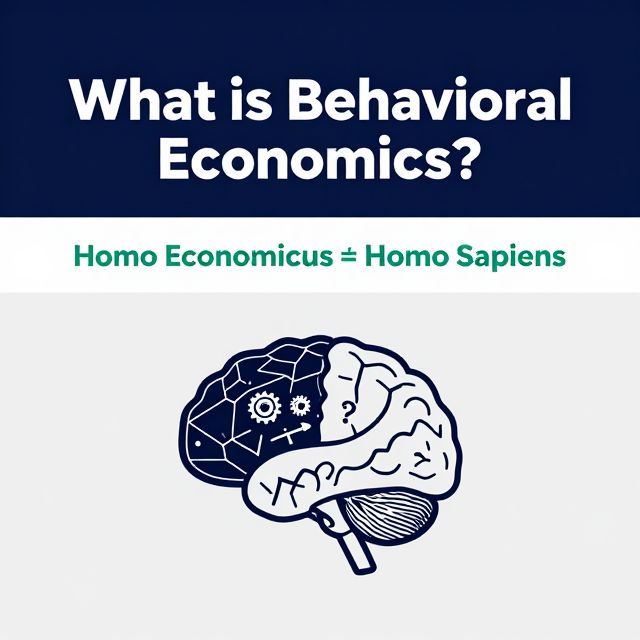
Traditional economic theory is built upon the concept of 'homo economicus,' an idealized rational agent.

Assumptions of Homo Economicus:

  • ✅ Is self-interested and ignores consequences for others.
  • ✅ Makes perfectly rational decisions and never makes systematic mistakes.
  • ✅ Has stable and consistent preferences.
  • ✅ Uses all available information.

Actual Human Behavior: In reality, human behavior is far more complex and influenced by:

  • First Impressions, Context, and Emotions: These factors significantly shape perceptions and decisions.
  • Consequences for Other People: Social considerations often play a role.
  • Unstable Preferences: Preferences are not always consistent over time.
  • Systematic Mistakes and Inconsistent Actions: People make predictable errors and behave inconsistently.

Examples of Deviations:

  • Subjective Perceptions: Our perception of reality (e.g., how we feel about a product) often outweighs objective measurements.
  • Distorted Memories: People judge past events by particular moments or outcomes, relying on ease of recall rather than objective facts.
  • Deciding by Not Deciding: Humans are creatures of habit and often prefer the status quo. Defaults can profoundly influence behavior (e.g., organ donation opt-in/opt-out systems).
  • Self-Control Problems: Individuals often make plans for future benefits (e.g., saving money, healthy eating) but succumb to immediate gratification in the present (e.g., signing up for a gym but not going).

4. Daniel Kahneman's Two Systems of Thinking 💡

Daniel Kahneman's dual-process theory describes two distinct systems that govern how people think and make decisions:

| Feature | System 1 | System 2 | | :---------------- | :------------------------------------- | :----------------------------------------- | | Nature | Automatic, Intuitive | Deliberate, Reflective | | Speed | Quick | Slow | | Effort | Effortless | Effortful | | Attention | Does not require attention | Requires attention | | Primary Mode | Intuition and emotion | Reasoning and self-control | | Tendency | Hyperactive | Lazy |

Examples of System 1 Tasks:

  • Detecting that one object is more distant than another.
  • Orienting to the source of a sudden sound.
  • Completing the phrase "bread and..."
  • Detecting hostility in a voice.
  • Driving a car on an empty road.
  • Answering "2 + 2".

Examples of System 2 Tasks:

  • Naming the capital of France.
  • Looking for a particular person in a crowded street.
  • Counting the letter 'f' in a text.
  • Parking a car in a narrow space.
  • Filling out a tax form.
  • Performing complex computations.

Interaction and Biases:

  • System 1 runs most of our daily activities efficiently.
  • System 2 is activated when System 1 has no answer or when complex, effortful thought is required.
  • ⚠️ System 1 has inherent biases: It often lacks understanding of logic and statistics, cannot be easily turned off, and prefers coherent stories, even inventing causal links where none exist. For example, if an old man died and his dog died a few weeks later, System 1 might readily accept the explanation that the dog died "of grief" because it creates a more coherent, albeit unproven, narrative.

5. Heuristics: Mental Shortcuts 🛣️

A heuristic 📚 is a rule of thumb by which a person solves a problem. When faced with a difficult question, System 1 often substitutes it with a related, easier question.

  • Target Question: The actual assessment you want to produce.
  • Heuristic Question: The simpler question you answer instead.

Example:

  • Target Question: "Should I invest in BMW stocks?"
  • Heuristic Question: "How much do I like BMW?"

Many decisions rely on heuristics, which are often useful for navigating a complex world but can lead to systematic errors.

6. Key Cognitive Biases and Heuristics 📊

Here are some of the most important cognitive biases and heuristics:

6.1. Halo Effect ✨

The halo effect is the tendency to like (or dislike) everything about a person based on only a few known characteristics. System 1 prefers coherent stories and uses available information, often ignoring what's unavailable. This effect explains why first impressions are so powerful.

  • Example: If presented with "Alan: intelligent – impulsive – stubborn – envious" versus "Ben: envious – stubborn – impulsive – intelligent," many people prefer Alan because the initial positive trait ("intelligent") creates a positive halo, influencing the perception of subsequent traits.

6.2. Confirmation Bias ✅

Confirmation bias is the tendency to seek out or interpret information in a way that fits with existing theories, beliefs, and convictions. People's beliefs may change with new information, but often less than they should.

  • Example: If you like nuclear power, you might believe its risks are relatively low, and you'll likely seek out information that supports this view.
  • Consequences:
    • Science & Research: Researchers may favor results supporting their theories and overlook contradictory data.
    • Politics & Society: People follow media that supports their ideology, reinforcing stereotypes and contributing to polarization.

6.3. Availability Bias 🧠

Availability bias is the tendency to assess the likelihood of an event based on how easily an example, instance, or case comes to mind. People often use information that is most readily available.

  • Factors Influencing Availability:
    • Retrievability: Categories with easily retrieved instances appear more numerous.
    • Salience: Personal experiences, vivid examples, and pictures are more available than abstract statistics.
    • Recency: Recent occurrences have a greater impact.
  • Consequences:
    • Risk Perception: People may overestimate rare but vivid events (e.g., plane crashes) due to extensive media coverage, while underestimating common but less dramatic risks (e.g., heart disease).
    • Policy: Politicians might respond more strongly to recent, salient events (e.g., natural disasters) than to long-term, less dramatic risks (e.g., climate change).

6.4. Anchor Effect ⚓

The anchor effect occurs when initial exposure to a number serves as a reference point, influencing subsequent judgments about quantity or value, even if the number is irrelevant.

  • Anchoring as Priming (System 1): An irrelevant number can create an impression that System 1 tries to make true.
    • Example: Asking "Was Gandhi more or less than 144 years old when he died?" before asking "How old was Gandhi when he died?" will likely lead to higher age estimates, as "144" acts as an anchor.
  • Anchoring as Adjustment (System 2): When estimating an unknown value, people often start with an initial anchor (self-generated or provided) and adjust from there. Adjustments tend to be insufficient, leaving the final estimate too close to the anchor.
    • Example: Estimating the freezing point of vodka by starting from 0 degrees Celsius (water's freezing point) and adjusting downwards.

6.5. Representativeness Heuristic & Base-Rate Neglect 🧑‍🏫

The representativeness heuristic is the tendency to assess probabilities solely by the degree to which one item (A) is representative of another (B), often based on stereotypes. This can lead to base-rate neglect, where objective probabilities are ignored.

  • Example: Mark is 54, thin, wears glasses, likes reading, Mozart, and museums. Is he more likely a literature professor in Frankfurt or a truck driver? Many assume professor due to stereotypes, neglecting the much higher base rate of truck drivers.
  • Reasoning: System 1's intuitive guessing based on stereotypes can be more accurate than random guesses but often ignores objective probabilities.

6.6. Conjunction Fallacy ⚠️

The conjunction fallacy is the mistaken belief that a combination of multiple conditions is more probable than a single one. This occurs because System 1 prefers coherent stories.

  • Example: Linda is 31, single, outspoken, and bright, majored in philosophy, and was concerned with social justice. Is she more likely "a bank teller" or "a bank teller and member of the Green party"? Many choose the latter because it creates a more coherent story, even though the probability of two events occurring together must be less than or equal to the probability of either event occurring alone.

6.7. Law of Small Numbers 📉

The law of small numbers is the erroneous assumption that small samples are as representative of a population as large samples.

  • Mathematical Fact: Extreme results are statistically more likely to be found in small samples.
  • Consequence: People often draw conclusions from insufficient data, leading to flawed judgments (e.g., judging a coach's skill based on a few games).

6.8. Gambler's Fallacy 🎲

The gambler's fallacy is the mistaken belief that the probabilities of independent random events are connected. People assume that past outcomes influence future independent events.

  • Example: In roulette, after a long sequence of black, people might bet more on red, wrongly believing red is "due." They perceive chance as a self-correcting process, where deviations in one direction will be balanced by deviations in the opposite direction. However, independent events have no memory.

6.9. Regression to the Mean 📈

Regression to the mean is the mathematical fact that extreme outcomes, often produced by chance (luck or bad luck), tend to move closer to the average over time.

  • Example: The "New-Coach Effect" in Football: Studies show that after a coach is dismissed following a period of poor performance, team performance often improves. However, this improvement is largely due to regression to the mean (the team was likely performing unusually poorly due to bad luck and would naturally return to its average performance), not necessarily the new coach's skill. System 1 often invents causal explanations, failing to recognize the role of chance.

6.10. Hindsight Bias 🤔

Hindsight bias is the inclination to perceive unpredictable events as predictable after they have occurred. People often claim they "knew it all along" after an event, even if it was unknowable beforehand.

  • Example: After a football team loses, experts might claim they knew the coach's strategy would fail from the start. This bias distorts judgments of probabilities after an event has happened.

6.11. Outcome Bias 🏆

Outcome bias describes the tendency to judge the quality of a decision based on its outcome rather than on the soundness of the decision-making process itself. It is often a consequence of hindsight bias.

  • Example: A surgeon's decision to perform a risky operation might be judged solely on whether the patient survives, rather than on the information and probabilities available at the time the decision was made.

7. Conclusion 🎯

The study of cognitive biases and heuristics provides a critical understanding of how human decision-making deviates from purely rational models. Recognizing the interplay between System 1's intuitive processes and System 2's deliberate reasoning is fundamental to comprehending the complexities of human economic and social behavior. This knowledge is essential for both academic inquiry and practical applications in various fields, helping us to make more informed decisions and understand the systematic errors we are prone to.

Kendi çalışma materyalini oluştur

PDF, YouTube videosu veya herhangi bir konuyu dakikalar içinde podcast, özet, flash kart ve quiz'e dönüştür. 1.000.000+ kullanıcı tercih ediyor.

Sıradaki Konular

Tümünü keşfet
Behavioral Economics: Understanding Real-World Decision Making

Behavioral Economics: Understanding Real-World Decision Making

Explore behavioral economics, contrasting rational economic agents with real human behavior, and delve into preferences, utility, and cognitive biases influencing choices.

Özet 25 15
Your Brain's Shortcuts: Cognitive Biases

Your Brain's Shortcuts: Cognitive Biases

Ever wonder why you sometimes make decisions that don't seem logical? Let's explore cognitive biases, your brain's mental shortcuts, and how they influence your thinking and choices every day.

25 15
Adolescents and Social Media: Engagement, Theories, and Well-being

Adolescents and Social Media: Engagement, Theories, and Well-being

Explore how adolescents and young adults engage with social media, examining key theories, the screen time debate, and the nuanced impact of online interactions on well-being.

Özet Görsel
Self and Personality: Psychological Perspectives

Self and Personality: Psychological Perspectives

This audio summary explores the psychological concepts of self and personality, examining how individuals understand themselves, various theoretical approaches to personality, biological influences, and assessment methods.

8 dk Özet 25 15 Görsel
From Learning Theory to Contemporary Models in Psychology

From Learning Theory to Contemporary Models in Psychology

Explore the evolution of psychological thought from early behaviorism to the cognitive revolution and sociobehaviorism, focusing on key figures like Bandura and Rotter.

Özet 15
Social Psychology: Core Concepts and Influences

Social Psychology: Core Concepts and Influences

An academic overview of social psychology, covering its definition, historical development, foundational principles, cultural influences, and key concepts like affect, behavior, and cognition.

5 dk Özet 25 15
Test and Measurement II for Psychology Students

Test and Measurement II for Psychology Students

An academic overview of advanced psychometric principles, test development, adaptation, and their application in psychological assessment for psychology students.

4 dk Özet 15
Prenatal Development: Stages and Processes

Prenatal Development: Stages and Processes

Explore the fascinating journey of prenatal development, from conception through the germinal, embryonic, and fetal stages, including key cellular processes and support systems.

Özet 25 15