
Expressing Opinions and Beliefs Using Sync Belief - kapak
Psikoloji#opinions#beliefs#communication#sync belief

Expressing Opinions and Beliefs Using Sync Belief

This summary explores the articulation of opinions and beliefs, differentiating between them, examining communication strategies, and detailing the 'sync belief' approach for effective, aligned discourse.

ywef2uoyApril 28, 2026 ~22 dk toplam
01

Sesli Özet

7 dakika

Konuyu otobüste, koşarken, yolda dinleyerek öğren.

Sesli Özet

Expressing Opinions and Beliefs Using Sync Belief

0:006:43
02

Görsel Özet

İnfografik

Konunun tüm parçalarını tek bakışta gör.

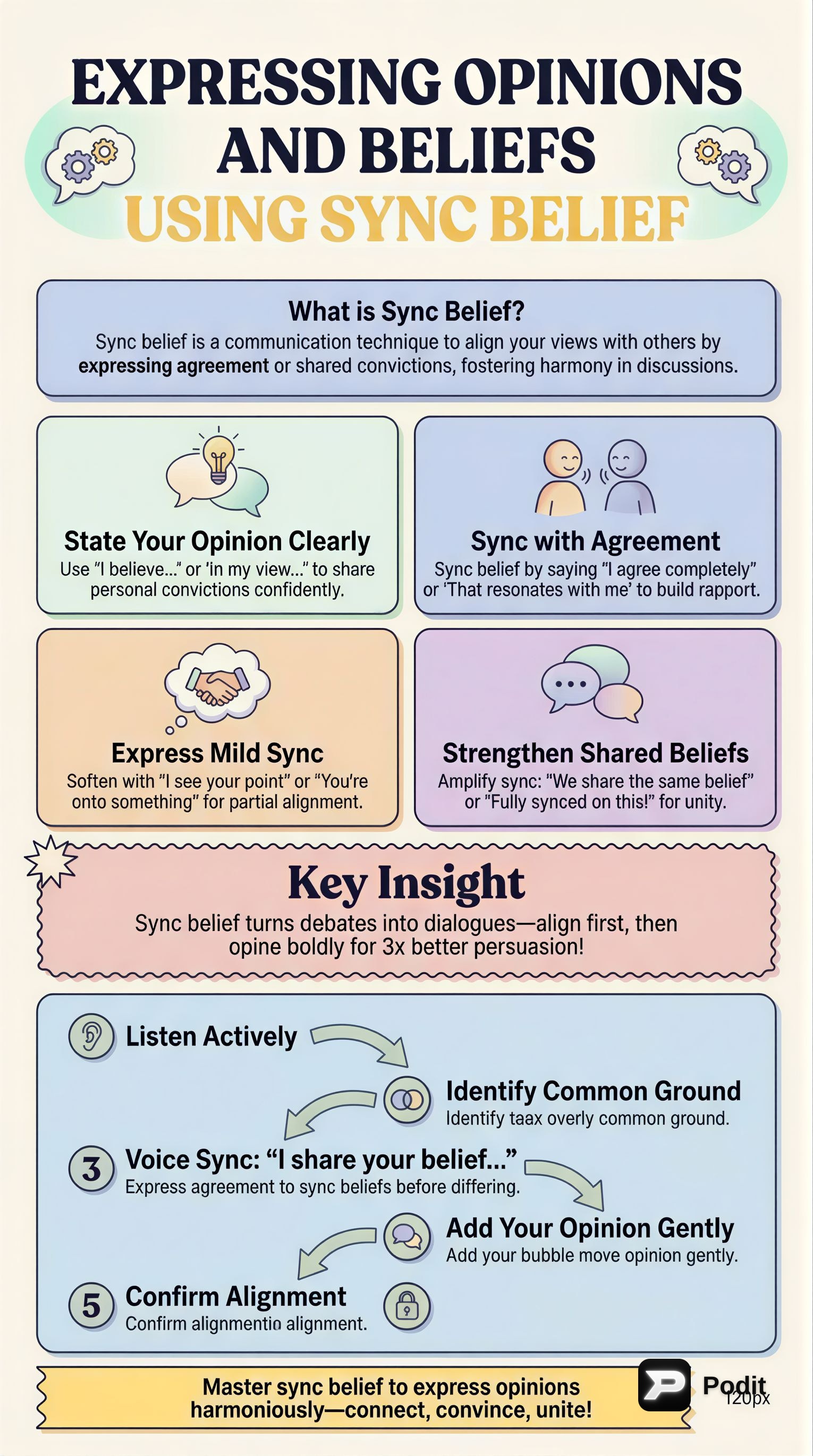
Expressing Opinions and Beliefs Using Sync Belief - görsel özet infografik
Tam boyutta görüntüle →
03

Flash Kartlar

25 kart

Karta tıklayarak çevir. ← → ile gez, ⎵ ile çevir.

1 / 25
Tüm kartları metin olarak gör
  1. 1. What is the fundamental role of expressing personal opinions and deeply held beliefs in human communication?

    Expressing personal opinions and beliefs is a fundamental aspect of human communication and social interaction. It's not just about conveying information, but also about shaping perceptions, influencing others, and defining one's identity within a social context. This process allows individuals to engage with their environment and others on a deeper level, fostering connection and understanding.

  2. 2. Define 'sync belief' as described in the text.

    'Sync belief' refers to a strategic communication approach where individuals consciously aim to align their expressed views with their audience's existing beliefs or perspectives. It involves identifying common ground to foster greater understanding, reduce potential conflict, and enhance the effectiveness of their message. This strategy moves beyond simple assertion towards collaborative discourse, prioritizing mutual understanding.

  3. 3. What are the primary goals or benefits of employing a 'sync belief' strategy in communication?

    The primary goals of 'sync belief' are to foster greater understanding, reduce potential conflict, and enhance the efficacy of a message. By aligning views with the audience or finding common ground, it aims to make communication more collaborative and less confrontational. This approach helps in building rapport, increasing trust, and ensuring the message is received more positively and constructively.

  4. 4. What is the key distinction between an 'opinion' and a 'belief'?

    An opinion is typically a judgment, viewpoint, or statement often based on personal interpretation, preference, or limited information, and is generally more fluid and subject to change. A belief, conversely, is a more deeply ingrained conviction or acceptance that something is true or exists, often without empirical proof. Beliefs are foundational to an individual's worldview and identity, making them more stable and resistant to change.

  5. 5. Describe the characteristics of an 'opinion'.

    An opinion is generally a judgment, viewpoint, or statement about something, often stemming from personal interpretation or preference. It can also be based on limited information and is typically more fluid and subject to change as new information or experiences arise. Opinions represent a less deeply held conviction compared to beliefs, making them more adaptable.

  6. 6. Describe the characteristics of a 'belief'.

    A belief is a deeply ingrained conviction or acceptance that something is true or exists, often held without empirical proof. Beliefs are foundational to an individual's worldview, values, and identity, significantly influencing attitudes and behaviors. Unlike opinions, beliefs are generally more stable and resistant to change, forming a core part of who a person is and how they perceive the world.

  7. 7. What factors contribute to the formation of both opinions and beliefs?

    The formation of both opinions and beliefs is a complex process influenced by several factors. These include personal experiences, cultural background, education, and the social groups an individual belongs to. Additionally, cognitive biases play a significant role in shaping how individuals perceive information and form their views, highlighting the multifaceted nature of their development.

  8. 8. Why is understanding the distinction between opinions and beliefs crucial for effective communication?

    Understanding the distinction between opinions and beliefs is crucial for effective communication because it helps in tailoring one's approach. Knowing whether someone holds a fluid opinion or a deeply ingrained belief allows for more nuanced and respectful engagement. This understanding is particularly important when attempting to express one's own views or challenge those of others, preventing miscommunication and fostering better dialogue.

  9. 9. What is assertive communication and what are its key characteristics?

    Assertive communication involves expressing one's thoughts, feelings, and beliefs clearly and directly, while simultaneously respecting the rights and opinions of others. Its key characteristics include aiming for mutual understanding and resolution, fostering open dialogue without aggression or passivity. Individuals using this style typically employ 'I' statements and maintain appropriate non-verbal cues, promoting honest and respectful interaction.

  10. 10. Provide examples of how individuals typically communicate assertively.

    Individuals communicating assertively typically employ 'I' statements, such as 'I feel X when Y happens,' to express their feelings and thoughts directly without blaming. They also maintain appropriate eye contact and speak with a confident yet respectful tone. This approach demonstrates self-respect while acknowledging the other person's perspective, fostering open and honest dialogue and mutual understanding.

  11. 11. What is passive communication and what are its common outcomes?

    Passive communication involves suppressing one's own opinions or expressing them indirectly, often due to a fear of conflict, rejection, or disapproval. Common outcomes include misunderstandings, unaddressed issues, and a build-up of resentment within the individual. This style often leads to one's needs not being met and can damage relationships over time due to a lack of direct expression.

  12. 12. What is aggressive communication and what are its typical consequences?

    Aggressive communication involves expressing opinions in a forceful, demanding, or hostile manner, often disregarding the feelings, rights, or perspectives of others. Its typical consequences include escalating conflict, damaging relationships, and creating an environment of fear or defensiveness. This approach prioritizes one's own needs at the expense of others, hindering constructive dialogue and fostering animosity.

  13. 13. How does passive-aggressive communication differ from purely passive or aggressive styles?

    Passive-aggressive communication combines elements of both passive and aggressive styles, where hostility is expressed indirectly rather than directly. Instead of open confrontation, individuals might use sarcasm, procrastination, or subtle sabotage to convey their displeasure or resistance. This differs from passive communication by having an underlying hostile intent, and from aggressive communication by avoiding direct, overt confrontation.

  14. 14. Why is a nuanced approach often necessary for effective expression of opinions and beliefs?

    A nuanced approach is necessary for effective expression because it allows individuals to adapt their strategy to the specific context, audience, and desired communicative outcome. It requires not only clarity in articulation but also an awareness of non-verbal cues, the emotional landscape of the interaction, and the potential impact of one's words. This adaptability helps in achieving better reception, understanding, and more constructive results.

  15. 15. What is the first key component of the 'sync belief' strategy?

    The first key component of the 'sync belief' strategy is active listening and empathetic understanding. This diagnostic phase is critical for accurately discerning the audience's existing beliefs, values, and perspectives. Without this foundational understanding, identifying potential areas of agreement or divergence becomes impossible, making attempts at alignment appear disingenuous or misdirected and ultimately ineffective.

  16. 16. Explain the importance of the 'diagnostic phase' in the 'sync belief' strategy.

    The diagnostic phase, which involves active listening and empathetic understanding, is crucial in the 'sync belief' strategy because it allows for the accurate discernment of the audience's existing beliefs, values, and perspectives. This understanding is vital for identifying potential areas of agreement, shared concerns, or subtle divergences. Without this foundational insight, any attempt to align views would be superficial, misdirected, and likely ineffective in fostering genuine connection.

  17. 17. What is the second key component of the 'sync belief' strategy?

    The second key component of the 'sync belief' strategy involves framing one's own opinions and beliefs in a manner that resonates with or builds upon the identified common grounds of the audience. This means selecting language, analogies, and arguments that are more likely to be understood, accepted, and integrated by the audience. It does not imply dishonesty but rather strategic presentation to enhance message reception.

  18. 18. How does framing one's opinions in 'sync belief' differ from abandoning one's core convictions?

    Framing one's opinions in 'sync belief' does not imply dishonesty or abandoning one's core convictions. Instead, it involves strategically selecting language, analogies, and arguments that are more likely to resonate with the audience's existing cognitive frameworks. The goal is to connect one's message to what the audience already values or understands, making it more palatable and relevant without compromising personal integrity or the essence of one's message.

  19. 19. Provide an example of how framing can be used in the 'sync belief' strategy, as mentioned in the text.

    An example of framing in the 'sync belief' strategy is when advocating for environmental protection. If the audience primarily values financial stability, one might emphasize the economic benefits of green initiatives. If they value personal well-being, one could highlight health improvements. This approach connects the message to the audience's existing priorities, making it more persuasive and relatable to their specific concerns.

  20. 20. What is the third key component of the 'sync belief' strategy?

    The third key component of the 'sync belief' strategy involves acknowledging and validating differing viewpoints, even while presenting one's own. This demonstrates respect, intellectual humility, and openness, which can significantly disarm defensiveness in the audience. It helps create a more receptive environment for constructive dialogue, showing that one has considered other perspectives and values their input.

  21. 21. Give examples of phrases that can be used to acknowledge and validate differing viewpoints in 'sync belief'.

    Examples of phrases used to acknowledge and validate differing viewpoints include: 'I understand your concern about X, and I believe Y addresses that by...' or 'While we may differ on Z, we both agree on A.' These phrases demonstrate respect and intellectual humility, showing that the speaker has listened and considered the other person's perspective, even if they don't fully agree, fostering a more collaborative atmosphere.

  22. 22. List at least three benefits of employing a 'sync belief' strategy in communication.

    Employing a 'sync belief' strategy offers multiple benefits. It can significantly reduce communication barriers by finding common ground, foster trust and rapport between communicators, and facilitate persuasion by making arguments more palatable and relevant. Ultimately, it leads to more constructive and collaborative outcomes, transforming potential confrontation into shared exploration and stronger relationships.

  23. 23. How does 'sync belief' transform potential confrontation in communication?

    'Sync belief' transforms potential confrontation into a shared exploration of ideas. By prioritizing alignment, commonality, and mutual understanding, it disarms defensiveness and creates a more receptive environment. Instead of a clash of opposing views, it encourages consensus-building and stronger interpersonal relationships, fostering a collaborative rather than adversarial dynamic and promoting harmonious discourse.

  24. 24. What is the overall conclusion regarding the expression of opinions and beliefs and the role of 'sync belief'?

    The expression of opinions and beliefs is a complex communicative act central to human interaction. While various strategies exist, the deliberate application of 'sync belief' offers a particularly effective method for navigating diverse perspectives. It enhances clarity, persuasiveness, and positive impact by fostering genuine understanding and constructive engagement, ultimately strengthening social bonds and facilitating more harmonious discourse.


  25. 25. How does expressing opinions and beliefs contribute to an individual's identity?

    Expressing opinions and beliefs is crucial for defining one's identity within a social context. It allows individuals to articulate their worldview, values, and convictions, which are foundational to who they are. This process helps in self-definition and in communicating one's unique perspective to others, thereby solidifying their place and role in society and fostering a sense of self.

04

Bilgini Test Et

15 soru

Çoktan seçmeli sorularla öğrendiklerini ölç. Cevap + açıklama.

Soru 1 / 15Skor: 0

What is the primary purpose of 'sync belief' in communication, as described in the text?

05

Detaylı Özet

5 dk okuma

Tüm konuyu derinlemesine, başlık başlık.

Study Material: Expressing Opinions and Beliefs with Sync Belief

This study material explores the fundamental aspects of expressing personal opinions and deeply held beliefs, focusing on various communication strategies and the advanced concept of 'sync belief'. It draws upon insights from a lecture transcript to provide a comprehensive understanding of effective communication in diverse social and professional contexts.


1. Introduction: The Art of Expressing Oneself 🗣️

The ability to articulate personal opinions and beliefs is a cornerstone of human communication and social interaction. It's not just about sharing information; it's about shaping perceptions, influencing others, and defining one's identity. This guide will delve into the nature of opinions and beliefs, explore different expression strategies, and introduce 'sync belief' – a sophisticated approach to aligning one's views with an audience for greater understanding and impact.

2. The Nature of Opinions and Beliefs 📚

While often used interchangeably, opinions and beliefs possess distinct characteristics:

  • Opinions:
    • Represent a judgment, viewpoint, or statement about something.
    • Often based on personal interpretation, preference, or limited information.
    • Generally more fluid and subject to change.
    • Example: "I think classical music is the most relaxing genre."
  • Beliefs:
    • More deeply ingrained convictions or acceptances that something is true or exists.
    • Often held without empirical proof.
    • Foundational to an individual's worldview, values, and identity.
    • Influence attitudes and behaviors.
    • Example: "I believe in the importance of environmental sustainability for future generations."

Formation: Both opinions and beliefs are complex constructs, influenced by: ✅ Personal experiences ✅ Cultural background ✅ Education ✅ Social groups ✅ Cognitive biases

Understanding this distinction and their formation is crucial for effective communication, especially when expressing or challenging them.

3. Strategies for Expressing Opinions 💬

The way opinions and beliefs are expressed significantly impacts their reception. Here are common communication styles:

  • 1️⃣ Assertive Communication:

    • Description: Expressing thoughts, feelings, and beliefs clearly and directly, while respecting others' rights and opinions. Aims for mutual understanding and open dialogue.
    • Characteristics: Uses "I" statements, maintains appropriate eye contact, confident yet respectful tone.
    • Outcome: Fosters understanding, reduces conflict, builds trust.
    • Example: "I understand your perspective on this project, but I believe my approach offers a more efficient solution because..."
  • 2️⃣ Passive Communication:

    • Description: Suppressing one's own opinions or expressing them indirectly, often due to fear of conflict, rejection, or disapproval.
    • Characteristics: Avoids direct confrontation, often apologetic, unclear statements.
    • Outcome: Misunderstandings, unaddressed issues, resentment, lack of personal agency.
    • Example: (When asked for an opinion) "Whatever you think is best, I guess."
  • 3️⃣ Aggressive Communication:

    • Description: Expressing opinions in a forceful, demanding, or hostile manner, disregarding others' feelings or rights.
    • Characteristics: Loud voice, interrupting, accusatory language, dismissive of others.
    • Outcome: Escalates conflict, damages relationships, creates fear or defensiveness.
    • Example: "Your idea is completely wrong; we're doing it my way, end of discussion."
  • 4️⃣ Passive-Aggressive Communication:

    • Description: Combines elements of both passive and aggressive styles, where hostility is expressed indirectly.
    • Characteristics: Sarcasm, backhanded compliments, procrastination, subtle sabotage.
    • Outcome: Confusion, resentment, unresolved issues, breakdown of trust.
    • Example: (After agreeing to a task they didn't want to do) "Oh, I'll get to it eventually, if I have time after fixing everyone else's mistakes."

💡 Insight: Effective expression requires a nuanced approach, adapting the strategy to the specific context, audience, and desired outcome. It involves clarity, awareness of non-verbal cues, and understanding the emotional landscape of the interaction.

4. The Role of Sync Belief in Communication 🤝

'Sync belief' is a sophisticated communication strategy that prioritizes alignment, commonality, and mutual understanding when expressing opinions and beliefs. It moves beyond simple assertion to foster collaborative discourse.

Key Components of Sync Belief:

  1. Active Listening & Empathetic Understanding (Diagnostic Phase) 👂:

    • Process: Accurately discern the audience's existing beliefs, values, and perspectives. This involves deep listening and empathy.
    • Purpose: Identify potential areas of agreement, shared concerns, or subtle divergences. Without this foundational understanding, attempts at alignment may appear disingenuous.
  2. Framing Opinions to Resonate with Common Ground 🖼️:

    • Process: Present your own opinions and beliefs in a manner that resonates with or builds upon the identified common ground.
    • Principle: This doesn't mean abandoning your core convictions, but selecting language, analogies, and arguments that are more likely to be understood and accepted by the audience.
    • Goal: Connect your message to the audience's existing cognitive frameworks.
    • Example: When advocating for environmental protection to an audience primarily valuing financial stability, emphasize the economic benefits of green technologies (e.g., job creation, reduced energy costs) rather than solely focusing on ecological preservation.
  3. Acknowledging and Validating Differing Viewpoints ✅:

    • Process: Demonstrate respect, intellectual humility, and openness by acknowledging and validating perspectives that differ from your own, even while presenting your argument.
    • Impact: Disarms defensiveness and creates a more receptive environment for constructive dialogue.
    • Phrases to use: "I understand your concern about X, and I believe Y addresses that by..." or "While we may differ on Z, we both agree on A."

Benefits of Employing a Sync Belief Strategy:

  • Reduced Communication Barriers: Makes your message more accessible.
  • Fostered Trust and Rapport: Builds stronger relationships.
  • Facilitated Persuasion: Arguments become more palatable and relevant.
  • Constructive Outcomes: Leads to more collaborative solutions in personal and professional contexts.
  • Consensus-Building: Transforms potential confrontation into a shared exploration of ideas.

5. Conclusion: Cultivating Harmonious Discourse 🌟

The expression of opinions and beliefs is a complex communicative act. While various strategies exist, the deliberate application of 'sync belief' offers a particularly effective method for navigating diverse perspectives. By understanding the fundamental nature of opinions and beliefs, and by strategically identifying and leveraging common ground, individuals can enhance the clarity, persuasiveness, and overall positive impact of their communication. This approach moves beyond mere assertion to cultivate genuine understanding and constructive engagement, ultimately strengthening social bonds and facilitating more harmonious discourse.

Kendi çalışma materyalini oluştur

PDF, YouTube videosu veya herhangi bir konuyu dakikalar içinde podcast, özet, flash kart ve quiz'e dönüştür. 1.000.000+ kullanıcı tercih ediyor.

Sıradaki Konular

Tümünü keşfet
Social Psychology: Perception, Attitudes, and Influence

Social Psychology: Perception, Attitudes, and Influence

This summary explores fundamental concepts in social psychology, including social perception, attribution biases, stereotypes, attitude formation, persuasion, group dynamics, and the complexities of interpersonal relationships.

9 dk 15
Social Psychology: Core Concepts and Influences

Social Psychology: Core Concepts and Influences

An academic overview of social psychology, covering its definition, historical development, foundational principles, cultural influences, and key concepts like affect, behavior, and cognition.

5 dk Özet 25 15
Intergroup Relations and Prejudice

Intergroup Relations and Prejudice

This summary explores intergroup relations, defining intergroup behavior and examining two foundational theories: Realistic Conflict Theory and Social Identity Theory, along with strategies for improving intergroup interactions.

7 dk Özet 25 15
Social Groups: Dynamics, Influence, and Leadership

Social Groups: Dynamics, Influence, and Leadership

An academic overview of social groups, exploring their defining elements, functions, internal dynamics, decision-making processes, the influence of others, and various theories of leadership, including gender disparities.

6 dk Özet 25 15
Comprehensive Overview of Psychiatric and Psychological Concepts

Comprehensive Overview of Psychiatric and Psychological Concepts

This summary provides an academic overview of fundamental concepts in psychiatry and psychology, encompassing defense mechanisms, clinical phenomena, diagnostic tools, developmental theories, and cognitive processes.

11 dk 25
Understanding Interpersonal Relationships: Core Concepts and Dynamics

Understanding Interpersonal Relationships: Core Concepts and Dynamics

Explore the fundamental concepts, theories, and dynamics of interpersonal relationships, from attraction and love to maintenance and dissolution, including psychological and biological insights.

5 dk 15
Functionalism in Psychology: Origins and Impact

Functionalism in Psychology: Origins and Impact

This summary explores the historical development of functionalism in psychology, examining its roots in Darwinian evolution, Galton's individual differences, and William James's contributions, along with its criticisms and lasting impact.

6 dk 25 Görsel
Adolescents and Social Media: Engagement, Theories, and Well-being

Adolescents and Social Media: Engagement, Theories, and Well-being

Explore how adolescents and young adults engage with social media, examining key theories, the screen time debate, and the nuanced impact of online interactions on well-being.

Özet Görsel