Podit
Podit
📚 Organizational Behavior and Management Principles: Study Guide
This study guide compiles key concepts and review questions from various sources, including sample exam answers, lecture notes, and an audio lecture transcript. It is designed to help you review and consolidate your understanding of organizational behavior and management principles.
Week 2: Classic Management Theories
Introduction to Classic Management Theories
The foundational theories of management, Scientific Management and Human Relations, offer distinct perspectives on the role of managers and assumptions about workers. These theories are crucial for understanding how organizations function and how employee motivation and managerial effectiveness are perceived.
1. Scientific Management
📚 Key Idea: Focuses on standardizing work processes to increase efficiency and productivity.
- Role of Managers: Primarily involves controlling employees and ensuring adherence to standardized procedures. Managers are seen as responsible for optimizing work methods.
- Assumptions about Workers: Views workers as rational beings primarily motivated by monetary rewards.
- Positives: Increased efficiency, clear task definitions, potential for higher output.
- Negatives: Can lead to dehumanization of work, lack of employee autonomy, potential for worker dissatisfaction due to repetitive tasks.
2. Human Relations
📚 Key Idea: Emphasizes the social needs and well-being of employees, recognizing their importance in motivation and productivity.
- Role of Managers: Acts as a facilitator, focusing on employee welfare, social interaction, and recognition.
- Assumptions about Workers: Assumes employees are motivated by social interaction, recognition, and a sense of belonging, not just monetary incentives.
- Positives: Improved employee morale, better communication, increased job satisfaction.
- Negatives: Can sometimes overlook the importance of task efficiency, potential for "happy worker, low productivity" scenarios if not balanced.
💡 Comparing Scientific Management to Human Relations (Q1)
Question: Comparing Scientific Management to Human Relations, which of the following statements correctly captures the difference in the role of managers?
- a. Scientific management requires managers to use coercion, while Human Relations requires managers to use influence.
- b. Scientific management requires managers to use rewards linked to seniority, while Human Relations requires managers to use rewards that do not vary by worker tenure.
- c. Scientific management requires managers to increase worker’s outputs, while Human Relations requires managers to let workers set their own outputs.
- d. None of the above – all are false.
Correct Answer: d. None of the above – all are false. ✅ Explanation:
- Scientific management focuses on control and efficiency, not necessarily coercion.
- Neither theory strictly dictates rewards based on seniority or tenure in the way described.
- Human Relations emphasizes employee well-being and involvement, but not necessarily letting workers set their own outputs without managerial guidance.
3. Hackman and Oldham’s Job Characteristics Model (JCM)
📚 Key Idea: Aims to enhance the motivational potential of a job itself by focusing on core job dimensions.
- Problem Addressed: How to design jobs to be intrinsically motivating.
- Tools/Core Job Dimensions: Skill variety, task identity, task significance, autonomy, and feedback.
- Desired Outcomes: High internal work motivation, high-quality work performance, high satisfaction with the work, low absenteeism and turnover.
💡 Feedback in JCM (Q2)
Question: In Hackman and Oldham’s Job Characteristics Model (JCM), feedback is emphasized as an important tool for helping to create which desirable outcomes?
- A. Freedom from routine
- B. Higher production rates
- C. Knowledge of the results of the work
- D. Both (a) and ( c)
- E. All of the above
Correct Answer: C. Knowledge of the results of the work ✅ Explanation: Feedback directly provides employees with information about the effectiveness of their performance, leading to a clearer understanding of their work's impact.
4. The Mystery of the Miserable Employee
- This refers to a case study or scenario discussed in the lecture, likely illustrating how applying these theories can help diagnose and solve workplace issues. Review the specific findings from this case.
Week 3: Motivation
Review: Motivation Tools of Scientific Management (SM) and Human Relations (HR)
- SM: Primarily uses monetary rewards and performance-based incentives to motivate workers.
- HR: Focuses on social recognition, positive relationships, employee involvement, and satisfying social needs.
1. Content Theories of Motivation
These theories focus on what motivates individuals by identifying specific needs or factors.
a. Maslow’s Hierarchy of Needs
📚 Key Idea: People have a hierarchy of five needs that must be fulfilled in a specific order.
- Levels of the Pyramid (from bottom to top):
- Physiological Needs: Basic survival needs (food, water, shelter).
- Safety Needs: Security, stability, protection from harm.
- Social Needs: Belongingness, love, affection, friendship.
- Esteem Needs: Self-respect, recognition, status, achievement.
- Self-Actualization Needs: Realizing one's full potential, personal growth, self-fulfillment.
- Assumptions about People’s Needs: Lower-level needs must be satisfied before higher-level needs become motivators.
- Application: Managers must assess an individual's current need level to determine the most effective motivational strategy at that moment.
b. Herzberg’s Two-Factor Theory
📚 Key Idea: Distinguishes between factors that cause job satisfaction (motivators) and factors that prevent dissatisfaction (hygiene factors).
- Two Sets of Factors:
- Hygiene Factors: (e.g., salary, job security, working conditions, company policies, supervision). These do not motivate but prevent dissatisfaction. Their absence causes dissatisfaction.
- Motivators: (e.g., achievement, recognition, responsibility, advancement, growth). These lead to job satisfaction and motivation.
- Relation to Motivation: Hygiene factors must be adequate to avoid dissatisfaction, but only motivators can truly drive employees to higher performance and satisfaction.
c. McLelland’s Needs Theory
📚 Key Idea: Individuals differ in their relative need for achievement, power, and affiliation.
- Three Key Needs:
- Need for Achievement (nAch): Desire to excel, succeed, and master tasks.
- Met by: Challenging tasks, clear feedback, autonomy.
- Need for Power (nPow): Desire to influence, control others, or have an impact.
- Met by: Opportunities to lead, manage, or make decisions.
- Need for Affiliation (nAff): Desire for friendly and close interpersonal relationships.
- Met by: Positive social interactions, teamwork, collaborative environments.
- Need for Achievement (nAch): Desire to excel, succeed, and master tasks.
- Assumptions about People: People are different in their dominant needs, and these needs are learned over time.
- Application: Managers should identify an individual's dominant need to tailor motivational strategies effectively, rather than trying to increase all needs simultaneously.
💡 Demotivating Factors in McLelland’s Needs Theory (Q3)
Question: According to McLelland’s Needs Theory, what would employees find demotivating?
- a) Having a manager who matches them to their most prominent needs.
- b) Having a manager who directs them to increase their need for power, affiliation, and achievement at the same time.
- c) Having a manager who understands that people are different in their need for achievement
- d) Having a manager who does not require all employees to show affiliative behaviors
Correct Answer: b) Having a manager who directs them to increase their need for power, affiliation, and achievement at the same time. ✅ Explanation: McLelland's theory emphasizes individual differences in dominant needs. Trying to force all employees to develop all three needs equally would be counterproductive and demotivating, as it ignores their unique motivational profiles.
2. Process Theories of Motivation
These theories focus on how motivation occurs, examining the cognitive processes involved.
a. Expectancy Theory
📚 Key Idea: Individuals are motivated to exert effort when they believe their effort will lead to performance, that performance will lead to desired outcomes, and that these outcomes are valuable to them.
- Calculations People Make:
- Effort-Performance Expectancy: Belief that effort will lead to successful performance.
- Performance-Outcome Instrumentality: Belief that successful performance will lead to desired outcomes (rewards).
- Valence: The value or attractiveness of the outcomes/rewards.
- Motivation = Expectancy x Instrumentality x Valence. If any factor is zero, motivation is zero.
b. Equity Theory
📚 Key Idea: Individuals compare their input-to-outcome ratio with that of others and react to perceived inequities.
- Thought Processes: People compare their "inputs" (effort, skill, experience) and "outcomes" (salary, recognition, benefits) to those of relevant others (peers, colleagues).
- Perceptions of Unfairness: If an individual perceives their ratio to be unequal to that of others, they experience psychological tension.
- Responses to Perceptions of Inequity:
- Reduce inputs: (e.g., work less hard).
- Increase outcomes: (e.g., ask for a raise).
- Distort perceptions: (e.g., rationalize the inequity).
- Change the comparison other.
- Leave the field: (e.g., quit the job).
💡 Psychological Tension in Equity Theory (Q4)
Question: According to equity theory, people may experience psychological tension due to perceptions of unfairness because:
- a) they do not understand their manager’s feedback
- b) their self-actualisation need is not met
- c) they have a higher need for fairness than other people
- d) they do not get the same rewards as their peers for the same tasks
Correct Answer: d) they do not get the same rewards as their peers for the same tasks ✅ Explanation: Equity theory directly addresses the comparison of one's rewards (outcomes) relative to their contributions (inputs) compared to others. Perceived disparity in rewards for similar tasks is a core trigger for inequity and psychological tension.
Week 4: Power and Influence
1. Understanding Power in Organizations
- Power: The capacity to influence the behavior of others.
- Influence: The actual exercise of power.
2. French and Raven’s Bases of Power
- Coercive Power: Ability to punish.
- Reward Power: Ability to provide rewards.
- Legitimate Power: Formal authority due to position.
- Expert Power: Influence based on specialized knowledge or skills.
- Referent Power: Influence based on admiration, respect, or charisma.
3. Strategic Contingency Model of Power
📚 Key Idea: Power in an organization is held by individuals or departments that can solve the organization's most critical problems or reduce uncertainty.
- Implications for Who Should Have Power: Power shifts to those who possess unique skills or resources to address the organization's current strategic challenges. For example, if a startup's biggest problem is customer acquisition, marketing/sales roles gain more power.
💡 Key Idea of Strategic Contingency Model (Q6)
Question: Which of the following descriptions illustrates the key idea of the Strategic Contingency Model of Power?
- a. The CTO of a company has the formal authority to lead the engineers and therefore has power.
- b. If a start-up’s biggest problem is getting new customers, people in marketing/sales roles should have the most say over the start-up’s evolving strategy.
- c. Marketing specialists who have a lot of experience should be given job titles that reflect their seniority.
- d. (b) and (c)
- e. All of the above (a, b, c)
Correct Answer: (b) If a start-up’s biggest problem is getting new customers, people in marketing/sales roles should have the most say over the start-up’s evolving strategy. ✅ Explanation: This option directly reflects the model's premise that power accrues to those who can address the organization's most critical strategic contingencies (e.g., customer acquisition for a startup).
4. Benefits of Empowerment
- Increased employee motivation and job satisfaction.
- Improved decision-making quality (closer to the action).
- Greater innovation and flexibility.
- Reduced managerial workload.
5. Politically Skilled People
- Are adept at understanding social dynamics and influencing others effectively.
- Possess social astuteness, interpersonal influence, networking ability, and apparent sincerity.
6. Cialdini’s Seven Principles of Influence
- Reciprocity: People are more likely to comply with requests from those who have previously done something for them.
- Commitment and Consistency: People tend to honor commitments they have made publicly.
- Social Proof: People are more likely to do something if they see others doing it.
- Liking: People are more easily influenced by those they like.
- Authority: People tend to obey authority figures.
- Scarcity: Opportunities seem more valuable when they are less available.
- Unity: People are more likely to say yes to someone they perceive as "one of us."
💡 Scarcity Influence Tactic (Q5)
Question: Identify the influence tactic being used by the salesperson in this scenario: A customer walks into a leather goods shop. The store has only a few items on display on the shelf. The sales person mentions to the customer that they are nearly out of stock on their most popular bags of the season, and these bags will never be manufactured again.
- a. Liking
- b. Reciprocation
- c. Scarcity
- d. Social proof
Correct Answer: c) Scarcity ✅ Explanation: The salesperson is highlighting the limited availability ("nearly out of stock") and uniqueness ("never be manufactured again") of the bags, which are classic elements of the scarcity principle to drive immediate action.
Week 5: Leadership
1. Leadership Attribution Error
📚 Key Idea: The tendency to overemphasize the role of leaders in organizational success or failure, often overlooking other internal and external factors.
2. Hersey and Blanchard’s Situational Leadership Theory
📚 Key Idea: Effective leadership depends on adapting one's leadership style to the readiness level (competence and commitment) of the follower.
- Implication for Behavior: Leaders should adjust their mix of task-oriented and relationship-oriented behaviors based on the follower's development level (e.g., directing for low readiness, coaching for moderate, supporting for high, delegating for very high).
3. Transformational Leadership Theory
📚 Key Idea: Leaders inspire and motivate followers to achieve extraordinary outcomes and develop their own leadership potential.
- Elements/Tools:
- Idealized Influence (Charisma): Leaders act as role models, inspiring trust and respect.
- Inspirational Motivation: Leaders articulate a compelling vision and inspire enthusiasm.
- Intellectual Stimulation: Leaders challenge followers to be innovative and creative.
- Individualized Consideration: Leaders pay attention to individual needs and development.
4. Transactional Leadership
📚 Key Idea: Leaders guide or motivate followers in the direction of established goals by clarifying role and task requirements. It's based on an exchange process.
- Approach: Focuses on clear expectations, rewards for performance, and corrective actions for deviations.
- Tools:
- Contingent Reward: Rewarding employees for achieving specific goals.
- Management by Exception (Active/Passive): Monitoring for deviations from rules and taking corrective action.
💡 Feature of Transactional Leadership (Q7)
Question: Which of the below leadership tools is a feature of transactional leadership:
- a. Intellectual stimulation
- b. Rewards based on accomplishments
- c. Charisma
- d. Individualized consideration
Correct Answer: b. Rewards based on accomplishments ✅ Explanation: "Rewards based on accomplishments" (contingent reward) is a core component of transactional leadership, where leaders exchange rewards for desired performance. The other options are features of transformational leadership.
5. Servant Leaders
📚 Key Idea: Leaders prioritize the needs of their followers and the organization, focusing on serving others first.
- What they do differently: Emphasize empathy, listening, healing, awareness, persuasion, conceptualization, foresight, stewardship, commitment to the growth of people, and building community.
6. Leadership Across Organizational Levels
- Individual Contributors: Focus on managing tasks and self.
- Middle Managers: Need to pay attention to both strategic direction from senior leaders and operational execution from individual contributors. They bridge the gap.
- Senior Leaders: Focus on setting strategic direction, shaping organizational culture, and developing future leaders. They do not typically get involved in day-to-day operational details.
7. Setting Goals to Shape Follower Behaviors
- Leaders use SMART goals (Specific, Measurable, Achievable, Relevant, Time-bound) to provide clarity, direction, and motivation for followers.
8. Creating Psychological Safety
- Leaders foster an environment where employees feel safe to speak up, ask questions, admit mistakes, and offer ideas without fear of punishment or humiliation. This encourages learning and innovation.
9. Management Activities vs. Leadership Activities (Kotter)
📚 Key Idea: Kotter distinguishes between management (coping with complexity) and leadership (coping with change).
- Management Activities: Planning and budgeting, organizing and staffing, controlling and problem-solving.
- Leadership Activities: Setting direction, aligning people, motivating and inspiring.
💡 Kotter's View on Leadership (Q8)
Question: Kotter lays out several differences between management activities and leadership activities. According to Kotter, which of the below statements is true:
- a. Organizing and staffing is a leadership activity
- b. Setting direction for an organization is a management activity
- c. Leadership is about coping with change.
- d. Changing strategic direction is a management activity
- e. Both (b) and (c )
Correct Answer: c) Leadership is about coping with change. ✅ Explanation: Kotter explicitly defines leadership as dealing with change, while management deals with complexity. Organizing and staffing are management activities, and setting direction is a leadership activity.
Week 7 & 9: Culture and Control
1. Organizational Culture
📚 Key Idea: The shared values, beliefs, assumptions, and norms that influence how employees perceive, think, and behave within an organization.
- How to Analyze: Observe artifacts (symbols, stories, rituals), understand espoused values (stated beliefs), and uncover underlying assumptions (taken-for-granted beliefs).
2. Benefits of a Strongly Held Organizational Culture
- Motivation: Provides clarity about goals and expectations, motivating employees.
- Commitment: Increases employee commitment to organizational goals.
- Control: Reduces the need for direct supervision, as employees internalize norms and values.
- Identity: Fosters a sense of belonging and shared identity.
💡 False Statement about Strong Organizational Culture (Q9)
Question: Which of the below statements about a strong organizational culture is false?
- a) A strong organizational culture can motivate employees because it gives them clarity about their goals
- b) Strong cultures generally increase the amount of time managers spend supervising employees
- c) Strong culture can produce greater commitment to organizational goals
- d) None of the above; all are true.
Correct Answer: b) Strong cultures generally increase the amount of time managers spend supervising employees ✅ Explanation: A strong culture often reduces the need for extensive supervision because employees are guided by shared values and norms, leading to self-control and internalized discipline.
3. Maintaining Organizational Cultures
- Selection: Hiring individuals who fit the culture.
- Socialization: Training and mentoring new employees to adopt cultural norms.
- Leadership: Leaders act as role models and reinforce cultural values through their actions and communication.
- Rewards: Recognizing and rewarding behaviors consistent with the culture.
- Stories and Rituals: Sharing narratives and practices that embody cultural values.
4. Role of Leaders in Managing Culture
- Leaders are crucial in establishing, shaping, and maintaining organizational culture through their vision, values, and daily behaviors.
5. Normative Control through Culture
- Most Valuable Contexts: When tasks are complex, ambiguous, or require high levels of creativity and autonomy, where direct supervision is difficult or undesirable. Culture provides internalized guidance.
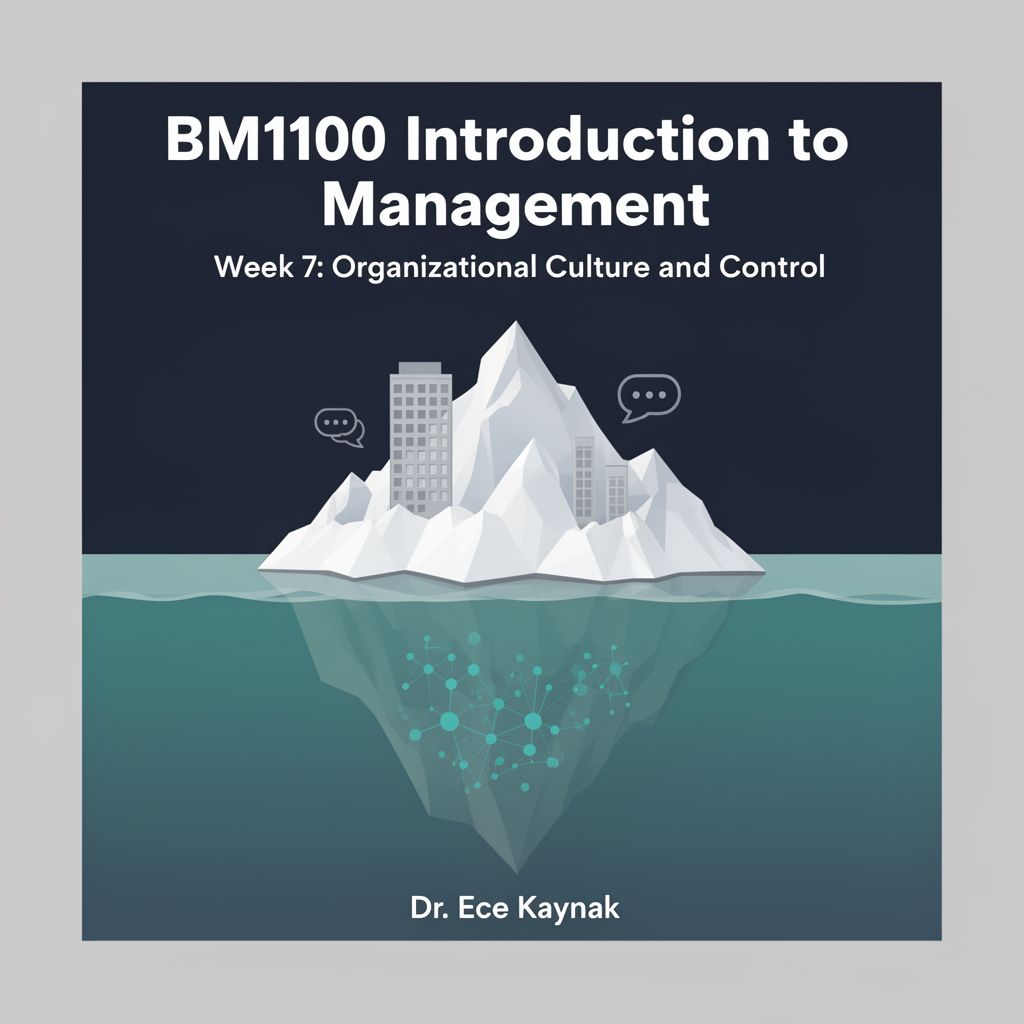
6. Schein’s ‘Iceberg’ Metaphor of Culture
📚 Key Idea: Organizational culture has observable (above the waterline) and unobservable (below the waterline) components.
- Observable Aspects (Artifacts): Visible structures, processes, behaviors, language, dress code, office layout.
- Unobservable Elements:
- Espoused Values: Stated philosophies, goals, strategies.
- Basic Underlying Assumptions: Unconscious, taken-for-granted beliefs, perceptions, thoughts, and feelings. These are the ultimate source of values and actions.
- Implication: Employee behavior is often shaped by these deep-seated, unconscious beliefs and assumptions, not just what is explicitly stated or observed.
💡 Implications of Schein’s Iceberg Metaphor (Q10)
Question: The ‘iceberg’ metaphor of culture by Schein suggests which of the following?
- a) The observable aspects of culture (artifacts, speech, practices) are more important than the unobservable elements.
- b) Employees’ behavior is often shaped by taken-for-granted, unconscious beliefs and assumptions.
- c) An organization’s values cannot be identified through what people say.
- d) Both (b) and (c)
Correct Answer: b) Employees’ behavior is often shaped by taken-for-granted, unconscious beliefs and assumptions. ✅ Explanation: The iceberg metaphor highlights that the most powerful and influential aspects of culture are the hidden, unconscious assumptions that drive behavior, rather than just the visible artifacts.
7. Different Forms of Control
- Bureaucratic Control: Rules, procedures, hierarchy, standardization.
- Market Control: Prices, competition, economic data.
- Clan Control (Cultural Control): Shared values, beliefs, norms, trust.
Week 8: Structure and Coordination
1. Five Key Concepts of Organizational Design
- Work Specialization: Degree to which tasks are divided into separate jobs.
- Departmentalization: Basis by which jobs are grouped together.
- Chain of Command: Line of authority from top to bottom.
- Span of Control: Number of subordinates a manager can efficiently and effectively direct.
- Centralization/Decentralization: Degree to which decision-making is concentrated at a single point.
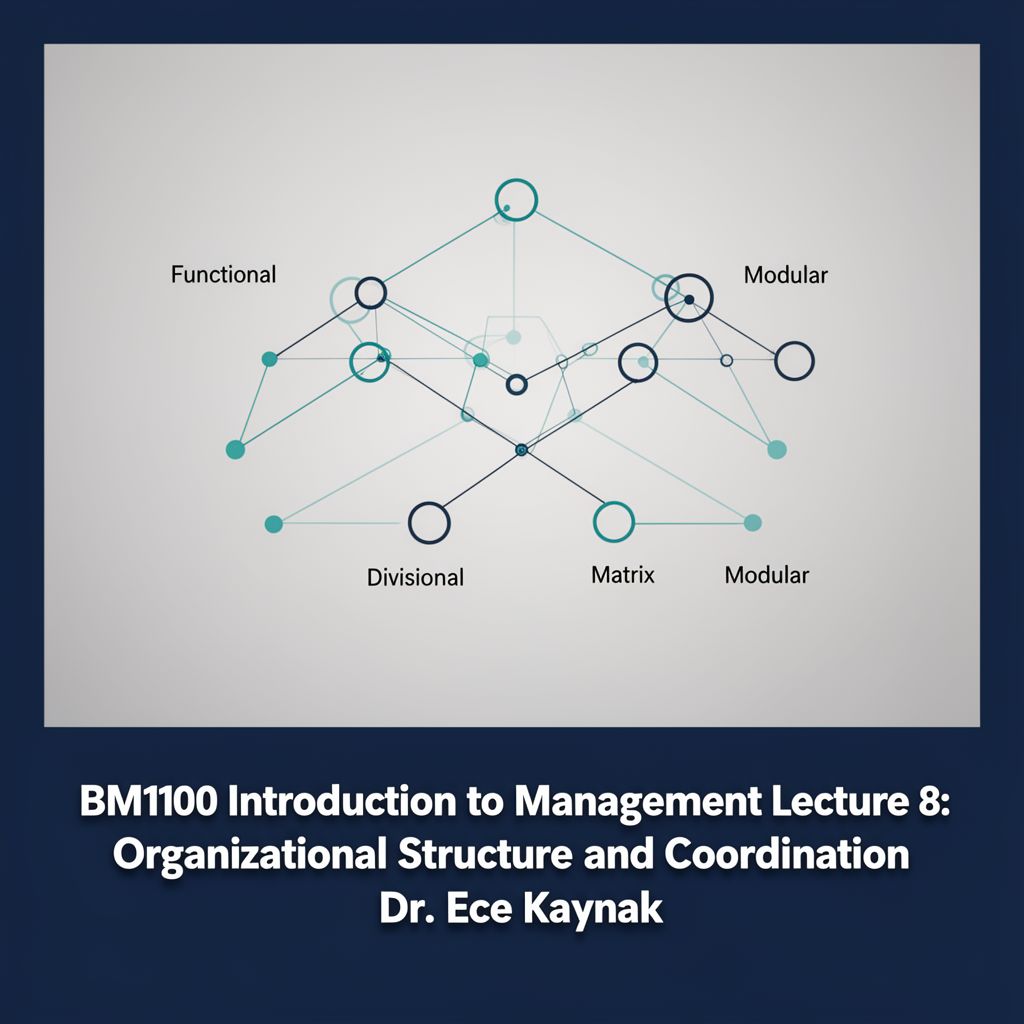
2. Three Generic Organizational Structures
a. Functional Structure
- Description: Groups jobs by similar functions (e.g., marketing, finance, production).
- Design Variables: High specialization, clear chain of command within functions.
- Pros: Efficiency, economies of scale, deep expertise development.
- Cons: Poor inter-functional communication, slow decision-making, narrow functional focus.
- When to Choose: Stable environments, small to medium-sized organizations, focus on efficiency and specialized skills.
b. Divisional Structure
- Description: Groups jobs by product, service, customer, or geographic region.
- Design Variables: Each division operates somewhat autonomously, with its own functional departments.
- Pros: Increased flexibility, better customer focus, clear accountability for products/services, easier to manage diverse product lines.
- Cons: Duplication of resources, potential for inter-divisional conflict, loss of economies of scale.
- When to Choose: Dynamic environments, large organizations with diverse offerings or customer bases.
💡 Divisional Structure by Customer Group (Q11)
Question: You are an entrepreneur running a growing social media agency. The company has three types of business: individual influencers who need your advice about increasing their follower count across platforms; small businesses that need help developing ad campaigns on Instagram; and brands that need help hiring influencers. These three streams require employees to follow different timelines for work, and draw on different skill sets and tools. What kind of organizational structure would probably be best suited for this organization?
- a) Divisional structure by product group
- b) Divisional structure by customer group
- c) Functional structure
- d) Matrix structure
Correct Answer: b) Divisional structure by customer group ✅ Explanation: Since the agency serves distinct customer segments (individual influencers, small businesses, brands), each with unique needs, timelines, and skill requirements, a divisional structure organized by customer group allows for specialized focus and better service delivery to each segment.
c. Matrix Structure
- Description: Combines functional and divisional departmentalization, creating dual lines of authority.
- Design Variables: Employees report to both a functional manager and a project/product manager.
- Pros: Efficient allocation of specialists, flexibility, better communication across functions, suited for complex projects.
- Cons: Dual reporting can lead to confusion and conflict, high administrative costs, power struggles.
- When to Choose: Complex, dynamic environments with multiple projects or product lines requiring cross-functional collaboration.
3. Modular (Networked) Organization
📚 Key Idea: A flexible organization that outsources non-core functions to external specialists, focusing on its core competencies.
- Definition: A central hub organization that coordinates a network of external organizations (suppliers, manufacturers, distributors) to produce a product or service.
- Key Design Variables:
- What to rent rather than own: Deciding which functions to outsource (e.g., manufacturing, logistics, IT).
- Who are the partners: Identifying and managing relationships with external partners.
💡 Design Variables of a Modular Organization (Q12)
Question: Which of the following correctly captures the design variables in a modular (networked) organization?
- a. How should projects be staffed?
- b. What should the organization rent rather than own?
- c. Who are the partners that organizations can work with?
- d. Both (b) and (c)
Correct Answer: d. Both (b) and (c) ✅ Explanation: Modular organizations are defined by their strategic decisions about which functions to outsource ("rent rather than own") and the selection and management of their external partners.
4. Role-Based Coordination
- Coordination achieved through clearly defined roles, responsibilities, and reporting relationships within the organizational structure.
5. Coordination in Organizations with Temporary, Fluid Membership
- Relies heavily on shared understanding, strong communication, clear goals, and flexible processes rather than rigid structures. Often seen in project-based teams, consulting firms, or volunteer organizations.
Week 9: Decision Making and Communication
1. Decision Making
a. Nature of Decision-Making in Groups and Organizations
- Often involves multiple perspectives, potential for conflict, and biases.
- Can lead to better decisions through diverse input but also to groupthink or slow processes.
b. Effective Decision-Making Behaviors
- Collect relevant information first before allowing people to discuss the decision itself. This ensures discussions are informed.
- Encourage diverse perspectives and critical thinking.
- Establish clear decision-making criteria.
💡 Effective Decision-Making Behaviors (Q13)
Question: Which of the following are examples of effective decision-making behaviors?
- a. Asking members of the decision-making group to share their positions up front.
- b. Strategically withhold information that you consider irrelevant.
- c. Suppressing all conflict
- d. Collect relevant information first before allowing people to discuss the decision itself.
- e. Both (c ) and (d)
Correct Answer: d. C…