Podit
Podit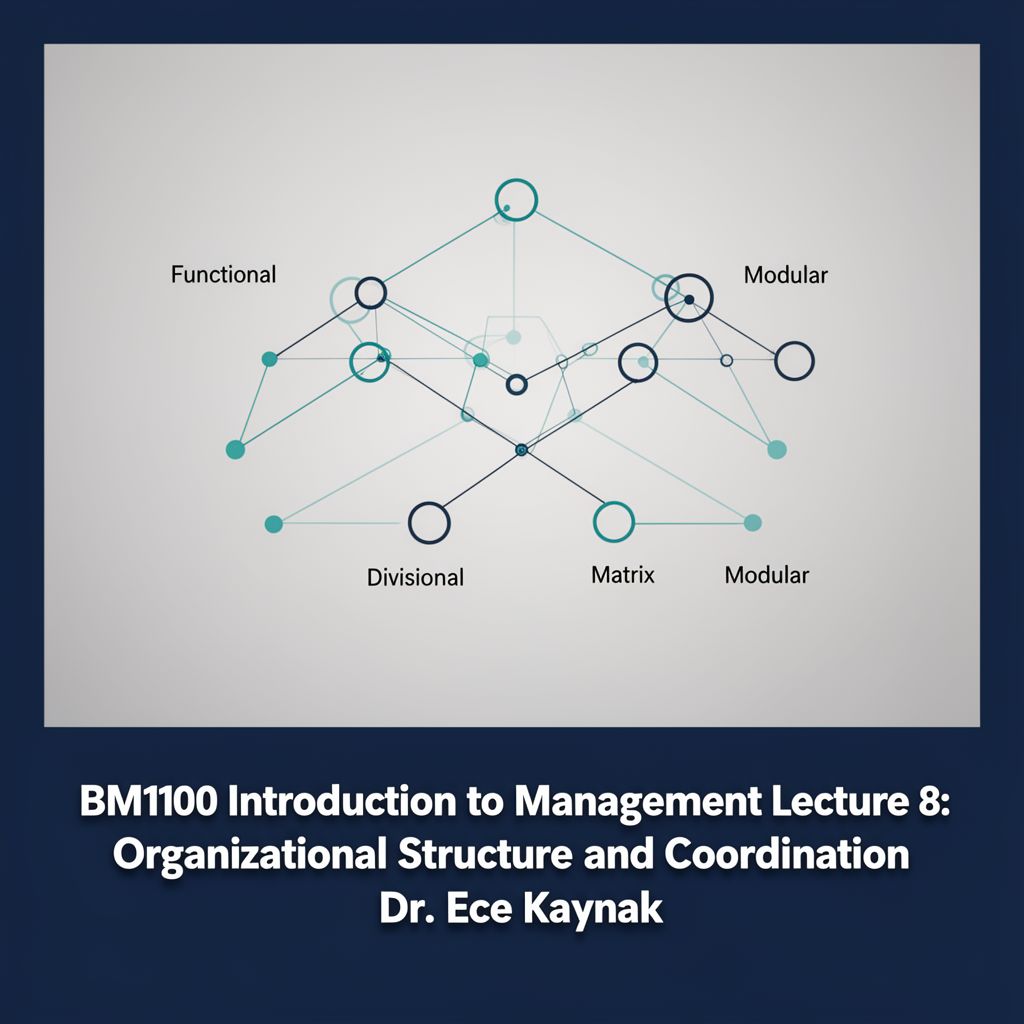
This study material is compiled from a lecture transcript and copy-pasted text provided by the user. All content has been organized, consolidated, and translated into English for clarity and ease of study.
📚 BM1100: Organizational Structure and Coordination
🎯 Overview
This study guide explores the fundamental principles of organizational structure and coordination. It delves into how organizations are designed, the various types of structures they adopt, and the mechanisms used to coordinate activities within them. Understanding these concepts is crucial for managing complexity and uncertainty in any organization.
1️⃣ Organizational Structure and Design Choices
📚 Definition
Organizational Structure: Defines how tasks within an organization are divided, grouped, and coordinated.
- Example: In a pharmaceutical company, organizational design choices determine the overall structure.
📊 Factors Affecting Organizational Design
Organizational design choices are influenced by several key factors:
- Size: The scale of the organization.
- Environment: The external conditions and challenges.
- Strategy: The organization's long-term goals and how it plans to achieve them.
- Technology: The tools and processes used in operations.
✅ Structure-Environment Fit
An organization's structure must:
- Serve its strategy.
- Match the needs of its environment. Organizations constantly remodel themselves to respond to environmental challenges. This fit is a dynamic relationship between:
- Culture
- Environment
- Strategy
- Structure
2️⃣ Key Concepts in Organizational Design
Organizational design involves several core concepts that define how work is organized and managed:
2.1. 📚 Work Specialization (Division of Labor)
- Definition: The degree to which activities are subdivided into separate jobs.
- Low Specialization:
- Seen in artisanal or craft production.
- Common in startup environments where individuals "wear multiple hats."
- High Specialization:
- Jobs are broken down into smaller, standardized tasks.
- Pros: Initially leads to efficiency and higher productivity.
- Cons: Over time, excessive specialization can lead to:
- Boredom
- Fatigue
- Stress
- Greater absenteeism
- High employee turnover
- Ultimately, lower productivity.
- 💡 Managerial Interventions: To improve productivity, managers might:
- Give workers a larger portion of a job.
- Allow workers to switch between tasks.
2.2. 📚 Centralization vs. Decentralization
- Definition: The degree to which decision-making authority is concentrated at higher levels of the hierarchy.
- Centralization:
- Key decisions are made centrally by top management.
- Can be very efficient, especially in stable environments.
- Example: Toyota's recall case in the U.S. (decisions made at headquarters).
- ⚠️ Disadvantage: Can lead to slower decision-making.
- Decentralization:
- Companies give more decision-making authority to employees closer to the decision context.
- Pros: Faster reaction time, empowers employees.
- Example: Tyson Foods' operations in China (local managers have significant autonomy).
2.3. 📚 Formalization
- Definition: The degree to which job descriptions, policies, rules, and procedures are explicitly articulated.
- Pros: Leads to consistent and uniform output.
- Example: McDonald's 'Operations and Training Manual' ensures consistency across its 75% franchised restaurants.
2.4. 📚 Span of Control
- Definition: How many individuals a manager can efficiently and effectively manage.
- Narrow Span of Control:
- Fewer employees per manager.
- Results in more hierarchical levels (e.g., a span of 4 leads to 7 levels for 4096 employees).
- Wide Span of Control:
- More employees per manager.
- Results in fewer hierarchical levels (e.g., a span of 8 leads to 5 levels for 4096 employees).
- 📊 Recent Trend: Towards wider spans of control to:
- Reduce operating costs.
- Make the organization more nimble and faster reacting.
- Empower employees.
2.5. 💡 Can You Have an Organization Without Bosses?
- Google's Experiment (2002): Founder Larry Page tried to eliminate middle management.
- Outcome: Failed. Over 100 engineers reported to a single executive, leading to frustration and confusion. It became impossible for people to work and for executives to understand what was happening.
- Insight: A hierarchy can be too flat; middle managers are often a necessary complexity.
- Self-Managing Teams:
- Historical Example: Coal mines in South Yorkshire (1950s) showed improved productivity.
- Modern Example (Holacracy): Zappos experiment (2013).
- Decision-making power is given to fluid teams ('circles') and roles, rather than individuals.
- Leadership is contextual, based on one's role in a given circle.
- ⚠️ Potential Disadvantages of "No Bosses" Models:
- Lack of clarity around progression, compensation, and responsibilities.
- Informal power structures can arise.
- No checks and balances, leading to unchecked power of emergent informal leaders.
- Conclusion: A certain level of hierarchy is needed to balance reliability with adaptability.
2.6. 📚 Departmentalization
- Definition: How jobs are grouped together within the larger organization.
- Possible Arrangements:
- By function (e.g., marketing, finance).
- By product group (e.g., medical devices, baby care).
- By geography (e.g., Region 1, Region 2).
- By customer group (e.g., consumers, corporate clients).
- A mix of these arrangements.
3️⃣ Generic Organizational Structures
Organizations typically adopt one of three generic structures, or a hybrid of them, based on their needs and environment. For each, we'll examine its key idea, design variables, pros, cons, and applicability.
3.1. 📊 Functional Structure
- Key Idea: The organization is built around inputs, usually the functional skills of people. Often the first formal structure adopted when a company grows and employees specialize.
- Design Variables: Which skill sets does the organization need?
- Example:
CEO ├── Sales ├── Marketing ├── R&D ├── Production ├── Government Affairs ├── HR └── Finance - ✅ Pros:
- In-depth knowledge sharing and specialization within functional departments.
- Economies of scale (efficient use of resources).
- ⚠️ Cons:
- Poor horizontal communication across departments (creates "silos").
- No one sees the "big picture" except the CEO.
- Slow decision-making (hierarchical overload).
- Limited adaptability to changes.
- Applicability: Organizations with little product diversity (small number of related products/services) operating in a stable environment.
3.2. 📊 Divisional Structure
- Key Idea: Organize around outputs (products, customer segments, geographies) to reduce the amount of information needed by functional specialists.
- Historical Example (DuPont, 1920s):
- After WWI, DuPont expanded from explosives into dyes, paints, plastics.
- Their functional structure couldn't support this diversification, leading to losses and inability to pinpoint responsibility for product line profits.
- Solution: Shifted to a multi-divisional structure, making the product the center. Created self-contained divisions (Explosives, Dyes, Plastics, etc.), each with its own General Manager and functional departments.
- Design Variables:
- Which outputs to organize around (e.g., product, customer segment, geography)?
- Which outputs are similar enough to be grouped, and different enough to deserve their own divisions?
- What should be the degree of self-containment for each division?
- Examples:
- By Product:
CEO ├── Medical Devices Division (Production, Finance, Sales & Marketing) ├── Baby Care Division (Production, Finance, Sales & Marketing) └── Nutritional Supplements Division (Production, Finance, Sales & Marketing) - By Customer Group:
CEO ├── Consumers Division (SW, HW, Sales & Marketing) ├── Corporate Clients Division (SW, HW, Sales & Marketing) └── Carriers Division (SW, HW, Sales & Marketing) - By Geography:
CEO
├── Region 1 Division (Marketing, Finance, Production)
├── Region 2 Division (Marketing, Finance, Production)
└── Region 3 Division (Marketing, Finance, Production)
- By Product:
- ✅ Pros:
- Maximizes interaction within the unit.
- Reduces the need for information since each unit handles only one group of output.
- Decision-making authority is given to divisional units, leading to faster responses.
- Serves as a training ground for executives (they gain experience running a "small business").
- ⚠️ Cons:
- Functional economies of scale are lost.
- Tendency to duplicate work across divisions.
- Difficulty communicating across divisional units.
- Applicability: Diversified organizations, dynamic markets, firms with high information processing needs.
3.3. 📊 Matrix Structure
- Key Idea: Emerged to combine the benefits of both functional and divisional structures. The organization is structured around both functions AND outputs. People report to two bosses (e.g., a functional manager and a project/product manager).
- Design Variables: What are the projects or product lines?
- Example:
(Functional Departments: Engineering, Marketing, Production) | V Product A Team <--- Reports to Product A Manager AND Functional Managers Product B Team <--- Reports to Product B Manager AND Functional Managers Product C Team <--- Reports to Product C Manager AND Functional Managers - ✅ Pros:
- Increases information-processing capacity.
- Improves decision-making.
- Retains specialization and functional economies of scale.
- High adaptability to the environment.
- ⚠️ Cons:
- More time needed to constantly communicate and align people.
- Multiple reporting relationships can be confusing and stressful.
- Increased likelihood of a conflict-laden environment.
- Applicability: Environments with high uncertainty (i.e., high information processing demands), high performance pressure, and dual demands (e.g., for both skill development and product development).
- 💡 Employee/Manager Needs in a Matrix:
- Manage Stakeholders and Priorities: Prioritize roles, communicate effectively with multiple stakeholders (over-communicate!).
- RACI Matrix: Ask: Who is Responsible, who is Accountable, who needs to be Consulted, and who needs to be Informed?
- Lead Without Authority: Influence and guide without direct hierarchical power over all team members.
4️⃣ Newer Modes of Organizing: Modular Structures
📚 Definition
Modular (or Network) Organizations: "Loosely coupled" networks of organizational actors. If the hierarchical, multi-divisional structure defined the 20th century, the modular structure is emblematic of the 21st century.
📈 Catalysts for Modular Structures
- Global competition.
- Technological advances.
- Shorter product life cycles.
💡 Solution
Look beyond the boundaries of the organization and connect with networks of suppliers and other partners.
❓ Design Variable
"What can I rent/borrow rather than own?" What resources in the environment can the organization tap into?
🌐 Structure
- The focal organization collaborates with external partners (suppliers, service providers) to keep overhead costs low and increase flexibility.
- Example:
External Advertising Agency
Manufacturers in different parts of the world
Outsourced Payroll
Outsourced Call Center
<--- All connected to ---> Focal Organization
🌍 Examples
- Instant Pot:
- Only 50 employees in Canada.
- Production outsourced to factories in China.
- Marketing through 'influencers,' word-of-mouth, cookbooks.
- Distribution primarily through Amazon.
- Movie Industry:
- Used to be dominated by large, vertically integrated studios (e.g., Warner Bros).
- Today, most movies are produced on a 'project' basis by an assemblage of contracted specialists (actors, directors, editors, screenwriters, set designers, makeup artists) and small companies.
- These actors are assembled for a finite period, then disassembled after the project.
- Pros: Increases flexibility and reduces bureaucratic overhead.
5️⃣ Coordination in Temporary, Modular Structures
🚧 Challenges
- Organizing around 'projects' is a type of modular organization that is temporary.
- There are no stable relationships, administrative routines, or formal hierarchy.
- Complex and interdependent tasks must be accomplished by specialists who may have never worked together before, within a bounded timeframe.
✅ Solution
In such temporary organizations, roles and role structures provide the basis for coordination. Clear definition and understanding of individual roles are paramount.
💡 Key Takeaways
- Leaders use organizational design choices to manage complexity and uncertainty.
- The goal is to optimize the organization's information processing capacity without overburdening individuals.
- In reality, many organizational structures are a hybrid of functional and divisional forms.
- The formal organizational chart tells only part of the story; there is always an 'informal' organization at play.