Podit
Podit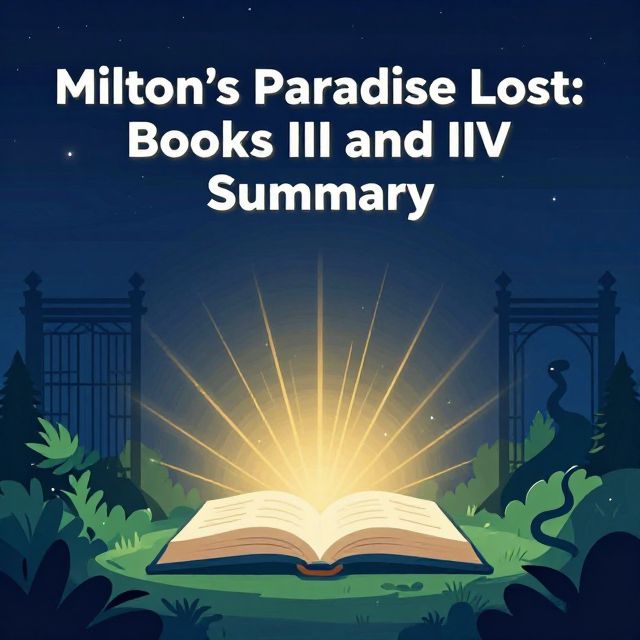
Study Guide: John Milton's Paradise Lost - Books III & IV
Source Material:
- Copy-pasted text from "Paradise Lost" (Pages 49-85, Books III and IV)
- Lecture Audio Transcript: "Introduction to Paradise Lost: Books III and IV"
📚 Introduction to Books III & IV
John Milton's epic poem, Paradise Lost, delves into the biblical story of the Fall of Man. Books III and IV are pivotal, shifting focus from the infernal council to the divine perspective and the initial infiltration of Paradise. Book III reveals God's plan for humanity's redemption and the Son's sacrificial offer, while Book IV details Satan's journey to Earth, his first encounter with Adam and Eve, and the initial angelic efforts to thwart his malevolent designs. These books explore profound theological concepts such as free will, divine justice, mercy, and the nature of evil.
📖 Book III: The Divine Council and Redemption
Book III opens with a powerful invocation and then transports the reader to the celestial realm, where the fate of humanity is deliberated.
1. The Poet's Invocation to Light 💡
The book begins with the poet's personal plea to "holy light," a divine emanation. Milton, who was blind, laments his physical darkness and seeks spiritual illumination to guide his epic narrative. This invocation serves as a transition from the darkness of Hell in the preceding books to the light of Heaven.
- Key Theme: The poet's reliance on divine inspiration to "see and tell / Of things invisible to mortal sight" (lines 54-55).
- Personal Connection: Milton draws a parallel between his own blindness and that of ancient prophets like Thamyris and Tiresias, emphasizing his unique position to interpret divine truths.
2. God's Foreknowledge and Free Will ✅
From his throne in the Empyrean, God the Father surveys all creation, including the newly formed Earth and Satan's approach. He foresees humanity's impending Fall.
- Divine Foreknowledge: God knows Adam and Eve will fall, but clarifies that this is not predestination.
- Human Free Will: Humanity's transgression will stem from their own "free will," not from a divine decree (lines 96-128). God created all beings, including angels, with the freedom to stand or fall, emphasizing that true allegiance must be freely chosen.
- Distinction from Fallen Angels: Unlike the rebellious angels, humanity will be offered grace and mercy, alongside justice, because they are "deceiv'd / By the other first" (lines 130-131).
3. The Son's Redemptive Sacrifice 💖
In response to God's pronouncement, the Son, embodying divine compassion and love, voluntarily offers himself as a sacrifice to atone for humanity's future sin.
- Voluntary Offer: The Son offers his life ("life for life / I offer," lines 236-237) to satisfy divine justice and redeem mankind.
- Unparalleled Love: This act of "unexampl'd love" (line 410) demonstrates his filial obedience and boundless compassion.
- Prophecy of Kingship: God accepts the Son's offer, prophesying his future role as universal King, judge of all beings, and orchestrator of a "New Heav'n and Earth" (line 335).
4. Heavenly Adoration 🎶
The heavenly host responds with hymns of adoration, praising both the Omnipotent Father and the Begotten Son.
- Hymns of Praise: Angels sing praises to God as the "Author of all being, / Fountain of Light" (lines 374-375) and to the Son as "Saviour of Men" (line 412).
- Symbolism: They cast down their crowns woven with "Immortal Amarant" (line 352), a flower symbolizing immortality and unfading glory.
🏞️ Book IV: Satan's Journey and Discovery of Paradise
Book IV shifts to Satan's perspective as he makes his way to Earth, driven by malice and despair.
1. Satan's Internal Torment and Defiance 😈
Satan's journey to Earth is marked by profound internal conflict. He is consumed by hatred for the celestial light, which reminds him of his lost glory.
- Soliloquy: His famous soliloquy (lines 32-113) reveals his despair and defiance. He acknowledges his culpability ("Till Pride and worse Ambition threw me down," line 40) but rejects repentance, declaring, "Evil be thou my Good" (line 110).
- Motivation: His primary goal is to corrupt humanity, God's latest creation, as an act of vengeance against God.
2. Satan's Disguise and Deception of Uriel 🎭
Satan traverses the desolate outer regions of the cosmos, eventually reaching the "firm opacous Globe" (line 418) of Earth.
- Paradise of Fools: During his journey, he passes through a "Limbo large and broad, since calld / The Paradise of Fools" (lines 495-496), where vain and unaccomplished human endeavors and misguided religious practices end up.
- Disguise: To gain access to Paradise, Satan transforms himself into a "stripling Cherube" (line 366).
- Deception: He encounters the Archangel Uriel, Regent of the Sun, and feigns a pious desire to observe God's works, particularly humanity. Uriel, deceived by Satan's "saintly shew" (line 122), directs him to Earth and points out Paradise.
3. Description of Paradise 🌳
Satan arrives at Paradise, depicted as a magnificent, divinely cultivated garden, a "Heaven on Earth" (line 208).
- Idyllic Setting: It is a place of unparalleled beauty, with lush trees, fragrant flowers, and flowing rivers (lines 216-265).
- Trees of Life and Knowledge: The Garden contains the Tree of Life and, crucially, the Tree of Knowledge, "Knowledge of Good bought dear by knowing ill" (line 222).
4. Adam and Eve's Innocence and Conjugal Love ❤️
Satan observes Adam and Eve in their state of pristine innocence, reflecting the divine image.
- Perfect Innocence: They are "naked Majestie" (line 290), unashamed, and embody "Simplicitie and spotless innocence" (line 318).
- Complementary Roles: Adam is formed for "contemplation hee and valour" (line 297), while Eve is for "softness shee and sweet attractive Grace" (line 298). Their relationship is one of harmonious submission and mutual love.
- Eve's Creation: Eve recounts her awakening and her initial encounter with her own reflection, and how a divine voice guided her to Adam, whom she recognizes as her "Guide / And Head" (lines 442-443).
- Conjugal Love: Their love is portrayed as pure, a "mysterious Law, true source / Of human ofspring" (lines 750-751), contrasting sharply with Satan's corrupted desires.
5. Satan's Envy and Plan 🐍
Observing their bliss, Satan is consumed by envy and malevolence.
- Vulnerability: He overhears Adam reminding Eve of the sole prohibition: the Tree of Knowledge. Satan identifies this as the weakness he can exploit.
- Strategy: He resolves to incite their desire for knowledge, believing it will lead them to aspire to be "Equal with Gods" (line 526), thus ensuring their downfall and God's vexation.
⚔️ Confrontation in Paradise
As night falls, the angelic guards are on watch, leading to a direct confrontation with the infiltrating Satan.
1. Angelic Guards and Uriel's Warning 🚨
Adam and Eve retire to their bower, while angelic guards, led by Gabriel, prepare for their nightly watches.
- Uriel's Realization: Uriel, having observed Satan's "looks / Alien from Heav'n" (lines 570-571) after his departure, realizes he was deceived.
- Warning to Gabriel: Uriel descends on a sunbeam to warn Gabriel that a "banisht crew" (line 573) member has infiltrated Paradise.
2. Satan's Discovery and Transformation 🐸
Gabriel dispatches Ithuriel and Zephon to search Paradise.
- Discovery: They find Satan "Squat like a Toad, close at the eare of EVE" (line 800), attempting to inject "Illusions, Phantasms and Dreams" (line 803) into her sleep.
- Forced Transformation: Ithuriel's spear, being of "Celestial temper" (line 811), forces Satan to revert to his true, hideous form, revealing his "faded splendor wan" (line 870).
3. Verbal Exchange with Gabriel 🗣️
The angels confront Satan, questioning his presence and transformation.
- Satan's Defiance: Satan, filled with scorn, asserts his former glory and challenges their authority, arguing that escaping Hell is natural for one seeking relief from torment.
- Gabriel's Rebuke: Gabriel exposes Satan's hypocrisy, branding him a "lyar trac't" (line 949) and reminding him of his past subservience before his rebellion. He threatens to drag Satan back to Hell if he does not depart.
4. Divine Intervention and Satan's Retreat ⚖️
As the angelic host prepares for battle, God intervenes to prevent a destructive conflict.
- Golden Scales: God hangs forth his "golden Scales" (line 997) in Heaven, weighing the outcomes of "parting and of fight" (line 1003).
- Satan's Fate: The scale representing flight quickly ascends, signifying Satan's inevitable defeat if he were to fight.
- Retreat: Gabriel points this out to Satan, who, recognizing his fate, flees "Murmuring, and with him fled the shades of night" (lines 1014-1015), concluding Book IV.