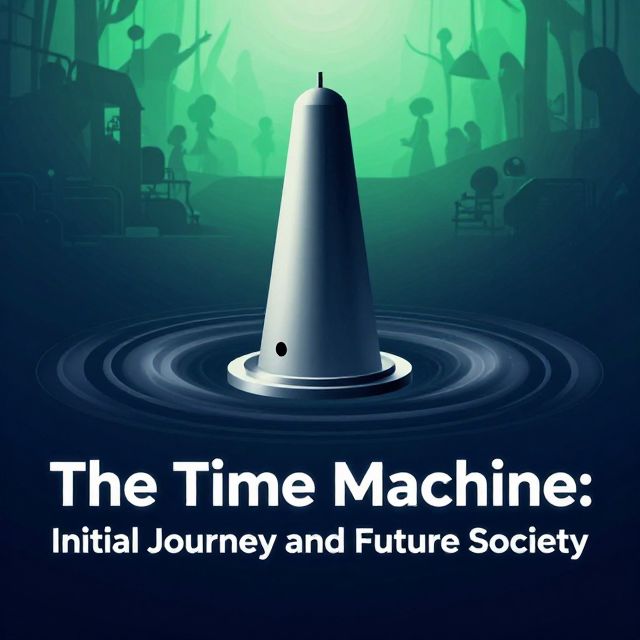
The Time Machine: Initial Journey and Future Society - kapak
Edebiyat#the time machine#h.g. wells#science fiction#time travel

The Time Machine: Initial Journey and Future Society

This summary explores the Time Traveller's initial exposition of the Fourth Dimension, his maiden voyage into the distant future, and his early observations and theories regarding the bifurcated human society of the Eloi and Morlocks.

carpedi3mApril 15, 2026 ~22 dk toplam
01

Sesli Özet

6 dakika

Konuyu otobüste, koşarken, yolda dinleyerek öğren.

Sesli Özet

The Time Machine: Initial Journey and Future Society

0:006:25
02

Flash Kartlar

25 kart

Karta tıklayarak çevir. ← → ile gez, ⎵ ile çevir.

1 / 25
Tüm kartları metin olarak gör
  1. 1. What radical concept does the Time Traveller introduce to his guests?

    The Time Traveller introduces the concept of Time as the Fourth Dimension. He argues that just as objects have length, breadth, and thickness, they must also possess duration to truly exist, making time an integral, analogous dimension to the three spatial ones.

  2. 2. How does the Time Traveller challenge conventional geometry?

    He challenges it by stating that abstract concepts like a mathematical line or plane lack real existence. He extends this to a cube, arguing that without duration, a cube cannot truly exist, implying that real bodies must extend in four directions, including time.

  3. 3. What analogy does the Time Traveller use to explain the Fourth Dimension?

    He uses the analogy of length, breadth, and thickness as the three spatial dimensions. He then posits that duration (time) is the fourth dimension, directly analogous to these three, suggesting that any real body must extend in all four.

  4. 4. Describe the model of the Time Machine presented by the Time Traveller.

    The model was intricately crafted, made of a glittering metallic framework, ivory, and crystalline substances. It was designed with two levers: one to send it into the future and another to reverse its motion, demonstrating his theoretical principles.

  5. 5. How did the Time Traveller demonstrate the functionality of his model Time Machine?

    He allowed the Psychologist to activate one of its levers. The model visibly vanished from the table, leaving it bare, which profoundly impacted the observers and confirmed the Time Traveller's claims of experimental verification.

  6. 6. What was the general reaction of the guests to the Time Traveller's theories and demonstration?

    The guests were largely skeptical, particularly Filby. Despite the convincing demonstration, they attributed the vanishing act to trickery rather than a genuine scientific breakthrough, struggling to accept such a radical concept.

  7. 7. What was the significance of the model's disappearance?

    The model's disappearance was crucial as it provided tangible, experimental verification for the Time Traveller's radical theories about time travel. It served as a powerful, albeit initially disbelieved, proof of concept for his guests.

  8. 8. What was the Time Traveller's next step after the model demonstration?

    Following the successful demonstration of the model, the Time Traveller revealed that a full-sized machine was nearing completion. This larger machine was intended for his personal journey, despite his guests' continued incredulity.

  9. 9. Describe the Time Traveller's state upon his return from his maiden voyage.

    Upon his return, the Time Traveller was found in a disheveled and injured state. He was exhausted and bore signs of a significant and challenging experience, indicating the arduous nature of his journey.

  10. 10. How did the Time Traveller describe the sensation of accelerating through time?

    He described it as a disorienting, headlong motion. Day and night rapidly succeeded each other, the sun streaked across the sky, and the landscape blurred into a continuous greyness, creating a sensation of immense speed and temporal distortion.

  11. 11. What was the approximate speed of his time travel, according to the machine's dials?

    The dials on his machine indicated an astonishing speed of over a year per minute. This rapid progression allowed him to witness seasons flash by in quick succession, highlighting the immense temporal distance he was covering.

  12. 12. In what year did the Time Traveller's maiden voyage culminate?

    His journey culminated in the distant future, specifically the year 802,701 A.D. This far-future setting provided the backdrop for his profound discoveries about humanity's evolution.

  13. 13. What was the Time Traveller's initial impression of the world upon his arrival?

    Upon arrival, he found himself in a garden-like world, surrounded by rhododendron bushes. He also observed a colossal white marble sphinx, suggesting a blend of natural beauty and ancient, monumental structures.

  14. 14. Who were the first creatures the Time Traveller encountered in the future?

    The first creatures he encountered were the Eloi. They were described as small, graceful, and frail human-like beings, dressed in tunics, and characterized by their beauty, apparent lack of fear, but also intellectual simplicity.

  15. 15. What critical event occurred shortly after the Time Traveller's arrival?

    A critical event occurred when he discovered his Time Machine had vanished from the pedestal of the White Sphinx. This plunged him into panic and despair, as he realized the immense danger of being stranded in this unknown future.

  16. 16. How did the Eloi react to the Time Traveller's distress over his vanished machine?

    The Eloi reacted with incomprehension or laughter to his attempts to communicate about the machine's disappearance. This highlighted their limited intellect, lack of concern, and general passivity, offering no help.

  17. 17. Who was Weena, and what was her significance?

    Weena was an Eloi whom the Time Traveller rescued from drowning, an act none of her own kind attempted. This event marked the beginning of a brief, affectionate friendship and further demonstrated the Eloi's passivity and lack of self-preservation.

  18. 18. What observation did the Time Traveller make about the Eloi's behavior at night?

    He observed that the Eloi had a profound fear of darkness. They would gather in large houses to sleep and never ventured out alone after nightfall, suggesting a hidden danger or threat associated with the dark.

  19. 19. What discovery led the Time Traveller to encounter the Morlocks?

    His investigation of numerous deep wells and ventilation shafts, coupled with the Eloi's fear of darkness, led him to explore one of these wells. This exploration resulted in his encounter with the subterranean Morlocks.

  20. 20. Describe the Morlocks.

    The Morlocks were pale, ape-like creatures with large, reflective eyes. They inhabited the subterranean world, adapted to darkness, and represented a stark contrast to the surface-dwelling Eloi.

  21. 21. What was the Time Traveller's initial theory about humanity's bifurcation?

    He theorized that humanity had bifurcated into two distinct species: the surface-dwelling Eloi and the underground Morlocks. He believed this was a result of extreme social stratification from his own era, where the wealthy lived above and laborers toiled below.

  22. 22. What role did the Time Traveller initially suspect the Morlocks played in this future society?

    He deduced that the Morlocks performed the necessary labor to sustain the Eloi's comfortable existence. They were adapted to darkness and were the subterranean workers, while the Eloi lived in idyllic ease on the surface.

  23. 23. How did the Time Traveller's understanding of the Eloi evolve?

    His initial optimistic view of the Eloi as inhabitants of a social paradise quickly changed. He concluded that their prolonged security and lack of hardship led to significant degeneration in physical strength, intelligence, and vitality, reducing them to childlike, passive beings.

  24. 24. How did his understanding of the Morlocks evolve beyond their initial discovery?

    He realized that the Morlocks, forced into a subterranean existence, had adapted to darkness, becoming physically modified and retaining a functional, albeit brutal, existence. This adaptation was a logical outcome of their environment and role.

  25. 25. What new, unsettling theory did the Time Traveller develop about the relationship between the Eloi and the Morlocks?

    He developed the unsettling theory that the Eloi were essentially livestock, unknowingly sustained and preyed upon by the Morlocks. This implied a horrific reversal of roles, where the former laborers now consumed their former masters.

03

Bilgini Test Et

15 soru

Çoktan seçmeli sorularla öğrendiklerini ölç. Cevap + açıklama.

Soru 1 / 15Skor: 0

What complex concept does the Time Traveller initially present to his guests?

04

Detaylı Özet

6 dk okuma

Tüm konuyu derinlemesine, başlık başlık.

H.G. Wells' The Time Machine: An Analysis of Time Travel and Future Societies

Source Information:

  • Lecture Audio Transcript: Provides an overview and thematic structure.
  • Copy-Pasted Text: Excerpts from H.G. Wells' The Time Machine (Chapters I-V), offering direct narrative details, character interactions, and the Time Traveller's observations and theories.

📚 Introduction: Pioneering Time Travel and Social Commentary

H.G. Wells' The Time Machine is a seminal work of science fiction that introduces the concept of time travel and uses it as a vehicle for profound social commentary. The narrative begins with the Time Traveller, an enigmatic scientist, presenting his radical theories to a group of skeptical guests. This study material explores his foundational ideas about time as the Fourth Dimension, his inaugural journey into the distant future, and his initial, unsettling discoveries about the fate of humanity.


1. ⏳ The Fourth Dimension: A Revolutionary Concept

The Time Traveller challenges conventional understanding by positing that Time is not merely an abstract concept but a physical dimension, akin to length, breadth, and thickness.

1.1. Challenging Conventional Geometry

Mathematical Abstractions: The Time Traveller argues that mathematical lines and planes, which have "thickness nil," lack real existence. He extends this to a cube, stating that a solid body cannot truly exist without "Duration." 📚 Key Concept: Duration - The fourth dimension, alongside length, breadth, and thickness, essential for any real body to exist.

  • He asserts that the geometry taught in schools is "founded on a misconception," implying a limited view of reality.

1.2. Time as the Fourth Dimension

💡 Overlooked Fact: Humanity tends to "overlook" Time as a dimension because consciousness moves "intermittently in one direction" along it, from birth to death.

  • He clarifies that there is "no difference between time and any of the three dimensions of space except that our consciousness moves along it."
  • This theory suggests that movement through time should be as possible as movement through space.

1.3. Experimental Verification: The Model Time Machine

🔬 The Demonstration: To prove his theory, the Time Traveller unveils a small, intricately crafted model of a machine made of "glittering metallic framework, ivory, and some transparent crystalline substance."

  • He explains that one lever sends it into the future, and another reverses its motion.
  • Despite the guests' skepticism, particularly from Filby, the Psychologist is persuaded to press the lever.
  • The model "vanished, pass[ed] into future Time, and disappear[ed]," leaving the table bare. This "experimental verification" profoundly impacts the observers, confirming the Time Traveller's radical claims.

2. 🚀 The Maiden Voyage: Into the Distant Future

Following the model's success, the Time Traveller embarks on his personal journey, returning with a harrowing tale of his first experience.

2.1. Departure and Sensations of Time Travel

⚠️ Guests' Incredulity: The guests initially dismiss the model's disappearance as a "sleight-of-hand trick," highlighting their deep-seated skepticism despite the evidence.

  • The Full-Sized Machine: The Time Traveller reveals a larger version of the machine, "generally complete," made of nickel, ivory, and rock crystal.
  • Disorienting Acceleration: His journey begins with a "nightmare sensation of falling." As he accelerates, day and night rapidly succeed each other, the sun becomes a "streak of fire," and the landscape blurs into a "continuous greyness."
  • Rapid Passage of Time: The dials on his machine indicate a speed of "over a year a minute," allowing him to witness seasons flash by.

2.2. Arrival in 802,701 A.D.

🌍 A Transformed World: He lands in a garden-like world, observing "huge buildings rise up faint and fair, and pass like dreams." The earth's surface appears "changed—melting and flowing under my eyes."

  • The White Sphinx: His arrival point is marked by a "colossal figure, carved apparently in some white stone... something like a winged sphinx."
  • First Encounter: The Eloi: He soon meets the inhabitants, the Eloi. They are described as "small, graceful, and frail" creatures, about four feet high, dressed in tunics. He notes their "beautiful and graceful" appearance but also their "indescribably frail" nature and "lack of interest."

2.3. The Vanished Machine and Rising Panic

🚨 The Discovery: Upon returning to his landing spot, the Time Traveller finds his machine gone. It was "removed out of my reach," presumably into the hollow pedestal of the White Sphinx.

  • Panic and Despair: This realization plunges him into "a passion of fear," as he faces the possibility of being "left helpless in this strange new world." He frantically searches, his "frenzy" leading to physical exhaustion and despair.

3. 👥 Initial Theories: Eloi, Morlocks, and Social Stratification

The Time Traveller's observations lead him to formulate initial theories about the future of humanity.

3.1. Characteristics of the Eloi

Decadent Innocence: The Eloi are childlike, gentle, and lack curiosity or intellectual depth. They communicate in "soft cooing notes" and are easily amused.

  • Lack of Self-Preservation: Their passivity is starkly illustrated when none attempt to rescue Weena, an Eloi, from drowning. The Time Traveller saves her, forming a brief, affectionate bond.
  • Fear of Darkness: A significant observation is their "singularly passionate emotion" of fear towards darkness, leading them to gather in large houses at night.

3.2. Discovery of the Morlocks

subterranean world.

  • The Wells and Ventilation Shafts: The Time Traveller notices numerous "circular wells" and "tall towers" which he deduces are part of an "extensive system of subterranean ventilation."
  • The Morlocks: Investigating a well, he encounters pale, ape-like creatures with large, reflective eyes and flaxen hair on their heads and backs. These are the Morlocks, adapted to darkness.
  • Bifurcation of Humanity: He realizes that humanity has "differentiated into two distinct animals": the surface-dwelling Eloi and the subterranean Morlocks.

3.3. The Theory of Social Evolution

📈 Extreme Social Stratification: The Time Traveller theorizes that the "gradual widening of the present merely temporary and social difference between the Capitalist and the Labourer" in his own era led to this biological split.

  • Eloi's Degeneration: The "Haves," pursuing pleasure and comfort above ground, evolved into the frail, unintelligent Eloi, their strength and intellect atrophied by "perfect comfort and security."
  • Morlocks' Adaptation: The "Have-nots," the "Workers" forced underground, adapted to their harsh conditions, becoming the physically modified Morlocks, who perform the necessary labor.
  • A Real Aristocracy: This is not a "triumph of moral education" but an outcome of an industrial system where "triumph over Nature" became "triumph over Nature and the fellow-man."

4. 🧐 Evolving Understanding and Unresolved Mysteries

The Time Traveller's initial, somewhat optimistic, theories quickly give way to a more unsettling reality.

4.1. The Eloi as "Livestock"

⚠️ Unsettling Realization: The Time Traveller's understanding evolves to the horrifying conclusion that the Eloi are not merely living in idyllic ease, but are "livestock, unknowingly sustained and preyed upon by the Morlocks."

  • The Morlocks, adapted to darkness, emerge at night to hunt the Eloi.

4.2. The Mystery of the Time Machine

Morlock Involvement: He feels "sure it was they who had taken" his Time Machine, though their motives remain unclear.

  • Eloi's Helplessness: The Eloi's inability or unwillingness to help him retrieve the machine further underscores their passivity and lack of agency.
  • Vulnerability: Stranded and facing a brutal reality, the Time Traveller is acutely aware of his "vulnerability in this strange new world."

4.3. Continued Determination

💡 Quest for Knowledge: Despite the profound implications and personal danger, the Time Traveller remains determined to "fully comprehend the dynamics of this future society and recover his means of returning home." His journey is far from over, setting the stage for deeper exploration and confrontation.
Kendi çalışma materyalini oluştur

PDF, YouTube videosu veya herhangi bir konuyu dakikalar içinde podcast, özet, flash kart ve quiz'e dönüştür. 1.000.000+ kullanıcı tercih ediyor.

Sıradaki Konular

Tümünü keşfet
The Time Machine: Final Journeys and Disappearance

The Time Machine: Final Journeys and Disappearance

An academic summary of the Time Traveller's harrowing encounters with Morlocks, his journey into Earth's distant future, and his enigmatic final disappearance, as depicted in H.G. Wells' classic novel.

6 dk Özet 25 15
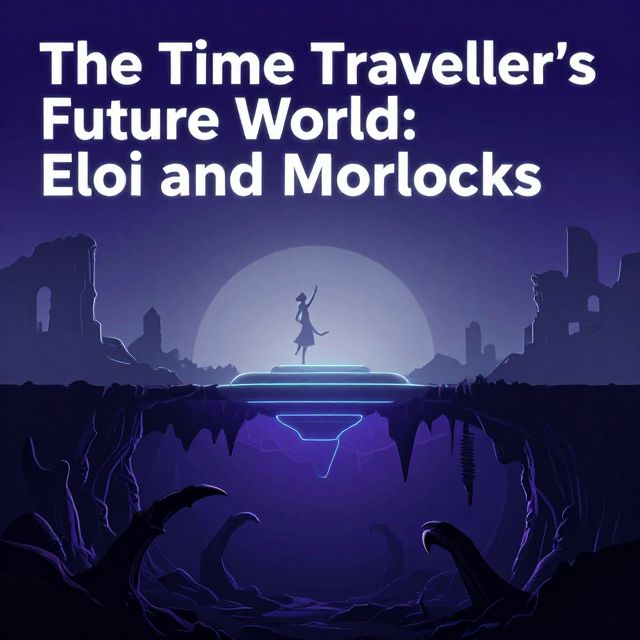
The Time Traveller's Future World: Eloi and Morlocks

The Time Traveller's Future World: Eloi and Morlocks

An academic summary of the Time Traveller's initial encounters, evolving theories on future humanity, and preparations for retrieving his Time Machine in H.G. Wells' 'The Time Machine'.

6 dk Özet 25 15
Development of Contemporary African American Fiction

Development of Contemporary African American Fiction

An academic overview of the development of contemporary African American fiction, exploring its narrative techniques, linguistic features, and key socio-historical and theoretical concepts.

7 dk Özet 25 15
Milton's Paradise Lost: Books III and IV Summary

Milton's Paradise Lost: Books III and IV Summary

An academic summary of John Milton's Paradise Lost, focusing on Book III's divine council and the Son's sacrifice, and Book IV's depiction of Satan's journey to Eden and his first encounter with humanity.

6 dk Özet 25 15
Imagist Poetry: Characteristics and Key Figures

Imagist Poetry: Characteristics and Key Figures

This audio summary explores Imagist Poetry, detailing its historical context, core principles, and the contributions of prominent figures such as Amy Lowell, H.D., and William Carlos Williams.

6 dk Özet 25 15
Oliver Twist: Plot, Characters, and Social Commentary

Oliver Twist: Plot, Characters, and Social Commentary

An academic summary of Charles Dickens's 'Oliver Twist,' detailing its intricate plot, key characters, and profound social commentary on Victorian England's poverty and injustice.

6 dk Özet 25 15
Common Characteristics of Living Organisms

Common Characteristics of Living Organisms

An academic summary detailing the fundamental characteristics shared by all living organisms, including cellular organization, metabolism, homeostasis, reproduction, growth, response to stimuli, and adaptation.

5 dk Özet 25 15
Common Characteristics of Living Organisms

Common Characteristics of Living Organisms

An academic summary detailing the fundamental properties that define living organisms, including cellular organization, metabolism, reproduction, growth, and adaptation, for foundational biological understanding.

6 dk Özet 25 15