 Podit
Podit
This content is based on a YouTube video.
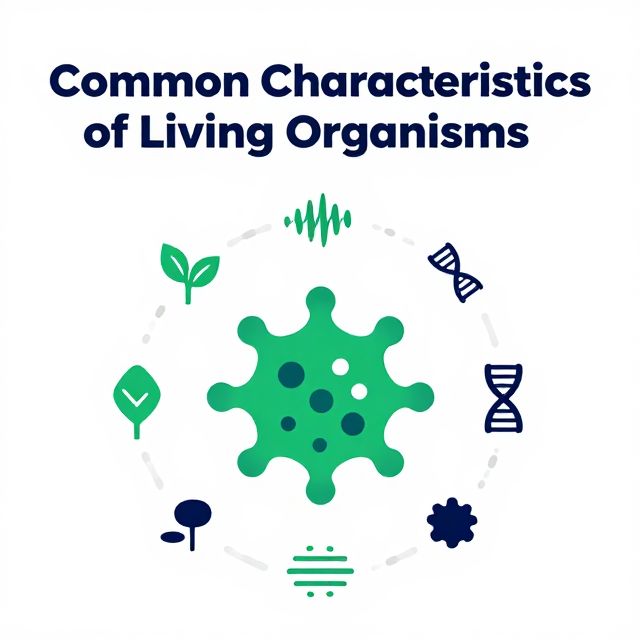
Common Characteristics of Living Organisms 🌿
Biology fundamentally begins with understanding what defines life. Despite the vast diversity observed across the biological world, all living organisms share a set of fundamental characteristics that distinguish them from non-living matter. These defining attributes provide a framework for classifying and comprehending the intricate processes that sustain life. This study material systematically explores these universal properties, elucidating their significance in maintaining biological integrity and ensuring the continuity of species.
1. Fundamental Structural and Metabolic Attributes
These characteristics define the basic building blocks and energy management systems of life.
1.1. Cellular Organization 🔬
All living organisms are composed of one or more cells, which are the basic structural and functional units of life.
- Unicellular Organisms: Consist of a single cell (e.g., bacteria, amoeba).
- Multicellular Organisms: Comprise numerous specialized cells organized into tissues, organs, and organ systems (e.g., plants, animals).
- Cells themselves exhibit complex organization, containing organelles that perform specific functions.
- ✅ This cellular structure is essential for compartmentalization and efficient biological processes.
1.2. Metabolism ⚡
📚 Metabolism refers to the sum of all chemical reactions that occur within an organism to maintain life. Energy, primarily in the form of adenosine triphosphate (ATP), is crucial for driving these reactions.
- Anabolism: The synthesis of complex molecules from simpler ones, requiring energy.
- Example: Photosynthesis, where plants use light energy to build glucose from carbon dioxide and water.
- Catabolism: The breakdown of complex molecules into simpler ones, releasing energy.
- Example: Cellular respiration, where glucose is broken down to release energy for cellular activities.
1.3. Homeostasis 🌡️💧
📚 Homeostasis is the ability of an organism to regulate its internal environment to maintain a stable, relatively constant condition.
- ✅ This dynamic equilibrium is vital for optimal cellular function and survival.
- Examples:
- Regulation of body temperature (e.g., sweating to cool down, shivering to warm up).
- Maintaining stable blood glucose levels (e.g., insulin and glucagon hormones).
- Controlling pH balance within cells and body fluids.
- Regulating water balance to prevent dehydration or overhydration.
- These processes are achieved through various physiological mechanisms and feedback loops.
2. Life Cycle and Continuity Attributes
These characteristics ensure the growth, development, and perpetuation of life across generations.
2.1. Growth and Development 🌳
Living organisms undergo processes of growth and development throughout their life cycles.
- Growth: Involves an increase in the size and number of cells, leading to an overall increase in the organism's mass.
- Example: A seedling growing into a mature tree.
- Development: Refers to the series of changes an organism undergoes from its origin to maturity. This involves cell differentiation and specialization, leading to the formation of distinct tissues and organs.
- Example: A caterpillar transforming into a butterfly (metamorphosis).
- ✅ Both processes are regulated by genetic information and environmental factors.
2.2. Reproduction 🧬
📚 Reproduction is a universal characteristic that ensures the perpetuation of a species by producing offspring.
- Asexual Reproduction: Involves a single parent producing genetically identical offspring.
- Example: Bacteria dividing by binary fission, or a plant growing from a cutting.
- Sexual Reproduction: Involves two parents contributing genetic material to produce genetically diverse offspring.
- Example: Humans, animals, and many plants reproduce sexually.
- ✅ Reproduction is critical for the continuation of life on Earth.
2.3. Heredity 📜
📚 All living organisms possess genetic material, typically deoxyribonucleic acid (DNA), which carries the instructions for their structure, function, and development.
- This genetic information is passed from parents to offspring, ensuring that traits are inherited.
- Heredity provides the basis for evolutionary change.
- ✅ The fidelity of DNA replication and the mechanisms of gene expression are central to heredity.
3. Interaction and Evolutionary Attributes
These characteristics highlight how organisms interact with their environment and change over time.
3.1. Response to Stimuli 💡
📚 Living organisms detect and react to changes in their internal or external environment. This capacity is often termed irritability.
- Stimuli Examples: Light, temperature, touch, sound, chemicals, or gravity.
- Example: A plant growing towards sunlight (phototropism) or a dog barking at a loud noise.
- ✅ The ability to respond allows organisms to adapt to their surroundings, seek resources, avoid danger, and maintain homeostasis, which is crucial for survival.
3.2. Adaptation and Evolution 🌍
📚 Over generations, populations of organisms undergo evolutionary changes, developing adaptations that enhance their survival and reproductive success in specific environments.
- Evolution: Driven by mechanisms such as natural selection, genetic drift, and mutation.
- Evolution explains the diversity of life and the remarkable fit of organisms to their ecological niches.
- Example: The long neck of a giraffe is an adaptation that allows it to reach leaves high in trees.
- ✅ This continuous process of change ensures the long-term survival and diversification of life forms.
Conclusion: The Unity of Life ✨
The common characteristics of living organisms—cellular organization, metabolism, homeostasis, growth and development, reproduction, heredity, response to stimuli, and adaptation—collectively define what it means to be alive. These attributes are interconnected and operate in concert to sustain life, from the simplest bacteria to the most complex multicellular organisms. Understanding these fundamental principles is essential for comprehending the intricate mechanisms of life and appreciating the underlying unity that connects all biological entities across the planet.