Native American Spatial Practices and Literature - kapak
Edebiyat#native american#literature#spatial practices#colonization

Native American Spatial Practices and Literature

This summary explores Native American spatial practices, ancestral and colonized spaces, liminality, and the concept of reclaiming spaces within Native American literature.

kahyaaliJune 1, 2026 ~24 dk toplam
01

Sesli Özet

6 dakika

Konuyu otobüste, koşarken, yolda dinleyerek öğren.

Sesli Özet

Native American Spatial Practices and Literature

0:005:41
02

Görsel Özet

İnfografik

Konunun tüm parçalarını tek bakışta gör.

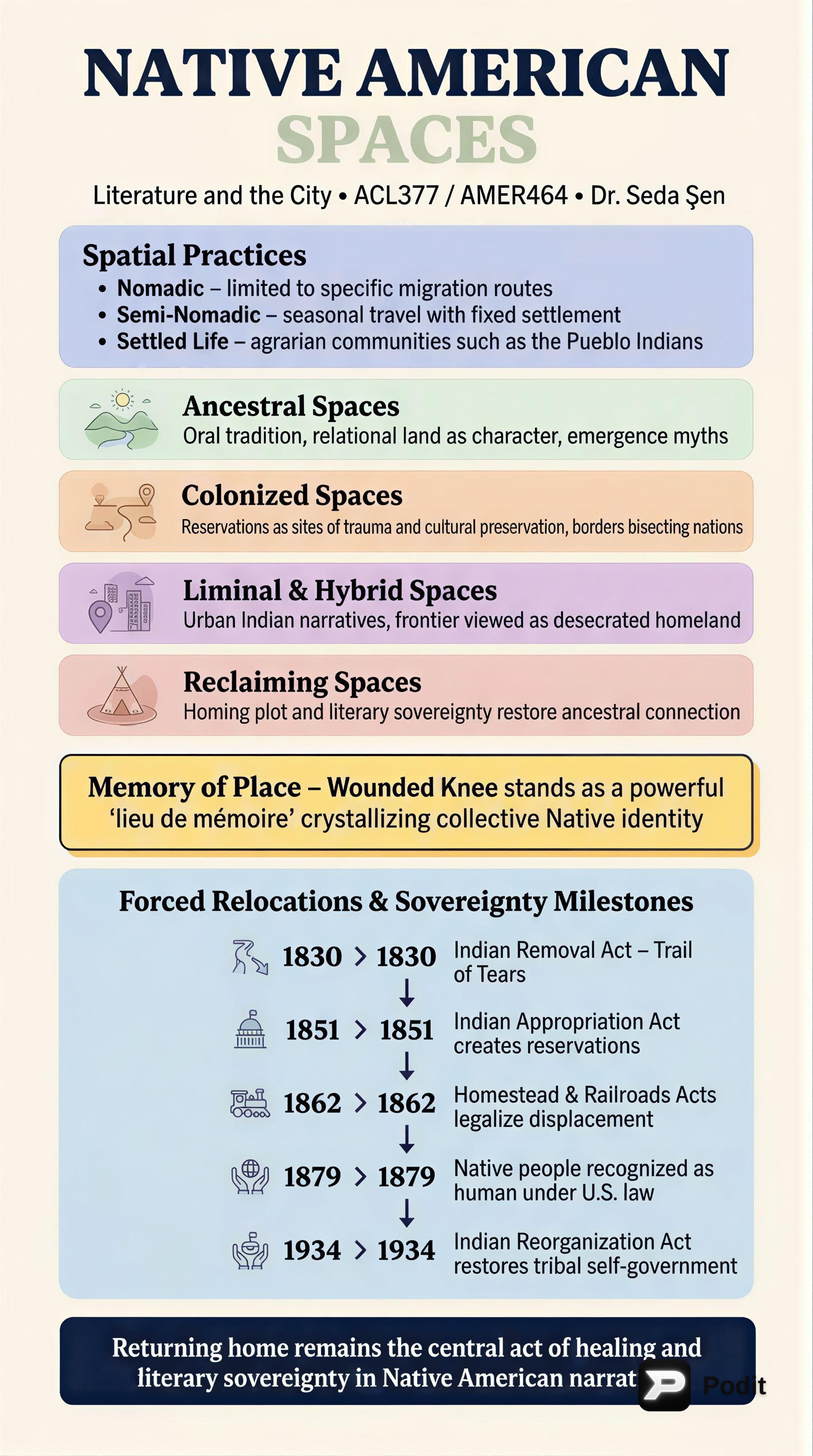
Native American Spatial Practices and Literature - görsel özet infografik
Tam boyutta görüntüle →
03

Flash Kartlar

25 kart

Karta tıklayarak çevir. ← → ile gez, ⎵ ile çevir.

1 / 25
Tüm kartları metin olarak gör
  1. 1. How do Native American spatial practices differ from typical Western land ownership concepts?

    Native American peoples historically engaged in diverse spatial practices, including nomadic, semi-nomadic, and settled agrarian lifestyles. These practices are fundamental to understanding their relationship with the land, which is often viewed not merely as property to be owned, but as a living entity with agency. This perspective emphasizes a deep, reciprocal connection rather than mere possession or exploitation.

  2. 2. What is the significance of 'space' in Native American cultures beyond its physical definition?

    In Native American cultures, the concept of space is deeply intertwined with identity, memory, and spiritual beliefs. It forms the bedrock for both traditional life and contemporary literary expressions. This holistic view means that space is not just a geographical location but a repository of cultural meaning, historical narratives, and spiritual connection.

  3. 3. How are ancestral spaces imbued with cultural significance in Native American traditions?

    Ancestral spaces gain cultural significance through their connection to oral traditions. Chants, songs, and storytelling cycles are used to maintain and transmit knowledge about these places, where specific landmarks evoke particular narratives and historical events. This oral tradition ensures that the cultural memory of these spaces is preserved across generations, linking people to their heritage.

  4. 4. Explain the concept of 'relationality of land' in Native American perspectives.

    The 'relationality of land' is a key distinction from Western perspectives, where land is considered a character with agency, not merely a passive backdrop. This means the land is seen as an active participant in life and history, capable of influencing events and holding spiritual power. It implies a reciprocal relationship where humans are part of the land, not separate from it, fostering respect and stewardship.

  5. 5. What are emergence myths and their role in Native American spatial understanding?

    Emergence myths are narratives found in many tribal literatures that detail journeys through spiritual or subterranean worlds before arriving at current physical locations. These myths explain the origins of a people and their deep connection to specific places, establishing a sacred and historical bond with their ancestral lands. They are fundamental to understanding a tribe's identity and their relationship to their environment.

  6. 6. How does Pierre Nora's concept of 'lieux de memoire' apply to Native American collective memory?

    Pierre Nora's concept of 'lieux de memoire' (memory of place) highlights how material or symbolic entities become crystallization points for collective memory and identity. In the Native American context, this applies to sites like monuments or events such as Wounded Knee, which serve as powerful reminders of historical trauma, resilience, and cultural significance. These places are vital for preserving collective identity and historical understanding.

  7. 7. Describe the dual nature of the reservation ('the Res') as a colonized space.

    The reservation, often termed 'the Res,' emerged as a site of profound disruption and trauma due to forced confinement and control by external authorities. Paradoxically, it also served as a space of protection, allowing for the preservation of culture and community amidst external pressures. While it restricted freedoms, it also became a crucible for cultural resilience and identity maintenance for many Native peoples.

  8. 8. What role did U.S. Indian Agents play in controlling reservations?

    U.S. Indian Agents exerted significant control over reservations, dictating entrance and exit, managing funding, and suppressing fundamental freedoms such as speech, assembly, and religion. Their authority often led to severe punishments, including deprivation of food or physical torture, effectively limiting the autonomy and self-determination of Native peoples. This system aimed to assimilate Native Americans and control their resources.

  9. 9. How did boarding schools impact Native American children and culture?

    Boarding schools were a tool of cultural assimilation, forcibly separating Native American children from their families and cultural practices. The aim was to eradicate Indigenous languages, traditions, and spiritual beliefs, causing immense trauma and disrupting intergenerational cultural transmission. This policy had long-lasting negative effects on Native communities and individual identities, contributing to a loss of heritage.

  10. 10. What was the significance of the Wheeler-Howard Act of 1934?

    The Wheeler-Howard Act, also known as the Indian Reorganization Act of 1934, marked a significant shift in U.S. policy towards Native Americans. It promoted tribal reorganization and self-government, aiming to reverse the assimilationist policies of the past. This act allowed tribes to establish their own constitutions and manage their own affairs, fostering a degree of autonomy and cultural revitalization.

  11. 11. What was the Indian Removal Act of 1830 and its primary consequence?

    The Indian Removal Act of 1830 was a federal law that forcibly extinguished Native American land rights east of the Mississippi River. Its primary consequence was the forced displacement of numerous tribes westward, most notably leading to the tragic event known as the Trail of Tears. This act resulted in immense suffering, loss of life, and the destruction of established communities, fundamentally altering Native American geography.

  12. 12. Which government entities were responsible for relocating tribes west of the Mississippi by 1840?

    By 1840, the Bureau of Indian Affairs (BIA) and the U.S. military were primarily responsible for relocating numerous Native American tribes west of the Mississippi River. These entities enforced federal policies, often through coercive means, to clear lands for white settlement and expansion. Their actions led to widespread displacement and the establishment of new, often inadequate, reservation lands.

  13. 13. Name three pieces of legislation that established the legal framework for creating reservations and enforcing relocations.

    Three key pieces of legislation that established the legal framework for creating reservations and enforcing further relocations were the Indian Appropriation Act of 1851, the Homestead Act of 1862, and the Railroads Act of 1862. These acts facilitated the systematic dispossession of Native lands and the confinement of tribes to designated areas, often far from their ancestral territories, to make way for American expansion.

  14. 14. How do international and state borders challenge Native American sovereignty?

    International and state borders often bisect Native spaces, creating tensions for 'nations within a nation' and challenging their inherent sovereignty. These artificial divisions can separate tribal members, disrupt traditional land use, and complicate governance, as Native nations often predate and transcend these imposed boundaries. This creates complex legal and cultural challenges for self-determination and cultural continuity.

  15. 15. What were the Urban Relocation programs of the 1950s, and what kind of space did they create?

    The Urban Relocation programs of the 1950s were federal initiatives designed to move Native peoples from reservations into white urban centers. These programs aimed to assimilate Native Americans into mainstream society by providing vocational training and housing assistance. However, they often created a diasporic space, leading to cultural dislocation and the formation of new urban Native communities, often facing new challenges and maintaining cultural ties in novel ways.

  16. 16. What does the theme of 'liminal or hybrid spaces' signify in contemporary Native literature?

    The theme of 'liminal or hybrid spaces' in contemporary Native literature reflects a feeling of being 'in-between' traditional and modern, capitalist worlds. It explores the complex experiences of Native individuals navigating multiple cultural identities and environments, often balancing ancestral traditions with contemporary realities. This theme highlights the challenges and adaptations involved in maintaining cultural heritage while living in a rapidly changing world.

  17. 17. How does the 'Urban Indian' narrative redefine Native space?

    The 'Urban Indian' narrative redefines Native space to encompass urban environments, demonstrating that Native identity and culture can thrive beyond rural or reservation landscapes. Works like Tommy Orange’s 'There There' exemplify this, showing that Native experiences and communities are vibrant and present in cities. This narrative challenges traditional notions of what constitutes 'Native space' and expands its definition to include contemporary urban life.

  18. 18. How does Native literature reinterpret the Western view of the frontier?

    Native literature sharply contrasts with the Western view of the frontier as a space for conquest and opportunity. Instead, Native literature reinterprets the frontier as a desecrated homeland, a site of invasion, loss, and trauma. This perspective highlights the devastating impact of colonization on Indigenous peoples and their ancestral lands, offering a counter-narrative to the dominant historical accounts and emphasizing resilience.

  19. 19. What is the 'homing plot' in Native American literature, and what does it signify?

    The 'homing plot' is a significant theme in Native American literature where protagonists often return to their ancestral homes. This return signifies a journey of healing, cultural reconnection, and the reclaiming of identity, often after experiencing displacement or cultural loss. It emphasizes the deep spiritual and cultural ties to ancestral lands as a source of strength and renewal for individuals and communities.

  20. 20. Who is Craig Womack, and what concept does he advocate for?

    Craig Womack is a scholar who advocates for 'Literary Sovereignty.' This concept posits that Native literature should be understood and judged within its own cultural and spatial contexts, rather than through the lens of the Western literary canon. Womack argues for recognizing the unique aesthetic and philosophical frameworks embedded in Indigenous literary traditions, asserting their independence and validity.

  21. 21. What does 'intellectual sovereignty' entail in the context of Native American literature?

    Intellectual sovereignty extends to the act of writing in Indigenous languages or incorporating tribal structures into Western genres. It involves reclaiming the 'space' of the book itself by asserting Native cultural and intellectual frameworks within literary expression. This practice affirms Indigenous knowledge systems, challenges colonial literary dominance, and ensures that Native voices are heard on their own terms.

  22. 22. Name three prominent authors associated with the Native American Renaissance.

    Three prominent authors associated with the Native American Renaissance are N. Scott Momaday, Louise Erdrich, and Sherman Alexie. Other notable figures include Simon J. Ortiz, Joy Harjo, and Leslie Marmon Silko. These authors played a crucial role in bringing diverse Native voices and narratives to national and international attention, exploring complex cultural and spatial dynamics and asserting Indigenous literary presence.

  23. 23. What is the enduring connection between Native American peoples and their spaces, as highlighted in the conclusion?

    The conclusion highlights that Native American spatial practices are deeply rooted in cultural and spiritual understandings, viewing land as an active, relational entity. Despite historical impositions and disruptions, the enduring connection is one of resilience, cultural assertion, and a continuous process of reclaiming and redefining these spaces through narratives and literary endeavors. This connection remains fundamental to their identity and survival.

  24. 24. How did Christian extremists impact Native American cultural practices after the 1870s?

    After the 1870s, Christian extremists often took over the role of U.S. Indian Agents, further intensifying efforts to eradicate Native cultural practices. They actively suppressed traditional ceremonies, languages, and spiritual beliefs, imposing Christian doctrines and values. This period saw increased pressure for assimilation and the systematic dismantling of Indigenous cultural systems, causing profound cultural loss and trauma.

  25. 25. What is the fundamental difference in how Native American cultures view land compared to Western cultures?

    The fundamental difference is that Native American cultures view land not merely as property or a resource to be exploited, but as a living entity with agency, deeply intertwined with identity, memory, and spiritual beliefs. In contrast, Western cultures often perceive land primarily as a commodity for ownership and economic development. This distinction shapes vastly different relationships with the environment, emphasizing stewardship over extraction.

04

Bilgini Test Et

15 soru

Çoktan seçmeli sorularla öğrendiklerini ölç. Cevap + açıklama.

Soru 1 / 15Skor: 0

What is a fundamental aspect of Native American peoples' relationship with the land, as described in the text?

05

Detaylı Özet

8 dk okuma

Tüm konuyu derinlemesine, başlık başlık.

This study material, compiled from lecture audio transcripts, personal notes, and PDF/PowerPoint texts, explores the multifaceted concept of "Native American Spaces" within the broader context of literature and the city. It delves into how Native American peoples have historically interacted with, perceived, and represented space, from ancestral lands to colonized territories and contemporary urban environments.


📚 Native American Spaces: Literature and the City

1. Introduction: Understanding Native American Spatial Practices 🌍

Native American cultures possess a profound and distinct relationship with space, viewing land not merely as property but as a living entity with inherent agency. This perspective forms the bedrock of their identity, memory, and spiritual beliefs. Historically, Native American peoples engaged in diverse spatial practices:

  • Nomadic: Groups who moved continuously, often following specific migration routes or seasonal resources. Their connection to space was defined by movement within a vast, interconnected territory.
  • Semi-Nomadic: Tribes that traveled seasonally but maintained a primary settlement or specific regions for parts of the year. This allowed for seasonal resource exploitation while retaining a sense of regional belonging.
  • Settled Life: Agrarian communities, such as the Pueblo Indians, who established permanent settlements and cultivated land. Their spatial practices centered around fixed agricultural cycles and community structures.

These practices highlight a deep, reciprocal relationship with the environment, contrasting sharply with Western notions of land ownership and exploitation.

2. Categories of Native American Spaces 🗺️

Native American literature and history reveal several distinct categories of spaces, each carrying unique cultural, historical, and literary significance:

  • Ancestral Spaces: Lands imbued with deep cultural, spiritual, and historical meaning.
  • Colonized Spaces: Territories forcibly altered and controlled by external powers, leading to trauma and displacement.
  • Liminal and Hybrid Spaces: "In-between" spaces reflecting complex identities and cultural negotiations.
  • Reclaiming of Spaces: Efforts to reassert Native American presence, culture, and sovereignty over physical and intellectual territories.

3. Ancestral Spaces: Roots and Relationality 🌱

Ancestral spaces are foundational to Native American identity. They are not just geographical locations but repositories of memory, story, and spiritual connection.

  • The Oral Tradition: Space is actively created and maintained through performance. Chants, songs, and storytelling cycles imbue landmarks with narrative significance. A specific mountain or river might evoke an entire origin story or historical event.
  • Relationality: Unlike the Western concept of land as inert property, Native literature portrays space as a relative, a character with agency. The land is an active participant in life, not merely a passive backdrop.
  • Emergence and Origin Myths: Many tribal literatures feature "Emergence Myths," which describe people's journeys through different subterranean or spiritual worlds before arriving at their current physical homelands. These narratives establish a deep, ancient connection to specific places.
  • Memory of Place (Lieux de Mémoire): Drawing on Pierre Nora's concept, ancestral spaces function as "sites of memory." These are material or symbolic entities—monuments, sacred sites, or even historical events—that become crystallization points for a community's collective memory and identity.
    • Example: Wounded Knee, a site of two massacres, serves as a powerful "lieu de mémoire" for many Native Americans, embodying both profound trauma and enduring resilience.

💡 Special Focus: N. Scott Momaday's The Way to Rainy Mountain

N. Scott Momaday's seminal work, The Way to Rainy Mountain, powerfully exemplifies the concept of ancestral spaces and the "memory of place." The book traces the journey of the Kiowa people from their origins in the Yellowstone region to their last migration to Rainy Mountain in Oklahoma.

  • Oral Tradition and Relationality: Momaday weaves together three distinct voices: Kiowa legends (oral tradition), historical commentary, and his personal reflections. This tripartite structure demonstrates how space is understood through layered narratives. The landscape itself is a character, with features like the Wichita Mountains and Rainy Mountain acting as silent witnesses and active participants in the Kiowa story.
  • Emergence and Origin: The narrative begins with the Kiowa's emergence from a hollow log, a classic emergence myth, immediately establishing their deep, spiritual connection to the land.
  • Homing Plot and Reclaiming Memory: Momaday's personal pilgrimage back to Rainy Mountain after his grandmother's death is a literal "homing plot." He seeks to understand his heritage by physically retracing his ancestors' steps and mentally reconstructing their history. This act of return is a profound reclaiming of ancestral memory and identity, demonstrating how personal and collective healing can be found by reconnecting with one's roots. The book itself becomes a "lieu de mémoire," preserving and transmitting Kiowa cultural memory.

4. Colonized Spaces: Trauma and Resilience 💔

The arrival of European colonizers drastically transformed Native American spatial realities, leading to the creation of "colonized spaces" marked by displacement, confinement, and cultural suppression.

  • The Reservation ("The Res"):
    • Often depicted as a site of both trauma and paradoxical protection. While a space of confinement, it sometimes served to preserve culture and community amidst external pressures.
    • Historically, reservations were controlled by U.S. Indian Agents who dictated entry/exit and funding. Native people on reservations were denied fundamental rights like freedom of speech, assembly, religion, and property ownership.
    • Punishments often included deprivation of food or physical torture. Children were forcibly sent to boarding schools, separating them from families and cultural practices.
    • After the 1870s, Christian extremists often took over agent roles, actively eradicating Native cultural practices.
    • The Indian Reorganization Act (IRA) of 1934 (Wheeler-Howard Act) marked a shift, promoting tribal reorganization and self-government, though its implementation was complex.
  • Forced Relocations:
    • The Indian Removal Act of 1830 extinguished Native land rights east of the Mississippi River, leading to the forced displacement of tribes like the "Five Civilized Tribes" to "Indian Country" (Oklahoma) via the Trail of Tears.
    • By 1840, the Bureau of Indian Affairs (BIA) and the U.S. military had relocated over thirty tribes west of the Mississippi.
    • Subsequent legislation like the Indian Appropriation Act (1851), Homestead Act (1862), and Railroads Act (1862) provided the legal basis for creating reservations and enforcing further relocations, driven by westward expansion and land speculation.
    • Until 1879, Native people were not regarded as human beings under U.S. law.
  • The Border: Native spaces are frequently bisected by international or state borders, creating tension for "nations within a nation" and challenging their sovereignty.
  • Urban Relocation Programs (1950s): These programs created a "diasporic" space by moving Native people into white urban centers, often disrupting community ties and traditional ways of life.

5. Liminal and Hybrid Spaces: In-Between Worlds 🌉

Contemporary Native literature frequently explores the experience of "liminal" or "hybrid" spaces, reflecting the feeling of being "in-between" traditional worlds and modern, capitalist societies.

  • The Urban Indian: A significant portion of modern Native literature is set in cities (e.g., Tommy Orange’s There There). These narratives redefine "Native space" as something that can exist and thrive in urban environments, not just rural landscapes.
  • Frontier vs. Homeland: While Western literature often views the "frontier" as a space to be conquered, Native literature reinterprets that same space as a desecrated homeland, highlighting the clash of perspectives on land and belonging.

💡 Special Focus: Sandra Cisneros's The House on Mango Street (Comparative Example)

While Sandra Cisneros is not a Native American author, her novel The House on Mango Street offers a compelling parallel to the themes of liminality, urban identity, and spatial negotiation discussed in the context of Native American literature. Esperanza Cordero's experience resonates with the "Urban Indian" narrative by exploring how marginalized communities navigate and redefine space within a dominant urban landscape.

  • "In-Between" Identity: Esperanza, a young Latina girl growing up in a Chicago barrio, constantly feels "in-between" her cultural heritage and the American dream, her family's expectations and her personal aspirations. This mirrors the "in-between" feeling of Native Americans living in urban centers, balancing traditional values with modern life.
  • Redefining Space: Esperanza's "house" is not just a physical structure but a symbol of identity, belonging, and aspiration. Her desire for a house of her own, distinct from the rented, dilapidated homes she inhabits, is a quest for self-definition and a secure space. This echoes the Native American struggle to define and reclaim spaces, whether ancestral lands or urban territories, as places where their identity can flourish.
  • Reclaiming Space Through Narrative: Esperanza ultimately finds her voice through writing. By telling her story and the stories of her community, she reclaims her space, transforming her experiences into a powerful narrative. This act of literary creation is a form of "intellectual sovereignty," akin to how Native American authors use writing to assert their cultural perspectives and redefine what "Native space" means in a contemporary context.

6. Reclaiming of Spaces: Sovereignty and Healing ✨

The act of reclaiming spaces is central to Native American resilience and cultural assertion, manifesting in both physical and intellectual forms.

  • The Return / Homing Plot: Many narratives feature a protagonist returning to their ancestral home to find healing, a common literary trope. This return is often a journey of self-discovery and cultural reconnection.
  • Literary Sovereignty: Scholars like Craig Womack advocate for "Literary Sovereignty," arguing that Native literature should be understood and judged within its own cultural and spatial contexts, rather than through the lens of the Western literary canon. This asserts the right of Native peoples to define their own literary traditions and critical frameworks.
  • Intellectual Sovereignty: This extends to writing in Indigenous languages or incorporating tribal structures into Western genres (like the novel). Such acts reclaim the "space" of the book itself, making it a vehicle for Indigenous knowledge and worldviews.
  • Native American Renaissance: This powerful literary movement, featuring authors like N. Scott Momaday, Louise Erdrich, Sherman Alexie, Simon J. Ortiz, Joy Harjo, and Leslie Marmon Silko, exemplifies the reclaiming of spaces through diverse voices and narratives. These authors explore complex spatial and cultural dynamics, asserting Native American presence and perspective in the literary world.

Conclusion ✅

Native American spatial practices are deeply rooted in cultural and spiritual understandings, viewing land as an active, relational entity. The historical imposition of colonized spaces profoundly impacted these traditional relationships, creating sites of both trauma and resilience. Contemporary Native literature actively explores themes of liminality, the urban experience, and the critical process of reclaiming spaces through narratives of return and the assertion of literary and intellectual sovereignty. These literary endeavors underscore the enduring connection between Native American peoples and their diverse, evolving spaces.
Kendi çalışma materyalini oluştur

PDF, YouTube videosu veya herhangi bir konuyu dakikalar içinde podcast, özet, flash kart ve quiz'e dönüştür. 1.000.000+ kullanıcı tercih ediyor.

Sıradaki Konular

Tümünü keşfet
Literature and the City: Native American Spaces

Literature and the City: Native American Spaces

An academic overview of Native American spatial practices, from ancestral lands to colonized territories, and their representation in literature, including concepts of sovereignty and reclamation.

8 dk Özet 25 15
Linguistics, Literature, and Stylistic Analysis

Linguistics, Literature, and Stylistic Analysis

This summary explores the intricate relationship between linguistics and literature, defines stylistics, outlines its major categories and subdisciplines, and highlights its application in analyzing literary texts.

6 dk Özet 25 15 Görsel
Literary & Philosophical Movements: A Comprehensive Overview

Literary & Philosophical Movements: A Comprehensive Overview

An academic summary exploring key literary and philosophical concepts, movements, and periods from ancient times to modernism, highlighting their definitions, characteristics, and influential figures.

10 dk Özet 25 15 Görsel
Modernism and Postmodernism in Literary History

Modernism and Postmodernism in Literary History

This summary explores the evolution of literary history from Modernism to Postmodernism, examining key characteristics, historical contexts, influential figures, and the shift in literary aesthetics and critical approaches.

10 dk Özet 25 15 Görsel
Understanding Modernism and Postmodernism in Literature

Understanding Modernism and Postmodernism in Literature

Explore the profound shifts in literary history from Modernism to Postmodernism, examining their intellectual foundations, key characteristics, and impact on art and culture.

Özet 25 15 Görsel
e.e. cummings: Poetic Innovation and Influences

e.e. cummings: Poetic Innovation and Influences

This summary explores the life, unique poetic style, major themes, and significant influences of American modernist poet e.e. cummings, focusing on his experimental approach to language and form.

6 dk Özet 25 15
William Carlos Williams and Modernist Poetry

William Carlos Williams and Modernist Poetry

An academic summary of William Carlos Williams's life, literary influences, stylistic features, poetic vision, and his distinct role within American Modernist poetry.

6 dk Özet 25 15 Görsel
Key Literary Terms and Concepts

Key Literary Terms and Concepts

An academic overview of fundamental literary terms, including classical Greek concepts, rhetorical devices, thematic elements, and the Bible's literary significance.

9 dk Özet 25 15 Görsel