Podit
Podit
Study Material: British Literature Since 1945
Source Information: This study material is compiled from a copy-pasted text and a lecture audio transcript.
📚 Introduction: A Shifting Landscape
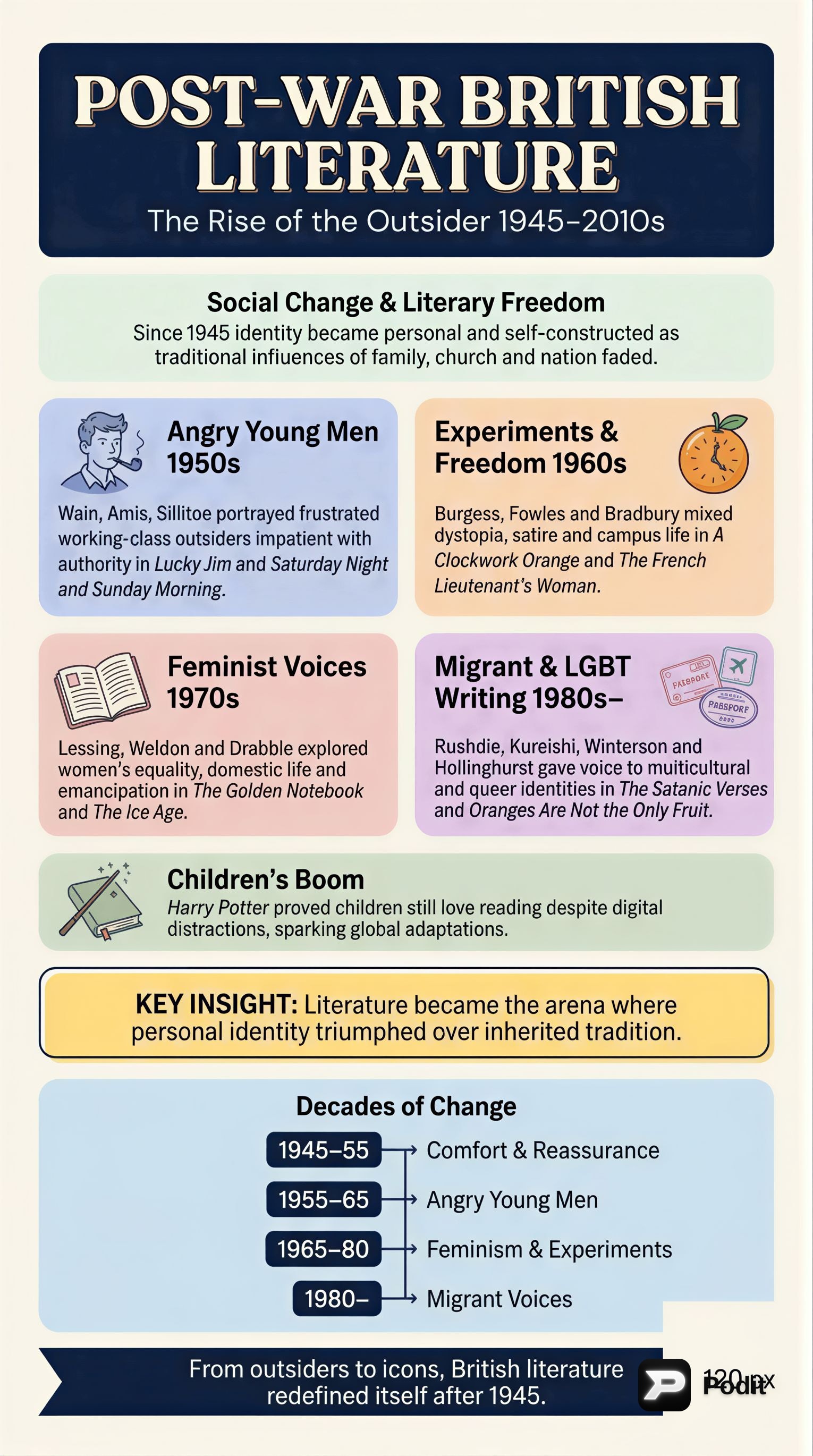
Since 1945, British society has undergone profound transformations, marked by globalization, increased migration, and significant strides in gender and racial equality. These societal shifts have profoundly influenced British literature, leading to a vigorous expansion of themes and narrative techniques. Traditional influences like family and nation have waned, giving way to a greater emphasis on individual identity, sexuality, and morality. Literature has mirrored these changes, embracing diverse voices and experimenting with new forms, including magic realism. Concurrently, children's literature has garnered unprecedented public and critical interest, exemplified by global phenomena like the Harry Potter series.
1️⃣ Post-War Disillusionment and Emerging Voices (1950s-1970s)
The immediate post-war period initially saw a public yearning for comfort and reassurance in literature. However, by the mid-1950s, a new generation of writers began to question established values.
-
The "Angry Young Men" 😠
- A group of critical young novelists, playwrights, and artists, often under 30, emerged by 1955.
- They expressed impatience with tradition, authority, and the ruling class.
- Characteristics: Social realism, 'outsider' protagonists, working-class settings (especially industrial north), challenges to conventional morality, sexually explicit scenes, regional dialects.
- Key Authors & Works:
- John Wain: Hurry on Down (1953)
- Kingsley Amis: Lucky Jim (1954)
- John Braine: Room at the Top (1957)
- Alan Sillitoe: Saturday Night and Sunday Morning (1958)
- Their work was considered provocative and subversive, introducing dissent and honesty into literature.
-
Poetry: "The Movement" and Philip Larkin 📜
- "The Movement" (1956): Poets like those in Robert Conquest's New Lines anthology rejected the perceived pretensions and elitism of modern writing, favoring a more accessible style.
- Philip Larkin: Offered a contrasting, more conservative approach, focusing on clear, economical observations of daily British life. His satirical The Whitsun Weddings (1964) established him as a major poet.
-
Early Immigrant Narratives & Youth Culture 🌍
- Samuel Selvon: The Lonely Londoners (1956) captured the experiences of Afro-Caribbean immigrants.
- Colin MacInnes: His "London Trilogy" (City of Spades, Absolute Beginners, Mr Love and Justice) depicted emergent English youth culture (coffee bars, clubs, fashion) and conflict with authority, recognizing the rise of pop culture.
-
William Golding 🏝️
- Lord of the Flies (1954) explored humanity's descent into savagery in the absence of democratic structures, gaining significant recognition, especially during the Cold War. He later won the Nobel Prize in Literature (1983).
-
Experimental Fiction (1960s-1970s) 🧪
- Anthony Burgess: A Clockwork Orange (1962) satirized societal control and morality in a dystopian future, notable for its invented "Nadsat" slang.
- "Campus Novels": The expansion of higher education inspired satirical works by authors like Malcolm Bradbury (The History Man, 1975) and David Lodge (Changing Places, 1975), often set in new "plate-glass" universities.
- Iris Murdoch: Combined philosophical questions with academic intrigue and middle-class life, exploring human freedom and the triumph of good over evil (The Bell, 1958).
- John Fowles: Known for serious, experimental fiction with strong heroines, such as the psychological thriller The Collector (1963) and the innovative The French Lieutenant's Woman (1969).
-
Youth Culture and Mersey Poets 🎶
- Sensationalized stories like Richard Allen's Boot-Boy (1970) depicted tough urban youth.
- The Mersey Poets (Roger McGough, Adrian Henri) pioneered light, satirical "pop poetry" with a performance element, popular with younger, non-literary audiences.
2️⃣ Diversification and Identity: Feminism, LGBT, and Migrant Voices
The mid-1960s onwards saw a profound diversification of British literature, driven by evolving social identities.
-
Feminist Literature ♀️
- Impact: Germaine Greer's The Female Eunuch (1970) popularized feminist theory, leading to a significant body of women's writing.
- Publishing: New feminist publishing houses (Virago, The Women's Press) actively promoted female authors.
- Themes: Social injustice, female experience, relationships, gender inequality, and the search for equality.
- Key Authors:
- Muriel Spark: Emphasized female characters in stylish, funny stories (The Prime of Miss Jean Brodie, 1961).
- Fay Weldon: Robustly feminist novels dealing with female resentment and anger (Down Among the Women, 1971).
- Margaret Drabble: Explored female protagonists' education, careers, and family relationships, often reflecting societal issues (The Millstone, 1965; The Ice Age, 1977).
- Edna O'Brien: Portrayed women's frustrating choices between loneliness and subservience, with frank exposure of sexual needs (The Country Girls, 1960-63).
- Doris Lessing: A highly respected author, transitioned from social realism to imaginative styles. The Golden Notebook (1962) is a seminal work on women's emancipation.
- Experimental Styles: Authors like Jean Rhys (The Wide Sargasso Sea, 1966) and Eva Figes used split narratives to explore divided selves. "Reworking" traditional stories became a distinctive characteristic (e.g., Fay Weldon's The Cloning of Joanna May).
-
LGBT Literature 🏳️🌈
- Increased social understanding and freedom of expression led to greater confidence in LGBT themes.
- By the "noughties" (2000s), LGBT writing became more mainstream.
- Key Authors:
- Alan Hollinghurst: Won the Man Booker Prize for The Line of Beauty (2004).
- Adam Mars-Jones: Explored gay and disabled protagonists (Pilcrow, 2009).
- Jeannette Winterson: Her semi-autobiographical Oranges Are Not the Only Fruit (1985) explored lesbian sexuality and religious conflict, often using magic realism.
-
Migrant Voices: The Empire Writes Back 🗣️
- Post-1950s multiculturalism, driven by migration from former colonies, invigorated English literature with new perspectives.
- Themes: Displacement, cultural upheaval, bicultural identities, the "death" of empire, and adaptation to new realities.
- Key Authors:
- V.S. Naipaul: Born in Trinidad, his early works satirized Trinidadian society; later works examined social dislocation and post-colonial societies (In a Free State, 1971). Nobel Prize winner (2001).
- Salman Rushdie: Born in India, his work critically examined post-imperial identities and cultural adaptation. Midnight's Children (1981) is a landmark work. The Satanic Verses (1988) sparked significant controversy but highlighted the complexities of migrant identity and religious conviction.
- Hanif Kureishi: Explored growing up in multicultural Britain, satirizing race, family, and integration (The Buddha of Suburbia, 1990; My Beautiful Laundrette).
- Kazuo Ishiguro: Explored Japanese attitudes and British life, often through precise observation (The Remains of the Day, 1989).
- Timothy Mo: Brought a unique vision from his Hong Kong and English background, depicting Chinese communities in London (Sour Sweet, 1982).
- Monica Ali, Zadie Smith, Hari Kunzru: Continued to explore themes of displacement and multicultural life in the 21st century.
3️⃣ Contemporary Trends, Genres, and Poetry (1980s onwards)
The late 20th and early 21st centuries saw literature grappling with new anxieties and evolving popular tastes.
-
Themes of Doubt and Uncertainty ⚠️
- Reflected economic shifts, social anxieties (Cold War, terrorism, Thatcherism's impact), and a sense of societal drift.
- Ian McEwan: Known for precise prose and dark, sinister themes (incest, infanticide) in early works (The Cement Garden, 1978). Later novels feature sudden disruptions in everyday life (Atonement, 2001; Saturday, 2005).
- Martin Amis: Satirized the "age of greed" and societal decay, often with heavy irony (Money, 1984; London Fields, 1989).
- Graham Swift: Explored dark themes and the shadow of a suspect past (Waterland, 1983).
- Julian Barnes: Known for his light, confident style, often illuminating French and English culture (Flaubert's Parrot, 1984).
-
Regional Literature 🏴🇮🇪
- Northern Ireland: Authors like Bernard MacLaverty examined the "Troubles."
- Scotland: Bleak social realism became prominent, with authors like James Kelman (using local dialect, How Late it Was, How Late, 1994) and Irvine Welsh (Trainspotting, 1993) depicting urban deprivation and complex Scottish identity. Iain Banks mixed fantasy and reality (The Wasp Factory, 1984).
-
Popular Genres 📈
- Crime and Detective Stories: Increased sharply in popularity.
- Traditional "Whodunits": Maintained by authors like Agatha Christie, P.D. James, Ruth Rendell.
- "Nordic Noir": Scandinavian crime fiction gained unexpected popularity in Britain.
- Spy Thrillers: Declined post-Cold War, leaving works by Graham Greene and John Le Carré as monuments to an era.
- Science Fiction (Sci-Fi): Grew in popularity, offering limitless creative possibilities (J.G. Ballard, Brian Aldiss).
- Biography: Increased interest in personal details and celebrity culture fueled its growth.
- Romantic Writing: Remained a strong genre, especially among women readers (Jilly Cooper, Catherine Cookson).
- Crime and Detective Stories: Increased sharply in popularity.
-
Poetry Evolution 🎤
- Post-War Figures: Ted Hughes (Poet Laureate, known for nature themes and Birthday Letters), Seamus Heaney (Nobel laureate, focused on love, nature, and the "Troubles").
- Performance Poetry: Pioneered by the Mersey Poets in the 1960s, evolved with figures like Linton Kwesi Johnson (dub poetry) and Benjamin Zephaniah (rap poetry), bringing verse to wider, non-literary audiences, often with political and social themes. "Slam" poetry emerged as a competitive form.
-
Children's Literature 🧒📖
- Classics: From early moralistic tales to enduring classics like Alice's Adventures in Wonderland and Peter Pan. Enid Blyton became a bestselling author.
- Modern Era: Greater concern for egalitarian values and imaginative fiction (Roald Dahl, Philip Pullman).
- J.K. Rowling: Her Harry Potter series became a global phenomenon, breaking sales records and influencing the genre significantly, promoting social awareness and multiculturalism.
4️⃣ Publishing and Publicity 📊
The publishing industry has become a major force, with numerous awards (Booker Prize, Costa Book Awards) ensuring wide publicity for authors. Marketing and publicizing new books have become a fine art, supported by literary festivals and authors' online presence (websites, social media). Creative writing courses, like the one founded by Malcolm Bradbury at the University of East Anglia, have also fostered new talent.
✅ Conclusion: A Dynamic and Diverse Literary Landscape
British literature since 1945 has served as a dynamic mirror and shaper of the nation's evolving social and cultural landscape. It transitioned from post-war disillusionment to embrace a multitude of voices, including those of women, LGBT individuals, and migrants, reflecting a society grappling with new identities and moral frameworks. This period is characterized by a vibrant interplay of traditional and experimental forms, consistently addressing complex issues of identity, morality, and societal change, while simultaneously fostering the growth of popular genres and a globally impactful children's literature.