Podit
Podit
English Literary Periods: Romantic and Victorian Ages
This study material has been compiled from various sources, including a copy-pasted text and an audio lecture transcript, to provide a comprehensive overview of the Romantic and Victorian Ages in English literature.
📚 Introduction: A Shift in Literary Sensibility
The late 18th and 19th centuries witnessed profound transformations in English literature, moving from the Enlightenment's emphasis on reason and order to the Romantic Age's celebration of emotion and imagination, and subsequently to the Victorian Age's engagement with social realities and moral complexities. These periods, though distinct, are interconnected by evolving societal values and literary responses.
🌸 The Romantic Age (c. 1780s - 1830s)
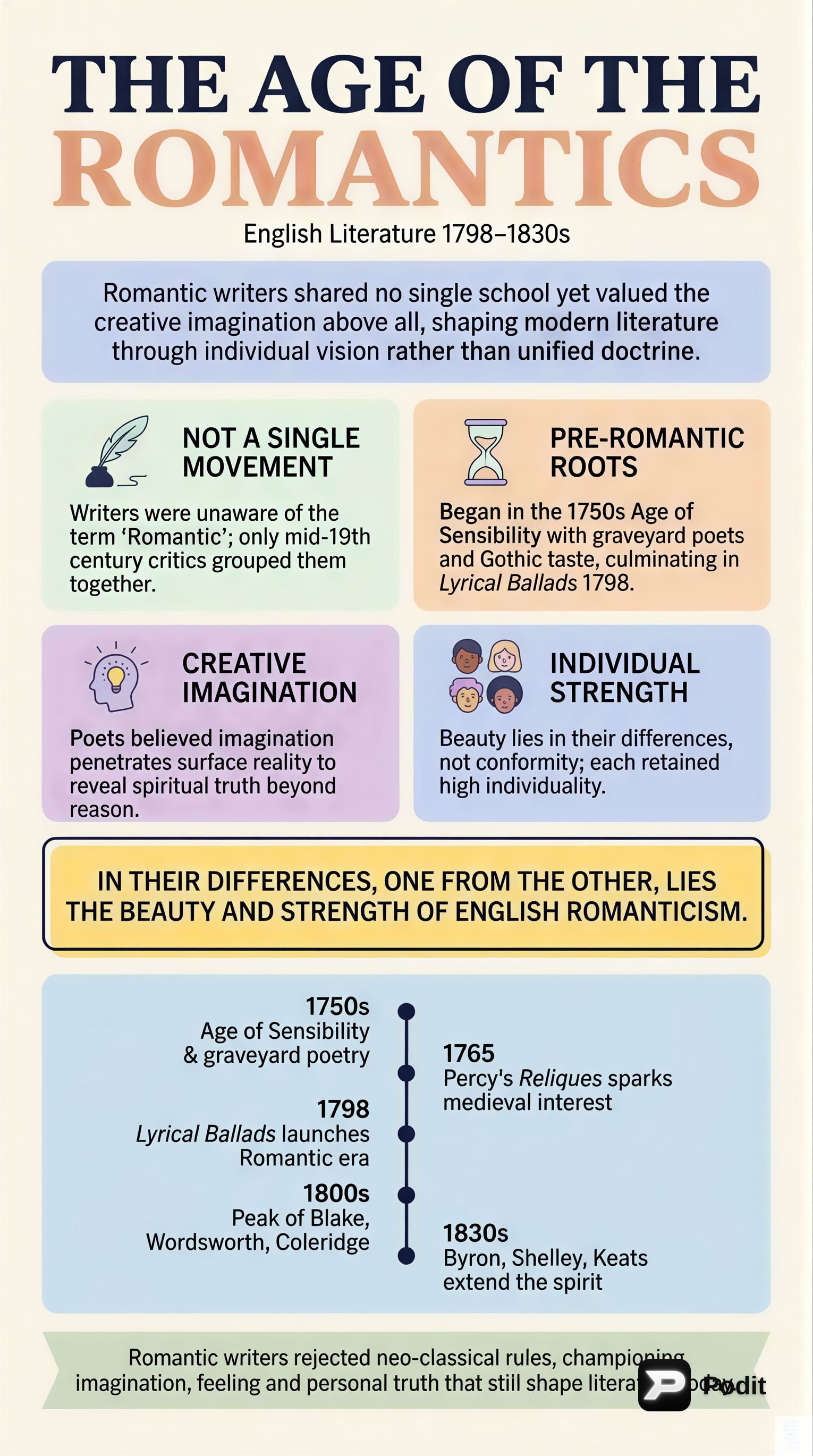
The Romantic Age, while not a self-aware movement at its inception, marked a significant shift in literary and social thought. It was characterized by an intellectual rebellion against established norms and a growing dissatisfaction with contemporary literary and social mores.
1. Historical & Philosophical Context ✅
- Betrayal of Revolutionary Ideals: Many Romantics initially shared revolutionary political ideals, particularly those of the French Revolution, but later felt betrayed by its outcomes.
- Intellectual Rebellion: A healthy spirit of intellectual rebellion pervaded their literary work.
- Growing Dissatisfaction: Writers expressed discontent with prevailing literary and social conventions.
2. Pre-Romanticism: The Age of Sensibility (Mid-1700s) 💡
The upheaval of the Romantic period was not sudden but a culmination of earlier shifts:
- Shift in Taste: An early indication of change was the explicit sentimentalism in novels by Samuel Richardson and Laurence Sterne, where the expression of feelings and emotions became acceptable.
- "Graveyard Poetry": Poets like Edward Young and Robert Blair explored themes of death and melancholy, suggesting a greater concern with individual feeling.
- Changing Approach to Nature: Thomas Gray's poetry showed a more pronounced sentimentalism and subjective feeling for nature, moving away from objective neo-classical descriptions.
- New Inspirations: Interest in mysterious pagan traditions (Nordic, Celtic) and the Middle Ages grew, as seen in Percy's Reliques of Ancient English Poetry (1765) and Robert Burns's Poems, Chiefly in the Scottish Dialect.
3. The Writer and the Reading Public 📖
- Decline of Patronage: The traditional system of patronage disappeared, replaced by a more modern, commercial publishing model.
- Amorphous Public: Writers now faced a broader, less defined reading public, making it harder to gauge expectations.
- Artist as Visionary: Poets began to see themselves as inspired visionaries rather than skilled craftsmen, often expressing hostility towards public expectations.
- Independent Genius: This period fostered the idea of the literary artist as an independent, creative genius whose work possessed intrinsic value.
4. Key Themes and Characteristics of Romantic Poetry 📝
Romantic poetry largely overthrew the neo-classical regime, focusing on:
- The Individual Self: A diminished concern with "man as a social animal" in favor of the individual.
- The Imagination:
- Seen as a "divine" faculty capable of penetrating surface reality and apprehending truth beyond reason.
- A source of spiritual energy, allowing poets to share in an "almost divine activity" in re-creating the world.
- Coleridge distinguished between Primary Imagination (human perception) and Secondary Imagination (poetic creation, dissolving and re-creating experience).
- Individual Thought and Feeling: Greater freedom and intensity of feeling, leading to introspective and often autobiographical poetry (e.g., the lyric form).
- The Irrational: Exploration of the subconscious, mystery, supernatural, magic, and superstition, expanding human experience in art.
- Childhood: Valued for its uncorrupted, instinctive knowledge and clarity of vision (reminiscent of Rousseau).
- The Exotic: Attraction to distant times and places, particularly the Middle Ages, as a refuge and source of inspiration.
- Nature: Variously interpreted as:
- Man's real home.
- A beneficial source of comfort and morality.
- A pantheistic embodiment of the life force, permeated by God.
- A reflection of inner moods and sentiments.
- Poetic Composition:
- Organic Form: Poetry was seen as growing spontaneously from genius, not manufactured.
- Rejection of "Poetic Diction": A move towards "language really used by men" (Wordsworth).
- Diverse Verse Forms: Abandonment of the heroic couplet in favor of ballads, sonnets, blank verse, and lyrics.
5. Major Romantic Poets 🌟
- William Blake (1757-1827): Celebrated individual freedom and the imagination as a divine faculty. Critiqued Enlightenment rationalism and societal injustices (e.g., Songs of Innocence and Experience).
- William Wordsworth (1770-1850): Co-authored Lyrical Ballads. Advocated for simple language and common life subjects. Emphasized imagination, memory, and nature as a moral guide. Poet as a "man speaking to men" with heightened sensibility.
- Samuel Taylor Coleridge (1772-1834): Aimed to make extraordinary events credible, promoting "willing suspension of disbelief." Distinguished primary and secondary imagination. Known for blending mystery and realism (e.g., The Rime of the Ancient Mariner, Kubla Khan).
- George Gordon, Lord Byron (1788-1824): Embodied the "Byronic hero" – rebellious, melancholic, and liberty-loving. Influential despite his classical leanings in satirical verse (e.g., Don Juan).
- Percy Bysshe Shelley (1792-1822): Radical poet and reformer. Explored themes of revolt, freedom, and love. Embraced Neoplatonic ideas of a universal spiritual force (e.g., Ode to the West Wind).
- John Keats (1795-1821): Pursued beauty in art and nature, believing imagination led to truth. His poetry is rich in sensuous imagery, exploring immortality and transient beauty (e.g., Odes like On a Grecian Urn).
🏭 The Victorian Age (1837 - 1901)
The Victorian Age, coinciding with Queen Victoria's reign, marked the climax of Britain's imperial ambitions and was characterized by immense social, political, and industrial transformations.
1. Historical Context: Social & Political Landscape 📊
- Population Explosion: From 10.5 million (1801) to 37 million (1901), leading to significant social and political pressures.
- Social Unrest: High inflation (due to Corn Laws) and post-Napoleonic War unemployment fueled unrest.
- Reforms:
- First Reform Bill (1832): Extended voting rights to middle classes, gave representation to large cities.
- Poor Law (1834): Established feared "workhouses" for the poor, critiqued by Dickens.
- People's Charter (1838): Demanded universal male suffrage, secret ballot, and payment for MPs (initially rejected).
- Further Reform Bills (1867, 1884): Expanded male suffrage significantly.
- Urbanization & Public Health: Rapid growth of towns led to poor conditions and epidemics (e.g., cholera). Later, municipal reforms addressed these issues.
- Political Evolution:
- Rise of Liberalism (Whigs) and a two-party system (Conservatives/Tories).
- Influential figures like Robert Peel (repealed Corn Laws) and Lord Palmerston.
- Increased importance of public opinion and popular newspapers.
- Emergence of the Co-operative Movement and Trade Unions.
- Education:
- Early elementary education (village schools, Sunday Schools).
- Factory Act (1833): Mandated education for young workers (often ineffective).
- Education Act (1870): Laid foundations for free, compulsory education.
- Monarchy & Empire:
- Queen Victoria provided a moral example, making the monarchy popular.
- Aggressive imperial expansion (Opium Wars, Crimean War, African colonization) driven by economic interests and "civilizing mission" (often contradictory to liberal ideals at home).
- Jingoism: Extreme patriotism and pride in the empire.
- Ireland: Continued struggle between Catholics and Protestants, exacerbated by the Potato Famine (1840s) and delayed Home Rule.
- Victorian Family: Often strict and repressive. Women had limited rights, considered property of their husbands.
- Religion & Science: Waning authority of the Church. Darwin's The Origin of Species (1857) sparked major controversy, challenging traditional beliefs.
- Leisure: Growth of leisure activities towards the end of the century (sports, parks, public baths).
2. Literary Context: Realism and Social Critique 🎭
- Writer-Reader Connection: A strong sense of shared interests and opinions between writers and a diverse, growing reading public.
- Literary Platforms: Circulating libraries and influential periodicals (e.g., Edinburgh Review, The Pall Mall Gazette) played a crucial role in disseminating literature and shaping public opinion.
- Themes: Writers grappled with the era's materialism, industrialization, and the perceived decline of spiritual values (e.g., John Ruskin, Matthew Arnold).
- Prose Dominance: While Victorian poetry was seen by some as a continuation of Romanticism, prose, especially the novel, took on the Romantics' high ambitions.
- The Novel:
- Social-Problem Novels: Directly addressed the turmoil of the 1830s-40s (e.g., Elizabeth Gaskell's "Manchester novels," Benjamin Disraeli's Young England trilogy).
- The Brontë Sisters (Charlotte, Emily, Anne): Isolated yet produced powerful novels blending Gothic elements with psychological insight (e.g., Charlotte's Jane Eyre, Emily's Wuthering Heights).
- Charles Dickens (1812-1870): Renowned for his energy, comic genius, social conscience, and vivid characterizations. His novels (e.g., Oliver Twist, Hard Times, Great Expectations) were instrumental in advocating for social reform.
- George Eliot (Mary Ann Evans, 1819-1880): Excelled in close observation, depicting rural life and social values with psychological depth.
- Thomas Hardy (1840-1928): Masterful evocations of rural England and fatalistic themes.
- Evolution of Novel Structure: Shift from episodic narratives to more tightly constructed, "organized, moulded, balanced" compositions.
🌍 Conclusion: Enduring Legacies
Both the Romantic and Victorian Ages left indelible marks on English literature. The Romantics championed individualism, imagination, and emotional depth, laying the groundwork for modern literary thought. The Victorians, in turn, built upon these foundations, engaging critically with the complexities of industrialization, empire, and societal change, producing a rich body of literature that continues to resonate today. Their influential authors and diverse literary forms remain central to the global literary canon.