 Podit
Podit
This study material has been compiled and organized from a combination of a lecture audio transcript and copy-pasted text provided by the user.
English Literary and Historical Periods: Civil War to Early Romantics 📚
This guide explores the significant literary works, authors, and socio-political contexts that shaped English literature from the mid-17th century through the early 19th century. It highlights the evolution of prose, drama, and poetry, and the emergence of the novel as a dominant literary form.
1. The Civil War and Restoration Era (Mid-17th Century) ⚔️
This period witnessed profound transformations in English society and literature, marked by political upheaval and a subsequent cultural re-evaluation.
1.1. Historical Context
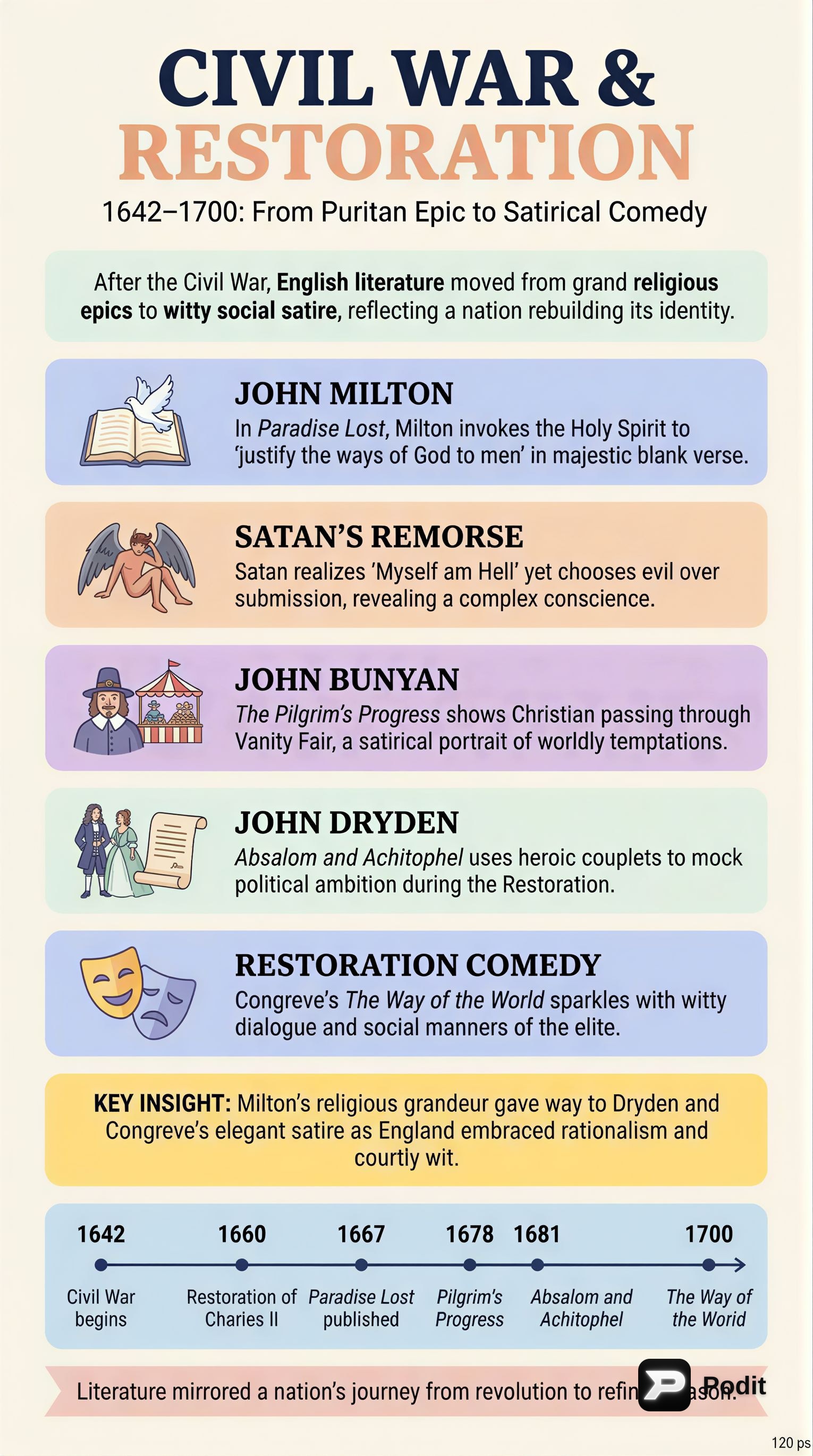
- Civil War (1642-1651) & Interregnum (1649-1660): A period of intense conflict between Parliamentarians and Royalists, leading to the execution of Charles I and the establishment of the Commonwealth under Oliver Cromwell. Theatres were closed during this time (Copy-pasted text).
- Restoration (1660): The monarchy was restored with Charles II, bringing a new cultural and political climate, often characterized by a reaction against Puritan austerity (Copy-pasted text).
1.2. Literary Developments
1.2.1. Poetry
- John Milton (1608-1674):
- Aim: His epic poem, Paradise Lost, aims to "justify the ways of God to men" (Audio transcript).
- Style: Characterized by grandiloquent, rolling blank verse and complex syntax (Copy-pasted text).
- Themes: Narrates Satan's fall, his remorse, and the temptation of Eve, invoking divine aid for its "unattempted" themes (Copy-pasted text).
- Example: Satan's internal conflict and decision to embrace evil: "Farewell remorse! All good to me is lost; Evil, be thou my Good" (Copy-pasted text).
- Samuel Butler (1613-1680):
- Work: Hudibras is a satirical poem that mocks the attitudes and behaviors prevalent during the Civil War and Commonwealth, particularly targeting a bigoted Presbyterian knight (Copy-pasted text).
- Style: Uses simple doggerel verse and grotesque rhymes (Copy-pasted text).
- John Dryden (1631-1700):
- Versatility: A highly versatile writer, excelling in drama, criticism, and poetry (Audio transcript).
- Poet Laureate: Became Poet Laureate in 1668 (Copy-pasted text).
- Style: Mastered the heroic couplet, known for its skill, vigor, flexibility, and linguistic refinement (Copy-pasted text).
- Satire: Influential satirical works include Absalom and Achitophel, which uses biblical parallels to critique contemporary politics (Copy-pasted text).
1.2.2. Prose
- King James Authorized Version of the Bible (1611): A masterpiece of English prose, reflecting the Protestant emphasis on individual interpretation, a movement championed by figures like Wyclif and Tyndale (Audio transcript).
- Stuart Period Prose: Became more introspective and analytical (Copy-pasted text).
- Key Writers: Robert Burton (Anatomy of Melancholy), Sir Thomas Browne (Religio Medici), and Izaak Walton (The Compleat Angler) (Copy-pasted text).
- John Bunyan (1628-1688):
- Work: The Pilgrim's Progress is a forceful allegory of humanity's quest for salvation (Audio transcript).
- Themes: Vividly portrays worldly temptations through allegorical settings like "Vanity Fair," where all is vanity and pilgrims face trials (Copy-pasted text).
- Allegory: Characters and places often have symbolic names (e.g., Mr. Blind-man, Mr. Hate-good in the jury) (Copy-pasted text).
1.2.3. Drama
- Restoration Comedy (Comedy of Manners): Flourished after the reopening of theatres in 1660 (Audio transcript).
- Characteristics: Cynical wit, focus on elite audiences, reflecting the court of Charles II. Plots often involved intrigue, obscenity, and mockery of marriage and country people (Copy-pasted text).
- Key Playwrights: Etherege, Wycherley, Vanbrugh, Farquhar, and William Congreve (The Way of the World) (Copy-pasted text).
- Innovation: The introduction of actresses on stage added to the fascination (Copy-pasted text).
2. The Eighteenth Century: The Augustan Age (1702-1798) 👑
This century, often termed the Augustan Age, was characterized by relative peace, prosperity, and a strong emphasis on reason and order, laying the groundwork for modern society and literature.
2.1. Historical Context
- Political Stability: Followed the Glorious Revolution of 1688, with power shared between the monarch and Parliament, dominated by landowning oligarchies (Whigs and Tories) (Audio transcript).
- Act of Union (1707): United Scotland and England, forming Great Britain (Copy-pasted text).
- Hanoverian Kings: George I, George II, and George III reigned, with Robert Walpole's political astuteness defining an era of low taxes and peaceful foreign policy (Audio transcript).
- Global Power: Britain achieved hegemony in India and North America, becoming a leading colonial and trading nation (Copy-pasted text).
- Challenges: Stability was later challenged by the American War of Independence (1775-1783) and the French Revolution (1789) (Audio transcript).
2.2. Social Context
- Rationalism & Enlightenment: A prevailing spirit of optimism and faith in human reason, influenced by John Locke and Sir Isaac Newton, leading to a more empirical worldview (Audio transcript).
- Industrial & Agricultural Revolutions: Transformed Britain into a prosperous, urbanized nation, though with significant human cost (Audio transcript).
- Enclosure Acts: Replaced communal farming with private estates, creating a landless class (Copy-pasted text).
- Urbanization: Towns like London, Birmingham, and Manchester grew rapidly, but living conditions for the poor were often wretched, with overcrowding, poor sanitation, and disease (Copy-pasted text).
- Social Issues: Gambling and drinking were popular pastimes, and Methodism emerged as a response to social and spiritual neglect (Copy-pasted text).
- Expanding Reading Public: The middle classes and women became increasingly prominent readers, fostering the growth of newspapers, periodicals, and circulating libraries (Copy-pasted text).
2.3. Literary Developments
2.3.1. Prose and the Rise of the Novel
- New Prose Style: Simpler, clearer, and more precise, moving away from the intricacies of earlier styles. It was adaptable and logic-aspiring, suitable for instruction, description, and persuasion (Copy-pasted text).
- The Novel's Emergence: A new literary form, influenced by philosophers questioning traditional realities and emphasizing individual experience (Audio transcript).
- Daniel Defoe (1660-1731):
- "Father of the English Novel": Considered a pioneer of the realistic novel (Copy-pasted text).
- Works: Robinson Crusoe (1719) is noted for its realism, detailed narrative, and moral purpose, often presented as a "history of fact" (Audio transcript).
- Style: His journalistic background contributed to his method, style, and language (Copy-pasted text).
- Jonathan Swift (1667-1745):
- Master Satirist: Used a clear, plain style to critique society (Audio transcript).
- Works: Gulliver's Travels (1726) is a harsh satire on mankind's follies, often misinterpreted as a children's book due to its fantastic imagery (Copy-pasted text).
- Critique: His depiction of Lilliput satirizes the pomposity of court life and political absurdity (Copy-pasted text).
- Samuel Richardson (1689-1761):
- Epistolary Novel: Pioneered this form with Pamela, or Virtue Rewarded (1740-41) and Clarissa Harlowe (1747-48) (Audio transcript).
- Psychological Depth: Offered deep psychological analysis, allowing readers into characters' innermost thoughts and feelings (Copy-pasted text).
- Moral Aim: Novels often had a strong moralizing tendency, upholding religion and virtue (Copy-pasted text).
- Henry Fielding (1707-1754):
- "Comic Epic in Prose": Approached the novel systematically, defining it as such (Copy-pasted text).
- Works: Tom Jones (1749) features a wider social panorama and a more tolerant morality than his contemporaries (Audio transcript).
- Narrative: Employed an omniscient, often ironic narrator who directly addresses the reader, providing a "literary tour" (Copy-pasted text).
- Characterization: Focused on "manners" and "species" rather than individual psychological growth, with characters from all social classes (Copy-pasted text).
- Laurence Sterne (1713-1768):
- Unconventional: Tristram Shandy (1760-67) challenged conventional narrative structures, exploring the irrational workings of the mind through digressions and non-chronological storytelling (Audio transcript).
- "Anti-novel": Anticipated modern literary experiments, questioning the novel's ability to represent an ordered reality (Copy-pasted text).
- Influence: Heavily influenced by John Locke's ideas on the "association of ideas" and the subjective experience of time (Copy-pasted text).
- Daniel Defoe (1660-1731):
2.3.2. Poetry
- Alexander Pope (1688-1744):
- Master of Heroic Couplet: Polished Dryden's legacy, making the heroic couplet a staple form of 18th-century verse (Copy-pasted text).
- Mock-Heroic: The Rape of the Lock (1712) is a mock-heroic satire that uses elevated language to treat a trivial subject, satirizing high society (Copy-pasted text).
- Satire: Displayed concern over a Whig-dominated society and its corruption, often with a moralizing didactic function (Copy-pasted text).
- Characteristics: Poetry was seen as a craft, adhering to rules and classical models (Ovid, Horace, Virgil). Emphasis on correctness, order, propriety, and sobriety. Satire played a leading role (Copy-pasted text).
2.3.3. Drama
- Fallow Period: Generally considered a less significant period for drama compared to the Restoration (Copy-pasted text).
- Notable Exceptions: Richard Sheridan (The School for Scandal), Oliver Goldsmith (She Stoops to Conquer), and John Gay (The Beggar's Opera) (Copy-pasted text).
- Shift: Restoration comedy fell into disrepute, replaced by more sentimental and moralizing comedies catering to middle-class tastes (Copy-pasted text).
3. The Age of Romantics (1798-1837) 💖
This turbulent era marked a profound shift in sensibility, challenging the rationalism of the Enlightenment and paving the way for a new emphasis on emotion, individualism, and nature.
3.1. Historical Context
- Post-Revolutionary Turmoil: Shaped by the aftermath of the French Revolution and the Napoleonic Wars (1793-1815), leading to social unrest and demands for reform in Britain (Audio transcript).
- Domestic Politics: William Pitt the Younger's administration faced radical calls for reform, but repressive measures (e.g., suspension of Habeas Corpus, Combination Acts) stifled dissent (Copy-pasted text).
- Reforms:
- Reform Act of 1832: A significant turning point, shifting political dominance from agricultural landowners to urban-based industrial and commercial middle classes, though universal suffrage was still decades away (Copy-pasted text).
- Other Reforms: Factory Acts (1833, forbidding child labor under 9), abolition of slavery (1833), new Poor Law (1834), and Municipal Corporations Act (1835) (Copy-pasted text).
3.2. Social Context
- Industrial & Agricultural Revolutions: Continued to accelerate, making Britain the world's most powerful nation but also creating severe social problems (Audio transcript).
- Economic Hardship: Unemployment, static wages, rising prices, and poor living conditions in burgeoning industrial towns led to acute social unrest (Copy-pasted text).
- Protest Movements: Luddite riots (1811-1816) against machines, Captain Swing riots (1830-31) against agricultural mechanization, and early trade unions (Copy-pasted text).
- Population Growth: Significant population boom and migration from rural areas to industrial centers (Copy-pasted text).
3.3. Literary Context
- Challenge to Old Ideals: The political, social, religious, philosophical, and artistic ideals of the early 18th-century ancien régime were no longer considered adequate (Copy-pasted text).
- New Sensibilities:
- Rousseau's Influence: Emphasized emotional capacities and imaginative powers over "reason" (Copy-pasted text).
- German Sturm und Drang: A movement (Goethe, Schiller) that rejected rationalism in favor of individual genius and intense emotion, anticipating Romanticism (Copy-pasted text).
- Shift in English Literature: English writers moved away from "poetic diction" and neoclassical constraints, paving the way for a more personal, imaginative, and emotional form of expression that would define Romanticism (Audio transcript).
Conclusion 💡
The period from the Civil War and Restoration through the Eighteenth Century to the early Romantics demonstrates a continuous interplay between historical events, societal changes, and literary evolution. From Milton's theological epics and the rise of analytical prose to the cynical wit of Restoration comedy and the emergence of the novel as a powerful medium for exploring individual experience and social realities, English literature underwent significant transformations. The Augustan Age's emphasis on reason and order gradually yielded to the burgeoning Romantic sensibilities, prioritizing emotion and individualism, often in response to the profound social and economic upheavals of the Industrial Revolution. This era laid the groundwork for modern literary forms and critical thought, reflecting a dynamic society in constant flux.