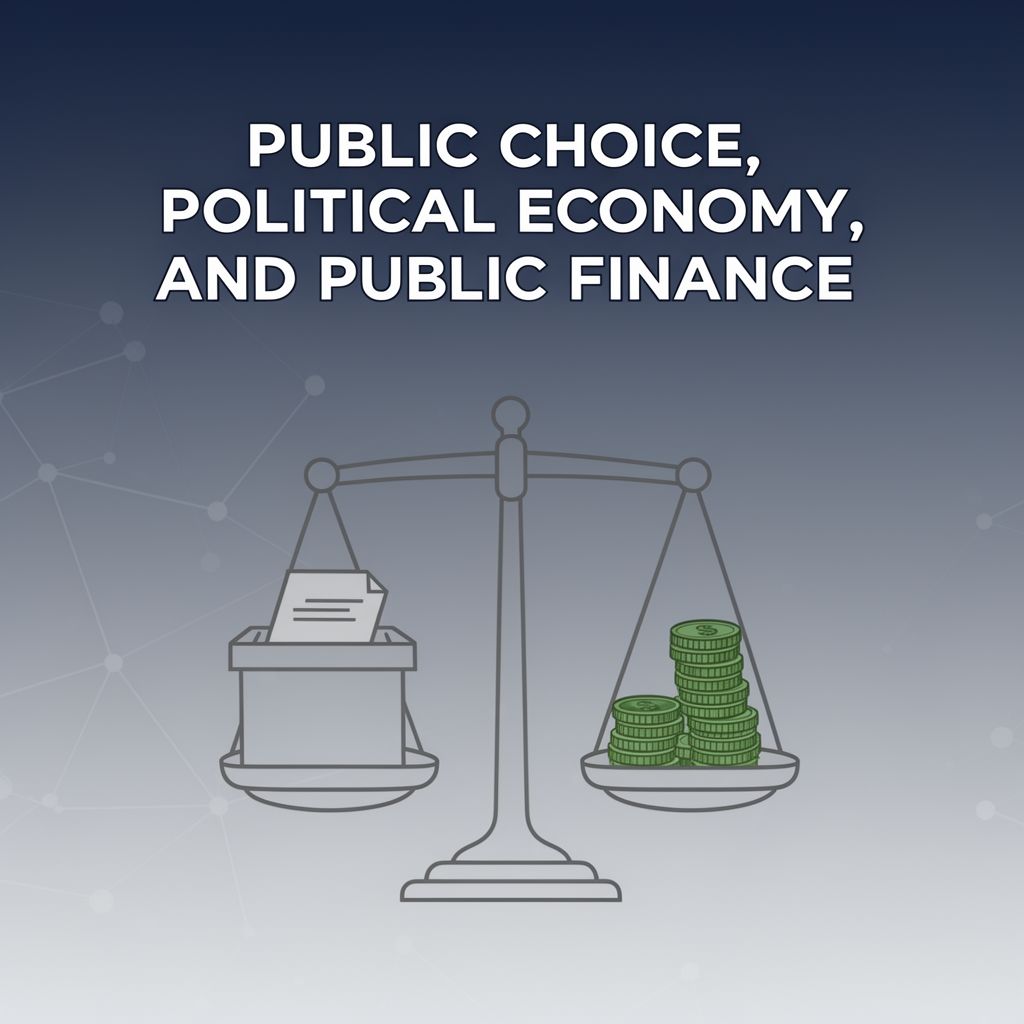
Public Choice, Political Economy, and Public Finance - kapak
Siyaset#voting systems#public choice#political economy#public finance

Public Choice, Political Economy, and Public Finance

Explore voting systems, political economy dynamics, and the comprehensive breakdown of public revenues and taxation aims, providing a foundational understanding of governmental finance.

January 11, 2026 ~22 dk toplam
01

Sesli Özet

8 dakika

Konuyu otobüste, koşarken, yolda dinleyerek öğren.

Sesli Özet

Public Choice, Political Economy, and Public Finance

0:007:51
02

Flash Kartlar

25 kart

Karta tıklayarak çevir. ← → ile gez, ⎵ ile çevir.

1 / 25
Tüm kartları metin olarak gör
  1. 1. What is the primary focus of public choice theory?

    Public choice theory examines how individual preferences are aggregated into collective decisions, often through various voting mechanisms.

  2. 2. Define the Unanimity Rule in collective decision-making.

    The Unanimity Rule requires 100% approval for any decision to pass, ensuring Pareto efficiency but often being impractical.

  3. 3. What is a major drawback of the Unanimity Rule for large groups?

    It is often impractical for large groups due to high transaction costs and the potential for a single dissenter to block progress.

  4. 4. Explain Wicksell's concept of Relative Unanimity.

    Relative Unanimity requires a high, but not absolute, level of approval (e.g., three-quarters) to balance broad consensus with practical decision-making.

  5. 5. How is a decision typically made under Majority Voting?

    Under Majority Voting, a decision passes with more than 50% of the votes, though it can lead to complex outcomes.

  6. 6. What does the Arrow Impossibility Theorem state about voting systems?

    It states that no voting system can convert individual preferences into a consistent social ranking while satisfying fair conditions like non-dictatorship, consistency, and independence of irrelevant alternatives.

  7. 7. What is the outcome suggested by the Median Voter Theorem?

    The Median Voter Theorem suggests that under majority voting, the outcome will often reflect the preferences of the median voter.

  8. 8. Describe the phenomenon known as Cyclical Majority or the Voting Paradox.

    This occurs when collective preferences are inconsistent, leading to an endless cycle where X is preferred to Y, Y to Z, and paradoxically Z to X.

  9. 9. What is the Plurality Rule in voting?

    The Plurality Rule states that the option with the most votes wins, even if it does not achieve an absolute majority.

  10. 10. How does Point Voting allow voters to express preferences?

    Point Voting allows voters to assign numerical points to options, enabling them to express the intensity of their preferences.

  11. 11. Define Logrolling in the context of political economy.

    Logrolling, or vote trading, is a practice where politicians exchange support for each other's proposals, often to facilitate legislation.

  12. 12. What is a potential negative consequence of Logrolling?

    It carries the risk of leading to inefficient outcomes or the approval of projects that benefit only a few at the expense of the many.

  13. 13. How is Corruption defined in public administration?

    Corruption is defined as the abuse of public power for private or self-interest, with far-reaching negative impacts on economy and society.

  14. 14. Name two significant economic consequences of corruption.

    Corruption leads to the misallocation of resources, exacerbates income inequality, decreases Foreign Direct Investment (FDI), and negatively impacts public investment.

  15. 15. What are Public Revenues?

    Public Revenues are the funds collected by the government to finance its operations and provide public goods and services.

  16. 16. What are the two broad categories of Public Revenues?

    Public Revenues are broadly categorized into Tax Revenues and Non-Tax Revenues.

  17. 17. Give three examples of Tax Revenues.

    Examples of Tax Revenues include direct taxes, indirect taxes, and quasi-taxes like duties, funds, and contributions.

  18. 18. Give three examples of Non-Tax Revenues.

    Non-Tax Revenues include user charges, prices for goods and services provided by public enterprises, administrative fees, and borrowing.

  19. 19. What are Quasi-taxes?

    Quasi-taxes are compulsory payments often linked to specific services or benefits, such as duties for passport issuance or customs clearance.

  20. 20. What is the purpose of User Charges?

    User charges are payments made by individuals for the direct consumption of public services, such as tolls for highways or bridge fees.

  21. 21. Explain the concept of Conversion in government debt management.

    Conversion involves lowering the interest rate on existing bonds to reduce the government's debt servicing costs.

  22. 22. What does Consolidation mean in the context of government debt?

    Consolidation entails delaying the maturity date of debt, essentially rescheduling payments into the future to manage financial obligations.

  23. 23. What is the regulatory function of taxation?

    The regulatory function of taxation involves influencing production and consumption patterns through incentives or disincentives, like excise taxes on harmful goods.

  24. 24. How does taxation serve a distributive function?

    Taxation serves a distributive function by aiming to transfer income from higher-income groups to lower-income groups, reducing income inequality.

  25. 25. What is the macroeconomic function of taxation?

    The macroeconomic function of taxation is to serve as a tool for stabilization and growth, adjusting tax rates to stimulate or cool down the economy.

03

Bilgini Test Et

15 soru

Çoktan seçmeli sorularla öğrendiklerini ölç. Cevap + açıklama.

Soru 1 / 15Skor: 0

Which voting mechanism ensures Pareto efficiency but is often impractical for large groups due to high transaction costs and the potential for a single dissenter to block progress?

04

Detaylı Özet

4 dk okuma

Tüm konuyu derinlemesine, başlık başlık.

📚 Public Choice, Political Economy, and Fiscal Principles: A Study Guide

Source Information: This study material has been compiled and organized from a lecture audio transcript and supplementary copy-pasted text.


🎯 Introduction to Public Choice and Fiscal Principles

This guide explores the mechanisms of collective decision-making, the dynamics of political interactions, and the fundamental principles governing public revenues and taxation. It aims to provide a comprehensive understanding of how individual preferences are aggregated into social choices and how governments finance their operations.


1️⃣ Public Choice and Voting Mechanisms

Public choice theory examines how individual preferences are aggregated into collective decisions. Various voting mechanisms are employed, each with its own advantages and limitations.

1.1. Types of Voting Rules

  • Unanimity Rule
    • Requires 100% approval for a decision.
    • Benefit: Ensures Pareto efficiency (no one can be made worse off without making someone else better off).
    • Drawback: Often unrealistic and impractical due to high transaction costs and the potential for a single dissenter to block progress.
  • Relative Unanimity 💡
    • Proposed by Wicksell.
    • Requires a high, but not absolute, level of approval.
    • Examples: 3/4, 2/3, or 9/10 of votes.
    • Purpose: Balances broad consensus with practical decision-making.
  • Majority Voting
    • A decision passes with more than 50% of the votes.
    • The most common method, but can lead to complex outcomes.
  • Plurality Rule
    • The option with the most votes wins, even if it does not achieve a majority.
  • Point Voting
    • Voters assign numerical points to options to express the intensity of their preferences.

1.2. Challenges and Concepts in Voting

  • Arrow Impossibility Theorem 📚
    • States that no voting system can convert individual preferences into a consistent social ranking while satisfying all fairness conditions simultaneously.
    • Fairness Conditions:
      • Non-dictatorship: No single individual can determine the outcome.
      • Consistency: If all individuals prefer X to Y, then the social ranking must prefer X to Y.
      • Independence of Irrelevant Alternatives: The social ranking of X versus Y should only depend on individual preferences between X and Y, not on preferences for other alternatives.
  • Median Voter Theorem 📊
    • Suggests that under majority voting, the outcome will often reflect the preferences of the median voter (the voter exactly in the middle of the political spectrum).
  • Cyclical Majority (Voting Paradox) ⚠️
    • Occurs when collective preferences are inconsistent.
    • Example: If X is preferred to Y, and Y is preferred to Z, one might paradoxically find Z preferred to X, leading to an endless cycle without a clear winner.

2️⃣ Political Economy Dynamics

This section explores the interplay between political processes and economic outcomes.

2.1. Logrolling (Vote Trading)

  • Definition: A practice where politicians exchange support for each other's proposals.
  • Mechanism: "I support yours if you support mine."
  • Potential Outcomes:
    • Can facilitate the passage of legislation.
    • Carries the risk of leading to inefficient outcomes or the approval of projects that benefit only a few at the expense of the many.

2.2. Corruption

  • Definition: The abuse of public power for private or self-interest.
  • Consequences of Corruption 📉
    • Misallocation of Resources: Funds are diverted from essential public services to projects offering personal gain.
    • Inequality of Income: Illicit gains concentrate wealth in the hands of a few.
    • Decrease in Foreign Direct Investment (FDI): Investors are deterred by unstable and unpredictable business environments.
    • Negative Impact on Public Investment: Funds intended for infrastructure, education, or healthcare are siphoned off.

3️⃣ Public Revenues: Principles and Sources

Public revenues are the funds collected by the government to finance its operations and provide public goods and services.

3.1. Public Revenues Breakdown

Public revenues are broadly categorized into:

  1. Tax Revenues: Compulsory payments.
  2. Non-Tax Revenues: Other sources of government income.

3.2. Detailed Sources of Public Revenues

3.2.1. Tax Revenues

  • Taxes 💰
    • Compulsory payments levied by the government on individuals or corporations (e.g., income tax, corporate tax, consumption taxes).
  • Quasi-Taxes
    • Compulsory payments often linked to specific services or benefits.
    • Duties: Payments for specific services (e.g., passport issuance, customs clearance, notary fees).
    • Funds: Revenues earmarked for specific purposes (e.g., social security contributions, dedicated defense expenditures).
    • Contributions: Payments made for social security systems (e.g., pensions, healthcare).

3.2.2. Non-Tax Revenues

  • User Charges
    • Payments made by individuals for the direct consumption of public services (e.g., tolls for highways, bridge fees).
  • Prices (Public Enterprises - PPEs)
    • Revenues generated by state-owned enterprises operating in commercial sectors.
    • Examples: Public healthcare services, state-owned transportation companies (e.g., TCDD), state-owned sugar factories (e.g., Şeker).
  • Administrative Fees
    • Charges for permits, licenses, and other administrative services.
  • Borrowing 🏦
    • A critical source of revenue, especially when governments face budget deficits.
    • Can be domestic (from citizens/institutions) or foreign (from international markets/institutions).
    • Related Debt Management Concepts:
      • Conversion: Lowering the interest rate on existing bonds to reduce debt servicing costs.
      • Consolidation: Delaying the maturity date of debt, rescheduling payments into the future.

4️⃣ Aims of Taxation

Taxation serves multiple vital functions beyond simply collecting revenue.

  1. Collect Revenue 💸
    • The primary aim: to finance public goods and services.
  2. Regulatory Function ⚖️
    • Influences production and consumption patterns through incentives or disincentives.
    • Examples: Excise taxes on harmful goods, tax breaks for environmentally friendly practices.
  3. Distributive Function 🤝
    • Aims to transfer income from higher-income groups to lower-income groups.
    • Achieved through progressive tax systems and social welfare programs, reducing income inequality.
  4. Macroeconomic Function 📈
    • Serves as a tool for stabilization and growth.
    • Governments can adjust tax rates to stimulate economic activity during recessions or cool down an overheating economy, contributing to overall economic stability and sustainable growth.

Kendi çalışma materyalini oluştur

PDF, YouTube videosu veya herhangi bir konuyu dakikalar içinde podcast, özet, flash kart ve quiz'e dönüştür. 1.000.000+ kullanıcı tercih ediyor.

Sıradaki Konular

Tümünü keşfet
Theories of International Relations and Political Economy

Theories of International Relations and Political Economy

An in-depth look at the English School, International Political Economy theories, and Neo-Realism, exploring global interactions.

11 dk Özet 23 15
National Security and Its Dimensions

National Security and Its Dimensions

This podcast explores the concept of national security, its fundamental importance, and its four crucial dimensions: military, political, economic, and social security, based on the provided lesson.

Özet 25 15
Turkey-Greece Relations: Treaties and Disputes

Turkey-Greece Relations: Treaties and Disputes

An in-depth analysis of Turkey-Greece relations, focusing on the Treaty of Lausanne (1923) and the Paris Peace Treaty (1947), covering Aegean islands, minority rights, and population exchange.

Özet 25 15
Abolition of Caliphate and Turkish Constitutional Evolution

Abolition of Caliphate and Turkish Constitutional Evolution

This summary examines the abolition of the Caliphate in Turkey and the subsequent constitutional developments, including the 1921 and 1924 Constitutions, and the integration of secular principles.

6 dk Özet 25 15
Contemporary British Sociopolitical and Cultural Dynamics

Contemporary British Sociopolitical and Cultural Dynamics

An academic overview of Britain's social and cultural context, examining political challenges, demographic shifts, gender equality, LGBTQ+ rights, and the evolving role of arts and popular culture in the 21st century.

8 dk Özet 25 15
British Social and Cultural Context: 1979-2014

British Social and Cultural Context: 1979-2014

An academic overview of Britain's social and cultural landscape from the late 1970s through the early 2010s, focusing on the Thatcher era, New Labour, and subsequent challenges.

9 dk Özet 25 15
Multiculturalism and Gender in Britain: A Historical and Political Analysis

Multiculturalism and Gender in Britain: A Historical and Political Analysis

An academic overview of Britain's multicultural society and evolving gender issues, examining historical contexts, policy developments, and the significant influence of figures like Margaret Thatcher.

6 dk Özet 25 15
Toward an Asian Order: Confrontation or Partnership?

Toward an Asian Order: Confrontation or Partnership?

An in-depth analysis of the historical and contemporary approaches of China and the United States to world order, exploring their contrasting philosophies and the challenges of their relationship.

21 dk Özet