Podit
Podit
🇬🇧 Post-Consensus Britain: A Study Guide (Late 1970s - Early 2010s)
Source Information: This study material has been compiled from a copy-pasted text and a lecture audio transcript, providing a comprehensive overview of the social and cultural context of Britain during this transformative period.
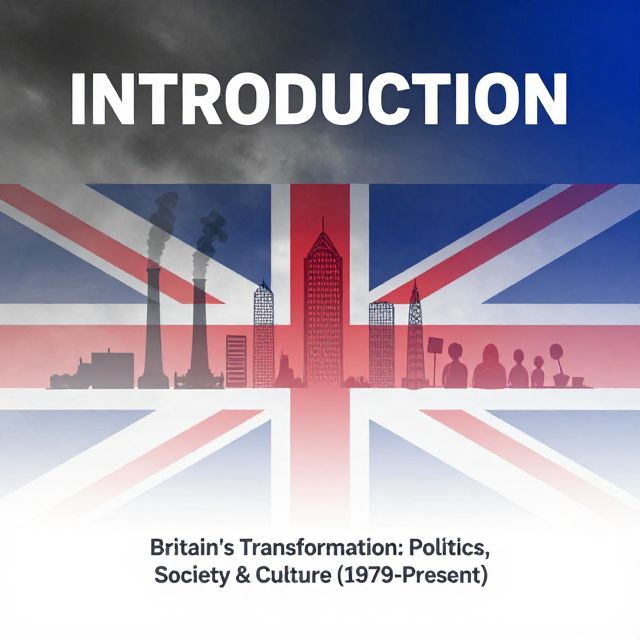
📚 Introduction: The End of Consensus and a New Era
The period from the late 1970s to the early 2010s in Britain marked a significant departure from the post-war consensus, which had emphasized state intervention, welfare provision, and social cohesion. This era was characterized by profound political, economic, and social transformations, leading to widespread public desperation and confrontation in the late 1970s. This environment set the stage for the rise of new political ideologies and their far-reaching consequences across British society, fundamentally reshaping the nation's identity and direction.
1️⃣ The Thatcher Era: Economic Restructuring and Social Division (1979-1997)
Margaret Thatcher's premiership ushered in a radical shift in British politics and economics, often referred to as "Thatcherism."
1.1 📈 Rise to Power and Economic Ideology
- Ascension: Following the Conservative Party's defeat in 1974, Margaret Thatcher became the first female leader of a British political party. Initially portrayed as a suburban housewife, she was developing strong economic ideas.
- Monetarism: Her economic policies were guided by monetarism, aiming to reduce inflation through:
- High interest rates.
- Submitting the economy to free-market principles.
- Adherence to the laws of supply and demand.
- Appeal: Her forceful personality and free-market ideology attracted many electors amidst the strikes and confrontations of the late 1970s. This ideology evoked a nostalgic image of Victorian Britain's imperial height, often overlooking the associated inequality and suffering.
1.2 📉 Economic Crisis and Deindustrialization
- Policy Implementation: After her 1979 election victory, Thatcher began implementing policies that involved withdrawing state support for nationalized industries.
- Devastating Impact: This led to a severe economic crisis:
- Manufacturing declined significantly.
- Traditional industries like shipbuilding, mining, and steel virtually disappeared.
- Regional Devastation: Regions traditionally dependent on these industries (Scotland, North of England, Wales, West Midlands) were economically devastated.
- Unemployment: Rose to over 13%, with more than three million people out of work.
- Social Unrest: Widespread civil and industrial conflict ensued:
- Brixton Riots (1981): Spontaneous, anarchic riots broke out in Brixton, South London, and other cities, directed against the police and local environment.
- Miners' Strike (1984-1985): A bitter and violent confrontation, which Thatcher saw as crucial to breaking the power of trade unions. She earned the moniker "Iron Lady" and passed legislation to permanently weaken union influence.
1.3 ⚔️ The Falklands War and Cold War Strategy
- Falklands War (1982): Argentina's occupation of the Falkland Islands led to a war. Britain's victory on June 14, 1982, allowed Thatcher to exploit the moment, distracting attention from domestic economic woes and boosting her popularity.
- Cold War Alliance: The government forged a closer alliance with the USA to develop a Cold War strategy, involving nuclear weapons as a deterrent.
- Mutually Assured Destruction (MAD): A central element of this policy, implying that a nuclear strike by either side would result in the destruction of both.
1.4 💸 Privatization and Social Costs
- Thatcherism Fully Expressed (Post-1983): Following her 1983 re-election, Thatcherism involved:
- Further reduction of public spending.
- Extensive privatization of public sector industries (e.g., gas, steel, transport, telecommunications).
- Funding: These measures were partly financed by North Sea oil revenues discovered in the 1970s.
- Unpopularity: Highly unpopular with the working class and unemployed, leading to more violent industrial disputes.
- "Enemy Within": Thatcher sought to cement government authority by confronting perceived internal enemies, including powerful trade unions, miners, left-wing local governments, and even "unreliable" members of her own party.
- Social Impact:
- Increased industrial strife and crime rates.
- Urban riots in the mid-1980s.
- Criticism: The left blamed high unemployment, homelessness, and the erosion of community due to economic individualism.
- Disproportionate Impact: Policies severely affected the poorly educated, least skilled, immigrants, and women in manufacturing.
1.5 💰 Financial Boom and Regional Disparity
- Mid-1980s Boom: Restrictions on moneylending and share-dealing were lifted, leading to a booming financial sector.
- Easy credit and tax cuts.
- Rapid rise in share prices, especially for newly privatized industries (e.g., British Airways, British Steel, public utilities).
- Economic Shift: Britain's economy shifted from heavy industry to financial services and North Sea oil revenues.
- "Two-Speed Economy": By 1986, the economy was stronger, and house prices rose sharply, creating an air of excitement and optimism. However, these benefits were felt chiefly in the South of England, while the North continued to suffer from deindustrialization and long-term unemployment.
1.6 🎭 Arts and Culture Under Thatcher
- Arts Council Funding Cuts: Funding for the Arts Council, established in 1946 to support the arts, was sharply reduced.
- Commercialization: The arts were treated as any other economic activity, leading to:
- Museums and galleries charging admission fees for the first time.
- Productions becoming less critical and adventurous, more populist, to attract subsidies (e.g., Shakespeare plays stripped of social content).
1.7 🏳️🌈 Social Issues and Thatcher's Downfall
- AIDS Crisis and Clause 28: The spread of AIDS prompted public discussion of gay lifestyles. However, the government introduced Clause 28 of the Local Government Act (1987), prohibiting state schools from "promoting homosexuality." This led to increased activism by gay rights groups.
- Political Instability: By 1990, Thatcher faced increasing internal party division, particularly over European integration.
- Poll Tax Riots: Violent rioting erupted in London over the universally unpopular "poll tax."
- Resignation: A combination of recession, anti-European sentiment, and the poll tax led to her resignation after 11 years.
- John Major: Succeeded Thatcher, securing an unexpected victory in 1992 but struggling with a divided party and public disillusionment, exacerbated by allegations of "sleaze" (financial and moral impropriety) within the Conservative Party.
2️⃣ New Labour and the Age of Insecurity (1997-2014)
The decline of the Conservatives paved the way for Tony Blair's New Labour, which sought to modernize the party's image and policies.
2.1 🌹 New Labour's Rise and Political Changes
- Tony Blair: Elected leader, he transformed the Labour Party, moving away from traditional socialist tenets like stronger unions, nationalization, and wealth redistribution.
- Historic Victory (1997): Labour achieved a massive electoral victory, ending 18 years of Conservative rule.
- Devolution: Early political changes included:
- Devolution of power to Scotland (Scottish Parliament) and Wales (Welsh Assembly).
- A peace treaty in Northern Ireland.
- Establishment of the Greater London Authority with its own mayor and assembly.
- New Political Landscape: The press often acted as an "unofficial" opposition, and external bodies like the European Union, IMF, and World Bank exerted greater influence on government policy.
2.2 📊 Economic Stability and Social Concerns
- Pragmatic Economic Management: The economy showed steady improvement, with low inflation (2-3% by 2004) and almost full employment.
- Housing Market: Home ownership rose, but house prices doubled between 1997 and 2002, making it harder for first-time buyers.
- Domestic Agenda: New issues dominated:
- Education: University attendance rose significantly (from 7% in 1975 to 33% in 2005), but university fees were introduced for the first time.
- Public Health: Major concern with rising obesity (67.6% of men, 56.4% of women overweight in 2004), increasing alcohol consumption (binge drinking), sexually transmitted diseases, and cancer rates. Food standards and "junk food" became public issues.
2.3 📉 Declining Public Trust and Foreign Policy
- Political Participation: Declined, with only 39% of under-25s voting in 2001, and overall turnout being the lowest since 1918.
- Institutional Trust: Public trust in politicians, the monarchy, and the Anglican Church waned.
- Blair's Foreign Policy: Marked by a sense of "moral outrage" and advocacy for the use of force, leading to multiple overseas interventions:
- Iraq (1998 and 2003)
- Kosovo (1999)
- Sierra Leone (2000)
- Afghanistan (2001)
- Iraq War (2003): Blair supported the US "war on terror" and the invasion of Iraq, despite massive public protests in Britain. The intervention was controversial due to unproven claims of Iraq possessing weapons of mass destruction.
2.4 🎨 "Cool Britannia" and Arts Funding
- Cultural Renewal (Mid-1990s): Britain experienced a period of renewed national pride and flourishing creative industries (fashion, design, pop music), dubbed "Cool Britannia."
- Euro '96: England hosting the football championship contributed to this sense of national unity.
- Government Support: The Department for Culture, Media and Sport (DCMS) was established, and Blair actively promoted a youthful, progressive image of Britain.
- Criticism: "Cool Britannia" was sometimes criticized as elitist and English-centric, ignoring diverse arts.
- Arts Funding Shift: Public funding for the arts declined, replaced by an individualistic entrepreneurial ethic and reliance on schemes like the National Lottery (started 1994). This led to debates about commercialization versus public access and quality.
2.5 ⚠️ The Age of Insecurity (Post-2007)
- Perceived Stability: By the mid-2000s, there was a belief that economic boom-and-bust cycles were over, and ideological divides had vanished.
- Media Scandals:
- News International Phone Hacking: A major scandal involving illegal phone tapping of celebrities, politicians, and crime victims by Rupert Murdoch's News International. Led to the closure of the News of the World and the Leveson Inquiry (2011-2012).
- BBC Sex Abuse Allegations: Allegations of sex abuse and harassment against children by BBC entertainers from the 1970s and 1980s (e.g., Jimmy Savile), leading to public disgust and resignations.
- Public Confidence in Police: Declined due to high-profile incidents:
- Allegations of racism and disproportionate treatment of young black people.
- The "stop-and-search" policy.
- Controversial shootings (e.g., Mark Duggan in 2011, Jean Charles de Menezes in 2005).
- Unreliable crime rates due to police manipulation to meet targets.
- Mood of Despair: A pervasive public mood of quiet anger, frustration, and despair, symbolized by the popular wartime slogan "Keep calm and carry on."
- Moments of Respite: The Queen's Diamond Jubilee and the London Olympic and Paralympic Games in 2012 offered temporary national celebrations.
- Scottish Independence Referendum (2014): Scots voted on independence, with 55.3% voting "No," temporarily settling the question of home rule.
- Thatcher's Death (2013): Briefly reignited old divisions, highlighting the enduring controversial legacy of her premiership.
✅ Conclusion: A Shifting National Identity
The period from the late 1970s to the early 2010s was one of profound and often turbulent change for Britain. It witnessed the dismantling of the post-war consensus, the rise and fall of Thatcherism, and the emergence of New Labour, each leaving an indelible mark on the nation's economic, social, and cultural fabric. This era was characterized by significant economic restructuring, leading to both prosperity in some sectors and devastating social costs in others. The decline in public trust in institutions, evolving social values, and a complex foreign policy agenda further shaped a national identity that became increasingly diverse, yet often fraught with internal divisions and external pressures.