 Podit
Podit
This study material synthesizes information from a copy-pasted text and a lecture audio transcript to provide a comprehensive overview of Britain's social, cultural, and linguistic evolution from the mid-20th century to the 2010s.
🇬🇧 Britain's Evolving Landscape: Society, Culture, and Language (1950s-2010s)
1. Introduction: A Nation in Flux 🌍
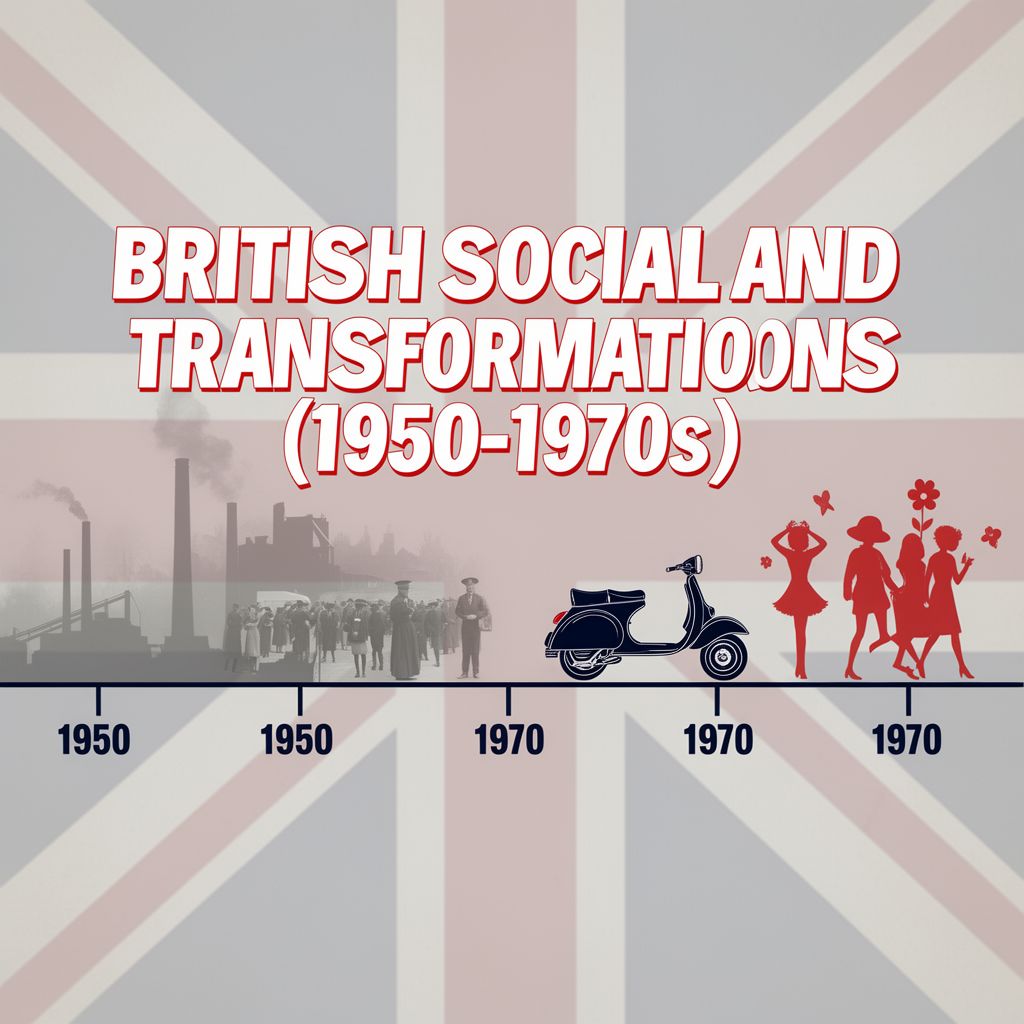
Since the 1950s, Britain has undergone rapid and profound social and cultural changes. This period saw the decline of the British Empire, the expansion of the Commonwealth, and significant immigration, leading to a remarkably diverse nation. Key movements like the women's rights movement and the emergence of youth as a distinct social group fundamentally reshaped society. These transformations deeply influenced the arts and the very fabric of the English language, reflecting a continuous process of adaptation and redefinition.
2. Post-War Reconstruction and Social Transformation (1940s-1970s)
2.1. Laying the Foundations: The Welfare State 🛠️
Prior to the late 1940s, Britain was marked by widespread poverty and social inequality. Post-World War II, a concerted effort for social and economic reconstruction aimed to create a more equitable society.
- Beveridge Report (1942): Identified "five giants" to overcome: Want, Disease, Ignorance, Squalor, and Idleness.
- Arts Funding: Economist John Maynard Keynes advocated for state funding of the arts, seeing it as crucial for social improvement.
- Education Reform: The 1944 Butler Education Act introduced free grammar school education, aiming to boost social mobility.
- Labour Government (1945): Clement Attlee's government nationalized key industries and established the welfare state and the National Health Service (NHS) in 1948, providing social security and free healthcare "from the cradle to the grave." This era was envisioned as building a "new Jerusalem."
2.2. Economic Boom and Emerging Anxieties (1950s) 📈
Despite initial austerity, the 1950s brought economic prosperity, increased consumerism, and a sense of optimism, famously captured by Prime Minister Harold Macmillan's phrase, "You've never had it so good."
- Consumer Society: The rise of a youth consumer market, with disposable income, led to a distinct youth culture.
- Immigration: The arrival of the Empire Windrush in 1948 symbolized significant immigration from Commonwealth countries, contributing to ethnic diversity.
- Social Tensions: This period also saw the rise of racial tensions, exemplified by the Notting Hill riots of 1958. Public anxiety grew regarding youth crime and the perceived moral decline linked to popular culture (e.g., "Teddy Boys," rock 'n' roll).
2.3. Liberalization and Division (1960s-1970s) 🕊️
The 1960s were characterized by significant social liberalization and cultural shifts.
- Social Reforms:
- Abolition of capital punishment (1965)
- Legalization of gambling (1960) and homosexuality (1967)
- Advancements in women's rights (e.g., Abortion Act 1967, Divorce Reform Act 1969, access to contraception).
- Voting age lowered to 18 (1969).
- Growing Dissent: Demands for regional autonomy (Scottish, Welsh, Irish nationalists) and increased social polarization, highlighted by Enoch Powell's controversial anti-immigrant speeches.
- Turbulent 1970s: Marked by economic stagnation, high inflation, widespread industrial strikes, and social division. Traditional heavy industries declined, and nationalist and far-right movements gained traction.
3. Thatcherism and its Legacy (1979-1997)
3.1. The Shift to Free-Market Economics 📊
The election of Margaret Thatcher in 1979 initiated a profound ideological shift towards free-market economics, individualism, and reduced state intervention.
- Economic Policies: Privatization of public industries (e.g., gas, steel, transport), reduced state subsidies, and confrontation with powerful trade unions (e.g., miners' strike of 1984-85).
- Social Impact: Led to high unemployment, decline of traditional industries, and civil unrest (e.g., Brixton riots of 1981). The Falklands War (1982) provided a temporary boost to national morale.
- Arts Funding: State funding for the arts was significantly cut, pushing cultural institutions towards commercialization and populist appeal.
3.2. Social Issues and Activism ✊
Thatcher's era also brought new social challenges and spurred activism.
- Public Health: The emergence of HIV/AIDS led to public discussion and activism, often in defiance of government policies like Clause 28 (1987), which prohibited the "promotion of homosexuality" by local authorities.
- Protest Movements: Environmental groups (Greenpeace) and peace camps (Greenham Common) gained prominence.
- Thatcher's Fall: Her resignation in 1990, partly due to opposition over the unpopular "poll tax" and European integration, marked the end of a highly contentious period. John Major's subsequent government struggled with public disillusionment and internal divisions.
4. New Labour and the Age of Insecurity (1997-2014)
4.1. 'Cool Britannia' and Economic Stability (1997-2007) 💡
Tony Blair's New Labour government, elected in 1997, ushered in a period of renewal and relative prosperity.
- "Third Way" Politics: Redefined the Labour Party as pro-business while increasing investment in public services.
- Cultural Resurgence: The "Cool Britannia" movement celebrated British culture, particularly in music, fashion, and design, fostering a renewed sense of national pride (e.g., Euro '96). However, it faced criticism for being elitist and English-centric.
- Foreign Policy: Blair's tenure was marked by controversial overseas interventions, notably the Iraq War (2003), which significantly eroded public trust.
4.2. Economic Crises and Public Trust Erosion (2007-2014) ⚠️
The mid-22000s brought an "age of insecurity," characterized by international economic crises and a decline in public trust.
- Financial Crisis: The 2008 global financial crisis led to public spending cuts under the subsequent Conservative-Liberal Democrat coalition government (2010).
- Scandals: Public trust in institutions plummeted due to financial scandals (e.g., bank bailouts, executive bonuses), political expenses controversies, and media scandals (e.g., News International phone hacking, BBC sex abuse allegations).
- Domestic Issues: Concerns over police conduct, racial tensions (e.g., Mark Duggan shooting), and social problems like homelessness and food banks persisted.
- National Events: Moments of national unity, such as the Queen's Diamond Jubilee and the London 2012 Olympic Games, offered temporary relief.
- Political Debates: The Scottish independence referendum (2014) highlighted ongoing debates about national identity and devolution.
4.3. Multiculturalism and Equality 🤝
Britain's multicultural society continued to evolve, with ongoing debates and progress in social equality.
- Immigration: Significant immigration, particularly from the Commonwealth and later EU countries (e.g., Poland), further diversified the population. Debates on integration, especially concerning Muslim communities, became prominent.
- Mixed-Race Population: A growing mixed-race population indicated increasing social mixing and assimilation.
- Gender Equality: Progress continued with increased female representation in politics and professions, though a gender pay gap and the "glass ceiling" remained concerns. Divorce rates continued to rise, impacting family structures.
- LGBT Rights: Significant advancements were made, including the Civil Partnership Act (2004) and the Marriage (Same Sex Couples) Act (2013), granting same-sex couples equal rights.
4.4. The Arts in the 21st Century 🎭
The arts faced new challenges in an age of insecurity.
- Disconnection from Politics: A growing detachment from overt political activism, as many social issues became mainstreamed through legislation.
- Commercialization: Public funding for the arts declined, leading to increased reliance on private sponsorship and a focus on profitability, sometimes at the expense of experimental or critical works.
- Instrumental Use: Arts were increasingly used for "soft diplomacy" and to enhance corporate or regional images.
5. The English Language: Diversity and Authority 📚
5.1. Global Reach and Internal Diversity 🌐
English has become a global lingua franca, essential in various fields worldwide. Within Britain, it exhibits profound internal diversity.
- Dialects and Accents: Numerous regional dialects and accents (e.g., Scouse, Cockney, Multicultural London English/MLE) reflect geographical and social backgrounds.
- Indigenous Languages: Britain is home to distinct indigenous languages: Welsh, Irish, Scottish-Gaelic, and Scots, each with rich histories and ongoing revival efforts.
- Non-Indigenous Languages: Immigration has significantly enriched Britain's linguistic landscape, with languages like Polish, Urdu, and Punjabi widely spoken.
5.2. Authority and Evolution: Descriptive vs. Prescriptive 📖
Uniquely, English lacks an official regulatory body.
- Descriptive Approach: Dictionaries like the Oxford English Dictionary (OED) adopt a descriptive approach, documenting how language is actually used rather than prescribing rules.
- Hybrid Origins: English is a "linguistic stew," influenced by Latin, Germanic dialects, and Norman French, evolving from Old English to Middle English and spreading globally to form diverse varieties (e.g., "Singlish," creoles).
- Received Pronunciation (RP): Historically, RP was the accent of authority and prestige. However, its influence has diminished, and it is now sometimes perceived as old-fashioned. Post-war arts and popular culture have increasingly embraced regional accents, challenging RP's dominance.
5.3. Taboo Words and Political Correctness ✅
Attitudes towards language have become more tolerant, but new sensitivities have emerged.
- Relaxation of Taboos: The mid-20th century saw a gradual relaxation of censorship around taboo words, notably after the Lady Chatterley's Lover trial (1960) and Kenneth Tynan's use of "fuck" on TV (1965).
- Political Correctness (PC): The concept of PC gained prominence, advocating for inclusive language to avoid offending socially disadvantaged groups. This led to gender-neutral job titles (e.g., "chairperson" instead of "chairman") and the prohibition of discriminatory terms. Debates persist regarding its perceived extremes and impact on free speech.
- Dynamic Language: The OED continues to document the dynamic evolution of English, including slang, internet English, and "management-speak," reflecting ongoing debates about grammar and usage.
5.4. Revival of Celtic Languages 🏴🇮🇪🏴
Despite historical decline due to English dominance, indigenous Celtic languages have seen modern revival efforts.
- Welsh: Supported by legislation like the Welsh Language Act (1993), Welsh is now taught in schools, used in official contexts, and has a thriving media presence (e.g., S4C).
- Irish: In the Republic of Ireland, it is the first official language. In Northern Ireland, its use remains politicized but is increasingly encouraged through official efforts.
- Scottish Gaelic and Scots: Both have seen efforts to preserve and promote them through education, media, and cultural festivals, though their positions remain precarious.