 Podit
Podit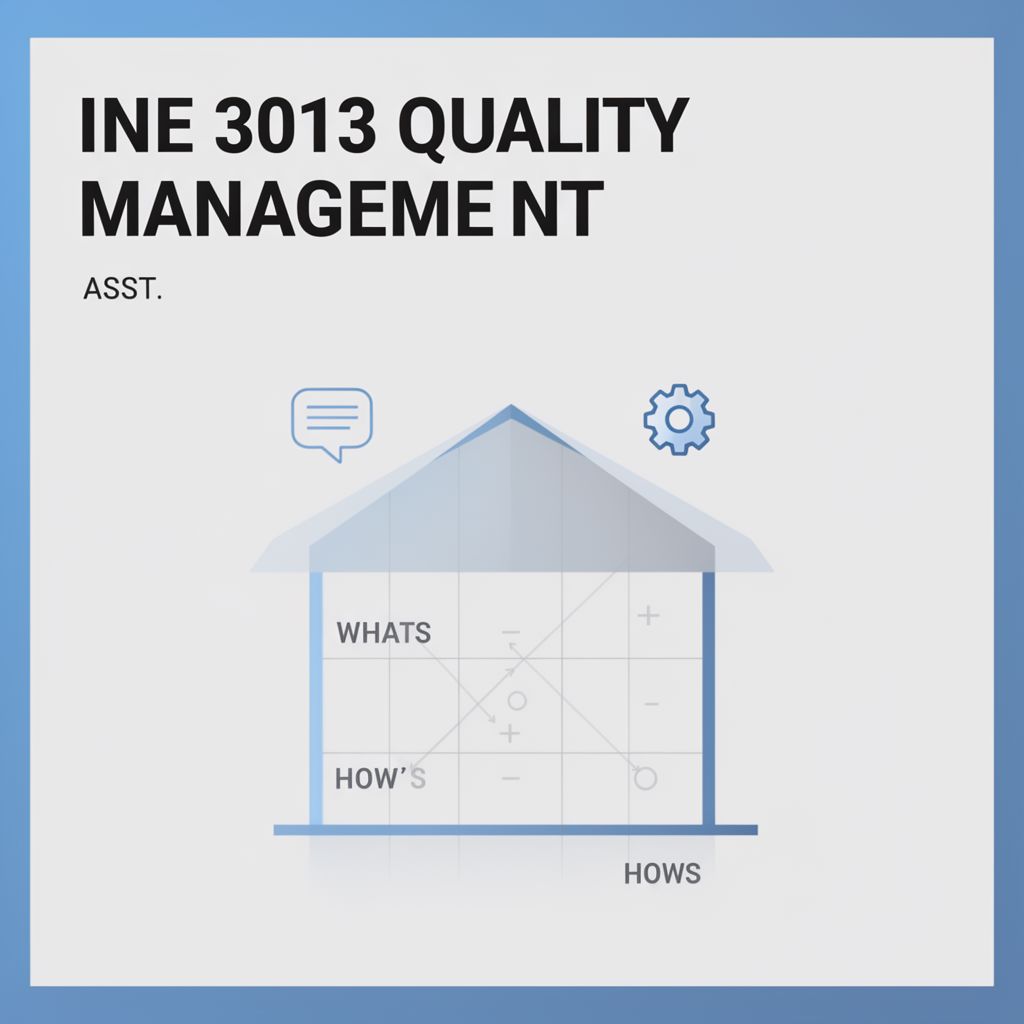
Study Material: Quality Function Deployment (QFD) and the House of Quality
Source Information: This study material has been compiled and organized from a lecture audio transcript and a copy-pasted text provided by the user.
📚 Introduction to Quality Function Deployment (QFD)
Quality Function Deployment (QFD) is a specialized methodology designed to integrate customer needs and wants directly into the design and production processes of a product or service. Its core purpose is to ensure that customer satisfaction and continuous improvement are central to product development.
✅ Key Focus of QFD: Understanding customer needs and desires to guide design and subsequent processes, ultimately creating a product customers will purchase and use.
Historical Context:
- Developed by Japanese quality expert Dr. Yoji Akao in 1966.
- Combined established quality strategies with "function deployment" principles from Value Engineering.
QFD's Role: QFD essentially makes the customer – the potential user – an integral part of the design team. It systematically guides designers and planners to focus on product attributes most important to the customer.
1️⃣ Three Critical Steps in QFD:
- Identify Customer Needs: Known as the "Voice of the Customer" (VOC).
- Identify Product Attributes: Determine which attributes will best satisfy the VOC.
- Establish Targets and Priorities: Set product development and testing targets that align with the VOC.
💡 Value Engineering: A Foundational Concept
Value Engineering (VE) is a process developed at General Electric during World War II. It aims to enhance the value of products or services by focusing on what they do (their functions) rather than what they are.
📚 Definition of Value in VE: Value is considered to have two components: function and cost.
- Formula: V = F/C (Value = Function / Cost)
- If a product's function (performance) is improved while its cost is maintained or reduced, its value increases. This principle underpins QFD's customer-centric approach.
🏠 The House of Quality (HOQ): The Heart of QFD
The House of Quality (HOQ) is a sophisticated set of interrelated matrices that forms the central component of QFD. It's named for its visual resemblance to a house.
Purpose of HOQ: The HOQ is utilized by a multidisciplinary QFD team to:
- Translate Customer Requirements: Gather input from customers and translate it into a coherent set of customer needs (the "Voice of the Customer" - VOC).
- Prioritize Product Features: Using the VOC and competitive benchmarking, determine the prioritized features for a new or improved product that will best respond to customer needs.
Structure: The HOQ is composed of six submatrices, which are systematically utilized in a formal sequence (1 through 6).
📊 HOQ Matrix 1: Developing Customer Needs (WHATs)
This initial matrix focuses on identifying and refining the "WHATs" – what the customer wants. The premise is that a thorough understanding of customer needs is crucial for market success.
Gathering Customer Input: Various methods are used to collect customer feedback:
- Focus Groups: Assembling 5-15 customers to discuss views, facilitated by a skilled moderator.
- User Groups
- Polling Customers of existing similar products
- Surveys and Questionnaires
- Customer Service Inputs
- Warranty Activity
Refining Customer Needs Inputs: Once raw data is collected, it must be distilled into actionable insights. This involves sorting data into a prioritized set of the most important customer needs, often using analytical techniques:
-
Affinity Diagram:
- Purpose: Promotes creative thinking and organizes complex, disorganized ideas into structured groups. Useful for challenging paradigms and building consensus.
- Development Steps:
- A cross-functional team (e.g., sales, marketing, design) is assembled.
- The issue is stated broadly (e.g., "Why are our textbooks not selling better?").
- Participants record ideas (customer input) on cards, one idea per card, using actual customer words. No judgment is allowed at this stage.
- Cards with related ideas are grouped together.
- A descriptive heading is created for each group.
- The diagram is replicated on paper for review and revision.
-
Tree Diagram:
- Purpose: Refines affinity diagram results into a concise list of customer needs (WHATs) for the HOQ. It breaks down broad issues into more specific, actionable items.
- Development Steps:
- Clearly identify the issue/problem (e.g., from the affinity diagram).
- Brainstorm all possible tasks, methods, or solutions related to the issue, asking "To achieve this, what must happen first?"
- Organize cards hierarchically, from top to bottom, adding any overlooked tasks.
- Duplicate the layout for team review.
- 💡 Insight: The team reduces the list to the most significant needs (typically 8-30). These represent the refined VOC.
Customer Importance:
- The QFD team estimates the relative importance of each listed customer need.
- Scale: Usually 1 to 5 (5 being highest priority).
- This information is derived from customer sources and team evaluation, then entered into the "Customer Importance" column of HOQ Matrix 1.
📈 HOQ Matrix 2: Planning the Improvement Strategy
This matrix focuses on planning how to improve customer satisfaction and competitiveness.
-
Competitive Benchmarking:
- Process: Compare existing product(s) against competitors based on customer satisfaction ratings for each customer need.
- Methods: Focus groups, questionnaires to customers of own and competing products.
- Scale: 1 to 5 (5 being most favorable).
-
Planned Customer Satisfaction Performance:
- Goal: Define the target customer satisfaction rating for the new product for each need.
- Consideration: Balance desired perfection (e.g., a rating of 5) with practical constraints like cost and market competitiveness. The aim is to be a competitive leader, not necessarily the most expensive.
-
Improvement Factor:
- Purpose: Quantifies the necessary improvement for each need.
- Formula: Improvement Factor = {(Planned CS Rating - Existing CS Rating) * 0.2} + 1
- Example: If Planned CS = 4, Existing CS = 3, then Improvement Factor = {(4 - 3) * 0.2} + 1 = 1.2
-
Sales Point:
- Purpose: A strategic marketing factor (1 to 1.5) to emphasize the marketing importance of a need in product promotion.
- Effect: A sales point of 1.5 increases the overall weighting by 50% beyond customer importance and improvement factor.
-
Overall Weighting:
- Purpose: Calculates the overall importance of each individual customer need.
- Formula: Overall Weighting = Customer Importance * Improvement Factor * Sales Point
- Example: For "Comprehensible Text" need: Customer Importance = 5, Improvement Factor = 1.2, Sales Point = 1.1. Overall Weighting = 5 * 1.2 * 1.1 = 6.6
-
Percentage of Total Weighting:
- Purpose: Converts overall weightings into percentages to understand resource allocation for design/improvement efforts.
- Formula: % of Total Weighting = (Overall Weighting / Sum of All Overall Weightings) * 100
- Example: If Sum of Overall Weightings = 51.3, and "Comprehensible Text" Overall Weighting = 6.6. % of Total Weighting = (6.6 / 51.3) * 100 ≈ 13%.
🛠️ HOQ Matrix 3: Selecting Technical Requirements (HOWs)
This matrix defines the "HOWs" – how the company intends to respond to each customer need. It represents the "voice of the company."
- Nature of HOWs: These are characteristics and features of a product perceived as meeting customer needs. They are measurable (e.g., weight, strength, speed, or a simple yes/no for a feature's inclusion).
- Flexibility: HOWs should be flexible enough to allow for creative solutions, not limiting design specifications.
- Generation: The QFD team generates HOWs through internal discussion and consultation, often using affinity or tree diagrams, similar to the WHATs development process, but with internal company input.
- Example (Textbook Publisher): A tree diagram might categorize HOWs into "Writing and Editorial," "Artwork," and "Physical Characteristics," with specific technical requirements branching out (e.g., "Accuracy checking policy," "Consistent Writing Style," "Use of color in artwork," "Binding durability").
↔️ HOQ Matrix 4: Evaluating Interrelationships (WHATs vs. HOWs)
This matrix links the customer needs (WHATs) with the technical requirements (HOWs), showing how they relate.
- Assessment: At each intersection cell, the team assesses the degree of relationship between a WHAT and a corresponding HOW.
- Scale: Usually 1 to 5 or 1 to 9 (higher number = stronger relationship), or symbols.
- Rule of Thumb: Approximately 15% of cells typically show a relationship.
- Firm Rule: Every row (WHAT) and every column (HOW) must have at least one entry. An empty column indicates a HOW that doesn't deliver customer value.
🤝 HOQ Matrix 5: Evaluating Correlations (HOWs vs. HOWs) - The "Roof"
Often called the "Roof" of the HOQ, this matrix evaluates the direction of correlation between different technical requirements (HOWs).
- Purpose: Identify whether technical requirements benefit (supportive/positive correlation) or work against (impeding/negative correlation) each other.
- Importance: Knowing correlations helps leverage supportive relationships and manage trade-offs for impeding ones, preventing costly redesigns and ensuring "getting it right the first time."
- Construction: A triangle is drawn over the Technical Requirements section. Intersecting diagonal columns are used to mark correlations.
- Supportive: Indicated by a plus sign (+).
- Impeding: Indicated by a minus sign (−).
- No Correlation: Cell left blank.
- Complexity: The number of possible correlations increases significantly with more technical requirements, highlighting the HOQ's power for complex projects.
🎯 HOQ Matrix 6: Selecting Design Targets (HOW MUCH)
The final matrix completes the HOQ by specifying "HOW MUCH" of each characteristic needs to be provided. This section translates QFD conclusions into concrete product specifications.
Three Sections:
-
Technical Priorities:
- Purpose: Determine the relative importance of each Technical Requirement (HOW) in meeting Customer Needs (WHATs).
- Calculation: Multiply each interrelationship rating (from Matrix 4) by the corresponding customer need's Overall Weighting (from Matrix 2), then sum the columns for each HOW.
- Example: For "Authors/Editors Guide" HOW:
- Comprehensible Text (9 * 6.6) = 59.4
- Accuracy (9 * 9) = 81.0
- Plausible Examples (9 * 5) = 45.0
- Consistent Writing Style (3 * 2) = 6.0
- Total Technical Priority = 191.4
- Percentage of Total Priority: (Individual Technical Priority / Σ Technical Priorities) * 100. This helps guide resource deployment.
-
Technical Benchmarking:
- Purpose: Compare the organization's current product (if any) and competing products against each technical requirement.
- Information Source: Customers, focus groups, press, actual testing/measurement.
-
Design Target Values:
- Purpose: Establish specific, measurable objectives for the design team.
- Derivation: Developed from Technical Priorities and Technical Benchmarking data.
- Example: If the goal is to enhance binding durability, the design target might be "increase binding strength by X%," or "withstand Y cycles of use." This might necessitate radical changes in materials or processes.
✅ Conclusion: The Complete House of Quality
Once all six matrices are completed, the HOQ provides a comprehensive guide for all departments.
- Guidance: Ensures all aspects of product design adhere to customer needs, prevents unnecessary features, and involves all relevant company activities.
- Application: The HOQ can be used at this level to guide product development or serve as a starting point for more detailed, lower-level HOQs for specific functions (e.g., design, procurement, manufacturing).
- Versatility: QFD and the HOQ are applicable to both tangible products and services.