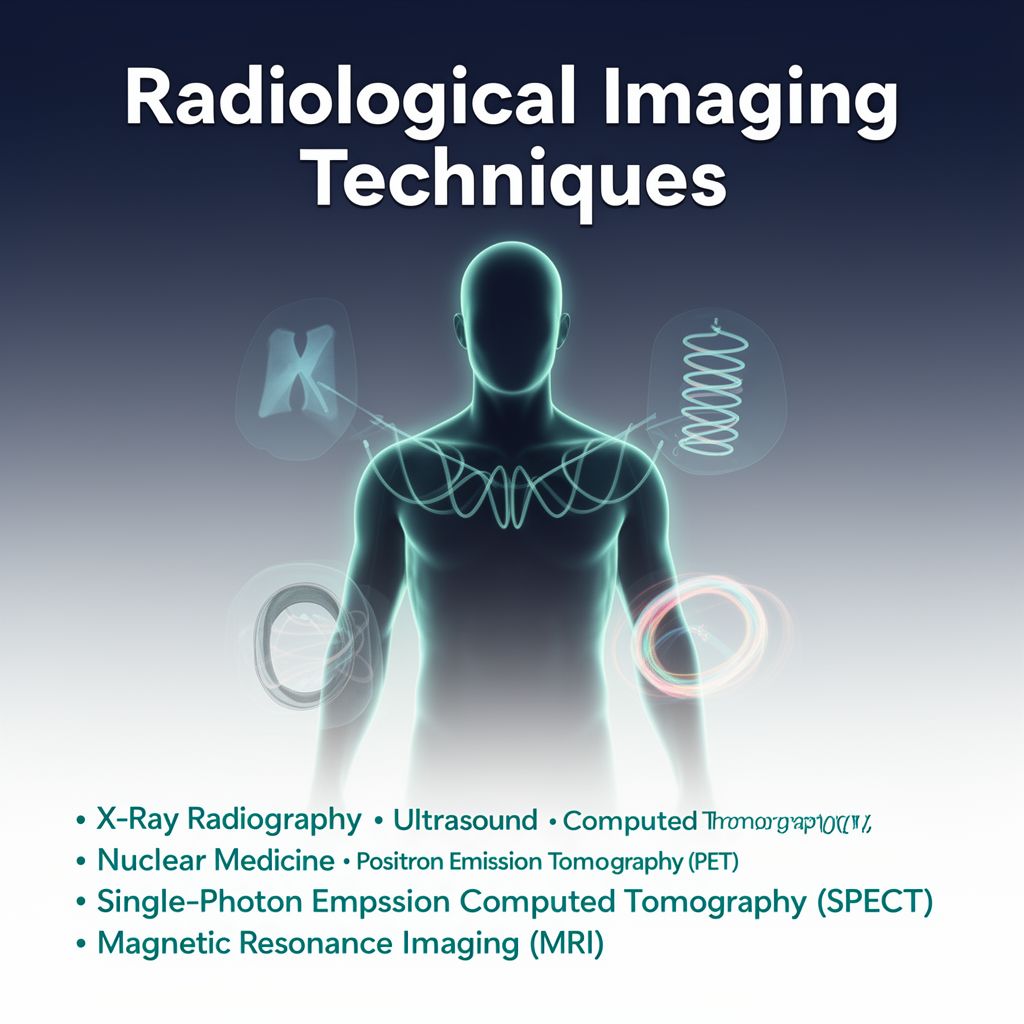
Radiological Imaging Techniques Explained - kapak
Sağlık#radiology#medical imaging#x-ray#ct scan

Radiological Imaging Techniques Explained

Explore the principles and applications of key radiological imaging techniques including X-ray radiography, Computed Tomography (CT), Single-Photon Emission Computed Tomography (SPECT), and Positron Emission Tomography (PET).

rana_lJanuary 21, 2026 ~18 dk toplam
01

Flash Kartlar

25 kart

Karta tıklayarak çevir. ← → ile gez, ⎵ ile çevir.

1 / 25
Tüm kartları metin olarak gör
  1. 1. What are the four main radiological imaging techniques discussed in the content?

    The content introduces X-ray radiography, Computed Tomography (CT), Single-Photon Emission Computed Tomography (SPECT), and Positron Emission Tomography (PET). These techniques allow for the visualization of internal body structures and functions, each utilizing different principles for image generation.

  2. 2. Explain the fundamental principle of X-ray generation within an X-ray tube.

    An X-ray tube generates high-energy electrons that are accelerated towards a target material, typically in the anode. When these electrons strike the target, they produce X-rays along with a significant amount of heat. This process is the core mechanism for creating the radiation used in X-ray radiography.

  3. 3. How does anodic voltage influence the X-ray beam characteristics?

    Anodic voltage directly determines the wavelength of the X-rays produced. A higher anodic voltage results in higher energy X-rays with a shorter wavelength. This voltage also limits the maximum energy of the X-rays, meaning an 80kV tube cannot produce X-rays exceeding 80keV.

  4. 4. What is the primary role of cathode current in X-ray generation?

    The cathode current controls the number of electrons generated within the X-ray tube. A higher cathode current leads to a greater number of electrons, which in turn results in more X-ray photons being produced. This parameter is crucial for adjusting the intensity of the X-ray beam.

  5. 5. Describe the two main types of radiation that contribute to the X-ray spectrum.

    The X-ray spectrum is formed by two types of radiation: braking radiation (Bremsstrahlung) and characteristic radiation. Braking radiation occurs when electrons are decelerated by the target material, producing a continuous spectrum. Characteristic radiation results from the ejection of inner-shell electrons, leading to discrete energy peaks.

  6. 6. Why is collimation essential in X-ray radiography?

    Collimation is essential because X-rays are emitted isotropically (in all directions) from the tube. A collimator, made of X-ray absorbent material, is a beam-limiting device that focuses this radiation into a usable beam, preventing unnecessary exposure to surrounding tissues and improving image quality.

  7. 7. Differentiate between primary and secondary collimation in X-ray imaging.

    Primary collimation focuses the X-ray beam as it enters the subject, ensuring only the area of interest is irradiated. Secondary collimation, on the other hand, focuses the radiation exiting the subject. Its crucial role is to reduce scattered radiation, which can degrade image quality, by absorbing off-axis photons.

  8. 8. What is the purpose of filters in X-ray radiography?

    Filters are used to remove undesired wavelengths from the X-ray beam, particularly low-frequency X-rays that would be absorbed by the skin and contribute to patient dose without aiding image formation. Compensating filters can also be used to limit exposure to off-target body parts, ensuring a more uniform radiation distribution.

  9. 9. How do tissues appear in a skiagraphy image based on their density?

    In skiagraphy, high-density tissues, which exhibit high X-ray absorption and low transmission, appear as a light color. This creates a negative image where denser structures like bones are bright. Skiagraphy produces still images and shows the entire depth of the imaged part, leading to tissue shading and overlapping.

  10. 10. What is the key difference in image presentation between skiagraphy and skiascopy?

    Skiagraphy produces still, negative images where high density appears light. Skiascopy, in contrast, provides real-time, dynamic imaging (like a video) and generates positive images where high-density tissues appear dark. Both techniques show the entire depth of the imaged part, resulting in tissue overlap.

  11. 11. What is a common challenge in X-ray radiography related to soft tissues, and how is it addressed?

    A common challenge is the low contrast between soft tissues due to their very similar X-ray absorption properties. This is addressed by using contrast agents. Positive contrast agents (e.g., iodine) increase absorption, while negative contrast agents (e.g., air) decrease absorption, making specific structures more visible.

  12. 12. Explain the principle and application of Digital Subtraction Angiography (DSA).

    DSA is a sophisticated technique used to visualize soft tissues by eliminating the obscuring effect of radio-opaque structures. It involves taking two images: one before and one after the administration of a contrast agent. Subtracting the first image from the second produces a 'clean' image of the soft tissues, commonly used for visualizing blood vessels.

  13. 13. What is densitometry and what is its primary application in medical imaging?

    Densitometry utilizes X-rays to measure the radiodensity of biological tissue, which is its relative inability to allow electromagnetic radiation to pass through. High absorbance indicates high radiodensity. Its primary application is comparing a patient's bone density to normal values, crucial for diagnosing conditions like osteoporosis.

  14. 14. How do modern X-ray detection systems differ from classic methods?

    Classic X-ray detection relied on X-ray film, which required chemical processing. Modern systems utilize flat panels equipped with large silicon sensors, similar to digital cameras, typically featuring 2000x2000 pixels. These digital detectors allow images to be stored directly in computer memory, offering immediate access and manipulation.

  15. 15. What is the fundamental principle behind Computed Tomography (CT) image generation?

    CT operates by taking numerous narrow X-ray images from multiple angles around the patient. These individual projections are then computationally reconstructed using algorithms to create a detailed three-dimensional image of the internal structures. This allows for cross-sectional views that overcome the superimposition issues of planar X-rays.

  16. 16. What is a Hounsfield unit (HU) and how is it used in CT imaging?

    The Hounsfield unit (HU) is a quantitative scale used in CT to estimate tissue density and type based on X-ray absorption values. It expresses voxel absorption values relative to water (which is 0 HU). Different tissues have characteristic HU values, allowing for their differentiation and display in shades of gray.

  17. 17. How does the Hounsfield effect impact CT image reconstruction?

    The Hounsfield effect refers to artifacts that can occur at interfaces between bone and soft tissue. It arises because bones highly absorb soft X-rays, leading to inaccuracies in absorption measurements. CT reconstruction algorithms must correct for these artifacts to ensure accurate tissue density estimation and image quality.

  18. 18. Explain the concept of 'Hounsfield window and level settings' in CT.

    Hounsfield window and level settings are parameters used to adjust the display of CT images. The 'window' defines the range of Hounsfield units displayed, while the 'level' sets the center of that range. These settings allow clinicians to optimize image contrast and brightness to highlight specific tissues or pathologies, as CT colors are entirely computed.

  19. 19. What is Spectral CT and what advantage does it offer?

    Spectral CT is an advanced technology that utilizes new chip technology, such as Medipix3, to achieve much finer differentiation of tissues. By analyzing X-rays at different energy levels, it can create a 3D color image that distinguishes various components like muscles, water, and fat, offering enhanced diagnostic capabilities compared to conventional CT.

  20. 20. How does Dual Source CT improve imaging capabilities, particularly for cardiac applications?

    Dual Source CT employs two X-ray tubes and two detector systems simultaneously. This configuration significantly increases imaging speed and shortens acquisition times, achieving time resolutions of approximately 80 milliseconds. This rapid imaging is particularly beneficial for cardiac CT, allowing for clear images even in patients with higher heart rates by minimizing motion artifacts.

  21. 21. What is the fundamental difference between X-ray transmission imaging and scintigraphy?

    X-ray transmission imaging (like radiography and CT) detects radiation that passes through the body from an external source. Scintigraphy, a form of nuclear medicine, detects radiation emitted by an internal source, specifically radiopharmaceuticals introduced into the body. This allows scintigraphy to visualize physiological processes rather than just anatomical structures.

  22. 22. How are radiopharmaceuticals used in scintigraphy to provide diagnostic information?

    Radiopharmaceuticals are radioactive substances bound to biological molecules that are administered to the patient. Their distribution within the body reflects the function or pathological condition of organs and tissues. By detecting the gamma radiation emitted by these radiopharmaceuticals, scintigraphy can observe metabolism and other physiological processes, providing functional diagnostic information.

  23. 23. Describe the principle of Single-Photon Emission Computed Tomography (SPECT).

    SPECT is a tomographic nuclear medicine technique that uses a radiopharmaceutical gamma source within the patient. Rotating scintillation cameras acquire a series of images from multiple directions around the body. These images are then computationally reconstructed to create a three-dimensional map, pinpointing the exact location of the gamma-emitting source within the body.

  24. 24. Why is SPECT often combined with a low-dose CT scan?

    SPECT alone provides functional data about physiological processes but lacks detailed anatomical context. Combining SPECT with a low-dose CT scan allows for the fusion of functional SPECT images with anatomical CT images. This provides a more comprehensive diagnostic picture, helping to precisely localize the functional abnormalities within the body's structure.

  25. 25. What is the primary advantage of SPECT over planar scintigraphy?

    The primary advantage of SPECT over planar scintigraphy is its ability to provide three-dimensional images with higher contrast. While planar scintigraphy offers a 2D projection, SPECT's tomographic reconstruction allows for better localization of radiopharmaceuticals within tissues and can even enable quantification, offering more detailed and accurate diagnostic information.

02

Bilgini Test Et

15 soru

Çoktan seçmeli sorularla öğrendiklerini ölç. Cevap + açıklama.

Soru 1 / 15Skor: 0

What is the primary function of the X-ray tube in X-ray radiography?

03

Detaylı Özet

8 dk okuma

Tüm konuyu derinlemesine, başlık başlık.

This study material has been compiled from a lecture audio transcript and copy-pasted text provided by the user.


🩺 Radiological Imaging Techniques: A Comprehensive Study Guide

📚 Introduction to Medical Imaging

Radiological imaging techniques are indispensable tools in modern medicine, allowing for non-invasive visualization of the human body's internal structures and functions. These methods aid in diagnosis, treatment planning, and monitoring disease progression. This guide will explore the principles, technologies, and applications of key imaging modalities, including X-ray radiography, Computed Tomography (CT), Single-Photon Emission Computed Tomography (SPECT), and Positron Emission Tomography (PET).


1️⃣ X-Ray Radiography

X-ray radiography is a foundational imaging technique that utilizes X-rays to create images of the body's internal structures.

💡 Principle of X-Ray Generation

The core of X-ray production is the X-ray tube.

  • Mechanism: High-energy electrons are generated and accelerated towards a target material (anode). Upon impact, these electrons ionize the target, producing X-rays and heat.
  • Target Material: The material of the anode (e.g., Cobalt-60, Technetium) determines the X-ray spectrum.
  • Safety Note: An X-ray tube is not radioactive when switched off.
  • Parameters:
    • Anodic Voltage (kV): Determines the X-ray wavelength. Higher voltage leads to higher energy and shorter wavelengths. X-ray energy is limited by this voltage (e.g., an 80kV tube cannot produce X-rays > 80keV).
    • Cathode Current (mA): Controls the number of electrons generated. Less than 1% of electrons produce X-ray photons; the rest generate heat.
    • Focal Spot Size: Affects image resolution.
  • X-ray Nature: X-rays are photons generated from the electron shell. They exhibit:
    • Braking Radiation (Bremsstrahlung): Produces a continuous spectrum.
    • Characteristic Radiation: Results from the ejection of electrons, yielding a characteristic spectrum.

⚙️ Beam Control and Interaction

  • Collimation: A collimator is a beam-limiting device, analogous to lenses in optics. Since X-rays are emitted isotropically (in all directions) from the tube, collimators focus the radiation into a usable beam.
    • Primary Collimation: Focuses the beam entering the patient.
    • Secondary Collimation: Focuses radiation exiting the patient, crucial for reducing scatter.
    • Collimators are made of X-ray absorbent material.
  • Filters: Used to remove undesired wavelengths, particularly low-frequency X-rays that would be absorbed by the skin, and to limit exposure to off-target body parts using compensating filters.
  • Absorption and Transmission: X-ray absorption by the body is non-uniform. Tissues are detected based on their differential absorption and transmission.
    • Interactions like Bremsstrahlung and Compton scattering occur, necessitating secondary collimation and limiting spatial resolution.

📸 Detection and Amplification

  • Image Intensifier: Allows for lower X-ray doses. It uses scintillation to detect non-absorbed X-rays and amplifies the signal via a photocathode and phosphor excitation, captured by a CCD camera.
  • Image Detection:
    • Classic: X-ray film.
    • Modern: Flat panels with large silicon sensors (similar to digital cameras), typically 2000x2000 pixels, storing images in computer memory.

🖼️ Planar X-Ray Techniques

  • Skiagraphy (Planar X-ray Projection):
    • Based on photochemical reaction and electronic screening digitalization.
    • Produces still images.
    • Shows the entire depth of the imaged part, leading to tissue shading and overlap.
    • High density = high absorbance = low transmission = light color (negative image).
  • Skiascopy:
    • Based on image amplification and CCD technology.
    • Provides real-time, dynamic imaging.
    • Also shows the entire depth with tissue shading and overlap.
    • High density = high absorbance = low transmission = dark color (positive image).
    • Operates at a low frame rate (e.g., 4 frames per second) to reduce patient exposure.
    • Uses: Monitoring dynamic processes (e.g., arteriography), guiding precise surgical interventions (e.g., stent placement).

🧪 Contrast Agents and Advanced Techniques

  • Problem: Soft tissues have very similar X-ray absorbance, leading to low contrast.
  • Solution: Contrast agents are used to enhance visibility.
    • Positive Contrast (e.g., iodine): Increases absorption, making structures more visible (e.g., blood vessels).
    • Negative Contrast (e.g., air): Decreases absorption (e.g., in intestines).
  • Digital Subtraction Angiography (DSA): Addresses the issue of all radio-opaque tissues obscuring soft tissues of interest.
    • Process: Two images are taken (one with, one without contrast agent), and the results are subtracted to produce a 'clean' image of soft tissues.
    • When performed in a CT scanner, it's called CT Angiography (CTA).
  • Densitometry: Measures radiodensity (relative inability of electromagnetic radiation to pass through a material). High absorbance indicates high radiodensity.
    • Application: Used to measure the density of biological tissue, e.g., bone density for osteoporosis diagnosis.

2️⃣ Computed Tomography (CT)

CT imaging uses X-rays combined with computer processing to create cross-sectional images (slices) of the body.

💡 Principle & Reconstruction

  • Principle: Narrow X-ray images are taken from multiple angles around the patient. These projections are then computationally reconstructed to form a 3D image.
  • CT Scanner: The device that performs this process.
  • Image Reconstruction Methods:
    • Back Projection: A fast method involving backward projection of the incident radiation beam. Can produce many artifacts.
    • Interactive Reconstruction: Compares real measured values with estimated values from a theoretical image model. More refined, solving n-equations for n-unknown variables.
  • Result: An absorption measure per voxel (3D pixel) at a known location.

📊 Differentiating Tissues (Hounsfield Unit, HU)

  • Hounsfield Unit (HU): Used to estimate tissue density/type based on absorption values.
  • Procedure:
    1. Calculate absorption of different X-ray frequencies.
    2. Correct for artifacts at bone/soft tissue interfaces (Hounsfield effect: high absorption of soft X-rays by bones).
    3. Reconstruct the 3D image.
    4. Voxel absorption values are expressed relative to water in Hounsfield units.
    5. Displayed in shades of gray.
  • Customization: Colors on CT images are fully computed and can be adjusted using Hounsfield window and level settings to suit diagnostic needs.

🚀 Special CT Technologies

  • Spectral CT: Utilizes advanced chip technology (e.g., Medipix3 from CERN) for much finer tissue differentiation.
    • Result: A 3D color image distinguishing muscles, water, fat.
    • Note: MRI offers excellent soft tissue imaging without X-rays.
  • Dual Source/Dual Energy CT:
    • Dual Source CT: Employs two X-ray tubes and two detector systems. Increases speed and shortens acquisition times (e.g., ~80 ms), beneficial for cardiac CT.
    • Dual Energy CT: Uses two X-ray tubes with different energies (e.g., 80 + 140 kV). Allows for better quantification of density distribution and differential density analysis.
    • Cost: These advanced systems are considerably expensive.

3️⃣ Nuclear Medicine: Scintigraphy, SPECT, and PET

Nuclear medicine techniques detect radiation emitted from within the body, providing functional rather than purely anatomical information.

💡 Scintigraphy Principle

  • Detection: Detects radiation emitted by an internal source (radiopharmaceuticals) rather than transmitted radiation.
  • Function: Allows observation of metabolism and other physiological processes. The distribution of the radioindicator reflects organ function or pathological conditions.
  • Administration: Radiopharmaceuticals can be administered orally, by injection, or through respiration.
  • Types of Scintigraphy:
    • Dimension-based: Planar (2D projection), Tomographic (3D projection).
    • Time-based: Static (screens captured without time dependency), Dynamic (observes processes changing over time).
    • Parametric: Qualitative (visual evaluation), Quantitative (obtaining radionuclide parameters).
  • Gamma Camera: Also known as a scintillation or Anger camera, it detects and visualizes gamma radiation using a scintillation crystal. Used for static and dynamic imaging.

4️⃣ Single-Photon Emission Computed Tomography (SPECT)

SPECT is a tomographic nuclear medicine technique that provides 3D functional images.

  • Principle: Uses a radiopharmaceutical gamma source. A series of images are acquired from multiple directions with rotating scintillation cameras. These images are then reconstructed to localize the source within the body.
  • Combination with CT: SPECT is usually combined with a low-dose CT scan to provide anatomical context, as SPECT alone offers functional data but lacks detailed anatomical information.
    • Low Dose Mode: SPECT images at low gamma radiation doses with approximate, low-resolution morphological CT images.
    • Full-Featured Diagnostic Mode: High-resolution CT images with detailed anatomical information, but with a higher effective dose for the patient.
  • Radiopharmaceuticals: Radioisotopes bound to biological molecules target specific organs, tissues, or cells.
    • Examples:
      • Technetium-99m (99mTcO4-): Pure gamma emitter.
      • Iodine-131 (NaI form): Used for thyroid gland imaging.
      • Thallium-201 (201Tl): Myocardium perfusion (replaces K).
      • Gallium-67 (67Ga): Inflammation, tumors.
      • Xenon-133 (133Xe): Lung ventilation.
      • Strontium-90 (90Sr): Bones (replaces Ca).
    • The isotope and radioligand are chosen based on the target tissue.
  • ✅ Advantages:
    • Higher contrast than planar scintigraphy.
    • Allows for quantification of radiopharmaceuticals in tissues.
    • SPECT alone represents less radiation burden than a full CT.
  • ⚠️ Disadvantages:
    • Quantification accuracy reduced by attenuated radiation (Compton or photoelectric effect).
    • Poor spatial resolution compared to MRI.
    • Long examination time.
    • Radiation dose depends on the decay of the radiopharmaceutical, not imaging duration.

5️⃣ Positron Emission Tomography (PET)

PET is a highly sensitive nuclear medicine technique based on positron annihilation.

  • Principle:
    1. A radiopharmaceutical emitting positrons (β+) is administered.
    2. When a positron encounters an electron, they undergo annihilation, producing two gamma photons.
    3. These photons are emitted at 180° to each other, each with 510 keV energy.
    4. The average positron travels 1-3mm before annihilation.
    5. A ring of detectors around the patient simultaneously detects these two photons, indicating that the emission occurred along the line connecting the two detection points.
  • Most Common Modality: 18F-fluorodeoxyglucose (FDG).
    • FDG behaves like glucose and is absorbed by highly metabolically active tissues (e.g., tumor cells).
    • Often combined with CT or MRI for enhanced diagnostic accuracy.
  • Applications:
    • Primary Oncology Diagnostics: Localization and sizing of tumors (>90% of PET use).
    • Neurology: Brain activity studies.
    • Perfusion: Extracorporeal circulation.
    • Myocardium Investigation.
  • Radiopharmaceutical Production: Emitters often have very short half-lives, requiring on-site production in medical cyclotrons.
  • ✅ Advantages:
    • High diagnostic accuracy and spatial resolution.
    • Modern devices have higher detection efficiency than SPECT (no collimators needed).
    • Bioactive elements used in PET are excreted faster than other radioactive markers in SPECT.
  • ⚠️ Disadvantages:
    • High technical complexity.
    • High purchase price of the device.
    • Requires a cyclotron for radiopharmaceutical production.
    • Typically performed in hybrid MRI-PET or CT-PET machines.
Kendi çalışma materyalini oluştur

PDF, YouTube videosu veya herhangi bir konuyu dakikalar içinde podcast, özet, flash kart ve quiz'e dönüştür. 1.000.000+ kullanıcı tercih ediyor.

Sıradaki Konular

Tümünü keşfet
Periodontal Diseases: Pathogenesis and Radiographic Assessment

Periodontal Diseases: Pathogenesis and Radiographic Assessment

This summary provides an academic overview of periodontal diseases, covering their pathogenesis, clinical manifestations, radiographic assessment, associated dental and systemic conditions, and differential diagnosis.

7 dk Özet
Understanding Rosacea: A Comprehensive Guide

Understanding Rosacea: A Comprehensive Guide

Explore the chronic inflammatory skin condition Rosacea, covering its definition, epidemiology, pathogenesis, clinical subtypes, diagnosis, and various treatment approaches.

Özet 15
Understanding Key Sexually Transmitted Infections

Understanding Key Sexually Transmitted Infections

This podcast provides a detailed educational overview of key sexually transmitted infections, including their clinical presentation, diagnosis, and treatment protocols.

Özet 15
Understanding Viral Hepatitis: Types, Diagnosis, and Prevention

Understanding Viral Hepatitis: Types, Diagnosis, and Prevention

Explore the five main hepatitis viruses, their modes of transmission, diagnostic methods, clinical features, and strategies for prevention and treatment.

10 dk Özet 15
Diagnosis and Treatment of Infectious Diarrhea

Diagnosis and Treatment of Infectious Diarrhea

An in-depth look into the diagnostic methods and treatment strategies for infectious diarrhea, covering common pathogens, diagnostic tests, and dietary management.

8 dk Özet 25 15
Bacterial Pathogens: Characteristics, Diagnosis, and Treatment

Bacterial Pathogens: Characteristics, Diagnosis, and Treatment

Explore key bacterial pathogens, their unique characteristics, disease mechanisms, diagnostic approaches, and effective treatment and prevention strategies based on a comprehensive medical document.

7 dk Özet
SI-Tuberculosis: Unraveling the Unknown

SI-Tuberculosis: Unraveling the Unknown

Explore Susceptibility-Indeterminate Tuberculosis (SI-TB). Learn what it means, why it's challenging to diagnose, and how healthcare tackles this complex form of TB for better patient care.

13 dk Özet 23 15
Dilated Cardiomyopathy: Causes, Diagnosis, and Treatment

Dilated Cardiomyopathy: Causes, Diagnosis, and Treatment

An in-depth educational overview of dilated cardiomyopathy, covering its prevalence, diverse etiologies, pathological features, clinical presentation, diagnostic methods, and treatment strategies.

5 dk Özet 25 10