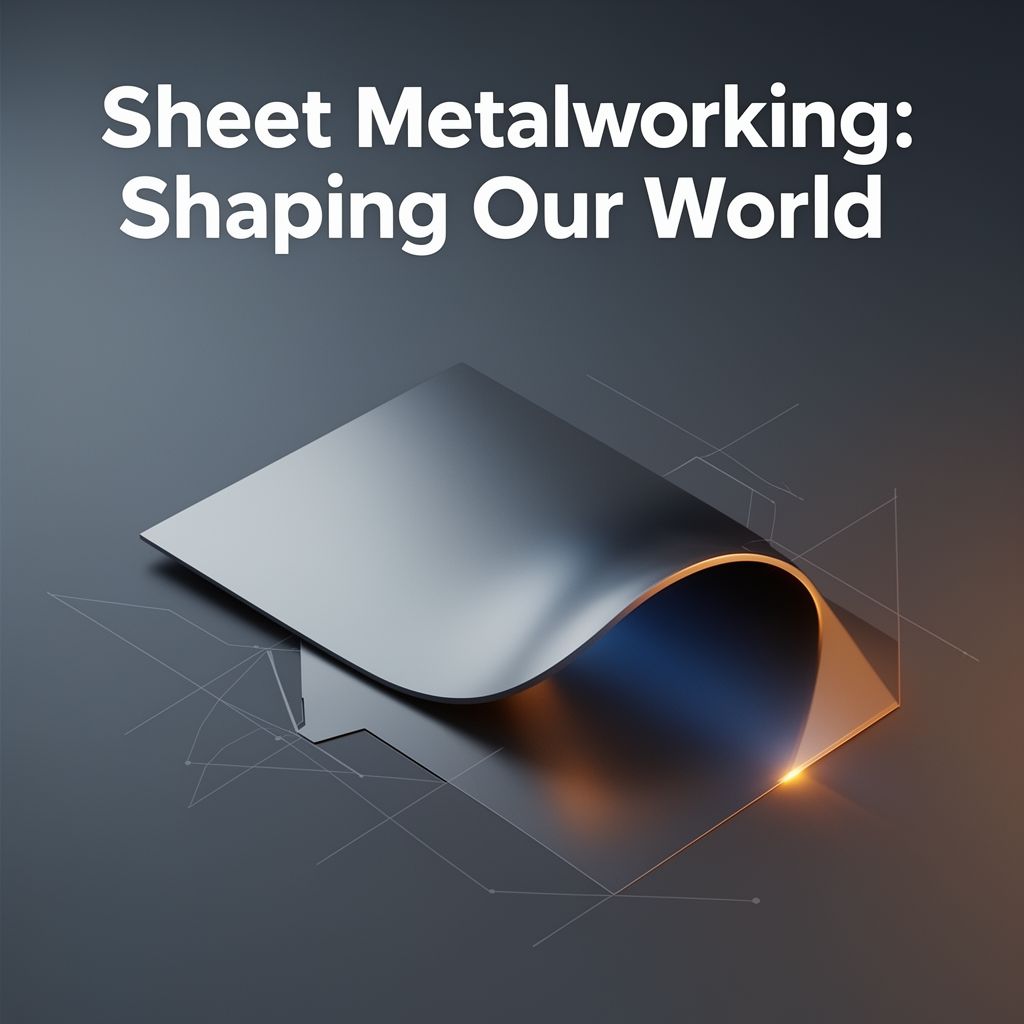
Sheet Metalworking: Shaping Our World - kapak
Teknoloji#sheet metal#metalworking#manufacturing#engineering

Sheet Metalworking: Shaping Our World

Discover the fascinating world of sheet metalworking! Learn how flat metal sheets are transformed into everyday objects, from cars to appliances, through cutting, bending, and advanced forming techniques. You'll understand the 'why' and 'how' behind this essential industrial process.

December 29, 2025 ~20 dk toplam
01

Sesli Özet

6 dakika

Konuyu otobüste, koşarken, yolda dinleyerek öğren.

Sesli Özet

Sheet Metalworking: Shaping Our World

0:005:48
02

Flash Kartlar

23 kart

Karta tıklayarak çevir. ← → ile gez, ⎵ ile çevir.

1 / 23
Tüm kartları metin olarak gör
  1. 1. What is the primary characteristic of sheet metal?

    Sheet metal is metal that has been rolled or hammered into thin, flat pieces, similar to a giant, strong piece of paper.

  2. 2. Name some common metals used in sheet metal production.

    Common metals used for sheet metal include steel, aluminum, copper, and brass, each chosen for specific properties.

  3. 3. Why is sheet metal considered versatile?

    Sheet metal is versatile because it can be cut, bent, and formed into almost any shape imaginable while maintaining its strength and integrity.

  4. 4. What is the first common step in manipulating a sheet of metal?

    The first common step in manipulating a sheet of metal is cutting it into desired shapes or sizes.

  5. 5. Describe the shearing process in sheet metalworking.

    Shearing uses two blades, one fixed and one moving, to make a clean, straight cut through a sheet of metal, much like giant scissors.

  6. 6. How does punching work in sheet metal fabrication?

    Punching involves a punch pressing through a metal sheet into a die, creating a hole or a specific cutout.

  7. 7. What advanced cutting methods are used for intricate designs?

    For more intricate or precise cuts, laser cutting or plasma cutting are used, employing focused beams to melt and vaporize metal.

  8. 8. What is the purpose of bending in sheet metalworking?

    Bending is used to transform a flat piece of metal into a three-dimensional form, giving it shape and structure.

  9. 9. Which tool is commonly used for bending metal sheets?

    A press brake is the most common tool for bending metal sheets, pressing the metal between a punch and a die.

  10. 10. What is crucial to understand when bending sheet metal?

    Understanding the bend radius, which dictates how sharp or gradual the curve is, is crucial for the metal's strength and appearance.

  11. 11. Explain the deep drawing technique.

    Deep drawing involves a punch pushing a flat sheet into a die, stretching and forming the metal into a hollow, three-dimensional shape without seams.

  12. 12. Provide examples of products made using deep drawing.

    Products like kitchen sinks, car oil pans, and beverage cans are commonly made using the deep drawing technique.

  13. 13. What is hydroforming?

    Hydroforming is a technique that uses high-pressure fluid, typically water, to shape metal by forcing it to conform precisely to a die's shape.

  14. 14. What are the advantages of hydroforming?

    Hydroforming can create incredibly complex and lightweight parts with fewer welds, resulting in stronger and more efficient products.

  15. 15. Where are hydroformed parts commonly found?

    Hydroformed parts are commonly found in automotive frames and aerospace components, where strength and weight are critical.

  16. 16. Describe the spinning process in sheet metalworking.

    Spinning involves rotating a flat metal disc at high speed while a tool presses against it, gradually forming it over a shaped mandrel.

  17. 17. What kind of shapes are typically produced by spinning?

    Spinning typically produces symmetrical, hollow shapes such as lamp shades, satellite dishes, or rocket nose cones.

  18. 18. Name common methods for joining shaped metal pieces.

    Common methods for joining shaped metal pieces include welding, riveting, or fastening to create the final product.

  19. 19. What is the overall impact of sheet metalworking on our world?

    Sheet metalworking transforms simple flat sheets into an incredible array of essential products, combining material science, engineering, and artistry.

  20. 20. What properties influence the choice of metal for sheet metalworking?

    Properties such as strength, lightweight characteristics, or corrosion resistance influence the choice of metal for sheet metalworking.

  21. 21. How does plasma cutting differ from laser cutting?

    Both use focused beams, but plasma cutting uses superheated gas to melt and vaporize metal, while laser cutting uses a focused beam of light.

  22. 22. What is a die in the context of punching or bending?

    A die is a shaped form or mold into which the metal is pressed or forced to achieve the desired shape or cut.

  23. 23. What is a mandrel used for in metal spinning?

    A mandrel is a shaped form or tool around which the metal disc is gradually formed during the spinning process.

03

Bilgini Test Et

10 soru

Çoktan seçmeli sorularla öğrendiklerini ölç. Cevap + açıklama.

Soru 1 / 10Skor: 0

According to the text, what is the fundamental characteristic of sheet metal?

04

Detaylı Özet

4 dk okuma

Tüm konuyu derinlemesine, başlık başlık.

Sheet Metalworking: An Introduction

Source Information: This study material is compiled from a lecture audio transcript on sheet metalworking.


📚 Introduction to Sheet Metalworking

Sheet metalworking is a fundamental manufacturing process that transforms flat sheets of metal into a vast array of complex, functional items. It is crucial for producing components found in everyday objects, from vehicle bodies and appliances to electronic casings. This field combines material science, engineering, and precision to create essential products that shape our modern world.


1️⃣ What is Sheet Metal?

📚 Definition: Sheet metal refers to metal that has been rolled or hammered into thin, flat pieces. It can be thought of as a strong, versatile material similar to a giant piece of paper.

✅ Key Characteristics:

  • Form: Thin, flat sheets.
  • Materials: Can be made from various metals, including:
    • Steel
    • Aluminum
    • Copper
    • Brass
  • Material Selection: Metals are chosen based on desired properties such as:
    • Strength
    • Lightweight characteristics
    • Corrosion resistance
  • Versatility: Sheet metal can be cut, bent, and formed into almost any shape while maintaining its structural integrity.

2️⃣ Basic Sheet Metalworking Techniques

These foundational processes are essential for preparing and initially shaping sheet metal.

2.1. Cutting Processes

The first step in sheet metalworking often involves cutting the material to the desired dimensions or creating specific patterns.

  • Shearing
    • Mechanism: Uses two blades (one fixed, one moving) to make a clean, straight cut through the metal sheet.
    • 💡 Analogy: Similar to using a large pair of scissors for metal.
  • Punching
    • Mechanism: A punch presses through the sheet into a die, creating a hole or a specific cutout.
    • 💡 Analogy: Like using a heavy-duty hole puncher.
  • Laser Cutting
    • Mechanism: Employs a focused beam of light to melt and vaporize the metal.
    • 📈 Accuracy: Offers incredible precision for intricate cuts.
  • Plasma Cutting
    • Mechanism: Uses a superheated gas stream to melt and vaporize the metal.
    • 📈 Accuracy: Provides high accuracy, similar to laser cutting.

2.2. Bending Processes

Once cut, flat pieces are often bent to achieve three-dimensional forms.

  • Press Brake
    • Mechanism: A powerful machine that presses the metal sheet between a punch and a die, forcing it to bend at a specific angle.
    • 💡 Function: The most common tool for bending operations.
  • Bend Radius
    • ⚠️ Importance: This refers to how sharp or gradual the curve of a bend is.
    • Impact: Crucial for the metal's strength, appearance, and preventing material failure.

3️⃣ Advanced Sheet Metalworking Techniques

These techniques allow for the creation of more complex, seamless, and intricate designs.

3.1. Deep Drawing

  • Mechanism: A punch pushes a flat sheet of metal into a die, stretching and forming the metal into a hollow, three-dimensional shape without seams.
  • 💡 Applications: Used for producing items like kitchen sinks, car oil pans, and beverage cans.
  • 📈 Benefit: Creates seamless, hollow forms from flat stock.

3.2. Hydroforming

  • Mechanism: Uses high-pressure fluid (typically water) to shape the metal. The metal sheet is placed into a die, and high-pressure water is injected, forcing the metal to conform precisely to the die's shape.
  • 💡 Advantages:
    • Creates incredibly complex and lightweight parts.
    • Reduces the need for welds, leading to stronger and more efficient products.
  • 🌍 Applications: Common in automotive frames and aerospace components where strength-to-weight ratio is critical.

3.3. Spinning

  • Mechanism: A flat metal disc is rotated at high speed, and a tool presses against it, gradually forming it over a mandrel (a shaped form).
  • 💡 Analogy: Similar to a potter's wheel, but for metal.
  • ⚙️ Output: Produces symmetrical, hollow shapes.
  • 🌍 Applications: Used for lamp shades, satellite dishes, and rocket nose cones.

4️⃣ Joining Processes

After shaping, individual sheet metal components often need to be joined together to form the final product.

  • Welding: Fuses metal pieces together using heat, with or without filler material.
  • Riveting: Joins pieces using rivets, which are mechanical fasteners.
  • Fastening: General term for joining components using various mechanical fasteners like screws, bolts, or clips.

5️⃣ Real-World Applications and Impact

Sheet metalworking is indispensable across numerous industries, contributing to a vast array of products we encounter daily.

✅ Examples of Sheet Metal Products:

  • Automotive bodies and chassis
  • Aircraft components
  • Household appliances (refrigerators, washing machines, ovens)
  • Computer casings
  • Kitchenware (sinks, pots)
  • Beverage cans
  • Architectural elements
  • HVAC ducts

💡 Key Takeaways:

  • Versatility & Precision: Sheet metalworking offers immense flexibility in design and high accuracy in production.
  • Material Science & Engineering: It's a field that deeply integrates knowledge of material properties with engineering principles.
  • Continuous Evolution: The techniques are constantly evolving to create stronger, lighter, and more complex designs, reflecting ongoing human ingenuity.

This comprehensive overview provides a solid foundation for understanding the principles and applications of sheet metalworking, highlighting its critical role in modern manufacturing.
Kendi çalışma materyalini oluştur

PDF, YouTube videosu veya herhangi bir konuyu dakikalar içinde podcast, özet, flash kart ve quiz'e dönüştür. 1.000.000+ kullanıcı tercih ediyor.

Sıradaki Konular

Tümünü keşfet
Mastering Bulk Deformation in Metalworking

Mastering Bulk Deformation in Metalworking

Discover the fascinating world of bulk deformation processes in metalworking. Learn how metals are shaped without material loss, exploring forging, rolling, extrusion, and drawing.

Özet 25 15
Shaping Metals: Your Guide to Metal Forming Basics

Shaping Metals: Your Guide to Metal Forming Basics

Ever wondered how metal objects get their shape? Join me as we explore the fascinating fundamentals of metal forming, from bending to stretching, and discover how materials are transformed.

Özet 22 15
Surface Integrity in Advanced Manufacturing Processes

Surface Integrity in Advanced Manufacturing Processes

This summary explores surface integrity, its impact on component performance, various measurement techniques, and methods for enhancing surface properties in advanced manufacturing.

8 dk Özet 25 15
Abrasive Processes: Grinding, Honing, Lapping, and Polishing

Abrasive Processes: Grinding, Honing, Lapping, and Polishing

An academic overview of abrasive machining, covering abrasive materials, grit interactions, grinding wheel characteristics, operational parameters, thermal effects, and various finishing processes.

6 dk Özet 25 15
The Synergy of Explicit and Tacit Knowledge in Engineering

The Synergy of Explicit and Tacit Knowledge in Engineering

Explore the critical interplay between explicit and tacit knowledge, the roles of engineers and artisans, and how their combined expertise drives innovation and excellence in design and construction.

Özet 15
Nondestructive Testing: The Replica Technique for Thermal Power Facilities

Nondestructive Testing: The Replica Technique for Thermal Power Facilities

Explore the replica technique, a crucial nondestructive testing method for assessing in-service degradation and remaining life of superheater pipes and welded joints in thermal power engineering facilities.

9 dk 15
Nondestructive Testing: Replica Technique for Thermal Power Engineering Facilities

Nondestructive Testing: Replica Technique for Thermal Power Engineering Facilities

Explore the replica technique as a nondestructive testing method for assessing in-service degradation, creep damage, and remaining life of superheater pipes and welded joints in thermal power plants.

11 dk 15
Understanding the Aircraft's Brain: The FMC

Understanding the Aircraft's Brain: The FMC

Ever wondered how planes navigate so precisely? Dive into the Flight Management Computer (FMC), the brain behind modern aircraft navigation and performance.

4 dk Özet 22 10