Podit
Podit
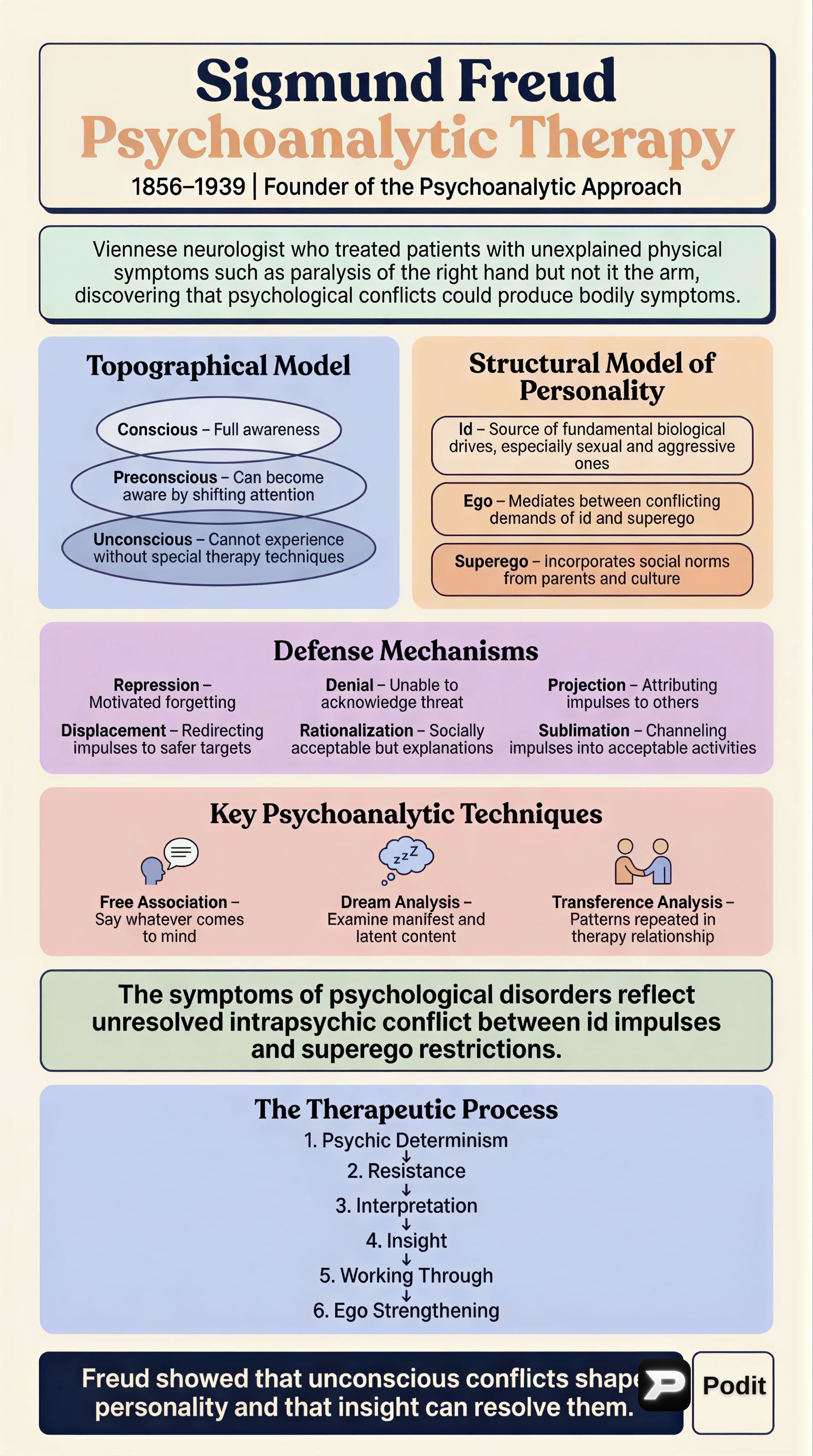
📚 Sigmund Freud and Psychoanalytic Therapy: A Study Guide
Source Information: This study material has been compiled from a lecture audio transcript and copy-pasted text, integrating information from both sources to provide a comprehensive overview of Sigmund Freud's theories and psychoanalytic therapy.
🧠 Introduction to Sigmund Freud and Psychoanalysis
Sigmund Freud (1856–1939), a prominent Viennese neurologist, is widely recognized as the founder of the psychoanalytic approach to psychology. His groundbreaking work emerged from his attempts to treat patients presenting with physical symptoms for which no clear organic cause could be identified. For instance, some patients reported paralysis affecting only their right hand but not their arm, while others experienced leg paralysis during the day yet could walk in their sleep. To understand these complex presentations, Freud drew upon philosophical ideas about multiple levels of human consciousness, laying the foundation for his theories of personality and psychopathology.
1️⃣ Freud's Models of the Mind
Freud proposed two fundamental models to describe the structure and functioning of the human mind: the Topographical Model and the Structural Model.
1.1. The Topographical Model of the Mind
This model describes mental life as occurring across three distinct levels of awareness:
- Conscious: ✅ Represents our full, immediate awareness. This includes everything we are currently thinking about or perceiving.
- Preconscious: ✅ Contains thoughts, feelings, and memories that are not currently in awareness but can easily be brought into consciousness by shifting attention.
- Unconscious: ✅ The most significant level, comprising thoughts, impulses, and memories that are inaccessible to direct experience. Special therapeutic techniques are required to bring unconscious material into awareness.
This continuum from unconscious to preconscious to conscious is fundamental to understanding Freud's view of personality.
1.2. The Structural Model of Personality
Freud saw personality developing through the dynamic interaction of powerful and often conflicting forces within each person. These forces are represented by three key components:
- Id: 📚 The primitive, instinctual component of personality. It is the source of fundamental biological drives, especially sexual/sensual and aggressive impulses. The id operates on the pleasure principle, seeking immediate gratification.
- Superego: 📚 The moral component of personality. It incorporates social and behavioral norms, values, and ideals learned from parents, family, and culture. The superego acts as our conscience, striving for perfection and imposing guilt.
- Ego: 📚 The rational, reality-oriented component. It mediates between the often-conflicting demands of the id (instinctual desires) and the superego (moral restrictions), while also responding to external realities. The ego operates on the reality principle, aiming to satisfy the id's desires in realistic and socially appropriate ways.
Freud believed that when these forces are in severe and prolonged conflict, the result is neurosis, a term for various psychological disorders characterized by anxiety and maladaptive behaviors.
2️⃣ Intrapsychic Conflict and Anxiety
Freud proposed that a dynamic, tension-filled conflict continuously occurs within all individuals. Much of mental life involves constant turmoil among the competing parts of the personality (id, ego, and superego).
- Conflict Arises: ⚠️ Tension between the id's impulses and the superego's restrictions.
- Anxiety Develops: 📈 Psychological discomfort signals potential danger or threat from these internal conflicts. This anxiety is an inevitable price for living in a civilization that imposes restrictions on desires.
- Defense Mechanisms Activate: 🛡️ Unconscious strategies are employed by the ego to protect the individual from overwhelming anxiety.
- Symptoms Appear: 📊 Psychological disorders are seen as reflections of this internal turmoil, representing the spilling over of unresolved intrapsychic conflicts and the individual's efforts to control the anxiety stemming from them.
3️⃣ Defense Mechanisms
Defense mechanisms are unconscious mental strategies designed by the ego to keep anxiety-provoking material from reaching consciousness, where it might interfere with functioning.
3.1. Types of Defense Mechanisms
These mechanisms can be categorized into primitive and higher-level types:
Primitive Defense Mechanisms:
- Repression: 🚫 Pushing threatening thoughts, feelings, or memories into the unconscious; often called "motivated forgetting."
- Denial: 🙅♀️ Being unable to recognize or acknowledge threatening experiences or realities.
- Regression: 👶 Retreating to coping strategies characteristic of earlier, less mature stages of development.
- Projection: 🎭 Attributing one's own unacceptable thoughts or impulses to others.
Higher-Level Defense Mechanisms:
- Reaction Formation: 🔄 Expressing the opposite of one's true feelings to protect against anxiety.
- Displacement: 🎯 Directing pent-up impulses toward a safer substitute rather than the original target that aroused the impulses.
- Rationalization: 💡 Providing socially appropriate, but often untrue, explanations for one’s undesirable behavior.
- Intellectualization: 🧠 Dealing with upsetting experiences in an overly logical, detached manner, often referencing non-emotional theories or scientific principles.
- Compensation: 💪 Coping with feelings of inferiority in one area by working to become superior in another area.
- Sublimation: 🎨 Channeling unacceptable impulses into socially acceptable and often productive activities.
3.2. Anna Freud's Contributions
Sigmund Freud's daughter, Anna Freud, significantly expanded upon his ideas regarding defense mechanisms. In her seminal work, Ego and the Mechanisms of Defense (1936/1966), she meticulously categorized and described these mechanisms, emphasizing their importance in both everyday life and psychoanalytic treatment. Anna Freud also contributed psychoanalytic theories on the development of psychological disorders in childhood, highlighting the significance of understanding how defense mechanisms function in children's psychological development.
3.3. Adaptive vs. Maladaptive Use
While a moderate use of defense mechanisms can be useful in daily life for temporary protection from anxiety, they are not always successful or adaptive. Individuals who habitually rely on primitive mechanisms like denial, repression, or projection may experience temporary relief but risk distorting reality and potentially jeopardizing their interpersonal relationships over time.
4️⃣ Foundations of Psychoanalytic Therapy
Psychoanalytic therapy evolved through several stages as Freud refined his techniques.
- Hypnosis and Cathartic Method: 🗣️ Initially, Freud used hypnosis combined with the cathartic method, learned from his mentor Joseph Breuer, to help patients express repressed emotions.
- Free Association: 💬 When hypnosis proved ineffective for some patients, Freud developed free association. Patients were asked to lie back and verbalize whatever thoughts came to mind, without censorship or judgment.
- Dream Analysis: 😴 Freud began analyzing patients' dreams, believing they represented disguised wishes and fantasies that defenses kept hidden from awareness during waking hours. Dreams have both a manifest content (obvious features) and a latent content (unconscious ideas, fantasies, and impulses).
- Psychoanalysis: These techniques collectively evolved into psychoanalysis, a comprehensive method designed to help clients gain insight into the unconscious thoughts and emotions presumed to be the root cause of their psychological problems.
4.1. The Case of Anna O.
A pivotal case in the development of psychoanalysis was that of Anna O. (Bertha Pappenheim).
- Symptom Development: Anna's symptoms included severe headaches, a persistent cough, paralysis of her neck and arm, and other physical ailments that emerged while she was caring for her seriously ill father.
- Mood Extremes: She displayed extreme mood fluctuations, ranging from agitation and hallucinations during the day to calm, trancelike states in the evening.
- "Talking Cure": Breuer discovered that if Anna described her hallucinations while in a hypnotic-like state, she would experience periods of tranquility and mental clarity.
- Key Discovery: A crucial insight came when Anna recalled and expressed emotions about a forgotten event involving a dog drinking water. Her fear of drinking subsequently disappeared, suggesting that repressed memories and emotions caused her symptoms. This led to the concept of the "talking cure."
5️⃣ Key Psychoanalytic Techniques
Modern psychoanalytic therapy utilizes several core techniques:
- Free Association: 🗣️ Clients are encouraged to say whatever comes to mind, without censorship, to provide clues to unconscious memories, impulses, and fantasies.
- Transference Analysis: 🔁 Examining how the client's typical relationship patterns and defense mechanisms appear in the therapy relationship.
- Dream Analysis: 🌙 Examining both the manifest content (obvious features) and the latent content (unconscious ideas, fantasies, and impulses) of dreams to uncover hidden meanings.
- Resistance Analysis: 🚧 Identifying and addressing client behaviors that interfere with the psychoanalytic treatment process (e.g., missed appointments, intellectualization). These are seen as reenactments of defense patterns.
5.1. Transference and Countertransference
- Transference: 🔄 Clients tend to repeat patterns of behavior in therapy. When clients express dependency, hostility, or love toward the therapist, Freud saw these behaviors as reflecting an unconscious process in which childhood feelings and conflicts about parents and other significant people are transferred to the therapist. Analysis of this "new edition" of the client's childhood conflicts is an essential psychoanalytic method, helping clients see how old conflicts haunt their lives and resolve them.
- Countertransference: ⚠️ Therapists are also affected by transference patterns. When therapists' reactions toward clients are based on the therapist's personal history and conflicts, these reactions are called countertransference. Countertransference can impair therapy progress if therapists distort the therapeutic interaction based on their own conflicts and defenses. This is why many psychoanalytically oriented clinicians believe therapists should undergo their own psychoanalysis.
6️⃣ The Therapeutic Process in Psychoanalysis
The psychoanalytic process is structured to facilitate deep psychological change:
- Psychic Determinism: 🔗 The belief that associations among memories, impressions, and experiences are not random but determined by underlying unconscious processes.
- Resistance: 🚫 Client behaviors that interfere with therapy (e.g., missed appointments, intellectualization) are seen as reenactments of defense patterns, indicating proximity to anxiety-provoking unconscious material.
- Interpretation: 🗣️ The therapist offers hypotheses about how current thoughts, feelings, and problems connect to underlying unconscious conflicts.
- Insight: 💡 The client gains conscious awareness of the underlying causes of their psychological problems. This is a crucial step toward resolution.
- Working Through: 🛠️ The client fully explores the implications of these insights for everyday life and relationships, integrating new understanding into their personality.
6.1. Main Goals of Psychoanalytic Treatment
The primary goals of psychoanalytic treatment are to help clients:
- Gain conscious and emotional insight into the underlying causes of their problems.
- Work through, or fully explore, the implications of those insights for everyday life.
- Strengthen the ego’s control over the id and the superego, thereby bolstering clients’ mastery over their sources of conflict.
7️⃣ Scientific Evaluation and Freud's Legacy
Freud's work remains a subject of intense debate, with strong emotions both positive and negative.
7.1. Key Assumptions of Freud's Model
- Unconscious drives, especially sex and aggression, are the primary influences on our personalities.
- Our early sexual development profoundly shapes our adult personalities.
- Dreams and neurotic symptoms are symbols that disguise a deeper meaning.
7.2. Evidence Supporting Freud's Ideas
While many of Freud's specific claims are difficult to test scientifically, some broader concepts have found support:
- We are often unconscious of the true causes of our behavior.
- Subliminal stimuli can affect our short-term moods.
- Early life experiences can influence development.
- Childhood physical abuse forecasts later behavioral problems.
7.3. Alternative Interpretations and Criticisms
- The unconscious is often viewed as consisting of mental processes rather than a "seething cauldron" of drives.
- There is limited evidence that the specific early experiences Freud emphasized (e.g., breastfeeding, toilet-training) play major roles in personality development.
- Other therapies are effective without directly addressing unconscious conflicts.
- Many of Freud's claims are difficult to test scientifically, leading to questions about falsifiability.
7.4. Freud's Legacy in Modern Psychology
Despite criticisms, Freud's influence is undeniable:
- Unconscious Influences: ✅ He correctly observed that we are often unaware of why we do things yet readily concoct plausible after-the-fact explanations.
- Childhood Importance: ✅ He was right that childhood experiences can profoundly influence our personalities.
- Talking Therapy: ✅ He was among the first scholars to recognize that psychotherapy, particularly through verbal expression, can alleviate neurotic symptoms.
- Theoretical Evolution: 💡 Most of Freud's insights have since been absorbed into other, better-supported theories of personality and psychopathology, evolving the field significantly.