Speaking in Tongues: Voice, Identity, and Multiplicity - kapak
Felsefe#voice#identity#culture#social class

Speaking in Tongues: Voice, Identity, and Multiplicity

This summary explores Zadie Smith's essay on voice adaptation, identity, and cultural multiplicity, contrasting the British societal pressure for a singular voice with the embrace of varied identities.

mahbobaApril 26, 2026 ~20 dk toplam
01

Sesli Özet

5 dakika

Konuyu otobüste, koşarken, yolda dinleyerek öğren.

Sesli Özet

Speaking in Tongues: Voice, Identity, and Multiplicity

0:005:22
02

Görsel Özet

İnfografik

Konunun tüm parçalarını tek bakışta gör.

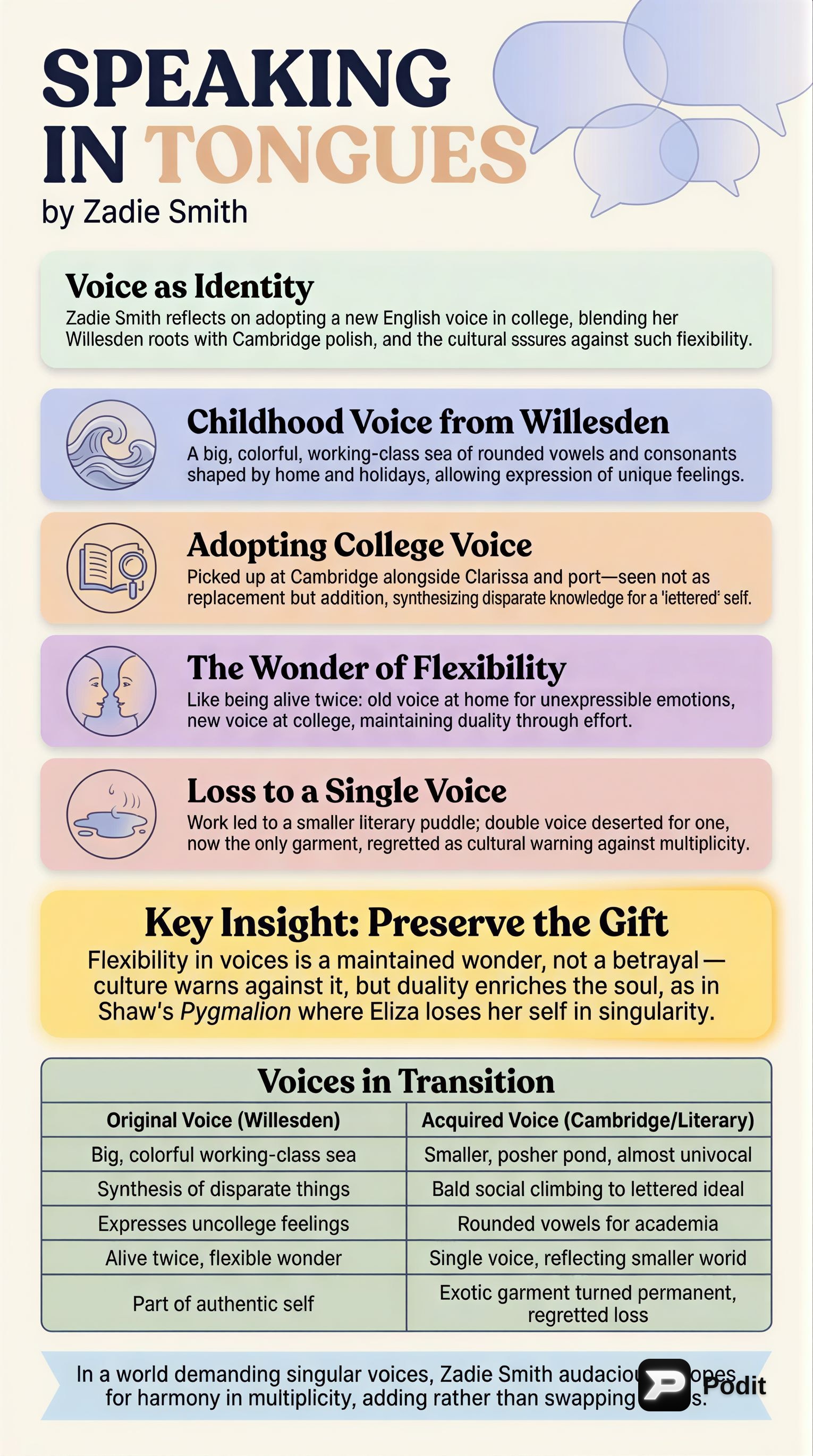
Speaking in Tongues: Voice, Identity, and Multiplicity - görsel özet infografik
Tam boyutta görüntüle →
03

Flash Kartlar

25 kart

Karta tıklayarak çevir. ← → ile gez, ⎵ ile çevir.

1 / 25
Tüm kartları metin olarak gör
  1. 1. According to Zadie Smith, what was her initial perception of acquiring a distinct 'English voice' during college?

    Smith initially perceived this as an additive process, believing she was integrating new linguistic and intellectual facets into her existing identity. She saw it as an expansion of her self, rather than a replacement or a loss of her original speech patterns. This flexibility was initially viewed positively.

  2. 2. What did Zadie Smith later regret regarding her voice adaptation?

    Smith expressed regret over the loss of her dual linguistic capacity, where her initial flexibility eventually yielded to a singular voice. She lamented the narrowing of her linguistic range, which she felt reflected the narrower confines of her professional life. This shift represented a loss of a part of her identity.

  3. 3. How is voice adaptation generally viewed in British culture, according to the text?

    In British culture, voice adaptation is often viewed critically, particularly as a betrayal of authenticity. It carries significant social implications, leading to public censure and accusations of class betrayal. Deviation from one's original voice is often perceived as duplicity or a fundamental loss of self.

  4. 4. What literary work does Smith reference to illustrate the social implications of voice alteration in the British context?

    Smith references George Bernard Shaw's *Pygmalion*. In this play, voice adaptation is depicted as an 'original British sin,' highlighting the societal scrutiny and negative interpretations associated with changing one's speech patterns in Britain. It serves as a prime example of cultural resistance to vocal transformation.

  5. 5. How does Eliza Doolittle's experience in *Pygmalion* exemplify the dilemma of voice adaptation in British society?

    Eliza Doolittle's transformation from a Cockney flower girl to a refined lady results in an 'awkward, in-between' existence. Her original voice is lost, and her newly acquired one fails to fully integrate her into either social stratum. This illustrates how voice change can lead to social limbo and a loss of identity.

  6. 6. What was George Bernard Shaw's didactic intent in *Pygmalion* regarding voice change?

    Shaw's didactic intent was to demonstrate that changing one's voice could lead to a loss of self, trapping individuals in a 'middling spot.' He aimed to show that such transformations could result in a comi-tragic state of existential limbo, rather than successful social integration or personal fulfillment. It was a warning against abandoning one's origins.

  7. 7. Beyond Eliza Doolittle, what other groups does Smith mention as facing pressure to conform to a singular identity?

    Smith extends this concept to broader societal anxieties concerning individuals perceived as existing between worlds, such as the 'tragic mulatto,' transsexuals, and contemporary immigrants. These groups often face pressure to sacrifice one aspect of their identity for another to conform to a singular, culturally prescribed self, highlighting a universal struggle.

  8. 8. How does Barack Obama's approach to identity and voice contrast with the narrative of Eliza Doolittle?

    Obama embodies a more hopeful and additive approach, where his 'Pygmalion experience' leads not to a loss of self, but to an understanding of identity as an accumulation of selves. Unlike Doolittle, his multiple voices are perceived as a gift rather than a burden or a source of limbo. He synthesizes, rather than sacrifices, his identities.

  9. 9. What exceptional facility does Smith highlight in Barack Obama regarding his communication?

    Smith highlights Obama's exceptional facility for dialogue, which enables him to authentically represent a wide array of voices and perspectives. This capacity allows him to 'speak them' – to embody the experiences of diverse individuals – rather than merely speaking for them. This demonstrates a deep empathy and understanding of varied backgrounds.

  10. 10. What does Smith mean by Obama's ability to 'speak them' rather than 'speak for them'?

    'Speaking them' implies an authentic embodiment and representation of diverse experiences and voices, as if he truly understands and can articulate their perspectives from within. 'Speaking for them,' in contrast, suggests a more detached advocacy or representation without necessarily sharing the lived experience. Obama's approach signifies a deeper connection and resonance.

  11. 11. How does Obama's personal 'Pygmalion experience' differ in outcome from Eliza Doolittle's?

    Obama's experience leads to an understanding of identity as an accumulation of selves, where having multiple voices is a gift. Eliza's, however, results in an 'awkward, in-between' existence and a loss of her original self, failing to fully integrate her. This highlights the positive versus negative outcomes of identity transformation based on societal acceptance and personal integration.

  12. 12. What concept does Smith introduce to describe a metaphorical space where multiplicity is inherent?

    Smith introduces the concept of 'Dream City.' This metaphorical space is where the unified, singular self is an illusion, and multiplicity is an inherent characteristic of identity. It represents a place where diverse backgrounds and narratives naturally coexist and contribute to a richer sense of self.

  13. 13. Why is Barack Obama considered a natural inhabitant of 'Dream City'?

    Obama, with his mixed heritage and diverse background, is presented as a natural inhabitant of Dream City because for him, crossing borders and 'speaking in tongues' are not choices but necessities. His life inherently embodies the multiplicity and synthesis of different cultural and social elements, making him a living example of this concept.

  14. 14. How did Obama's political campaign implicitly suggest that many individuals originate from 'Dream City'?

    His political campaign, characterized by the inclusive use of 'we' rather than 'I,' implicitly suggested that many individuals, despite not overtly displaying it, also originate from this 'Dream City' of complex backstories and multiple narratives. This approach resonated with those seeking synthesis between disparate elements of their identity, fostering a sense of shared experience.

  15. 15. According to Smith, what is required for living a life of varied identities?

    Smith emphasizes that living a life of varied identities is not merely an accidental gift but a continuous, conscious effort. It requires ongoing flexibility and the active embrace of multiplicity, suggesting it's a choice and a practice rather than a passive state. This active engagement allows for personal growth and integration.

  16. 16. What is Smith's 'audacious hope' for Barack Obama regarding his cultural sensibilities?

    Smith's 'audacious hope' is that Obama, born and raised amidst diverse cultures and opposing dogmas, would recognize the contingent nature of culture. She hopes he would not mistake his personal cultural sensibilities for universal natural laws, understanding that culture is constructed and not absolute. This would allow for a more nuanced and inclusive leadership.

  17. 17. With whose perspective on patriotism does Smith hope Obama would align?

    Smith hopes Obama would align with George Bernard Shaw's perspective on patriotism. Shaw viewed patriotism as a conviction rooted in birth rather than objective superiority, suggesting a more nuanced and less nationalistic understanding of one's country. This perspective allows for love of country without asserting its inherent supremacy over others.

  18. 18. How does Smith envision Obama demonstrating 'proper and decent human harmony' through multiple voices?

    Smith envisions Obama demonstrating this harmony by showing that holding multiple voices—such as expressing love for one's country while simultaneously acknowledging its shared humanity with other nations—does not imply contradiction or equivocation. Instead, it represents a richer, more integrated identity that embraces plurality. This approach fosters understanding and peace.

  19. 19. What is the core tension explored in the introduction regarding voice and identity?

    The introduction explores the inherent tension between individual multiplicity and societal expectations of singularity. It highlights how personal identity, social class, and cultural belonging are intrinsically linked to voice, yet society often pressures individuals to conform to a single, unchanging vocal identity, creating internal and external conflict.

  20. 20. What does the text suggest about the relationship between voice, personal identity, social class, and cultural belonging?

    The text suggests that voice is intrinsically linked to personal identity, social class, and cultural belonging. Altering one's voice can be perceived as a betrayal of these aspects, indicating that speech patterns are deeply embedded in how individuals are perceived and how they perceive themselves within society. Voice acts as a marker of one's place and self.

  21. 21. Why is the alteration of one's voice often interpreted as a 'betrayal of authenticity' in the British context?

    In the British context, the prevailing cultural sentiment dictates that voices should remain unchanging and singular. Therefore, any alteration is often interpreted as a betrayal of one's true self or origins, leading to accusations of duplicity or class betrayal. This rigid view values consistency over adaptation.

  22. 22. What is the significance of the term 'middling spot' as used by Shaw in *Pygmalion*?

    The 'middling spot' refers to a comi-tragic state of existential limbo where individuals who change their voice find themselves. They are no longer fully accepted by their original social group, nor are they fully integrated into their newly adopted one, leading to a sense of being stuck between worlds. It signifies a loss of belonging.

  23. 23. How does Obama's autobiography, *Dreams from My Father*, contribute to Smith's argument about multiplicity?

    *Dreams from My Father* presents a personal narrative of genuine multiplicity, showcasing Obama's ability to navigate and integrate various racial, social, and regional backgrounds. It serves as a counter-narrative to the singular identity expectation, illustrating identity as an accumulation of diverse experiences rather than a fixed state. This reinforces the idea of Dream City.

  24. 24. What does 'speaking in tongues' signify in the context of 'Dream City'?

    In the context of 'Dream City,' 'speaking in tongues' signifies the natural and necessary act of navigating and expressing oneself through multiple cultural and linguistic frameworks. It's not a choice but an inherent part of existing in a space where diverse identities converge and interact, reflecting a fluid and adaptable self. It's a metaphor for cultural fluency.

  25. 25. What is the 'societal phenomenon' Smith highlights regarding voice adaptation?

    Smith highlights a societal phenomenon where voice adaptation is often viewed critically, particularly within British culture. This critical view suggests a cultural resistance to individuals changing their speech patterns, often associating it with inauthenticity or social climbing. It underscores a societal expectation for vocal singularity and consistency.

04

Bilgini Test Et

15 soru

Çoktan seçmeli sorularla öğrendiklerini ölç. Cevap + açıklama.

Soru 1 / 15Skor: 0

According to Zadie Smith, what was her initial perception of acquiring a distinct 'English voice' during her college years?

05

Detaylı Özet

5 dk okuma

Tüm konuyu derinlemesine, başlık başlık.

📚 Study Guide: Voice, Identity, and Cultural Multiplicity

Source Information: This study material is compiled from an excerpt of Zadie Smith's lecture "Speaking in Tongues" (December 2008, New York Public Library) and a corresponding lecture audio transcript.


🌍 Introduction: The Shifting Landscape of Voice and Identity

Zadie Smith's "Speaking in Tongues" explores the intricate relationship between an individual's voice, their identity, and the broader cultural landscape. The essay delves into how linguistic adaptation shapes personal identity, societal perceptions, and the tension between individual multiplicity and cultural expectations of singularity. Smith uses her own experiences, literary examples like George Bernard Shaw's Pygmalion, and the public persona of Barack Obama to illustrate these complex dynamics.


1️⃣ The Personal Experience of Voice Adaptation

Smith begins by reflecting on her own journey of linguistic transformation.

  • Childhood Voice vs. Acquired Voice: She recounts acquiring a distinct "English voice" with "rounded vowels and consonants in more or less the right place" during her college years, differing significantly from her childhood speech patterns.
  • Initial Perception: Initially, Smith viewed this as an additive process ➕, believing she was "adding Cambridge to Willesden," integrating new linguistic and intellectual facets into her existing identity. She felt a "sort of wonder at the flexibility of the thing. Like being alive twice."
  • Loss of Flexibility: Over time, this dual linguistic capacity diminished, yielding to a singular voice that reflected the "smaller world" of her professional life. She expresses regret over this loss, noting that "flexibility is something that requires work if it is to be maintained."
  • Societal Scrutiny: This personal experience highlights a broader societal phenomenon where voice adaptation is often viewed critically, particularly within British culture.

2️⃣ The British Context: Voice, Class, and Societal Scrutiny

In Britain, altering one's voice carries significant social implications, often interpreted as a betrayal of authenticity.

  • "Original British Sin": Smith references George Bernard Shaw's Pygmalion, where voice adaptation is depicted as an "original British sin." Shaw noted that "many thousands of [British] men and women…have sloughed off their native dialects and acquired a new tongue," yet few admit it.
  • Cultural Expectation of Singularity: The prevailing cultural sentiment dictates that voices should remain unchanging and singular. Deviation is often perceived as:
    • Duplicity: "Janus-faced duplicity."
    • Loss of Self: "The loss of our very souls."
    • Class Betrayal: Moving up or down the class scale linguistically is seen as "an unforgivable act of class betrayal."
  • Eliza Doolittle: A Tragic Case Study 🎭
    • The Dilemma: Eliza, the protagonist of Pygmalion, transforms from a Cockney flower girl to a refined lady through Professor Higgins's experiment. This transformation leaves her in an "awkward, in-between" existence.
    • Shaw's Didactic Intent: Shaw intended Pygmalion to be didactic, demonstrating that changing one's voice could lead to a loss of self. Eliza's lament, "I have forgotten my own language, and I can speak nothing but yours," encapsulates this tragedy.
    • The "Middling Spot": Both Eliza and her father, Alfred Doolittle, find themselves trapped in a "comi-tragic" "middling spot"—neither fully belonging to their original class nor fully integrated into the new one.
  • Broader Anxieties: Smith extends this concept to broader societal anxieties concerning individuals perceived as existing "between worlds," such as:
    • The "tragic mulatto."
    • Transsexual individuals.
    • Contemporary immigrants.
    • These groups often face pressure to sacrifice one aspect of their identity for another to conform to a singular, culturally prescribed self.

3️⃣ Barack Obama: Embracing Multiplicity and "Dream City"

In contrast to the tragic narrative of Pygmalion, Smith presents Barack Obama as an embodiment of a more hopeful and additive approach to identity and voice.

  • Additive Identity: Obama's autobiography, Dreams from My Father, portrays a personal narrative of genuine multiplicity, where identity is an accumulation of selves.
  • "Speaking Them": Smith highlights Obama's exceptional facility for dialogue, enabling him to authentically represent a wide array of voices and perspectives from diverse racial, social, and regional backgrounds. He can "speak them" – embody the experiences of diverse individuals – rather than merely speaking for them.
  • The Gift of Multiple Voices: For Obama, having multiple voices is perceived as a gift 🎁 rather than a burden, leading to a conclusion that "each man must be true to his selves, plural."
  • "Dream City" Concept 🏙️
    • Definition: "Dream City" is a metaphorical space where the unified, singular self is an illusion, and multiplicity is inherent.
    • Inhabitants: Obama, with his mixed heritage (Hawaiian, Kenyan, Kansan, Indonesian influences) and diverse background, is presented as a natural inhabitant. Smith suggests that many people, despite not overtly displaying it, also originate from this "Dream City" of complex backstories and multiple narratives.
    • Necessity of Multiplicity: In Dream City, "everything is doubled, everything is various. You have no choice but to cross borders and speak in tongues."
  • Obama's Campaign Strategy: His political campaign, characterized by the inclusive use of "we" rather than "I," implicitly suggested that many individuals seek synthesis between disparate elements of their identity. This "invocation of our collective human messiness" was a "high-wire strategy" that resonated with many.
  • Cary Grant as an Example: Smith also cites Cary Grant (born Archibald Leach) as another example of a "self-created man" from "Dream City," whose "heavenly sui generis accent" was a product of collective imagination, transcending singular origins.

4️⃣ Conclusion: The Harmony of Plurality

Smith concludes by emphasizing that living a life of varied identities is not merely an accidental gift but a continuous, conscious effort.

  • Flexibility as a Choice: She illustrates this with a personal anecdote from election night, underscoring that flexibility and the embrace of multiplicity are choices available to all, irrespective of background. "Flexibility is a choice, always open to all of us." ✅
  • Audacious Hope for Obama: Smith expresses an "audacious hope" that Obama, as a figure born and raised amidst diverse cultures and opposing dogmas, would recognize the contingent nature of culture.
    • Avoiding Universal Laws: She hopes he would not mistake his personal cultural sensibilities for universal natural laws.
    • Reconciling Patriotism: She hopes he would align with George Bernard Shaw's perspective on patriotism as a conviction rooted in birth rather than objective superiority.
  • Human Harmony: Ultimately, Smith envisions Obama as a figure capable of demonstrating that holding multiple voices—such as expressing love for one's country while simultaneously acknowledging its shared humanity with other nations—does not imply contradiction or equivocation. Instead, it represents a "proper and decent human harmony" 🤝, where plurality enriches identity rather than diminishing it.

Kendi çalışma materyalini oluştur

PDF, YouTube videosu veya herhangi bir konuyu dakikalar içinde podcast, özet, flash kart ve quiz'e dönüştür. 1.000.000+ kullanıcı tercih ediyor.

Sıradaki Konular

Tümünü keşfet
Early Philosophical Roots of Psychology

Early Philosophical Roots of Psychology

Explore the foundational philosophical ideas from ancient Greece to the medieval period that shaped early psychological thought, covering key figures and cultural influences.

Özet 15
Philosophical Foundations of Welfare Economics

Philosophical Foundations of Welfare Economics

An overview of key concepts in welfare economics, including utilitarianism, social welfare functions, justice theories, and philosophical methods.

Özet 25
The Content of Individual Well-Being: Theories and Criticisms

The Content of Individual Well-Being: Theories and Criticisms

Explore diverse philosophical theories of individual well-being, from subjective hedonism to objective capability approaches, and analyze their inherent criticisms and challenges.

Özet 25 15
The Content of Individual Well-Being: Philosophical Theories

The Content of Individual Well-Being: Philosophical Theories

Explore various philosophical theories defining individual well-being, including hedonism, preference-based, eudaimonism, and capability approaches, and analyze their strengths and weaknesses.

Özet 25 15
The Content of Individual Well-Being: Theories and Critiques

The Content of Individual Well-Being: Theories and Critiques

Explore the philosophical and economic theories defining individual well-being, from hedonism and preference-based approaches to objective and hybrid models, and their inherent challenges.

Özet 25 15
Could Our Universe Be a Simulation?

Could Our Universe Be a Simulation?

Explore the mind-bending simulation hypothesis. We'll define this idea, delve into arguments for and against it, and ponder what it means for our understanding of reality.

4 dk Özet 25 15
The Elusive Definition of Tragedy: From Ancient Drama to Modern Thought

The Elusive Definition of Tragedy: From Ancient Drama to Modern Thought

Explore the complex and evolving definitions of tragedy, contrasting its everyday meaning with its rich philosophical, literary, and historical interpretations.

Özet 24
Ethical Decision-Making in Healthcare: Utilitarianism and Bioethics

Ethical Decision-Making in Healthcare: Utilitarianism and Bioethics

Explore ethical theories like utilitarianism and fundamental bioethical principles, applying them to complex medical dilemmas, including resource allocation during pandemics and patient autonomy.

Özet 23