 Podit
Podit
This content is based on a YouTube video.
📚 The Anatolian Seljuk Sultanate: A Comprehensive Study Guide
🌍 Introduction to the Sultanate of Rum
The Anatolian Seljuk Sultanate, also known as the Sultanate of Rum, represents a pivotal era in Turkish history, flourishing in Anatolia from the late 11th to the early 14th century. This powerful state played an indispensable role in shaping the cultural, political, and religious landscape of what would eventually become modern Turkey. While originating as a branch of the larger Great Seljuk Empire, the Anatolian Seljuks forged their own distinct identity, laying crucial foundations for subsequent Turkish states, including the Ottoman Empire.
This study guide will explore the origins of the Anatolian Seljuks, tracing their establishment after the momentous Battle of Manzikert. We will delve into their golden age, characterized by the construction of a sophisticated civilization that blended Persian, Byzantine, and Turkic traditions. Finally, we will examine their decline, which paved the way for the rise of the Ottoman Empire, and reflect on their enduring legacy. By the end, you will have a comprehensive understanding of their rise, prosperity, and eventual fragmentation.
1️⃣ Foundation and Early Expansion: From Manzikert to Konya
The genesis of the Anatolian Seljuk Sultanate is inextricably linked to a monumental event in 1071: the Battle of Manzikert. This was not merely a military confrontation but a profound turning point that irrevocably altered the destiny of Anatolia.
✅ The Battle of Manzikert (1071)
Under the leadership of Alp Arslan, the Seljuk Turks achieved a decisive victory over the Byzantine army. This triumph effectively opened the gates of Anatolia, allowing Turkic tribes to settle permanently in the region. This marked the beginning of a gradual yet profound process known as the Turkification and Islamization of Anatolia.
🚀 Establishment of the Sultanate
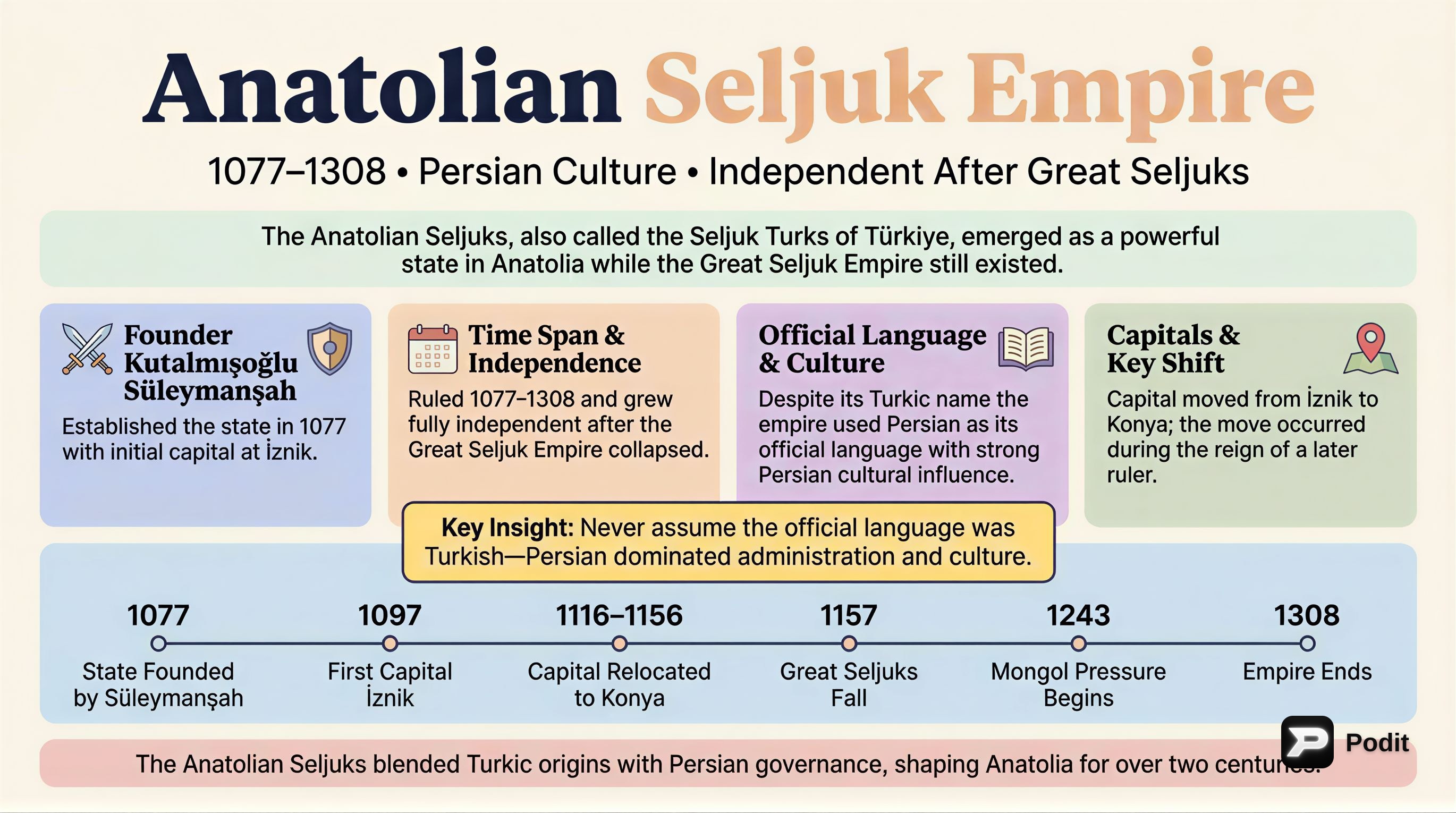
Among the early Turkic arrivals was Süleyman Shah I, a cousin of the Great Seljuk Sultan Malik Shah I.
- Circa 1075: Süleyman Shah I began consolidating Turkish control over parts of western Anatolia.
- First Capital: Nicaea (modern-day İznik) was established as the initial capital.
- Initial Status: The newly formed state initially acknowledged the suzerainty of the Great Seljuk Empire.
- Byzantine Response: The Byzantine Empire, significantly weakened by the defeat at Manzikert, struggled to repel these new arrivals, leading to continuous territorial losses.
⚔️ Early Challenges and Consolidation
The early years of the Sultanate were characterized by constant warfare and expansion, as the Seljuks contended with both the Byzantines and the emerging Crusader states.
- Kılıç Arslan I: Süleyman Shah's successor, Kılıç Arslan I, played a crucial role in defending the nascent state against the forces of the First Crusade.
- Capital Relocation: To ensure greater security and a more central, defensible position, Kılıç Arslan I moved the capital from Nicaea to Konya. This strategic move solidified the Seljuk presence in central Anatolia.
💡 Seljuk Strategy for Anatolian Integration
The Seljuks employed a multifaceted strategy to establish and expand their dominion:
- Military Action: Continuous campaigns against Byzantine forces and other rivals.
- Settlement: Encouraging Turkic tribes to settle in newly conquered territories, thereby increasing the Turkic demographic presence.
- Infrastructure Development: Providing land and building essential infrastructure to support these new settlements and facilitate economic activity.
- Cultural Synthesis: They absorbed elements of Byzantine administration and culture, while simultaneously introducing their own Islamic and Turkic traditions. This unique blend fostered a distinct Anatolian Seljuk identity.
By the early 12th century, despite internal struggles and external pressures, the Anatolian Seljuk Sultanate had firmly established itself as a significant regional power, laying the groundwork for future growth and prosperity.
2️⃣ The Golden Age: Prosperity, Culture, and Rumi
Following its tumultuous formative years, the Anatolian Seljuk Sultanate entered its golden age, particularly during the late 12th and early 13th centuries. This period was a remarkable era of political stability, economic prosperity, and an incredible blossoming of art, architecture, and intellectual life.
👑 Sultan Alaeddin Keykubad I (1220-1237)
A pivotal figure during this golden age was Sultan Alaeddin Keykubad I. Under his astute leadership, the Sultanate reached its territorial zenith and became a beacon of culture and trade.
- Military Prowess: He was a formidable military leader, successfully expanding Seljuk control to both the Mediterranean and Black Sea coasts, securing vital trade routes and strategic territories.
- Patron of Arts and Sciences: Keykubad I was also a great patron of the arts and sciences, fostering an environment conducive to intellectual and artistic pursuits.
📈 Economic Prosperity and Trade
The Seljuks strategically positioned themselves at the crossroads of major international trade routes, most notably the Silk Road. This geographical advantage was leveraged through proactive economic policies:
- Caravanserai Network: They actively promoted commerce by constructing an extensive network of caravanserai. These fortified roadside inns provided essential lodging, food, and security for merchants and their goods. This system facilitated safe passage across Anatolia, significantly boosting trade and transforming the region into a vibrant commercial hub.
- Urban Development: Cities such as Konya, Kayseri, and Sivas grew into bustling centers of craftsmanship, production, and trade, attracting merchants and artisans from across the known world.
🎨 Cultural and Intellectual Flourishing
The Anatolian Seljuks fostered a remarkable synthesis of Turkic, Persian, and Byzantine influences, creating a rich and unique cultural tapestry.
- Language and Literature: Persian served as the language of the court, leading to a rich literary tradition. Many Persian poets and scholars, often fleeing the Mongol invasions further east, found refuge and patronage in Seljuk Anatolia, contributing to a vibrant intellectual environment.
- Architectural Legacy: The most enduring legacy of the Seljuk golden age is its distinctive architecture. Seljuk buildings are characterized by:
- Robust stone construction.
- Intricate geometric patterns and elaborate ornamentation.
- Monumental scale, reflecting the power and ambition of the Sultanate.
- Examples include grand mosques, elegant madrasas (religious schools), impressive hospitals, and majestic bridges, many of which still stand today as testaments to Seljuk artistic sophistication.
- Sufism and Rumi: Sufism, a mystical branch of Islam, flourished under Seljuk patronage. Konya, the capital, became a significant spiritual center, home to Mevlana Jalaluddin Rumi. His teachings on love, tolerance, and spiritual enlightenment resonate globally to this day. The Mevlevi Order, famously known as the Whirling Dervishes, is a direct legacy of this Seljuk-era spiritual awakening, embodying the profound spiritual depth of the period.
🏛️ Administrative and Military Strength
The Seljuks developed a sophisticated administrative system, drawing heavily on established Persian bureaucratic traditions. This robust governance, coupled with a strong and well-organized military, created a stable environment essential for the Sultanate's prosperity and cultural achievements. This golden age truly transformed Anatolia into a prosperous and culturally rich region, laying many foundational elements for later Turkish states.
3️⃣ Decline and Fragmentation: The Mongol Impact
Despite its impressive achievements and golden age, the Anatolian Seljuk Sultanate was not immune to the forces of decline. The mid-13th century brought a devastating and existential threat from the east: the relentless advance of the Mongol Empire.
⚠️ The Mongol Invasion and Battle of Köse Dağ (1243)
The decisive moment that shattered Seljuk independence came in 1243 with the Battle of Köse Dağ.
- Catastrophic Defeat: The Seljuk army, led by Sultan Gıyaseddin Keyhüsrev II, suffered a catastrophic defeat against the formidable Mongol forces.
- Turning Point: This battle marked a critical turning point from which the Sultanate never truly recovered, effectively ending its sovereignty and ushering in a period of subjugation.
📉 Vassalage and Political Instability
Following the Battle of Köse Dağ, the Anatolian Seljuks were forced to become vassals of the Mongol Ilkhanate.
- Heavy Tribute: They were compelled to pay heavy tribute to their Mongol overlords.
- Mongol Oversight: The Seljuks accepted direct Mongol oversight in their internal affairs and were required to provide troops for Mongol campaigns.
- Oppressive Presence: The Mongol presence was oppressive, systematically draining the Sultanate's resources and severely undermining its authority and legitimacy.
This period of Mongol domination led to severe political instability within the Seljuk state.
- Puppet Sultans: Seljuk sultans became mere puppets, frequently installed and removed by the Ilkhanids according to their political whims.
- Internal Struggles: This power vacuum and external manipulation fueled intense internal struggles among Seljuk princes and viziers, further weakening the central government and accelerating the process of fragmentation.
🗺️ Rise of the Beyliks
As the central authority of the Seljuk Sultanate waned under Mongol pressure, various Turkic tribal leaders, known as Beyliks, began to assert their independence.
- Emergence of Independent Principalities: These Beyliks, often situated in the border regions (uç beylikleri), gradually carved out their own territories, establishing de facto independent principalities.
- Examples: Notable examples include the Karamanids, the Germiyanids, and crucially, the Ottoman Beylik, founded by Osman I in northwestern Anatolia. The rise of these Beyliks marked the final phase of the Sultanate's existence as a unified entity.
🔚 End of the Sultanate
While some Seljuk sultans continued to rule in name, their power was largely symbolic, confined to limited territories and subject to Mongol approval.
- Economic Decline: Economic prosperity dwindled significantly under the combined pressures of Mongol exploitation and incessant internal strife.
- Final Dissolution: By the early 14th century, the Anatolian Seljuk Sultanate had effectively ceased to exist as a unified, independent entity. The last Seljuk sultan, Mesud II, died around 1308, bringing an end to direct Seljuk rule.
However, the legacy of the Seljuks was far from over. The emerging Beyliks inherited much of its administrative, cultural, and military traditions. From one of these, the Ottoman Beylik, a new and even more powerful empire would rise to dominate Anatolia and beyond for centuries.
4️⃣ The Enduring Legacy of the Anatolian Seljuks
The Anatolian Seljuk Sultanate left an extraordinary and lasting legacy that profoundly shaped the history and identity of Anatolia and the broader Turkish world. Understanding their contributions is crucial for grasping the roots of modern Turkey.
🇹🇷 Turkification and Islamization of Anatolia
The Seljuks were instrumental in the Turkification and Islamization of Anatolia.
- Demographic Shift: Through sustained settlement and military expansion, they transformed Anatolia into a predominantly Muslim Turkic heartland.
- Cultural Transformation: This process involved not only a demographic shift but also a deep cultural and religious transformation, integrating Turkic customs and Islamic faith into the fabric of the region.
🏗️ Foundation for the Ottoman Empire
The Seljuks provided a crucial foundation for the subsequent Ottoman Empire, which would rise from the ashes of the Seljuk decline.
- Administrative Structures: The Ottomans adopted and adapted many of the sophisticated administrative structures and bureaucratic traditions established by the Seljuks, which were themselves influenced by Persian models.
- Legal Systems: Seljuk legal frameworks and principles contributed to the development of Ottoman jurisprudence.
- Cultural Synthesis: The Seljuk model of cultural synthesis, blending Turkic, Persian, and Byzantine elements, was continued and further developed by the Ottomans.
- Military Traditions: The military organization and strategies employed by the Seljuks also influenced the early Ottoman military.
🌆 Urban Development and Economic Networks
The Seljuks' efforts in urban development and trade infrastructure had long-lasting effects.
- Developed Cities: The cities they developed, such as Konya, Kayseri, and Sivas, continued to be important centers under Ottoman rule.
- Secured Trade Routes: The trade routes they secured and the caravanserai network they built facilitated commerce for centuries, underpinning regional economic prosperity.
- Architectural and Artistic Styles: The distinctive architectural and artistic styles pioneered by the Seljuks continued to influence the region's aesthetic for centuries, with many elements being incorporated into early Ottoman art and architecture.
💡 Cultural and Spiritual Heritage
The cultural and spiritual contributions of the Seljuk era, particularly the flourishing of Sufism and the legacy of Mevlana Jalaluddin Rumi, remain a vital part of Turkish heritage. Konya, as a spiritual center, continues to draw visitors and adherents from around the world.
🇹🇷 Roots of Modern Turkey
Understanding the Anatolian Seljuks isn't just about learning a chapter of medieval history; it's about grasping the deep historical roots of modern Turkey and appreciating the rich, complex tapestry of its heritage. Their story is a testament to resilience, cultural innovation, and the enduring impact of a powerful civilization that laid the groundwork for a new era in Anatolian history.
Thank you for joining this historical exploration of the Anatolian Seljuk Sultanate.