Podit
Podit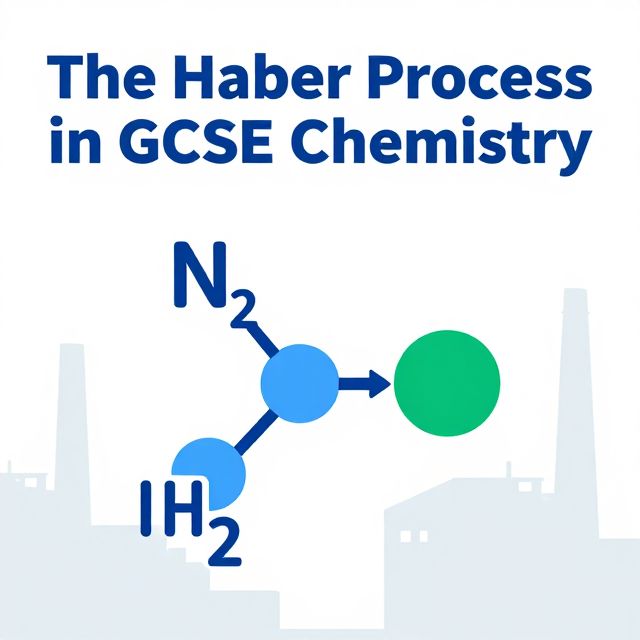
This content is based on a YouTube video.
The Haber Process: A GCSE Chemistry Study Guide 📚
The Haber Process, also known as the Haber-Bosch Process, is a cornerstone of industrial chemistry. It's a vital method for synthesizing ammonia (NH₃) from atmospheric nitrogen (N₂) and hydrogen (H₂). Developed in the early 20th century by Fritz Haber and Carl Bosch, this process dramatically changed agriculture and supported global population growth by enabling the large-scale production of nitrogen-based fertilizers. Understanding the Haber Process is crucial for comprehending industrial chemistry, chemical equilibrium, and the optimization of reaction conditions, especially for GCSE Chemistry examinations.
1. What is the Haber Process? 🤔
The Haber Process is an industrial method for producing ammonia (NH₃) from its constituent elements, nitrogen and hydrogen.
- Inventors: Fritz Haber and Carl Bosch.
- Historical Impact: Before its invention, nitrogen compounds for agriculture were scarce, relying on natural sources like guano. The Haber Process solved the challenge of converting inert atmospheric nitrogen into a usable form, significantly boosting crop yields.
- Beyond Agriculture: Ammonia is a fundamental precursor for many other chemical products, including explosives, plastics, and pharmaceuticals.
2. Chemical Principles & Equation 🧪
The core of the Haber Process is a reversible, exothermic reaction between nitrogen gas and hydrogen gas to produce ammonia gas.
-
Balanced Chemical Equation: N₂(g) + 3H₂(g) ⇌ 2NH₃(g) ✅ This means one mole of nitrogen gas reacts with three moles of hydrogen gas to yield two moles of ammonia gas.
-
Energy Change:
- Forward Reaction (N₂ + 3H₂ → 2NH₃): Exothermic (releases heat).
- Reverse Reaction (2NH₃ → N₂ + 3H₂): Endothermic (absorbs heat).
3. Raw Materials 🌍
The raw materials for the Haber Process are readily available, making it economically viable.
-
Nitrogen (N₂):
- Source: Obtained directly from the air.
- Method: Air is approximately 78% nitrogen by volume. Nitrogen is separated from liquid air through fractional distillation.
-
Hydrogen (H₂):
- Source: Typically sourced from natural gas (primarily methane, CH₄).
- Method: Steam reforming – methane reacts with steam at high temperatures to produce hydrogen and carbon monoxide.
- Alternative: Can also be produced by the electrolysis of water, but this is generally more energy-intensive and less common for large-scale industrial production.
4. Industrial Significance 📈
The impact of the Haber Process on global society is immense.
-
Primary Application: Fertilizers 🌱
- Ammonia is used to manufacture nitrogenous fertilizers like ammonium nitrate and urea.
- These fertilizers replenish nitrogen in the soil, a crucial nutrient for plant growth.
- This leads to enhanced agricultural productivity and increased crop yields.
- 💡 Global Food Security: Without the Haber Process, it's estimated that the Earth could sustain a significantly smaller population, highlighting its profound impact on global food security and human welfare.
-
Other Applications:
- Precursor for nitric acid (HNO₃).
- Used in the production of explosives (e.g., TNT, nitroglycerin).
- Used in the manufacture of dyes, plastics, and pharmaceuticals.
5. Reaction Conditions & Optimization ⚙️
Optimizing the conditions for the Haber Process involves a careful balance between achieving a high yield of ammonia, a fast reaction rate, and economic viability.
5.1. Temperature 🌡️
- Typical Range: 400 to 450 degrees Celsius.
- Rationale (Compromise):
- Lower Temperatures: According to Le Chatelier's Principle, lower temperatures would favor the forward exothermic reaction, leading to a higher equilibrium yield of ammonia. However, the reaction rate would be unacceptably slow.
- Higher Temperatures: Would increase the reaction rate but significantly decrease the equilibrium yield.
- ✅ Therefore, 400-450°C is a compromise temperature that provides a reasonable reaction rate and an acceptable equilibrium yield within an economically feasible timeframe.
5.2. Pressure PSI
- Typical Range: 150 to 250 atmospheres.
- Rationale:
- Le Chatelier's Principle: Increasing the pressure on a system at equilibrium shifts the equilibrium in the direction that produces fewer moles of gas.
- Reactants: N₂(g) + 3H₂(g) = 4 moles of gas
- Products: 2NH₃(g) = 2 moles of gas
- ✅ High pressure favors the formation of ammonia, increasing the equilibrium yield.
- Reaction Rate: High pressure also increases the concentration of reactant molecules, leading to more frequent collisions and a faster reaction rate.
- ⚠️ Compromise: Maintaining very high pressures requires robust and expensive equipment and presents significant safety challenges, necessitating a compromise.
- Le Chatelier's Principle: Increasing the pressure on a system at equilibrium shifts the equilibrium in the direction that produces fewer moles of gas.
5.3. Catalyst ⚛️
- Catalyst Used: Iron (Fe).
- Function:
- Increases the rate at which equilibrium is reached.
- Achieves this by providing an alternative reaction pathway with a lower activation energy.
- ✅ It speeds up both the forward and reverse reactions equally.
- ⚠️ Important Note: The catalyst does not affect the position of equilibrium or the overall yield of ammonia. It only helps the reaction reach equilibrium faster. This allows the process to operate efficiently at the compromise temperature.
5.4. Recycling Unreacted Gases ♻️
- Process: After the reaction, the ammonia produced is cooled and liquefied, separating it from the unreacted nitrogen and hydrogen gases.
- Efficiency: The unreacted gases are then recycled back into the reactor.
- ✅ This continuous recycling mechanism ensures maximum conversion of raw materials, improving the overall efficiency and sustainability of the process, which is crucial for economic viability.
Conclusion ✅
The Haber Process is a monumental achievement in industrial chemistry. It enables the large-scale synthesis of ammonia from atmospheric nitrogen and hydrogen through a reversible, exothermic reaction: N₂(g) + 3H₂(g) ⇌ 2NH₃(g).
Key optimized conditions include:
- 🌡️ A compromise temperature of 400 to 450 degrees Celsius.
- PSI A high pressure of 150 to 250 atmospheres.
- ⚛️ The presence of an iron catalyst.
These conditions are meticulously chosen to balance reaction rate, equilibrium yield, and economic considerations. The process's profound impact on global food security and its role as a precursor for various essential chemicals underscore its critical importance in modern civilization. Understanding the Haber Process provides valuable insights into the application of chemical principles like Le Chatelier's Principle and catalysis in real-world industrial settings.