Podit
Podit
Study Material: Atoms and Molecules
Source Information: This study material is compiled from a lecture audio transcript and copy-pasted text provided by the user.
📚 Introduction to the Atomic World
Welcome to a foundational journey into the microscopic world that constitutes everything around us: atoms and molecules. Understanding these fundamental units is crucial for comprehending chemistry, physics, biology, and the very nature of existence. This guide will explore the intricate structures of atoms, their subatomic particles, how they combine to form molecules, and their profound significance in both the natural world and technological advancements.
⚛️ The Atom: The Indivisible Unit of Matter
The atom is the fundamental building block of matter. Its concept has evolved significantly over centuries.
-
Historical Perspective:
- Ancient Greece (Democritus, ~400 BC): Proposed the idea of 'atomos' – indivisible particles, purely philosophical.
- John Dalton (Early 19th Century): Revived atomic theory with a scientific basis (1803).
- ✅ All matter is composed of indivisible atoms.
- ✅ Atoms of a given element are identical in mass and properties.
- ✅ Compounds form from combinations of different atoms in fixed ratios.
- ✅ Chemical reactions involve rearrangement, not creation or destruction, of atoms.
- 💡 Note: While some of Dalton's postulates have been refined (atoms are divisible), his work was revolutionary.
-
Subatomic Particles: Atoms are composed of even smaller particles.
- 1️⃣ Protons (p+):
- Charge: Positive (+)
- Location: Nucleus (central, dense core)
- Mass: ~1 atomic mass unit (amu)
- Defining Feature: The number of protons determines the atomic number (Z), which uniquely identifies an element.
- Example: All atoms with 6 protons are Carbon (C).
- 2️⃣ Neutrons (n0):
- Charge: Neutral (0)
- Location: Nucleus
- Mass: ~1 amu (similar to protons)
- Role: Contributes to the atom's mass and nuclear stability.
- 3️⃣ Electrons (e-):
- Charge: Negative (-)
- Location: Electron cloud/shells surrounding the nucleus
- Mass: Negligible (~1/1836th of a proton)
- Role: Determine chemical properties and bonding behavior, especially valence electrons (outermost shell electrons).
- ✅ In a neutral atom, the number of electrons equals the number of protons (Z), resulting in no net electrical charge.
- 1️⃣ Protons (p+):
-
Atomic Number (Z) & Mass Number (A):
- Atomic Number (Z): Number of protons. Defines the element.
- Mass Number (A): Sum of protons and neutrons in the nucleus. (A = Z + number of neutrons).
-
Isotopes:
- 📚 Definition: Atoms of the same element (same Z) but with different numbers of neutrons (different A).
- Example: Carbon-12 (6 protons, 6 neutrons) and Carbon-14 (6 protons, 8 neutrons). Both are carbon.
- Chemical Properties: Generally very similar due to identical electron configurations.
- Physical Properties: Can vary due to mass difference (e.g., density). Some isotopes are radioactive (unstable nuclei).
- Average Atomic Mass: The weighted average of the masses of all naturally occurring isotopes of an element, considering their relative abundances. This is the value found on the periodic table.
📊 Elements and the Periodic Table: Organizing the Atomic World
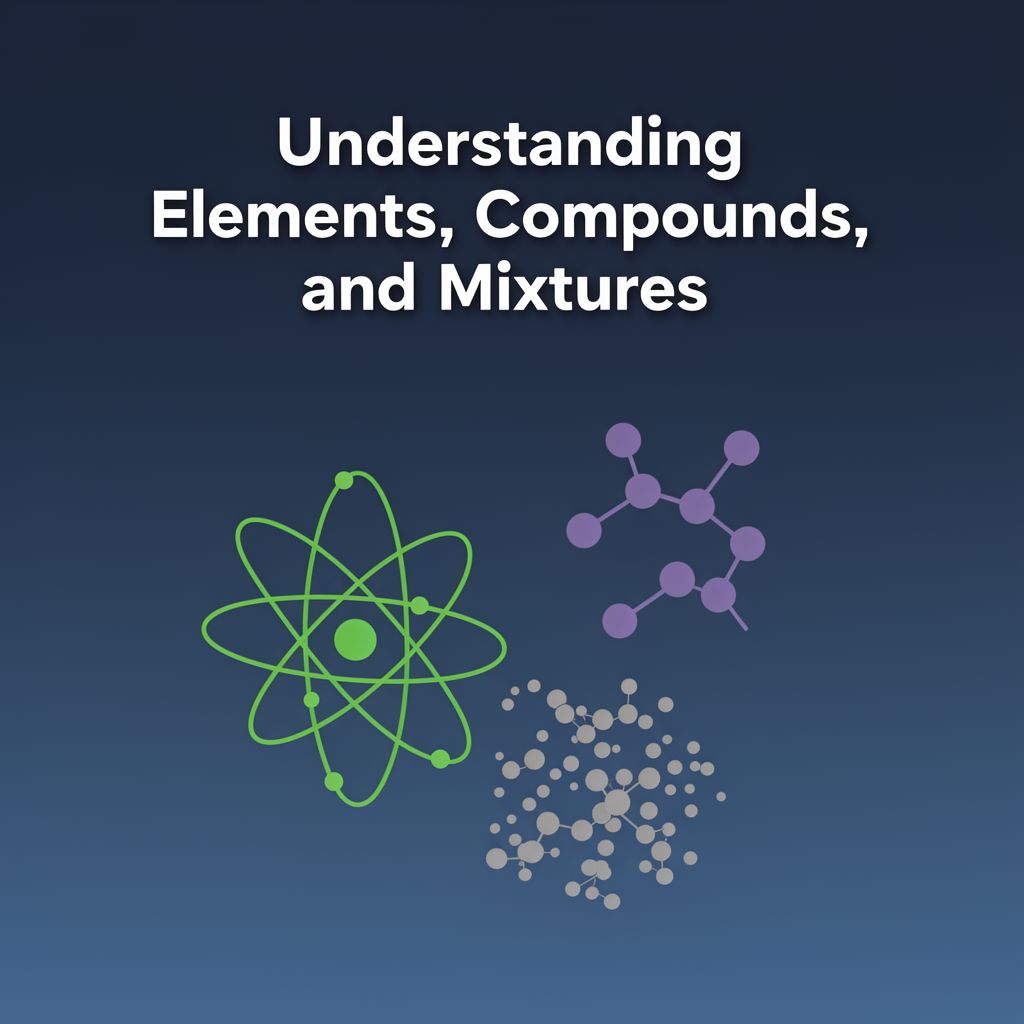
An element is a pure substance consisting only of atoms that all have the same atomic number (Z).
-
The Periodic Table:
- Creator: Primarily Dmitri Mendeleev (1869).
- Organization: Elements are arranged in increasing order of their atomic number (Z).
- Periods (Rows): Represent principal energy levels/electron shells. Moving left to right, atomic number increases, and electrons are added to the same valence shell.
- Groups/Families (Columns): Elements in the same group share similar chemical properties because they have the same number of valence electrons.
- Example: Group 1 (Alkali Metals) all have 1 valence electron, are highly reactive. Group 18 (Noble Gases) have a full outer shell (8 valence electrons), making them very stable and unreactive.
-
Categories of Elements:
- Metals: (Left and center) Shiny, malleable, ductile, good conductors of heat and electricity. Examples: Iron, Copper, Gold.
- Nonmetals: (Upper right) Brittle, poor conductors, often gases or dull solids. Examples: Oxygen, Nitrogen, Sulfur.
- Metalloids: (Along diagonal line between metals and nonmetals) Exhibit intermediate properties. Examples: Silicon, Germanium (crucial in semiconductor technology).
-
Predictive Power: The periodic table allows scientists to infer an element's electron configuration, typical oxidation states, electronegativity, atomic radius, and other physical and chemical characteristics based on its position.
🔗 Molecules and Chemical Bonding: Atoms in Concert
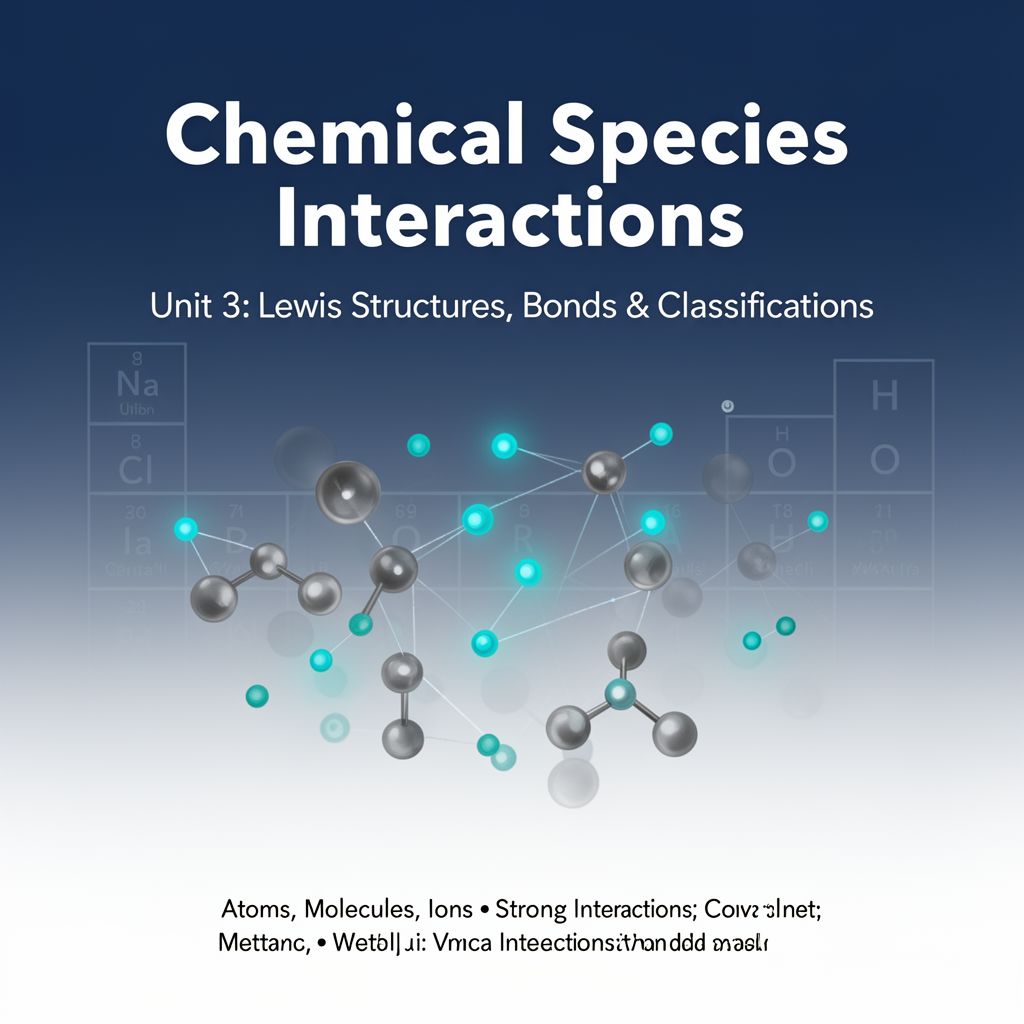
A molecule is formed when two or more atoms are held together by chemical bonds.
-
Driving Force for Bonding: Atoms tend to achieve a more stable electron configuration, typically by filling their outermost electron shell (like noble gases). This is known as the octet rule (aiming for 8 valence electrons).
-
Types of Chemical Bonds:
- 1️⃣ Ionic Bonds:
- Formation: Typically between a metal and a nonmetal.
- Mechanism: Complete transfer of one or more electrons from one atom to another.
- Result: Formation of oppositely charged ions:
- Cation: Positively charged ion (loses electrons).
- Anion: Negatively charged ion (gains electrons).
- Bond: Strong electrostatic attraction between cation and anion.
- Example: Sodium Chloride (NaCl). Na (metal) loses 1 electron to become Na+. Cl (nonmetal) gains 1 electron to become Cl-. Na+ and Cl- attract strongly.
- Properties: Form crystalline solids, high melting/boiling points, often dissolve in water to form conductive solutions.
- 2️⃣ Covalent Bonds:
- Formation: Typically between two nonmetal atoms.
- Mechanism: Sharing of one or more pairs of electrons.
- Types:
- Single Bond: Shares one pair of electrons. Example: H2O (each H shares with O).
- Double Bond: Shares two pairs of electrons. Example: O2.
- Triple Bond: Shares three pairs of electrons. Example: N2 (very strong).
- Properties: Can exist as gases, liquids, or solids; generally lower melting/boiling points than ionic compounds.
- Metallic Bonds (Briefly): Occur in metals, where a "sea" of delocalized electrons is shared among a lattice of positively charged metal ions, giving metals their characteristic conductivity.
- 1️⃣ Ionic Bonds:
-
Intermolecular Forces (IMFs):
- 📚 Definition: Weaker forces of attraction between molecules (not within them).
- Role: Determine physical properties like boiling points, melting points, and solubility.
- Examples: Hydrogen bonding, dipole-dipole interactions, London dispersion forces.
💨 States of Matter and Molecular Behavior: The Dynamic World
The state of matter (solid, liquid, gas, plasma) is determined by the balance between the kinetic energy of particles and the strength of intermolecular forces.
-
1️⃣ Solid State:
- Arrangement: Tightly packed, fixed, orderly arrangement (often crystal lattice).
- Forces: Very strong intermolecular forces.
- Movement: Particles vibrate in place.
- Shape/Volume: Definite shape and definite volume.
- Examples: Ice, metals, rocks.
-
2️⃣ Liquid State:
- Arrangement: Relatively close, but not fixed; can slide past each other.
- Forces: Strong enough to keep particles together, but weaker than solids.
- Movement: Particles flow.
- Shape/Volume: Indefinite shape (takes container's shape), definite volume.
- Examples: Water, oil, alcohol.
-
3️⃣ Gaseous State:
- Arrangement: Far apart, move randomly and rapidly.
- Forces: Very weak or negligible intermolecular forces.
- Movement: High kinetic energy, constant random motion.
- Shape/Volume: Indefinite shape and indefinite volume (expands to fill container).
- Examples: Air, oxygen, helium.
- 💡 Kinetic Molecular Theory: Explains gas behavior – particles in constant, random motion, elastic collisions.
-
4️⃣ Plasma State:
- Formation: Gas heated to extremely high temperatures, causing atoms to lose electrons and become ionized.
- Composition: Superheated mixture of ions and free electrons.
- Abundance: Most abundant state of matter in the universe.
- Examples: Stars, lightning, fluorescent lights.
-
Phase Transitions: Changes between states of matter involve changes in energy and particle arrangement.
- ✅ Melting (Solid → Liquid)
- ✅ Freezing (Liquid → Solid)
- ✅ Boiling (Liquid → Gas)
- ✅ Condensation (Gas → Liquid)
- ✅ Sublimation (Solid → Gas)
- ✅ Deposition (Gas → Solid)
🌍 The Profound Significance of Atoms and Molecules
The principles governing atoms and molecules are universally applicable and underpin all scientific disciplines and technological advancements.
- Biology:
- 🧬 DNA: Complex molecule (C, H, O, N, P) forming the blueprint of life.
- 🧪 Proteins: Macromolecules built from amino acids, performing countless functions.
- 🔄 Life Processes: Metabolism, respiration, photosynthesis are intricate molecular reactions.
- Materials Science & Engineering:
- 🏗️ New Materials: Manipulation of atoms and molecules creates materials with desired properties.
- 🔬 Polymers: Large molecules (plastics, rubber) whose properties depend on atomic structure.
- 💻 Advanced Tech: Semiconductors, superconductors, microchips rely on understanding atomic bonding.
- Energy:
- ⚡ Nuclear Energy: Harnesses power from splitting (fission) or combining (fusion) atomic nuclei.
- 🔥 Chemical Energy: Stored in bonds between atoms, released/absorbed in reactions (powers bodies, engines).
- Environmental Science:
- 🌬️ Climate Change: Understanding pollutants (CO2, methane) and their atmospheric interactions at a molecular level.
- 💧 Environmental Control: Water purification, soil remediation, air quality management involve specific atomic/molecular behaviors.
Atoms and molecules are the silent architects of everything, dictating properties, driving reactions, and enabling the complexity of life itself.