 Podit
Podit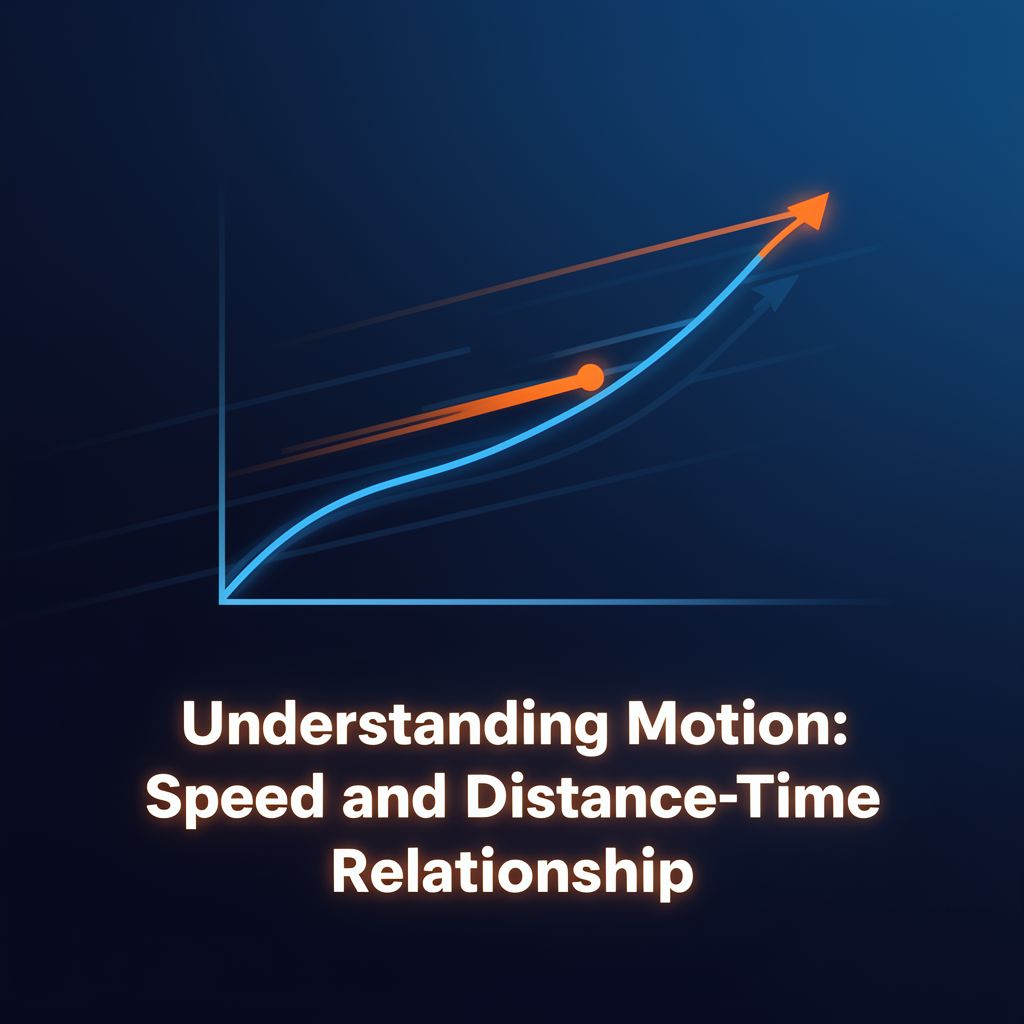
This study material is compiled from a lecture audio transcript on the topic of motion, speed, and distance-time relationships.
📚 Understanding Motion: Speed and Distance-Time Graphs
🚀 Introduction to Kinematics
Welcome to this study guide on the fundamental concepts of motion! In physics, understanding how objects move is crucial for comprehending the world around us. This guide will introduce you to the core ideas of motion, how we quantify it using speed, and how graphical representations, specifically distance-time graphs, provide powerful insights into an object's journey. These principles form the basis of kinematics, the branch of classical mechanics that describes motion without considering the forces causing it.
1️⃣ Defining Motion
Motion is a fundamental concept in physics, describing how an object changes its position.
- 📚 Definition: Motion is defined as a change in the position of an object over time.
- ✅ Key Concept: For an object to be considered in motion, its location must be different at one moment compared to another.
- 💡 Reference Frame: Motion is always relative to a reference point or reference frame. Without a fixed point of reference, describing motion can be ambiguous.
- Example: If you are sitting on a train, you are stationary relative to the train car. However, you are in motion relative to the ground outside the train.
2️⃣ Understanding Speed
Speed quantifies how fast an object is moving. It tells us the rate at which an object covers distance.
- 📚 Definition: Speed is a scalar quantity that refers to how fast an object is moving. It is the rate at which an object covers distance.
- Scalar Quantity: A quantity that has magnitude (size) but no direction.
- Formula: Speed is calculated by dividing the total distance traveled by the time it took to cover that distance. $$ \text{Speed} = \frac{\text{Distance}}{\text{Time}} $$
- Example: If an object travels 100 meters in 10 seconds, its average speed is: $$ \text{Speed} = \frac{100 \text{ m}}{10 \text{ s}} = 10 \text{ m/s} $$
- Types of Speed:
- ✅ Average Speed: Considers the total distance covered over the total time taken for the entire journey.
- ✅ Instantaneous Speed: Refers to the speed of an object at a specific moment in time.
- Example: Your car's speedometer shows your instantaneous speed at any given moment.
3️⃣ Analyzing Motion: Distance-Time Graphs
Distance-time graphs are powerful visual tools used to represent and analyze an object's motion. They plot the distance an object has traveled against the time elapsed.
-
📊 Graph Setup:
- Y-axis: Represents the distance traveled.
- X-axis: Represents the time elapsed.
-
💡 Interpreting the Slope: The slope (gradient) of a distance-time graph directly represents the speed of the object.
- A steeper slope indicates a greater speed.
- A flatter slope indicates a slower speed.
-
Key Interpretations of Graph Shapes:
-
Horizontal Line (Zero Slope):
- Description: The distance does not change over time.
- Meaning: The object is stationary (at rest).
- Speed: Speed is zero.
- Example: A car parked by the side of the road.
-
Straight Line Sloping Upwards (Constant Positive Slope):
- Description: Distance increases uniformly with time.
- Meaning: The object is moving at a constant speed.
- Speed: The speed is constant and non-zero. The steeper the line, the faster the constant speed.
- Example: A person walking at a steady pace.
-
Curved Line:
- Description: The slope of the line is changing, meaning the speed is not constant.
- Meaning: The object's speed is changing (it is accelerating or decelerating).
- Types of Curves:
- 📈 Upward Curve (Becoming Steeper): The slope is increasing, indicating that the object is accelerating (speed is increasing).
- Example: A car speeding up from a stop.
- 📉 Curve Flattening Out: The slope is decreasing, indicating that the object is decelerating (speed is decreasing).
- Example: A car slowing down as it approaches a stop sign.
- 📈 Upward Curve (Becoming Steeper): The slope is increasing, indicating that the object is accelerating (speed is increasing).
-
-
✅ Benefits of Distance-Time Graphs:
- Provide a visual summary of an object's journey.
- Allow for quick interpretation of complex movements.
- Help predict future positions and understand past movements.
- Enable efficient comparison of the motion of different objects.
📝 Conclusion
This study guide has covered the foundational concepts of motion, speed, and their representation through distance-time graphs.
- ✅ Motion is a change in position relative to a reference point.
- ✅ Speed is the rate at which an object covers distance, calculated as Distance / Time. It can be average or instantaneous.
- ✅ Distance-time graphs are essential tools where the slope indicates speed:
- Horizontal line = no motion.
- Straight upward line = constant speed.
- Curved line = changing speed (acceleration or deceleration).
Mastering these basic principles provides a robust framework for understanding more advanced topics in physics, such as velocity, acceleration, and Newton's laws of motion.