 Podit
Podit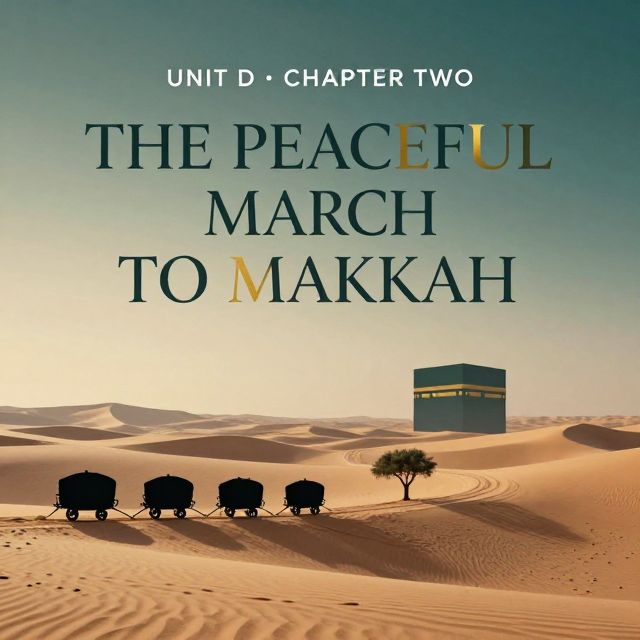
Flash Kartlar
25 kartKarta tıklayarak çevir. ← → ile gez, ⎵ ile çevir.
Tüm kartları metin olarak gör
1. What was the political status of Makkah six years after the Prophet Muhammad's Hijrah?
Six years after the Hijrah, Makkah remained under the control of the pagan tribe of Quraysh. Despite this, Islam continued to flourish outside Makkah, and the Quraysh had suffered defeats in battles like Badr and Al-Khandaq against the Muslims.
2. Name the four Sacred Months (Al-Ash-hur-ul-Hurum) mentioned in ancient Arab custom.
The four Sacred Months are Thul-Qi'dah, Thul-Hijjah, Muharram, and Rajab. During these months, fighting was strictly prohibited, and they were designated to ensure safe passage for people visiting Makkah without fear of violence.
3. What was the primary purpose of the Sacred Months according to ancient Arab custom?
The primary purpose was to ensure safe passage for people visiting Al-Masjid-ul-Haram in Makkah. During these months, fighting was strictly forbidden, allowing individuals to travel and perform religious rites without the threat of attack or violence.
4. Describe the vision Prophet Muhammad received in the month of Shawwal, six years after the Hijrah.
Prophet Muhammad had a profound dream where he saw himself entering Makkah, performing the Hajj pilgrimage, shaving his head, and sacrificing animals in the name of Allah. Crucially, this vision depicted these actions occurring without any conflict or fighting.
5. How did Prophet Muhammad interpret his vision of entering Makkah?
The Prophet understood his dream to be a divine message that must be fulfilled. He knew that the dreams of prophets are known to come true, indicating that this peaceful entry into Makkah for pilgrimage was Allah's will and would eventually materialize.
6. What preparations did Prophet Muhammad make after receiving his vision?
Following his vision, Prophet Muhammad immediately began preparations for a pilgrimage to Makkah. He encouraged his companions to join him, emphasizing that the journey would be peaceful and not involve fighting, instructing them to carry only traveler's swords for protection.
7. What type of weapons did the Prophet instruct his companions to carry for the journey to Makkah, and why?
The Prophet instructed his companions to carry only their traveler's swords. These were intended for protection against potential threats like pirates and wild animals during their journey, explicitly not for combat against the Quraysh or any other human adversaries.
8. What was Prophet Muhammad's true objective in undertaking the peaceful journey to Makkah?
The Messenger of Allah's true objective was to find a peaceful resolution to the ongoing conflict between Muslims and pagans. He hoped the Quraysh and other Arabian pagans would embrace Islam peacefully, countering their warmongering with a spirit of peace and reconciliation.
9. How many Muslims accompanied the Prophet on his journey to Makkah in Thul-Qi'dah of the 6th year after Hijrah, and what did they bring to signify their intention?
Approximately 1,400 Muhajireen and Ansar accompanied the Prophet. They brought about seventy camels as 'hadiy' (sacrificial animals) to clearly signify their intention for pilgrimage (Umrah), rather than warfare.
10. How did the pagan Quraysh react to the Prophet's peaceful expedition towards Makkah?
The pagan Quraysh reacted with hostility, preparing to prevent the peaceful party from performing Umrah. They mobilized their forces to oppose and fight the expedition, breaching ancient Arab traditions that allowed unarmed visitors during Sacred Months.
11. Who was leading the Quraysh cavalry that intended to prevent the Prophet's entry into Makkah?
Khalid Ibn-ul-Walid was leading the Quraysh cavalry. The Prophet was informed of this at 'Asfan, where the Quraysh had mobilized for a long war, swearing he would never enter Makkah.
12. What was Prophet Muhammad's exclamation upon learning of the Quraysh's mobilization?
Angrily, the Prophet exclaimed, 'Woe unto Quraysh! The war had eaten them up. What harm would there be if they let me and the Arabs meet freely?' He also vowed to continue his struggle for Allah's path until victory or advancement.
13. What alternative route did the Prophet take to avoid direct confrontation with the Quraysh?
To avoid direct confrontation, the Prophet sought an alternative, rugged route along the Red Sea coast. This difficult journey eventually led them to Al-Hudaybiyah, bypassing the main path where the Quraysh forces were positioned.
14. Where did the Prophet's camel halt, and what explanation did he give for it?
The Prophet's camel halted at Al-Hudaybiyah, which is fifteen miles northwest of Makkah. He explained that a divine power, similar to what prevented Abrahah's elephant from entering Makkah, had stopped his camel, indicating Allah's will.
15. Who was Budayl Ibn Warqa', and what role did he play in the events at Al-Hudaybiyah?
Budayl Ibn Warqa' was a tribal leader who approached the Prophet to inquire about his intentions. He offered to mediate between the Muslims and the Quraysh, reporting back that the Quraysh were determined to fight and prevent entry into Makkah, despite the Prophet's peaceful affirmations.
16. What message did Khurash Ibn Umayyah convey to the Makkans, and how did they respond?
Khurash Ibn Umayyah, from the Khuza'ah tribe, explained to the Makkans that Prophet Muhammad had come solely for worship during the sacred months. However, the Quraysh rebuked Khurash, refusing entry to the Muslims and asserting they would not allow themselves to be perceived as weak.
17. Who was Urwah Ibn Masoud Al-Thaqafy, and what was his role as an emissary?
Urwah Ibn Masoud Al-Thaqafy was an emissary sent by the Quraysh to the Prophet. During his conversation, he confronted the Prophet, accusing him of gathering a 'mob' to destroy his own tribe, attempting to gauge the Muslims' resolve.
18. What observation did Urwah Ibn Masoud Al-Thaqafy report back to the Quraysh about the Prophet's companions?
Urwah reported to the Quraysh the profound love, reverence, and protection the companions showed Prophet Muhammad. He stated he had never witnessed such loyalty even among the greatest kings, highlighting the deep devotion of the Muslims to their leader.
19. Who did Prophet Muhammad dispatch as his emissary to the Quraysh after Urwah's visit?
The Prophet dispatched Uthman Ibn Affan as his emissary to the Quraysh. Uthman's mission was to convey the Prophet's message and reiterate the intention to perform Umrah before returning to Madinah.
20. What offer did the Quraysh make to Uthman Ibn Affan when he was their hostage, and how did he respond?
The Quraysh offered Uthman the chance to perform Tawaf (circumambulation of the Kaaba) by himself. Uthman refused, stating he would not do so until the Prophet Muhammad had performed it, demonstrating his loyalty and solidarity with the Muslim community.
21. Why did the Muslims fear for Uthman Ibn Affan's safety after he was sent as an emissary?
The Muslims feared that Uthman had been killed or harmed because the Quraysh held him hostage after he refused their offer to perform Tawaf alone. This prolonged absence and lack of communication caused significant concern among the companions.
22. What was Uthman Ibn Affan's relationship to Prophet Muhammad, besides being a companion?
Uthman Ibn Affan was Prophet Muhammad's cousin and also his son-in-law, having married two of the Prophet's daughters, Ruqayyah and later Umm Kulthoom. This familial connection further deepened the Prophet's affection and concern for him.
23. What declaration did Prophet Muhammad make upon hearing the news that Uthman might have been killed or captured?
Upon hearing the alarming news, Prophet Muhammad declared, 'We will not leave this place until we have accomplished our objective, even if we have to fight these people.' This statement underscored his resolve and commitment to their mission.
24. What is the Arabic name for 'The Pledge of Allah's Pleasure'?
The Arabic name for 'The Pledge of Allah's Pleasure' is Bay'at-ur-Ridwan. This momentous oath was taken by the Muslims under a tree, signifying their unwavering allegiance and commitment to Allah and His Prophet.
25. How many Muslims participated in the Pledge of Ar-Ridwan?
All fourteen hundred Muslims who were with the Prophet at Al-Hudaybiyah participated in the Pledge of Ar-Ridwan. They gathered under a tree to offer their sincere allegiance, vowing obedience even in matters of life and death.
Bilgini Test Et
15 soruÇoktan seçmeli sorularla öğrendiklerini ölç. Cevap + açıklama.
What was the primary reason for the Prophet Muhammad's journey to Makkah six years after the Hijrah, as described in the text?