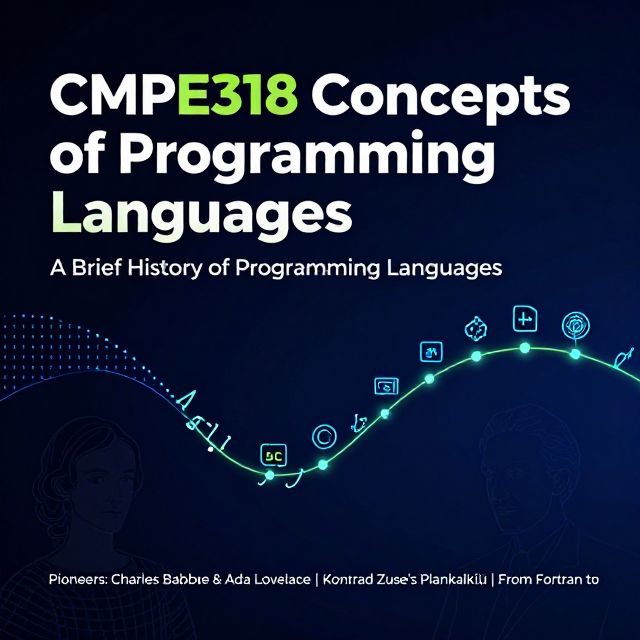
A Brief History of Programming Languages - kapak
Teknoloji#programming languages#history of programming#computer science#fortran

A Brief History of Programming Languages

Explore the evolution of programming languages from early pioneers and low-level systems to modern high-level and object-oriented paradigms, covering key innovations and their impact.

cinepApril 20, 2026 ~15 dk toplam
01

Flash Kartlar

25 kart

Karta tıklayarak çevir. ← → ile gez, ⎵ ile çevir.

1 / 25
Tüm kartları metin olarak gör
  1. 1. Who is recognized as the first programmer in history and what was her contribution?

    Ada Augusta Lovelace is widely recognized as the first programmer. She collaborated with Charles Babbage on his Analytical Engine, and her notes included what is considered the first algorithm intended to be carried out by a machine, laying foundational concepts for programming.

  2. 2. What was Charles Babbage's significant invention that laid groundwork for computing?

    Charles Babbage invented the Analytical Engine. This mechanical general-purpose computer design, though never fully built in his lifetime, incorporated many features of modern computers, including an arithmetic logic unit, control flow, and integrated memory, making it a crucial precursor to modern computing.

  3. 3. What was Plankalkül and who designed it?

    Plankalkül was a notation designed by Konrad Zuse. Although it was never implemented, it featured advanced concepts found in many contemporary programming languages, demonstrating early foresight into programming language design principles.

  4. 4. Describe the characteristics of machine languages.

    Machine languages are very low-level, machine-dependent coding systems. They were initially entirely binary and are specific to a particular processor model. A significant challenge with them is upward compatibility, making code migration between different processor architectures extremely difficult.

  5. 5. How do assembly languages relate to machine languages, and what is a key challenge for both?

    Assembly languages are also very low-level and machine-dependent, serving as symbolic representations of machine languages. Typically, there's one assembly language per processor model. A key challenge for both is upward compatibility, as moving code between different processor architectures is often very difficult.

  6. 6. What is the primary challenge associated with upward compatibility when using very low-level languages?

    The primary challenge is that code written for one processor architecture is extremely difficult to port or move to a significantly different version or new processor architecture. This means programs often need to be rewritten or heavily modified to run on different hardware, hindering long-term software viability.

  7. 7. Which language is considered the first effectively implemented high-level language, and what fundamental concepts did it introduce?

    Fortran is recognized as the first effectively implemented high-level language. It introduced fundamental concepts such as variables, loops, procedures, and statement labels, which are now standard in programming.

  8. 8. What were some unique features of early Fortran versions, and where is it still widely used today?

    Early Fortran versions had unique, often awkward features, many retained for compatibility. It remains widely used in engineering applications, particularly those requiring extensive array manipulation, due to its efficiency in numerical computation.

  9. 9. What significant milestones did Algol 60 achieve in programming language history?

    Algol 60 was the first language to feature block structure, recursion, and a formal definition. Although not used today, its design is considered arguably the most important innovation in programming language history, serving as the ancestor of most contemporary languages.

  10. 10. For what purpose was Cobol designed, and what notable data structure did it introduce?

    Cobol was designed specifically for business-oriented computations. It introduced elaborate data structures, including the record type, for the first time. Despite having poor control structures, it was once very popular in business and government sectors.

  11. 11. What was the ambition behind PL/I, and what significant feature did it introduce?

    PL/I was an ambitious attempt to combine the best features of Fortran, Algol 60, and Cobol. It was the first language designed to be completely general-purpose, suitable for all possible applications, and notably introduced event handling.

  12. 12. Why was Basic significant in the early days of personal computing?

    Basic emerged as the first language for personal computing, designed to be easy to learn. It served as the first programming language for many individuals, despite being simple and limited, making programming accessible to a wider audience.

  13. 13. How has Basic evolved from its original design for personal computing?

    While originally simple and limited, designed for ease of learning, modern versions of Basic have evolved significantly. They are now full-fledged languages, far from their 'basic' origins, offering advanced features and no longer as simple to learn as their predecessors.

  14. 14. What key object-oriented concepts did Simula 67 introduce, and what was its primary design purpose?

    Simula 67, an extension of Algol 60, was designed for simulating concurrent processes. It crucially introduced the central concepts of object orientation: classes and encapsulation, making it a direct predecessor to languages like Smalltalk and C++.

  15. 15. What made Algol 68 difficult to implement and grasp, despite its elegant design?

    Algol 68 featured a very elegant design and full orthogonality, a concept unmatched even today. However, its implementation proved extremely difficult, and its clever formal description was hard for most potential users to grasp, leading to its complete disuse.

  16. 16. What was Pascal's primary role in programming education, and what did it foster?

    Pascal, a simplified successor of Algol 60, became a great language for teaching structured programming. It was an excellent first language, fostering good programming habits among students due to its clear and disciplined structure.

  17. 17. What significant capability did Modula-2 introduce as a successor to Pascal?

    Modula-2, a conceptually uniform successor to Pascal, introduced mechanisms for programming concurrency. This allowed for many processes to run in parallel, addressing the need for more complex, multi-threaded applications, though it didn't achieve widespread use.

  18. 18. What was Ada's primary design goal, especially concerning concurrency?

    Ada was designed to be a more successful attempt at generality than PL/I, specifically created to support concurrency in a neat and systematic way. It resulted from an elaborate, multi-stage design process, aiming for robust and reliable systems.

  19. 19. For what type of programming is C particularly well-suited, and what is a caution for novice programmers?

    C is a great tool for systems programming and software development on personal computers, being the implementation language of Unix. However, it is a powerful but relatively low-level language, not recommended for novice programmers due to its potential for dangerous misuse if not handled properly.

  20. 20. What is Lisp's foundational principle, and for what field was it primarily used for many years?

    Lisp is based on computing by evaluating functions, making it very good for symbolic computing. For many years, it was the primary language for Artificial Intelligence work, predating Prolog by twelve years, and is known for its nice programming environments.

  21. 21. Describe Prolog as a programming language, highlighting its key features.

    Prolog is a very high-level declarative programming language based on a subset of logic, where proofs are interpreted as computation. It is powerful, featuring non-determinism with built-in backtracking, elaborate and flexible pattern matching, associative memory, and pattern-directed procedure invocation.

  22. 22. Why is Smalltalk considered a "pure" object-oriented language?

    Smalltalk is considered the purest object-oriented language ever designed because its entire environment, including its graphical interface and integrated programming environment, is built around the object-oriented paradigm, making it more consistent than languages like Java or C++.

  23. 23. How does C++ relate to C, and what is its design approach?

    C++ emerged as an object-oriented extension of the imperative language C. It represents a hybrid design, integrating object orientation into a fundamentally different base language, resulting in a powerful but often complex language with a complicated syntax and difficult semantics.

  24. 24. How is Java often described in relation to C++, and what was its initial design purpose?

    Java is often described as a neat, cleaned-up, and sized-down reworking of C++. It offers full object orientation, though perhaps not as consistently as Smalltalk. It was designed initially for Internet programming but has evolved into a general-purpose language.

  25. 25. What is a common misconception about Java's performance?

    A common misconception about Java is that it is inherently slow. While early versions might have had performance challenges, modern Java Virtual Machines (JVMs) and just-in-time (JIT) compilation have made Java highly performant, dispelling this myth.

02

Bilgini Test Et

15 soru

Çoktan seçmeli sorularla öğrendiklerini ölç. Cevap + açıklama.

Soru 1 / 15Skor: 0

Who is widely recognized as the first programmer in history?

03

Detaylı Özet

5 dk okuma

Tüm konuyu derinlemesine, başlık başlık.

📚 CMPE318: Concepts of Programming Languages - A Brief History

Source Information: This study material has been compiled from a lecture audio transcript and copy-pasted text provided by the user.


🚀 Introduction to Programming Language Evolution

This study guide explores the fascinating journey of programming languages, from their foundational concepts to modern paradigms. We will trace the key innovations, influential figures, and significant languages that have shaped the field of computer science. Understanding this history provides crucial context for appreciating the design principles and trade-offs in contemporary programming.


1️⃣ Pioneers and Foundational Concepts

The genesis of programming languages lies with visionary individuals who laid the theoretical and mechanical groundwork for computing.

  • Charles Babbage 💡: Invented the Analytical Engine, a design for a mechanical general-purpose computer.
  • Ada Augusta Lovelace 👩‍💻: Collaborated with Babbage and is widely recognized as the first programmer in history for her work on algorithms intended for the Analytical Engine.
  • Konrad Zuse ✍️: Designed Plankalkül, a notation that, despite never being fully implemented, introduced features found in many modern programming languages, showcasing forward-thinking design.

2️⃣ Very Low-Level Languages

The earliest forms of programming involved direct interaction with machine hardware.

  • Machine Languages 💻:
    • These are the native languages of a computer's processor.
    • Initially fully binary, consisting of sequences of 0s and 1s.
    • Later evolved to symbolic representations.
    • Machine-dependent: Each processor model has its unique machine language.
  • Assembly Languages ⚙️:
    • A symbolic representation of machine language instructions.
    • Typically, there is one assembly language per processor model.
    • Challenge: Upward compatibility is a significant issue; moving code between different processor architectures is a difficult task.

3️⃣ The Dawn of High-Level Languages

The development of high-level languages marked a revolutionary step, abstracting away machine-specific details and making programming more accessible.

  • Fortran (FORmula TRANslation) 📊:
    • The first effectively implemented high-level language.
    • Introduced fundamental concepts like variables, loops, procedures, and statement labels as we know them today.
    • Early versions had unique, sometimes awkward features, many retained for compatibility.
    • Current Use: Still widely used in engineering applications requiring extensive array manipulation.
    • Evolution: Fortran 90 converged towards features found in other popular languages.
  • Algol 60 (ALGOrithmic Language) 🌳:
    • A landmark language, considered the ancestor of most contemporary languages.
    • Key Innovations:
      • First to feature block structure.
      • First to support recursion.
      • First to have a formal definition.
    • Impact: Its design is arguably the most important innovation in programming language history. Not used today, but its influence is pervasive.
  • Cobol (COmmon Business-Oriented Language) 🏢:
    • Designed specifically for business-oriented computations.
    • Characteristics:
      • Very strict program organization.
      • Poor control structures.
      • Introduced elaborate data structures, including the record type, for the first time.
    • Historical Popularity: Very popular in business and government sectors.
  • PL/I (Programming Language One) 🧩:
    • An ambitious attempt to combine the best features of Fortran, Algol 60, and Cobol.
    • Goal: The first language designed to be completely general-purpose, suitable for all applications.
    • Notable Feature: Introduced event handling.
    • Status: Not widely used today.
  • Basic (Beginner's All-purpose Symbolic Instruction Code) 🧑‍💻:
    • The first language for personal computing.
    • Designed to be easy to learn, serving as the first programming language for many.
    • Initially simple and limited, yet general-purpose.
    • Modern Versions: Contemporary versions are full-fledged languages, far from their 'basic' origins and no longer as simple to learn.

4️⃣ Advanced Language Design and Paradigms

This era saw the introduction of more sophisticated design principles and new programming paradigms.

  • Simula 67 🧬:
    • An extension of Algol 60, designed for simulating concurrent processes.
    • Pioneering Role: Introduced the central concepts of object orientation: classes and encapsulation.
    • Legacy: Direct predecessor to languages like Smalltalk and C++. Now unused, but its conceptual impact was immense.
  • Algol 68 ✨:
    • Featured a very elegant design with full orthogonality (concepts are independent and can be combined freely).
    • Challenges: Extremely difficult to implement, and its clever formal description was hard for most users to understand.
    • Status: Completely unused.
  • Pascal 🍎:
    • A conceptually simplified and cleaned-up successor of Algol 60.
    • Educational Value: Excellent for teaching structured programming and fostering good programming habits as a first language.
    • Extensions: Later extensions (e.g., Delphi) evolved into powerful systems programming packages.
  • Modula-2 🔄:
    • A better, conceptually uniform successor to Pascal.
    • Introduced mechanisms for programming concurrency (many processes running in parallel).
    • Not as widely used as its merits suggest.
  • Ada 🛡️:
    • Resulted from an elaborate, multi-stage design process.
    • A more successful attempt at generality than PL/I.
    • Specifically designed to support concurrency in a neat and systematic way.
  • C 🛠️:
    • The implementation language of Unix.
    • A powerful tool for systems programming and software development on personal computers.
    • Characteristics: Relatively low-level, offering fine-grained control.
    • Caution ⚠️: Dangerous if not used properly; not recommended for novice programmers. Often superseded by C++.
  • Lisp (LISt Processing) 🧠:
    • One of the earliest programming languages.
    • Based on the concept of computing by evaluating functions.
    • Excellent for symbolic computing.
    • AI Dominance: For years, the primary language for Artificial Intelligence work.
    • Variations: Many dialects exist, with Scheme and Common Lisp being two standards. Known for nice programming environments.
  • Prolog (PROgramming in LOGic) 🧠:
    • A very high-level, declarative programming language.
    • Based on a subset of logic, where proofs are interpreted as computation.
    • Powerful Features:
      • Non-deterministic (built-in backtracking).
      • Elaborate, flexible pattern matching.
      • Associative memory.
      • Pattern-directed procedure invocation.
    • A strong tool in skilled hands.

5️⃣ Modern and Influential Languages

The evolution continues with languages that refined existing paradigms and introduced new approaches for specific domains.

  • Smalltalk 💎:
    • Considered the purest object-oriented language ever designed, even cleaner than Java and C++.
    • Comes complete with a graphical interface and an integrated programming environment.
    • A powerful tool in skilled hands.
  • C++ 📈:
    • An object-oriented extension of the imperative language C.
    • Design: A hybrid design, integrating object orientation into a fundamentally different base language.
    • Complexity: Known for its complicated syntax and difficult semantics.
    • Popularity: Very fashionable and highly in demand, having not yet been displaced by Java.
  • Java 🌐:
    • Often described as a neat, cleaned-up, and sized-down reworking of C++.
    • Offers full object orientation, though perhaps not as consistently as Smalltalk.
    • Initial Design: Designed for Internet programming, but evolved into a general-purpose language.
    • Performance: Despite common misconceptions, it is not inherently slow.
  • Scripting Languages 📝:
    • A category of languages designed for automating tasks and specialized applications.
    • Text Processing:
      • Perl
      • Python (also widely used for general-purpose programming, data science, AI)
    • Web Programming:
      • JavaScript (client-side and server-side with Node.js)
      • PHP (server-side)

Kendi çalışma materyalini oluştur

PDF, YouTube videosu veya herhangi bir konuyu dakikalar içinde podcast, özet, flash kart ve quiz'e dönüştür. 1.000.000+ kullanıcı tercih ediyor.

Sıradaki Konular

Tümünü keşfet
Understanding Data Types in Programming Languages

Understanding Data Types in Programming Languages

Explore the fundamental concepts of data types, including primitive types, character strings, arrays, and associative arrays, and their implementation in programming.

Özet 25 15
Programming Language Data Types and Memory Management

Programming Language Data Types and Memory Management

An in-depth look into record types, tuples, unions, pointers, references, heap allocation, garbage collection, and type checking in programming languages.

Özet 25 15
Names, Bindings, and Scopes in Programming Languages

Names, Bindings, and Scopes in Programming Languages

Explore fundamental concepts of names, variables, binding, scope, and named constants in programming languages, crucial for understanding program execution and design.

Özet 25 15
Syntax Analysis and Parsing Techniques

Syntax Analysis and Parsing Techniques

Explore the fundamentals of syntax analysis, lexical analysis, and different parsing approaches, including LL and the widely used LR parsers.

Özet 25 15
Lexical and Syntax Analysis in Language Processors

Lexical and Syntax Analysis in Language Processors

Explore the fundamental stages of language implementation: lexical analysis (scanning) and syntax analysis (parsing), their roles, and theoretical underpinnings.

Özet 25 15
Programming Language Semantics and Attribute Grammars

Programming Language Semantics and Attribute Grammars

This podcast explores attribute grammars for language definition and delves into three primary methods for describing programming language semantics: operational, denotational, and axiomatic semantics.

Özet 25 15
Describing Programming Language Syntax and Semantics

Describing Programming Language Syntax and Semantics

Explore the fundamental concepts of syntax and semantics in programming languages, from formal definitions and BNF to ambiguity and static semantics.

Özet 25 15
Understanding Pseudocode, Algorithms, and Data Integrity

Understanding Pseudocode, Algorithms, and Data Integrity

Explore the fundamentals of pseudocode, including assignment, conditional, and iteration statements, alongside essential algorithm design methods, data validation, and testing techniques for robust software development.

Özet 25