 Podit
Podit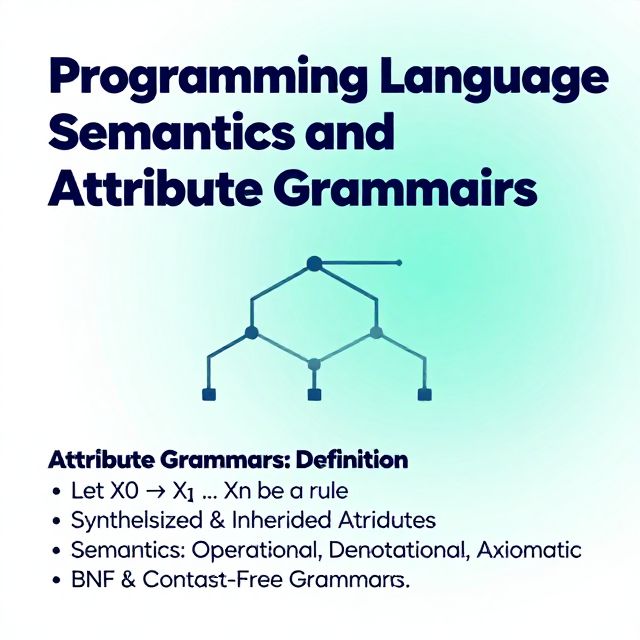
This study material has been compiled from a lecture audio transcript and copy-pasted text provided by the user.
📚 Programming Language Semantics and Attribute Grammars
This study guide explores the fundamental concepts of programming language semantics and attribute grammars, crucial for understanding how programming languages are defined, interpreted, and verified.
1. 📝 Attribute Grammars
Attribute grammars are a formal mechanism that extends context-free grammars to describe both the syntax and static semantics of a programming language. They associate attributes with grammar symbols and define rules for computing their values.
1.1. Definition of Attributes
When a grammar rule is defined as $X_0 \rightarrow X_1 \dots X_n$, attributes are categorized as follows:
- Synthesized Attributes ✅:
- Defined by functions of the form $S(X_0) = f(A(X_1), \dots, A(X_n))$.
- Computed from the attributes of the rule's children.
- Information flows up the parse tree.
- Inherited Attributes ✅:
- Defined by functions of the form $I(X_j) = f(A(X_0), \dots, A(X_n))$, for $1 \le j \le n$.
- Computed from the attributes of the parent or siblings.
- Information flows down or across the parse tree.
- Intrinsic Attributes 💡:
- Initially present on the leaves of the parse tree.
- Provide base values for attribute computations.
1.2. Attribute Grammar Example
Consider a simplified syntax for assignment and expressions:
-
Syntax Rules:
<stmt> <assign> | <if_stmt> | <while_stmt> | \dots<assign> id = <expr><expr> <expr> + <var> | <var><var> id
-
Attribute Types:
actual_type: Synthesized for<var>and<expr>(e.g., the actual data type of a variable or expression).expected_type: Inherited for<expr>(e.g., the type the context expects the expression to be).
-
Semantic Rules & Predicates:
- Syntax rule:
<assign> id = <expr>- Semantic rule:
<expr>.expected_type \leftarrow lookupType(id.index)- Explanation: The expected type of the expression on the right-hand side is inherited from the type of the identifier on the left-hand side, obtained via a
lookupTypefunction.
- Explanation: The expected type of the expression on the right-hand side is inherited from the type of the identifier on the left-hand side, obtained via a
- Semantic rule:
- Syntax rule:
<expr> <expr>[0] + <var>(using[0]for the left expr,[1]for the right expr in the original text, here simplified toexprandvar)- Semantic rules:
<expr>.actual_type \leftarrow <var>.actual_type<expr>.expected_type \leftarrow <expr>.expected_type(from parent)
- Predicates:
<var>.actual_type == <expr>.actual_type(Ensures type compatibility for addition)<expr>.expected_type == <expr>.actual_type(Ensures the resulting expression's actual type matches what's expected)
- Semantic rules:
- Syntax rule:
<expr> <var>- Semantic rule:
<expr>.actual_type \leftarrow <var>.actual_type - Predicate:
<expr>.expected_type == <expr>.actual_type
- Semantic rule:
- Syntax rule:
<var> id- Semantic rule:
<var>.actual_type \leftarrow lookup_type(id.index)
- Semantic rule:
- Syntax rule:
1.3. Attribute Value Computation
The order of attribute computation depends on their type:
- If all attributes are inherited, the parse tree can be decorated in a top-down order.
- If all attributes are synthesized, the parse tree can be decorated in a bottom-up order.
- In most practical cases, both types are used, requiring a combination of top-down and bottom-up evaluation strategies.
2. 🌍 Programming Language Semantics
Semantics defines the meaning of programming language constructs. Unlike syntax, there isn't a single universally accepted formalism for describing semantics.
2.1. Needs for Semantic Description
A robust methodology for semantics is crucial for several reasons:
- Programmer Understanding 🧑💻: To know what statements mean.
- Compiler Implementation ⚙️: Compiler writers need precise understanding of language constructs.
- Correctness Proofs ✅: Enables formal verification of programs.
- Compiler Generation 🤖: Facilitates automated compiler creation.
- Language Design 🎨: Helps designers detect ambiguities and inconsistencies.
2.2. Operational Semantics
Operational semantics describes the meaning of a program by simulating its execution on a machine.
- Definition 📚: Defines the meaning of a program by executing its statements on a machine (simulated or actual). The change in the machine's state (memory, registers, etc.) defines the meaning of the statement. It describes how a valid program is interpreted as sequences of computational steps.
- Process 1️⃣2️⃣3️⃣:
- Build a translator (source code to idealized machine code).
- Build a simulator for the idealized computer.
- A virtual machine is often needed for high-level languages.
- Levels of Use:
- Natural Operational Semantics (Big-Step Semantics): Describes how the overall results of program executions are obtained.
- Structural Operational Semantics (Small-Step Semantics): Formally details the individual steps of a computation.
2.3. Denotational Semantics
Denotational semantics is the most abstract method, based on recursive function theory.
- Definition 📚: Based on recursive function theory, it's the most abstract semantics description method.
- Process 1️⃣2️⃣:
- Define a mathematical object for each language entity.
- Define a function that maps instances of language entities onto instances of corresponding mathematical objects.
- Evaluation 📈:
- Can be used to prove program correctness.
- Provides a rigorous way to think about programs.
- Aids in language design.
- Used in compiler generation systems.
- ⚠️ Complexity: Due to its abstract nature, it is often of little practical use to language users.
2.4. Axiomatic Semantics
Axiomatic semantics is based on formal logic and primarily used for program verification.
-
Definition 📚: Based on formal logic (predicate calculus). Its original purpose was formal program verification.
-
Key Concepts:
- Assertions: Logic expressions describing relationships and constraints among variables.
- Precondition (P): An assertion before a statement, true at that point in execution.
- Postcondition (Q): An assertion following a statement.
- Weakest Precondition: The least restrictive precondition that guarantees the postcondition.
-
Form:
{P} statement {Q}- Example: For
a = b + 1to result in{a > 1}:- A possible precondition:
{b > 10} - The weakest precondition:
{b > 0}
- A possible precondition:
- Example: For
-
Program Proof Process 💡:
- Start with the desired postcondition for the entire program.
- Work backward through the program to the first statement.
- If the derived precondition for the first statement matches the program's specification, the program is considered correct.
-
Axioms and Inference Rules:
- Assignment (x = E):
{Q_{x \rightarrow E}} x = E {Q}- Example:
{(x > 3)_{x \rightarrow 5}} x = 5 {x > 3}simplifies to{5 > 3}which is{True}.
- Example:
- Sequences (S1; S2):
{P1} S1 {P2}{P2} S2 {P3}-----------------{P1} S1; S2 {P3} - Selection (if B then S1 else S2):
{B and P} S1 {Q}, {(not B) and P} S2 {Q}------------------------------------------{P} if B then S1 else S2 {Q} - Loops (while B do S end):
{I and B} S {I}----------------------------------{I} while B do S end {I and (not B)}- Where
Iis the loop invariant.
- Where
- Assignment (x = E):
-
Loop Invariant (I) ⚠️:
- A weakened version of the loop postcondition, also acting as a precondition.
- Must meet these conditions:
P => I: True initially.{I} B {I}: Evaluation of BooleanBmust not changeI's validity.{I and B} S {I}:Iis not changed by executing the loop bodyS.(I and (not B)) => Q: IfIis true andBis false (loop terminates),Qis implied.- Termination: The loop must terminate (can be difficult to prove).
- Must be weak enough to be satisfied before the loop, but strong enough with the exit condition to force the postcondition.
-
Evaluation 📈:
- Developing axioms for all statements is difficult.
- Excellent tool for correctness proofs and reasoning about programs.
- Limited usefulness for language users and compiler writers.
3. 📊 Comparison: Denotational vs. Operational Semantics
- Operational Semantics: State changes are defined by coded algorithms (how a machine executes steps).
- Denotational Semantics: State changes are defined by rigorous mathematical functions (what the program computes).
4. ✨ Summary
- BNF and Context-Free Grammars are meta-languages well-suited for describing programming language syntax.
- Attribute Grammars are a descriptive formalism for both syntax and static semantics.
- The three primary methods for semantics description are Operational, Axiomatic, and Denotational semantics.