Podit
Podit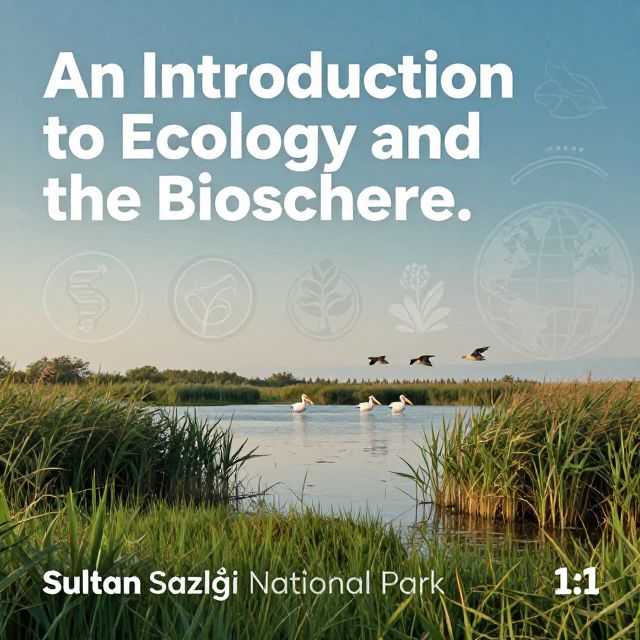
This study material is compiled from a copy-pasted text and a lecture audio transcript on "An Introduction to Ecology and the Biosphere."
📚 An Introduction to Ecology and the Biosphere
🌍 Overview of Ecology
Ecology is the scientific study of the interactions between organisms and their environment. These interactions are fundamental in determining the distribution and abundance of organisms across the planet. Wetlands, for instance, are highly diverse and productive ecosystems, second only to tropical rainforests, providing crucial habitats and playing vital roles in ecological cycles like flood control and groundwater recharge. Türkiye is home to 86 internationally important wetlands, including Sultan Sazlığı National Park in Kayseri, notable for its unique coexistence of freshwater and saline ecosystems, supporting a rich diversity of bird species.
🔬 The Scope of Ecology
Ecologists study life at various hierarchical levels, from individual organisms to the entire planet:
- Organismal Ecology: Focuses on how an organism's structure, physiology, and behavior help it meet environmental challenges.
- Population Ecology: Examines factors affecting the number of individuals of a single species in a specific area.
- Community Ecology: Deals with the entire array of interacting species within a given area.
- Ecosystem Ecology: Emphasizes energy flow and chemical cycling among the biotic (living) and abiotic (non-living) components of a community and its physical environment.
- Landscape Ecology: Studies mosaics of connected ecosystems and their arrangement in a geographic region.
- Global Ecology (Biosphere): Examines the influence of energy and materials on organisms across the entire global ecosystem.
🌿 Ecosystem Components: Biotic and Abiotic Factors
An ecosystem is defined as the community of organisms in an area and the physical factors with which they interact. The distribution of species is limited by two main types of factors:
- ✅ Biotic Factors: Living components of an ecosystem (e.g., plants, animals, fungi, bacteria).
- ✅ Abiotic Factors: Non-living physical and chemical components (e.g., temperature, water, sunlight, soil, wind).
🌡️ Abiotic Factors
Abiotic factors significantly influence where species can live and thrive.
-
Climate: The long-term prevailing weather conditions in an area.
- Components: Temperature, water, sunlight, and wind.
- Macroclimate: Global, regional, and local patterns.
- Microclimate: Very fine patterns, like conditions under a fallen log.
- 💡 Climate Change Impact: The American beech tree example illustrates how species may struggle to adapt to rapid climate shifts, potentially leading to reduced habitats or extinction if human intervention (e.g., assisted migration) is not provided.
-
Temperature: Crucial due to its effects on biological processes.
- Cells can freeze below 0°C, and most proteins denature above 45°C.
- Adaptations: Organisms develop strategies to cope with temperature extremes.
- Example: Cacti survive above 50°C in deserts. Desert foxes have large ears for heat dissipation, while arctic foxes have small ears to conserve heat. Camels store lipids for energy and water balance, reducing sweating to tolerate high temperatures.
-
Water: Availability is a critical factor in species distribution and biodiversity.
- Regions with abundant water typically have higher biodiversity.
- Adaptations: Desert organisms have evolved mechanisms for water conservation.
- Example: Aloe plants store water in leaves; kangaroo rats can survive without drinking by consuming dry seeds.
- Water is essential for vital biological processes (transport, digestion, photosynthesis, etc.). Insufficient water can impair enzyme function, making it a limiting factor in arid environments.
-
Soil: A fundamental ecosystem component, providing habitat and nutrients.
- Characteristics: Physical structure, pH, and mineral composition limit plant distribution, which in turn affects animals.
- Components: Organic matter (humus from decomposed organic matter), inorganic matter (minerals), water, and air.
- pH: Each organism has an optimum pH range. Pollution, agricultural waste, and acid rain can alter pH, negatively impacting aquatic and terrestrial ecosystems.
-
Sunlight: Essential for life, especially for photosynthesis.
- Photosynthesis: Forms the base of food chains, providing energy for most organisms.
- Influence: Light intensity, wavelength, and duration affect growth, reproduction, and behavior.
- Effects: Insufficient light slows plant growth. Day length regulates flowering in plants and triggers animal behaviors like bird migration or hibernation.
- Aquatic Environments: Most photosynthesis occurs near the surface due to light absorption by water.
- Desert Environments: High light intensity can increase temperature and cause stress.
🌳 Biotic Factors
Biotic components are classified by their function in energy flow and chemical cycling:
-
Producers (Autotrophs): 🥕
- Organisms that produce their own food, primarily through photosynthesis (e.g., plants, algae, cyanobacteria) or chemosynthesis (e.g., deep-sea bacteria).
- Form the base of food chains, providing energy for themselves and other ecosystem components.
-
Consumers (Heterotrophs): 🦊
- Organisms that obtain nutrients by feeding on other organisms (e.g., ibex, red fox). They cannot produce their own food.
-
Decomposers (Saprotrophs): 🍄
- Heterotrophic organisms (e.g., bacteria, fungi) that break down dead organic matter and waste into inorganic substances.
- Crucial for nutrient cycling, ensuring producers have access to necessary inorganic substances, thus maintaining ecosystem stability and the continuity of life.
🤝 Species Interactions
Interactions between species are vital for community structure and dynamics.
⚔️ Competition
- Interspecific Competition: Occurs between different species for limited resources (e.g., food, water, light, shelter).
- Example: G.F. Gause's experiment with Paramecium aurelia and Paramecium caudatum showed that when niches overlap and resources are limited, one species (the more efficient one) will outcompete the other.
- Resource Partitioning: Differentiation of ecological niches to reduce competition, allowing similar species to coexist.
- Intraspecific Competition: Occurs among individuals of the same species for limited resources. Increases as population size grows.
🐺 Predation
- Definition: One species (the predator) kills and eats another (the prey).
- Impact: A significant biotic factor affecting community structure, leading to regular fluctuations in predator and prey populations.
- Example: The Canada lynx and snowshoe hare populations show cyclical increases and decreases, demonstrating this dynamic balance.
🫂 Symbiosis
Symbiosis describes direct and intimate relationships between two or more species. These interactions can be positive (+), negative (–), or neutral (0) for each species.
-
Mutualism (+ +): Both species benefit.
- Obligate Mutualism: One species cannot survive without the other (e.g., lichens, where algae provide organic molecules and fungi provide water/minerals).
- Facultative Mutualism: Both species benefit but can survive independently (e.g., nitrogen-fixing bacteria in legume roots; crows feeding on insects from red deer).
-
Commensalism (+ 0): One species benefits, while the other is neither helped nor harmed.
- Example: Remora fish attach to sharks, feeding on leftovers without affecting the shark. Cattle egrets eat insects disturbed by water buffalo.
-
Amensalism (0 -): One species is harmed, while the other is neither benefited nor harmed.
- Example: Penicillin kills bacteria; humans trampling grass; black walnut trees secreting chemicals that inhibit other plants.
-
Parasitism (+ -): One organism (the parasite) benefits by obtaining nourishment from another (the host), which is harmed.
- Parasitic Plants:
- Hemiparasitic: Obtain water and minerals from the host but perform photosynthesis (e.g., mistletoe).
- Holoparasitic: Lack chlorophyll and obtain all organic/inorganic substances from the host (e.g., broomrape).
- Animal Parasites:
- Ectoparasites: Live on the external surface of the host (e.g., lice, fleas, ticks).
- Endoparasites: Live inside the host's body (e.g., pinworms, tapeworms).
- Parasitic Plants:
🔄 Ecological Succession
Ecological succession is the sequential replacement of species over time in a given area after a disturbance.
-
Primary Succession: Occurs in areas where no soil exists initially (e.g., after volcanic eruptions, glacial retreat).
- Begins with pioneer species (e.g., lichens) that help form soil.
- Over a very long time, leads to a stable climax community.
-
Secondary Succession: Occurs in areas where soil remains after a disturbance (e.g., forest fire, abandoned field).
- Faster than primary succession because soil and nutrients are already present.
- Eventually leads back to a climax community or a similar stable state.
-
Climax Community: The final, stable, and well-developed stage of succession in a particular climate, representing the endpoint of the process.
📈 Population Dynamics
Population ecology studies populations in relation to their environment, including density, distribution, age structure, and size.
- Population: A group of individuals of a single species living in the same general area, interacting and exchanging genetic material.
- Population Density: The number of individuals per unit area or volume.
- Influenced by births, deaths, immigration (influx of new individuals), and emigration (movement out of a population).
- Population Size: The total number of individuals in a population at a given time.
- Carrying Capacity (K): The maximum population size an environment can sustainably support given its limited resources.
- Environmental Resistance: All biotic and abiotic factors that limit population growth (e.g., limited food, increased competition, disease). As a population approaches carrying capacity, these factors intensify, helping to balance population size.