 Podit
Podit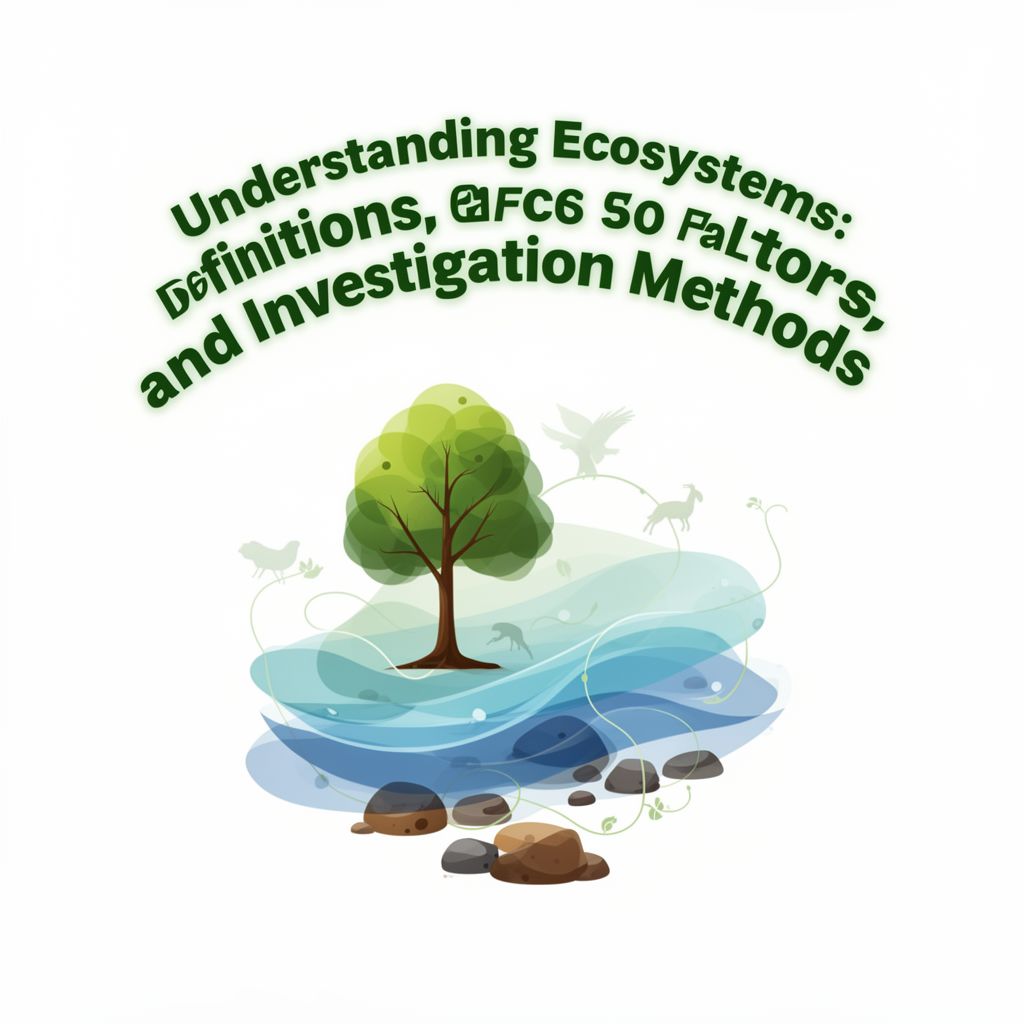
Ecology: Understanding Our Environment and Its Inhabitants
Source Information: This study material has been compiled from a lecture audio transcript and a copy-pasted text document, combining information on ecological concepts, factors, and investigation methods.
📚 Introduction to Ecology
Ecology is the scientific study of the interactions between organisms and their environment. To truly grasp the impact of human activities on our natural world, we must delve into this field, measuring how the distribution and abundance of various species change over time. A relatively new concept, 'wild law,' acknowledges the inherent rights of ecosystems. Its primary aim is to regulate human activities to prevent damage to the environment and the species within an ecosystem. This perspective challenges the traditional view that humans can exploit ecosystems without considering the organisms that reside there, aiming to safeguard ecosystems for future generations.
✅ Key Learning Outcomes:
- Understand fundamental ecological terms: biodiversity, habitat, ecosystem, population, and community.
- Explain how biotic and abiotic factors influence organism population size and distribution.
- Learn practical methods for investigating population size, distribution, and biodiversity using quadrats and transects.
🌍 Core Definitions in Ecology
Understanding the foundational terms is crucial for studying ecology.
1️⃣ Ecosystem
📚 An ecosystem is a dynamic interaction of all organisms living within a specific area and their surrounding environment. It encompasses both physical (abiotic) and biological (biotic) factors.
- Abiotic Factors: Non-living physical elements like rainfall, temperature, and light intensity.
- Biotic Factors: Living biological influences such as predation or competition for resources.
- Characteristics: Ecosystems are generally self-contained units, distinguishable by unique physical characteristics (e.g., a lake as a body of water) or specific plant and animal species that thrive there.
- Examples: A lake, a desert, a tropical rainforest, or a coral reef.
2️⃣ Habitat
📚 A habitat is the specific place or natural environment where an organism lives. Within an ecosystem, there are numerous habitats, each with distinct physical characteristics supporting individual species.
- Characteristics: Habitats can be defined by factors like limited light (e.g., a shaded area) or high moisture (e.g., under a rotting log).
- Examples within a lake ecosystem: Open water, the muddy bottom, or dense weed beds near the shores.
3️⃣ Population
📚 A population refers to a group of individuals all belonging to a single species living in the same area at the same time.
- Example: A population of perch or midge larvae inhabiting the open-water habitat of a lake.
4️⃣ Community
📚 A community is the collection of all the different populations of organisms living and interacting within a particular habitat or ecosystem.
- Relationship: All the populations of organisms in an ecosystem make up the community.
5️⃣ Environment
📚 The environment encompasses all the biotic and abiotic factors that influence a particular species.
📈 Biotic and Abiotic Factors Influencing Organisms
Both living (biotic) and non-living (abiotic) factors play crucial roles in determining the population sizes of organisms and their geographical distribution.
🌿 Biotic Factors
These are influences from other living organisms.
- Predation & Grazing:
- Predation: Animals hunting other animals (e.g., a fox hunting rabbits).
- Grazing: Animals consuming plants (e.g., deer grazing on grass).
- Effect: Both often reduce population sizes. When predation or grazing stops, the prey/plant species can significantly increase in numbers. Some species only survive where predators are few or absent (e.g., the Dodo on Mauritius before human arrival).
- Competition:
- Definition: The struggle for limited resources.
- Examples: Animals competing for food or shelter; plants competing for light or water.
- Effect: Keeps populations in check by limiting growth.
☀️ Abiotic Factors
These are influences from the non-living physical environment.
- Light:
- Importance: Essential for plants for photosynthesis and growth.
- Effect: Explains why plants cannot grow in deep caves or struggle in dense forest floors with reduced light.
- Temperature:
- Importance: Affects biological processes.
- Effect: Extreme temperatures can be lethal by impairing enzyme function. However, some species are adapted to thrive in very cold or hot environments.
- Water:
- Importance: Fundamental for all living things.
- Effect: Scarcity limits population size or dictates which species can survive.
- Adaptation Example: Waxy needles of pine trees reduce water loss, allowing them to survive when ground water is frozen and unavailable.
📊 Investigating Ecological Concepts
Ecologists use specific methods to measure and understand populations, distribution, and biodiversity.
📏 Estimating Population Size
It's rarely feasible to count every individual in an area, so estimation methods are used.
- Sampling: Count organisms in a small, representative part of the area.
- Extrapolation: Use that number to estimate the total population size across the whole habitat.
💡 Using Quadrats for Abundance
For organisms with limited movement, a quadrat is an effective tool.
- Definition: A square frame (e.g., 10x10 cm or 50x50 cm) made of wire, plastic, or wood.
- Method:
- Place the quadrat on the ground.
- Count the number of individuals of the target species within its boundaries.
- Ensuring Reliability:
- ⚠️ Representative Samples: Collect enough samples that truly represent the entire area.
- Appropriate Size: The quadrat must be large enough to contain a fair number of individuals, but not so large that counting becomes too time-consuming.
- Avoiding Bias: Do not deliberately choose "interesting" or "easy" areas.
- Random Placement: The most robust method involves establishing a grid over the area using measuring tapes and then using random numbers (e.g., from a calculator) to determine the precise coordinates for placing each quadrat.
🗺️ Investigating Distribution and Biodiversity
📚 Biodiversity
Biodiversity is the measure of the variety of living things in a given area.
- High Biodiversity: Ecosystems with a vast array of different species and numerous organisms (e.g., tropical rainforests).
- Low Biodiversity: Environments with a much smaller number of different species and fewer organisms overall (e.g., sandy deserts).
📈 Using Line Transects for Distribution
To study how organisms are spread (their distribution), especially in relation to a changing environmental factor, a line transect is used.
- Method:
- Establish a line (often marked by a long measuring tape) between two areas where an environmental factor changes (e.g., from a field to a pond edge, or from a tree base into full sunshine).
- Place quadrats at regular intervals along this line.
- Count the number of each plant species within each quadrat.
- Insights: Results can reveal which plants thrive in dry vs. damp soil, how shade affects plant distribution, or the impact of waves on marine species between high and low tide marks.