Podit
Podit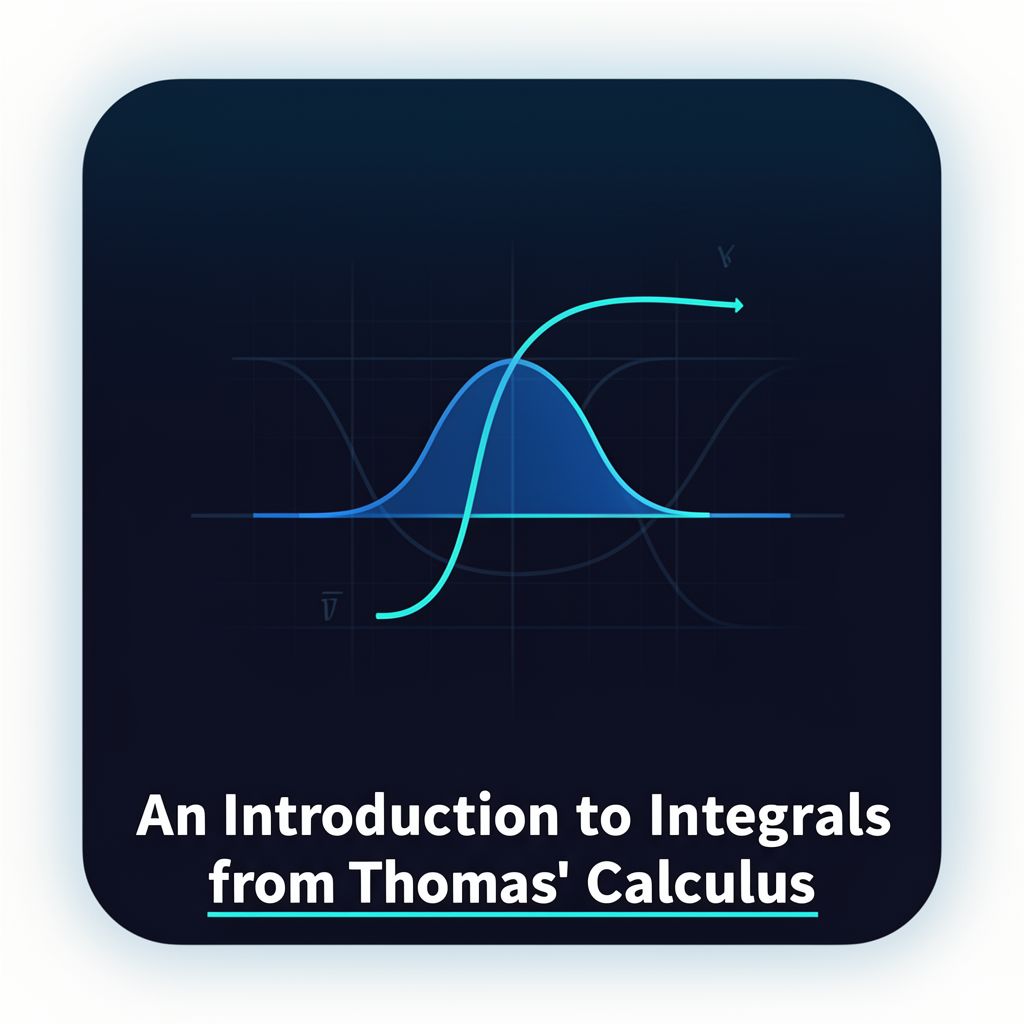
📚 Study Guide: Integrals (Thomas' Calculus, Chapter 5)
Source Information: This study material has been compiled from a lecture audio transcript and introductory slides for Chapter 5, "Integrals," from "Thomas’ Calculus, Fifteenth Edition in SI Units" (© 2023 Pearson Education Ltd.).
🎯 Introduction to Integrals
Welcome to this study guide on Integrals, focusing on Chapter 5 of "Thomas’ Calculus, Fifteenth Edition in SI Units." This chapter is a cornerstone of calculus, providing essential tools for understanding accumulation, change, and various phenomena across scientific and engineering disciplines. Mastering integrals is crucial for building a robust mathematical foundation and tackling complex real-world problems.
1️⃣ The Fundamental Concept of Integrals
Integrals represent one of the two primary operations in calculus, serving as the inverse process of differentiation. While differentiation helps us determine the rate of change of a function, integration allows us to calculate the total accumulation of a quantity or the area under a curve.
📚 Key Definitions & Concepts:
- Differentiation vs. Integration:
- ✅ Differentiation: Finds the rate of change (e.g., velocity from position).
- ✅ Integration: Finds the total accumulation (e.g., total distance from velocity).
- Visualization: Integrals are often visualized as summing an infinite number of infinitesimally small parts.
- 💡 Example: Finding the total distance traveled by an object given its velocity function over time.
- Riemann Sums: Historically, the concept of integration was formalized through Riemann sums.
- 1️⃣ Approximate the area under a curve using a series of rectangles.
- 2️⃣ Allow the width of these rectangles to approach zero.
- 3️⃣ This process leads to the precise definition of the definite integral.
- Definite Integral:
- Represents the numerical value of accumulation over a specific interval.
- Yields a single number (e.g., total area, total volume).
- Indefinite Integral (Antiderivative):
- Represents a family of functions whose derivative is the original function.
- Includes an arbitrary constant 'C' (e.g., ∫f(x)dx = F(x) + C).
- Fundamental Theorem of Calculus: This theorem encapsulates the duality between differentiation and integration, highlighting their inverse relationship. It is paramount to understanding the subject deeply.
2️⃣ Significance and Broad Applications of Integration
The utility of integrals extends far beyond theoretical mathematics, making them indispensable tools in numerous fields.
📊 Applications Across Disciplines:
- Physics:
- ✅ Calculating displacement from velocity.
- ✅ Determining work done by a variable force.
- ✅ Finding the center of mass or moments of inertia of objects.
- 💡 Example: If you know the force applied to an object as a function of distance, integrating that function gives the total work done.
- Engineering:
- ✅ Designing structures (e.g., bridges, buildings) for stability.
- ✅ Analyzing fluid flow and pressure.
- ✅ Determining volumes of complex shapes (e.g., in mechanical design).
- ✅ Understanding electrical circuits (e.g., charge accumulation in capacitors).
- 💡 Example: Calculating the volume of concrete needed for a uniquely shaped architectural element.
- Economics:
- ✅ Calculating total cost or revenue from marginal functions.
- ✅ Determining consumer and producer surplus.
- ✅ Analyzing continuous income streams over time.
- 💡 Example: Integrating a marginal cost function gives the total cost of production.
- Probability and Statistics:
- ✅ Crucial for finding probabilities associated with continuous random variables.
- ✅ Calculating the area under probability density functions (PDFs).
- 💡 Example: Finding the probability that a randomly chosen value falls within a certain range for a normal distribution.
- Biology and Medicine:
- ✅ Modeling population growth over time.
- ✅ Analyzing the concentration of drugs in the bloodstream.
- 💡 Example: Predicting how a bacterial population will grow given its growth rate function.
The ability to model and solve problems involving accumulation, area, volume, and other continuous changes makes integration an essential skill for anyone pursuing a career in STEM (Science, Technology, Engineering, Mathematics) and related fields.
3️⃣ Conclusion: The Enduring Importance of Integrals
Chapter 5 on "Integrals" from "Thomas’ Calculus" is a vital component of a comprehensive calculus education. Integrals are not just mathematical operations; they are powerful analytical tools that enable us to understand and quantify continuous change and accumulation.
By diligently studying this chapter, you will:
- ✅ Deepen your mathematical understanding.
- ✅ Gain powerful tools for problem-solving.
- ✅ Be equipped to tackle diverse real-world challenges in various professional and academic contexts.
Approach this topic with diligence, as the insights gained from studying integrals will undoubtedly prove invaluable throughout your academic and professional journey.