Anatomy of Shoulder and Arm Muscles: A Detailed Guide - kapak
Bilim#anatomy#muscles#shoulder#arm

Anatomy of Shoulder and Arm Muscles: A Detailed Guide

Explore the detailed anatomy, origins, insertions, innervations, and actions of key muscles in the shoulder and arm regions, including anterior, posterior, and arm flexor/extensor groups.

rana_lJanuary 18, 2026 ~14 dk toplam
01

Flash Kartlar

24 kart

Karta tıklayarak çevir. ← → ile gez, ⎵ ile çevir.

1 / 24
Tüm kartları metin olarak gör
  1. 1. What is the origin and insertion of the Subclavius muscle?

    It originates from the first rib and inserts onto the inferior surface of the clavicle.

  2. 2. Which nerve innervates the Subclavius muscle and what is its primary function?

    It is innervated by the subclavius nerve (C5, C6) and stabilizes the clavicle at the sternoclavicular joint.

  3. 3. Describe the origin and insertion points of the Pectoralis minor muscle.

    This muscle originates from the third to fifth ribs and inserts onto the coracoid process of the scapula.

  4. 4. What is the innervation and main function of the Pectoralis minor muscle?

    It is innervated by the medial pectoral nerve (C8, T1) and functions to depress the scapula, downwardly rotate the glenoid, and assist in respiration.

  5. 5. From which ribs does the Serratus anterior muscle originate, and where does it insert?

    The Serratus anterior originates from the first to ninth ribs and inserts onto the medial border of the scapula.

  6. 6. What is the innervation of the Serratus anterior muscle, and what specific action does its lower part perform?

    It is innervated by the long thoracic nerve (C5-C7). Its lower part performs scapular rotation, allowing arm elevation above ninety degrees.

  7. 7. List the origin points of the Trapezius muscle.

    The Trapezius originates from the occipital bone and the spinous processes of C1-T12 vertebrae.

  8. 8. Where does the Trapezius muscle insert, and which nerves innervate it?

    It inserts onto the lateral third of the clavicle, acromion, and scapular spine, and is innervated by the accessory nerve (CN XI) and C3-C4 cervical plexus nerves.

  9. 9. What are the functions of the descending and transverse parts of the Trapezius muscle?

    The descending part elevates the scapula and rotates the glenoid, while the transverse part retracts the scapula medially.

  10. 10. What is the origin and insertion of the Levator scapulae muscle?

    It originates from the transverse processes of C1-C4 vertebrae and inserts onto the superior angle of the scapula.

  11. 11. Which nerves innervate the Levator scapulae, and what are its actions?

    It is innervated by the dorsal scapular nerve and cervical spinal nerves (C3-C4), and it retracts and elevates the scapula, also flexing the neck to the same side.

  12. 12. What are the origin and insertion points for the Rhomboid minor and major muscles?

    They originate from the spinous processes of C6-T4 vertebrae and insert onto the medial border of the scapula.

  13. 13. What is the innervation and primary function of the Rhomboid muscles?

    They are innervated by the dorsal scapular nerve (C4-C5) and function to stabilize, retract, and elevate the scapula.

  14. 14. Name some of the diverse origin points of the Latissimus dorsi muscle.

    It originates from the spinous processes of T7-T12, thoracolumbar fascia, inferior angle of the scapula, 9th-12th ribs, and the iliac crest.

  15. 15. Where does the Latissimus dorsi muscle insert, and what is its innervation?

    It inserts into the floor of the intertubercular groove of the humerus and is innervated by the thoracodorsal nerve (C6-C8).

  16. 16. What are the main actions performed by the Latissimus dorsi muscle?

    It performs internal rotation, adduction, and extension of the arm, and also assists in respiration.

  17. 17. Describe the origin, insertion, and innervation of the Teres major muscle.

    It originates from the inferior angle of the scapula, inserts onto the crest of the lesser tubercle of the humerus, and is innervated by the lower subscapular nerve (C5, C6).

  18. 18. What are the primary functions of the Teres major muscle?

    The Teres major muscle performs internal rotation, adduction, and extension of the arm.

  19. 19. What are the origins of the long and short heads of the Biceps brachii muscle?

    The long head originates from the supraglenoid tubercle, and the short head originates from the coracoid process.

  20. 20. Which nerve innervates the Biceps brachii, and what are its actions at the elbow and shoulder?

    It is innervated by the musculocutaneous nerve (C5-C6), causing flexion and supination at the elbow, and flexion and stabilization at the shoulder.

  21. 21. What is the origin, insertion, and innervation of the Brachialis muscle?

    It originates from the distal half of the humerus, inserts onto the ulnar tuberosity, and is innervated by the musculocutaneous nerve (C5-C6) and radial nerve (C7).

  22. 22. What are the origins of the three heads of the Triceps brachii muscle?

    The long head originates from the infraglenoid tubercle, while the medial and lateral heads originate from the posterior humerus.

  23. 23. What is the innervation and primary function of the Triceps brachii muscle?

    It is innervated by the radial nerve (C6-C8) and primarily extends the elbow; its long head also extends and adducts the shoulder.

  24. 24. What is the origin, insertion, innervation, and function of the Anconeus muscle?

    It originates from the lateral epicondyle, inserts onto the olecranon of the ulna, is innervated by the radial nerve (C6-C8), and extends the elbow.

02

Bilgini Test Et

15 soru

Çoktan seçmeli sorularla öğrendiklerini ölç. Cevap + açıklama.

Soru 1 / 15Skor: 0

Which structure does the Subclavius muscle attach to on the clavicle?

03

Detaylı Özet

4 dk okuma

Tüm konuyu derinlemesine, başlık başlık.

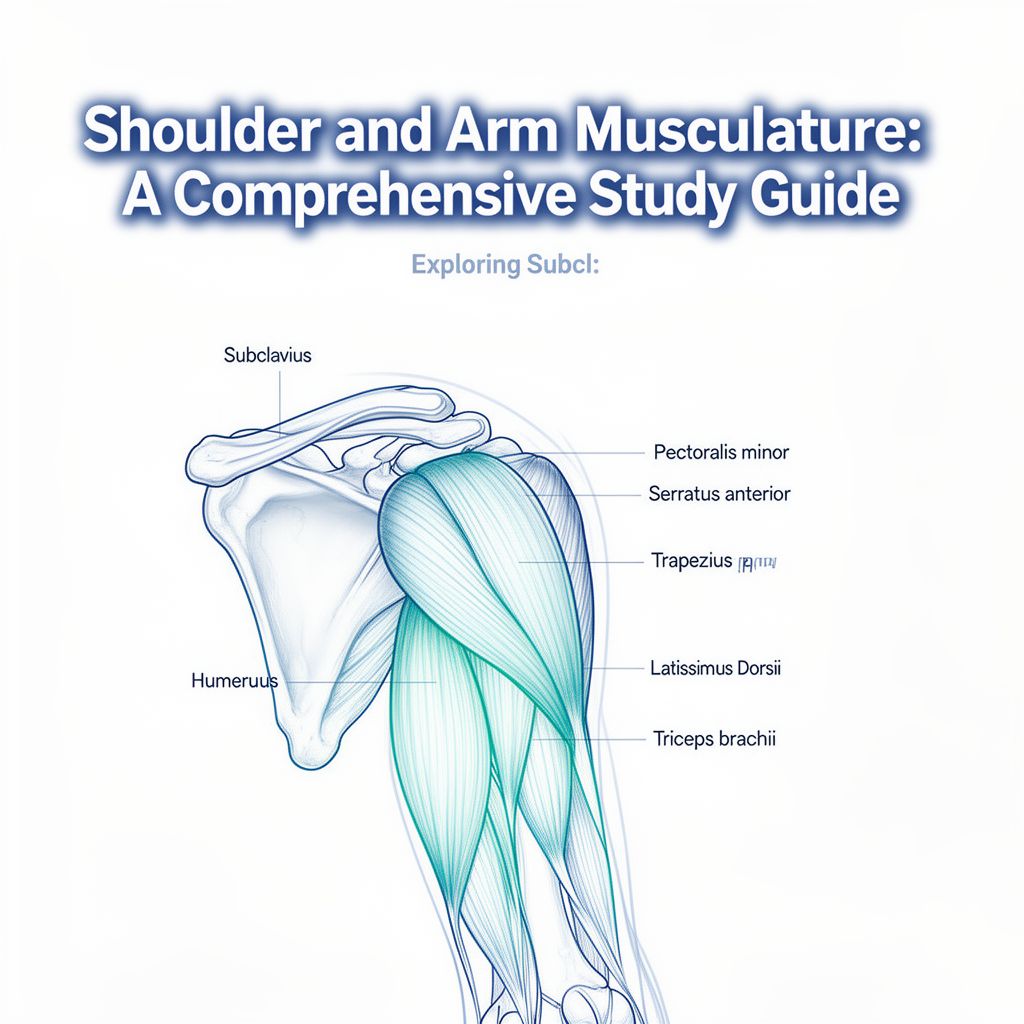
📚 Shoulder and Arm Musculature: A Comprehensive Study Guide

Source Information: This study material has been compiled from a combination of copy-pasted text (including anatomical figures and tables) and an audio lecture transcript. All information has been consolidated and presented in English for clarity and ease of study.


Introduction to Shoulder and Arm Musculature

This guide provides a detailed overview of the key muscles in the shoulder and arm regions. We will explore each muscle's origin, insertion, innervation, and primary actions, crucial for understanding human movement and anatomy.


1. Anterior Thoracic and Scapular Muscles

These muscles are located on the front of the chest and around the shoulder blade.

1.1. Subclavius

  • Origin: 1st rib 🦴
  • Insertion: Inferior surface of the clavicle
  • Innervation: Nerve to subclavius (C5, C6)
  • Action: ✅ Steadies the clavicle in the sternoclavicular joint.

1.2. Pectoralis Minor

  • Origin: 3rd to 5th ribs 🦴
  • Insertion: Coracoid process of the scapula
  • Innervation: Medial pectoral nerve (C8, T1)
  • Action:
    • ✅ Draws the scapula downward.
    • ✅ Causes the inferior angle of the scapula to move posteromedially.
    • ✅ Rotates the glenoid cavity inferiorly.
    • ✅ Assists in respiration.

1.3. Serratus Anterior

  • Origin: 1st to 9th ribs 🦴
  • Insertion: Costal and dorsal surfaces of the superior angle, medial border, and inferior angle of the scapula.
  • Innervation: Long thoracic nerve (C5-C7)
  • Action:
    • Superior part: ✅ Lowers the raised arm.
    • Entire muscle: ✅ Draws the scapula laterally forward.
    • ✅ Elevates ribs when the shoulder is fixed.
    • Inferior part: ✅ Rotates the inferior angle of the scapula laterally forward, enabling arm elevation above 90 degrees.

2. Posterior Thoracic and Scapular Muscles

These muscles are found on the upper back and around the shoulder blade.

2.1. Trapezius

  • Origin: Occipital bone, nuchal ligament, and spinous processes of C1-T12 vertebrae 🦴
  • Insertion: Lateral one-third of the clavicle, acromion, and scapular spine.
  • Innervation: Accessory nerve (CN XI) and C3-C4 nerves of the cervical plexus.
  • Action:
    • Descending (Upper) part: ✅ Draws the scapula obliquely upward; rotates the glenoid cavity superiorly; tilts the head to the same side and rotates it to the opposite side.
    • Transverse (Middle) part: ✅ Draws the scapula medially.
    • Ascending (Lower) part: ✅ Draws the scapula medially downward.
    • Entire muscle: ✅ Steadies the scapula on the thorax.

2.2. Levator Scapulae

  • Origin: Transverse processes of C1-C4 vertebrae 🦴
  • Insertion: Superior angle of the scapula.
  • Innervation: Dorsal scapular nerve and cervical spinal nerves (C3-C4).
  • Action: ✅ Draws the scapula medially upward while moving the inferior angle medially; inclines the neck to the same side.

2.3. Rhomboid Minor and Major

  • Rhomboid Minor:
    • Origin: Spinous processes of C6, C7 vertebrae 🦴
    • Insertion: Medial border of the scapula (above the scapular spine).
  • Rhomboid Major:
    • Origin: Spinous processes of T1-T4 vertebrae 🦴
    • Insertion: Medial border of the scapula (below the scapular spine).
  • Innervation (both): Dorsal scapular nerve (C4-C5).
  • Action (both): ✅ Steadies the scapula; draws the scapula medially upward.

3. Posterior Trunk and Arm Muscles

These include large muscles of the back and those connecting the trunk to the arm.

3.1. Latissimus Dorsi

  • Origin: Spinous processes of T7-T12 vertebrae, thoracolumbar fascia, inferior angle of the scapula, 9th to 12th ribs, and posterior one-third of the iliac crest 🦴
  • Insertion: Floor of the intertubercular groove of the humerus.
  • Innervation: Thoracodorsal nerve (C6-C8).
  • Action:
    • ✅ Internal rotation of the arm.
    • ✅ Adduction of the arm.
    • ✅ Extension of the arm.
    • ✅ Assists in respiration (often called the "cough muscle" 💡).

3.2. Teres Major

  • Origin: Inferior angle of the scapula 🦴
  • Insertion: Crest of the lesser tubercle of the humerus (anterior angle).
  • Innervation: Lower subscapular nerve (C5, C6).
  • Action:
    • ✅ Internal rotation of the arm.
    • ✅ Adduction of the arm.
    • ✅ Extension of the arm.

4. Anterior Arm Muscles (Flexors)

These muscles are primarily responsible for flexing the elbow joint.

4.1. Biceps Brachii

  • Origin:
    • Long head: Supraglenoid tubercle of the scapula 🦴
    • Short head: Coracoid process of the scapula 🦴
  • Insertion: Radial tuberosity and bicipital aponeurosis.
  • Innervation: Musculocutaneous nerve (C5-C6).
  • Action:
    • Elbow joint: ✅ Flexion; powerful supination (⚠️ especially when the elbow is flexed, as the lever arm is almost perpendicular to the axis of pronation/supination).
    • Shoulder joint: ✅ Flexion; stabilization of the humeral head during deltoid contraction; abduction and internal rotation of the humerus.

4.2. Brachialis

  • Origin: Distal half of the anterior surface of the humerus 🦴
  • Insertion: Ulnar tuberosity.
  • Innervation: Musculocutaneous nerve (C5-C6) and radial nerve (C7, minor contribution).
  • Action: ✅ Flexion at the elbow joint.

5. Posterior Arm Muscles (Extensors)

These muscles are primarily responsible for extending the elbow joint.

5.1. Triceps Brachii

  • Origin:
    • Long head: Infraglenoid tubercle of the scapula 🦴
    • Medial head: Posterior humerus, distal to the radial groove; medial intermuscular septum 🦴
    • Lateral head: Posterior humerus, proximal to the radial groove; lateral intermuscular septum 🦴
  • Insertion: Olecranon of the ulna.
  • Innervation: Radial nerve (C6-C8).
  • Action:
    • Elbow joint: ✅ Extension.
    • Shoulder joint (long head only): ✅ Extension and adduction.

5.2. Anconeus

  • Origin: Lateral epicondyle of the humerus (sometimes from the posterior joint capsule) 🦴
  • Insertion: Olecranon of the ulna (radial surface).
  • Innervation: Radial nerve (C6-C8).
  • Action: ✅ Extends the elbow and tightens its joint capsule.
Kendi çalışma materyalini oluştur

PDF, YouTube videosu veya herhangi bir konuyu dakikalar içinde podcast, özet, flash kart ve quiz'e dönüştür. 1.000.000+ kullanıcı tercih ediyor.

Sıradaki Konular

Tümünü keşfet
Upper Limb Muscle Anatomy: Deltoid, Rotator Cuff, Pectoralis Major, and Coracobrachialis

Upper Limb Muscle Anatomy: Deltoid, Rotator Cuff, Pectoralis Major, and Coracobrachialis

Explore the detailed anatomy and functions of key upper limb muscles: the deltoid, rotator cuff, pectoralis major, and coracobrachialis.

Özet 25 15
Lower Limb Muscle Anatomy: Origin, Insertion, Innervation, and Action

Lower Limb Muscle Anatomy: Origin, Insertion, Innervation, and Action

Explore the detailed anatomy of the lower limb muscles, including the iliopsoas, gluteal, medial thigh, anterior thigh, and posterior thigh muscle groups, covering their origins, insertions, innervations, and specific actions.

9 dk Özet 25 15
The Musculoskeletal System: Structure, Function, and Locomotion

The Musculoskeletal System: Structure, Function, and Locomotion

Explore the intricate musculoskeletal system, its components, functions, and the mechanisms of locomotion in various organisms, with a detailed focus on the human body.

Özet 25 15 Görsel
Skeletal Muscle Structure and Neuromuscular Junction

Skeletal Muscle Structure and Neuromuscular Junction

This audio summary provides an academic overview of skeletal muscle terminology, morphology, filament and sarcomere structure, innervation, and the intricate process of excitation-contraction coupling.

7 dk Özet 18 12
Neuron Types and Nervous System Structures

Neuron Types and Nervous System Structures

This summary explores the diverse morphology and classification of neurons, their fundamental components, synaptic connections, and the crucial role of glial cells and peripheral nervous system structures.

6 dk Özet 25 15
Male Reproductive Anatomy and Gonad Descent

Male Reproductive Anatomy and Gonad Descent

Explore the gross anatomy of the male reproductive system, accessory glands, and the embryological development and descent of gonads, including clinical correlations.

7 dk Özet 15
The Visual Pathway, Reflexes, and Eye Movements

The Visual Pathway, Reflexes, and Eye Movements

An academic overview of the visual pathway from retina to cortex, including visual field processing, magnocellular and parvocellular streams, light and accommodation reflexes, and conjugate eye movements.

8 dk Özet 25 15
The Anatomy and Physiology of the Human Heart

The Anatomy and Physiology of the Human Heart

Explore the intricate structure and function of the human heart, covering its location, chambers, valves, and the electrical conduction system that drives its rhythmic beat.

Özet 25 15