Podit
Podit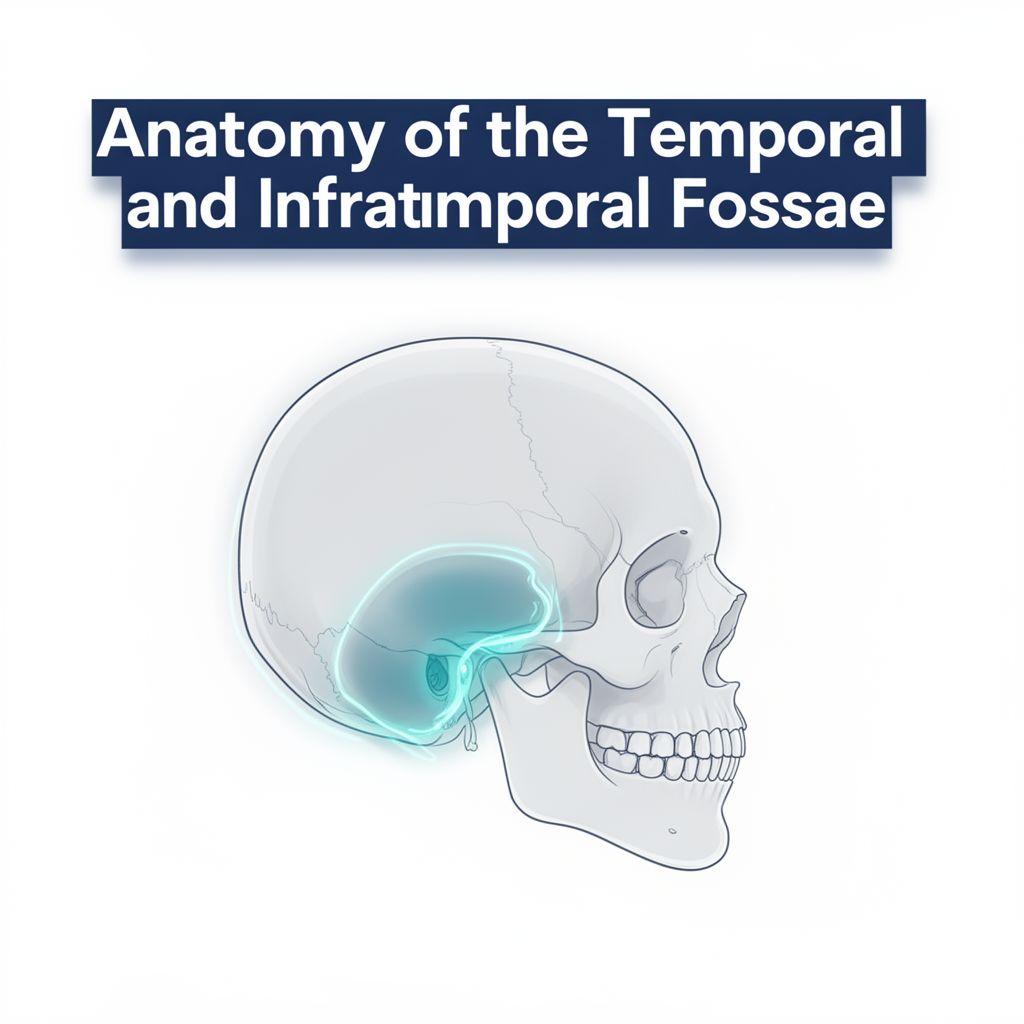
This study material has been compiled from a lecture audio transcript and supplementary text materials (copy-pasted text).
🧠 Anatomy of the Temporal and Infratemporal Fossae
This guide provides a comprehensive overview of the temporal and infratemporal fossae, two crucial anatomical regions of the skull. Understanding these areas is fundamental for studying head and neck anatomy, as they house vital structures and serve as important landmarks for clinical practice.
1. The Temporal Fossa 🕰️
The temporal fossa is a depressed area located on each side of the skull within the temporal region. It is situated between the temporal lines and the zygomatic arch, positioned superiorly to the infratemporal fossa.
1.1. Boundaries of the Temporal Fossa ✅
The temporal fossa is defined by specific bony landmarks:
- Postero-Superiorly: Superior temporal line
- Inferiorly: Infratemporal crest
- Anteriorly: Frontal process of the zygomatic bone
- Laterally: Zygomatic arch
- Floor: Formed by the articulation of four bones: frontal, parietal, temporal, and sphenoid.
1.2. The Pterion: A Critical Landmark ⚠️
Within the floor of the temporal fossa lies the pterion.
- 📚 Definition: The pterion is the thinnest part of the lateral wall of the skull. It is the point where the anteroinferior corner of the parietal bone articulates with the greater wing of the sphenoid bone.
- Clinical Significance: The pterion is clinically important because it directly overlies the anterior division of the middle meningeal artery and vein. Trauma to this area can lead to severe intracranial hemorrhage, making its precise location critical for medical professionals.
1.3. Contents of the Temporal Fossa 🎯
The primary contents of the temporal fossa include:
- 1️⃣ Temporalis Muscle:
- Description: A fan-shaped muscle originating from the superior temporal line. Its fibers converge inferiorly to form a strong tendon.
- Attachment: The tendon attaches to the anterior surface of the coronoid process of the mandible.
- Function: A powerful elevator and retractor of the mandible, playing a key role in mastication (chewing).
- Innervation: Deep temporal nerves (branches of the mandibular nerve, CN V3).
- Blood Supply: Deep temporal arteries and the superficial temporal artery.
- 2️⃣ Temporalis Fascia: Covers the temporalis muscle.
- 3️⃣ Deep Temporal Nerves and Vessels: Supply the temporalis muscle.
1.4. Clinical Significance of the Temporal Fossa 💡
Understanding the temporal fossa is crucial for several reasons:
- Anatomical Boundaries: Essential for accurate diagnosis and surgical planning.
- Muscle Function: Knowledge of the temporalis muscle's anatomy, innervation, and blood supply helps in assessing and treating jaw disorders (e.g., temporomandibular joint dysfunction).
- Pterion: Its location overlying the middle meningeal artery is vital for preventing complications during head trauma or neurosurgical interventions.
- Connection to Infratemporal Fossa: This continuity is fundamental for grasping the functional anatomy of mastication and understanding the pathways of various neurovascular structures.
2. The Infratemporal Fossa ⬇️
The infratemporal fossa is an irregularly shaped space located on the side of the skull, positioned below the zygomatic arch and deep to the ramus of the mandible. It is situated directly below the temporal fossa and is continuous with it.
2.1. Why Study the Infratemporal Fossa? 📈
This region is critically important due to its complex contents and connections:
- 1️⃣ Anatomical Link: It links major head and facial regions.
- 2️⃣ Neurovascular Hub: Contains key neurovascular structures, including the mandibular nerve (CN V3), maxillary artery, and pterygoid plexus of veins. These support blood supply and nerve function throughout the head and face.
- 3️⃣ Mastication Muscles: Houses essential muscles for chewing (lateral and medial pterygoid muscles).
- 4️⃣ Clinical & Surgical Relevance: Knowledge of this fossa is critical for various clinical and surgical procedures, especially when working near the middle meningeal artery.
- 5️⃣ Safe Outcomes: Understanding this area helps ensure safe surgical outcomes and aids in managing jaw function, pain, and vascular issues.
2.2. Boundaries of the Infratemporal Fossa ✅
The infratemporal fossa has the following boundaries:
- Laterally: Ramus of the mandible
- Medially: Lateral pterygoid plate
- Anteriorly: Posterior aspect of the maxilla
- Posteriorly: Tympanic plate and the mastoid and styloid processes of the temporal bone
- Superiorly: Greater wing of the sphenoid (forming its roof)
- Inferiorly: Where the medial pterygoid muscle attaches to the mandible near its angle.
2.3. Communications of the Infratemporal Fossa 🌐
The infratemporal fossa is not isolated but communicates with several other regions:
- 1️⃣ Temporal Fossa: Through a gap deep to the zygomatic arch.
- 2️⃣ Cranial Cavity: Via the foramen ovale, foramen spinosum, and foramen lacerum.
- 3️⃣ Orbit: Through the inferior orbital fissure.
- 4️⃣ Pterygopalatine Fossa: Through the pterygomaxillary fissure.
2.4. Foramina in the Infratemporal Fossa (Summary) 🕳️
Several foramina open into or from the infratemporal fossa, serving as passages for vital structures:
- Foramen Spinosum: Passage for the middle meningeal artery into the middle cranial fossa.
- Foramen Ovale: Passage for the mandibular nerve (CN V3) and accessory meningeal artery.
- Pterygomaxillary Fissure: A medial cleft leading into the pterygopalatine fossa, containing terminal branches of the maxillary artery.
- Inferior Orbital Fissure: Leads anteriorly into the orbit. Its contents include the zygomatic branch of the maxillary nerve (CN V2), infraorbital vessels, and the inferior ophthalmic vein (which communicates with the pterygoid plexus).
2.5. Contents of the Infratemporal Fossa 🎯
The infratemporal fossa is rich in structures, including:
- 1️⃣ Muscles of Mastication:
- Lower portion of Temporalis Muscle: While most of the temporalis is in the temporal fossa, its lower part extends into the infratemporal fossa.
- Lateral Pterygoid Muscle: Originates from the lateral pterygoid plate and greater wing of the sphenoid; inserts onto the neck of the mandible and articular disc of the TMJ. Action: Protrudes the mandible.
- Medial Pterygoid Muscle: Originates from the medial surface of the lateral pterygoid plate and tuberosity of the maxilla; inserts onto the medial surface of the ramus and angle of the mandible. Action: Closes the jaw with bilateral contraction.
- 2️⃣ Nerves:
- Mandibular nerve (CN V3) and its branches.
- Chorda tympani.
- Otic ganglion.
- 3️⃣ Vessels:
- Maxillary artery.
- Pterygoid plexuses of veins (directly connected to the cavernous sinus and drain the eye and its locality).
This detailed exploration highlights the intricate anatomy and profound clinical importance of the temporal and infratemporal fossae, essential knowledge for any student of human anatomy.