Podit
Podit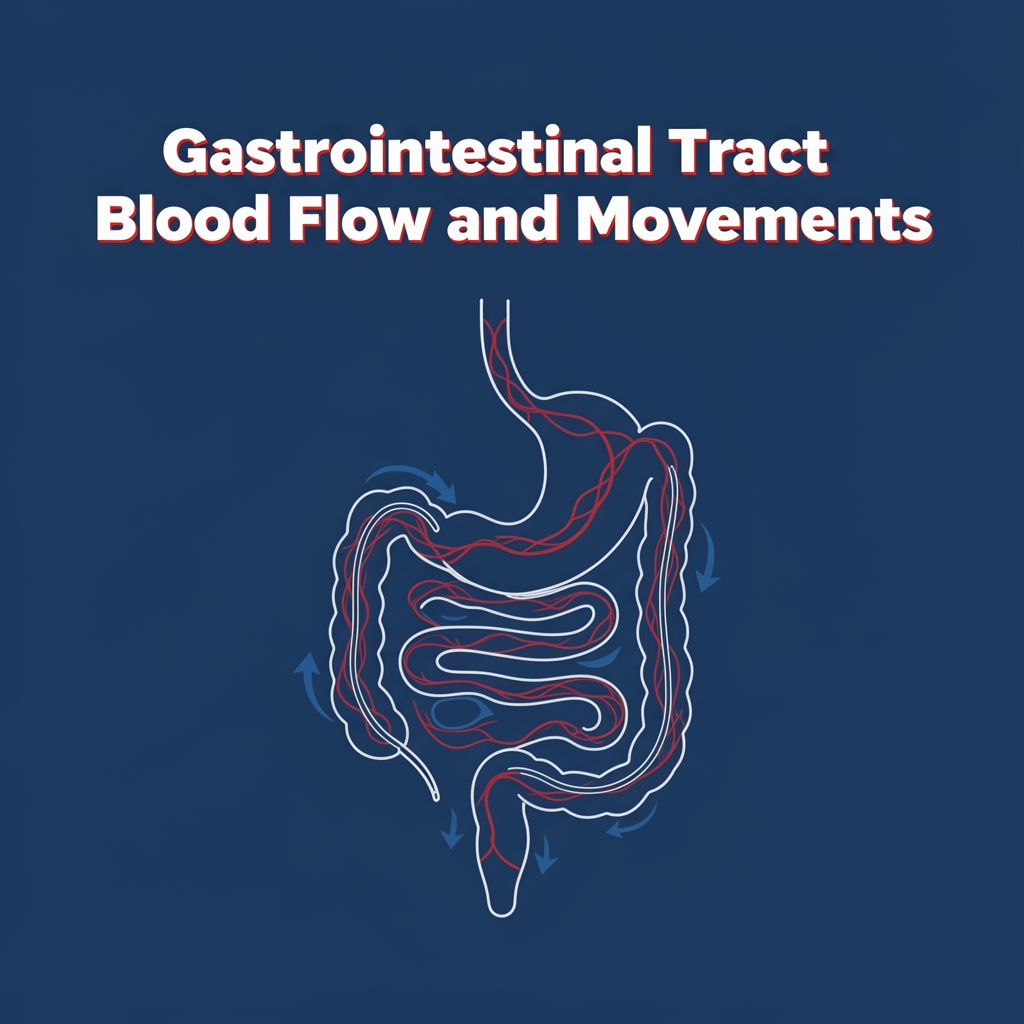
This study material has been compiled from various sources, including copy-pasted text and an audio lecture transcript.
Gastrointestinal (GI) Tract: Blood Flow and Movements
📚 Introduction
The gastrointestinal (GI) tract is a complex system responsible for digestion and nutrient absorption. This study guide explores the intricate mechanisms governing blood supply to the digestive system and the essential movements that facilitate digestion. We will delve into the splanchnic circulation, the anatomical organization of GI blood vessels, factors influencing blood flow, nervous system control, and the two primary types of GI tract movements: propulsive and mixing.
1. 🩸 Splanchnic Circulation: The GI Blood Network
The splanchnic circulation is a vital component of the body's vascular network, encompassing the blood flow through several key organs:
- ✅ Gut
- ✅ Spleen
- ✅ Pancreas
- ✅ Liver
This extensive network ensures these organs receive the necessary oxygen and nutrients for their complex functions.
1.1. Liver Blood Pathway
Within the liver, blood follows a specific route:
- Blood passes through specialized capillaries called sinusoids.
- It then collects into the hepatic veins.
- Finally, it drains into the vena cava, returning to the systemic circulation.
1.2. Reticuloendothelial System (RES)
The reticuloendothelial system (RES), particularly the Kupffer cells, lines the liver sinusoids.
- 📚 Kupffer Cells: Specialized macrophages in the liver that play a crucial role in the body's defense mechanism.
- Function: They remove bacteria that might enter the bloodstream from the GI tract, preventing systemic infections and maintaining the sterility of the general circulation.
1.3. Nutrient Transport
The splanchnic circulation is instrumental in nutrient transport:
- Water-soluble nutrients (e.g., carbohydrates & proteins): Absorbed from the gut and transported directly to the liver via the portal venous blood to the liver sinusoids.
- Both RES cells and hepatic cells absorb and temporarily store approximately 50-75% of these nutrients for metabolic regulation.
- Fats: Absorbed from the intestinal tract into the intestinal lymphatics, which eventually drain into the systemic circulation, bypassing initial liver processing.
2. 🗺️ Anatomy of GI Blood Supply
The arterial supply to the gut is intricately organized to support its specialized functions:
- Arteries branch into smaller arteries, circling the gut in both directions.
- For secretory and absorptive functions, these arteries extend:
- Along the muscle bundles: Supplying blood to the muscular layers responsible for gut movements.
- Into the intestinal villi: Crucial for nutrient absorption, ensuring these highly active structures receive ample blood supply.
- Into submucosal vessels: Supporting the submucosal layer where many glands and nerve plexuses are located.
3. 📈 Factors Influencing GI Blood Flow
A fundamental principle is that blood flow in each GI area is directly related to its level of local activity. Increased GI activity (digestion, secretion, absorption) leads to significantly increased blood flow due to several factors:
- Vasodilators: Released during the digestive process.
- Examples: Vasoactive Intestinal Peptide (VIP), cholecystokinin (CCK), gastrin, and secretin.
- Action: Act locally to dilate blood vessels, increasing blood flow.
- Kinins: Powerful vasodilators released locally.
- Examples: Kallidin and bradykinin.
- Action: Contribute significantly to local vasodilation during digestion.
- Decreased Oxygen Concentration: Increased metabolic activity in the gut consumes more oxygen.
- Action: If oxygen supply lags behind demand, the resulting local hypoxia triggers vasodilation, increasing intestinal blood flow to meet heightened metabolic needs.
4. 🧠 Nervous Control of GI Blood Flow
The autonomic nervous system plays a critical role in regulating GI blood flow:
-
Parasympathetic Stimulation:
- Generally leads to an increase in local blood flow and an enhancement of secretion, particularly in the stomach and lower colon.
- Supports digestive and secretory functions.
-
Sympathetic Stimulation:
- Initially causes vasoconstriction of the arterioles, leading to a decrease in blood flow to the gut.
- Autoregulatory Escape: After a few minutes, blood flow often returns to normal. Local metabolic vasodilator mechanisms, triggered by the initial reduced blood flow (ischemia), become pre-potent and override the sympathetic vasoconstriction. This is a vital protective mechanism.
- Blood Redirection: During heavy exercise, sympathetic vasoconstriction in the splanchnic circulation can redirect up to 400 ml of extra blood to skeletal muscles, prioritizing blood flow to areas of immediate need.
5. 🚶♀️ Movements in the GI Tract
Two primary types of movements are essential for digestion:
5.1. Propulsive Movements (Peristalsis)
📚 Peristalsis: Coordinated muscular contractions that move food forward along the digestive tract.
- Mechanism: A contractile ring appears around the gut and moves forward, pushing material in front of it.
- Occurrence: Also occurs in other smooth muscle tubes (e.g., bile ducts).
- Directionality:
- Can occur in either direction but dies out rapidly in the oral (orad) direction.
- Continues for 5-10 cm towards the anus before dying out (known as the "law of the gut").
- Mixing Contribution: Peristaltic contractions also contribute to mixing, especially when encountering a sphincter.
- Stimuli that initiate peristalsis:
- Distention/Irritation: Stimulates the enteric nervous system (ENS), causing the wall to contract ~3 cm behind the stimulus.
- Active Myenteric (Auerbach's) Plexus: Absolutely required for peristalsis.
- Parasympathetic Stimulation: Plays a role in stimulating and regulating peristaltic movements.
5.2. Mixing Movements (Segmentation)
📚 Segmentation: Intermittent constrictive contractions that thoroughly mix intestinal contents.
- Mechanism: Occur every few centimeters along the gut, lasting 5-30 seconds.
- Creates a pattern resembling a "chain of sausages."
- New constrictions form at different points as old ones relax, effectively chopping and shearing contents.
- Function: Ensures comprehensive mixing of chyme with digestive juices and facilitates efficient nutrient absorption.
💡 Key Takeaway: The GI tract's ability to regulate its blood flow and execute coordinated movements is fundamental to efficient digestion and nutrient absorption, adapting dynamically to the body's needs.