Podit
Podit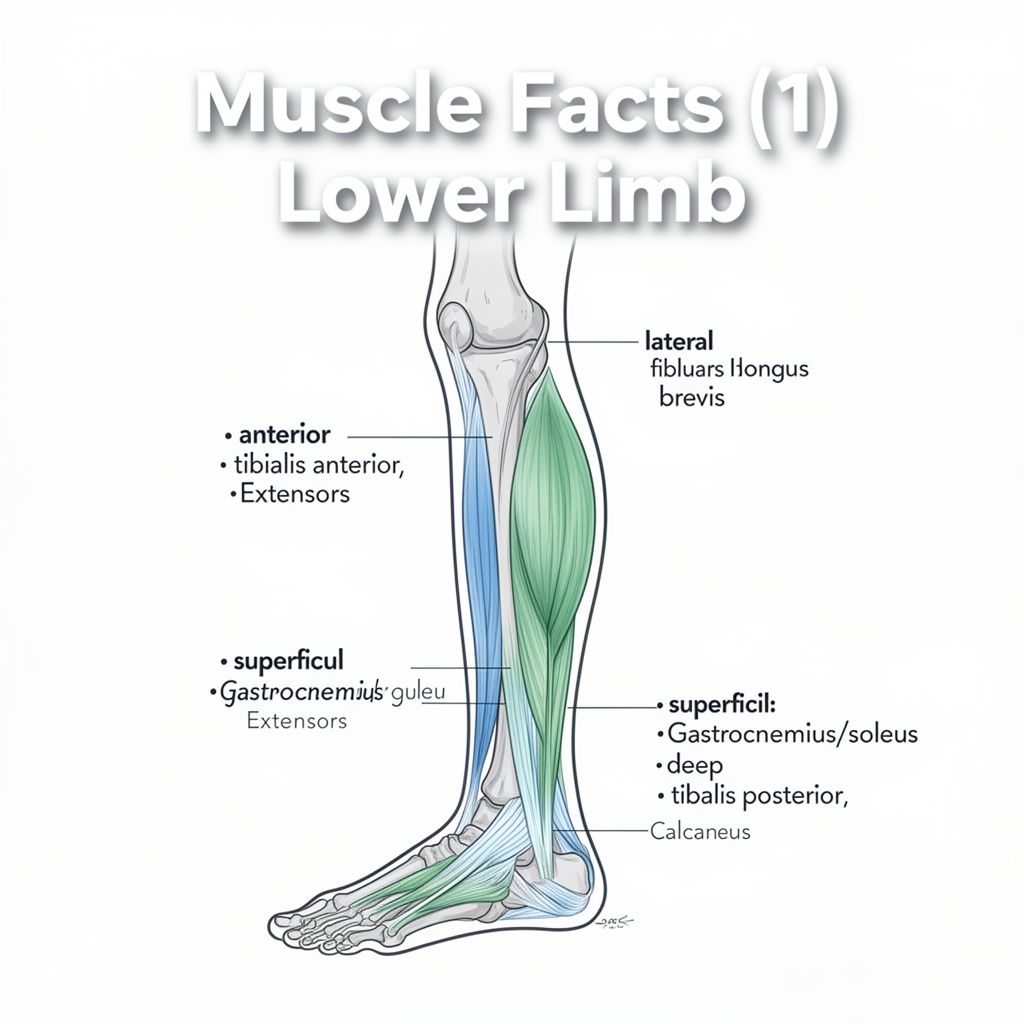
📚 Lower Limb Muscles: Leg Compartments Study Guide
This study material is compiled from a lecture audio transcript and copy-pasted text, providing a comprehensive overview of the muscles in the leg compartments.
Introduction to Leg Muscle Compartments
The muscles of the leg are fundamental for controlling foot movements, including flexion, extension, inversion, and eversion. These actions are crucial for maintaining stability in the lower limb during movements at both the knee and hip joints. Understanding these muscles involves categorizing them into distinct compartments, each with specific functions, origins, insertions, and innervations. This guide will detail the lateral, anterior, and posterior compartments of the leg.
1. Lateral Compartment Muscles
The lateral compartment of the leg primarily contains muscles responsible for eversion of the foot and assisting in plantar flexion. These muscles are key for dynamic stability during walking and running.
1.1. Fibularis Longus (Peroneus Longus)
- 📚 Origin: Head and proximal two-thirds of the lateral surface of the fibula, partially from intermuscular septa.
- 📚 Insertion: Plantar side of the medial cuneiform and base of the first metatarsal.
- 📚 Innervation: Superficial fibular nerve (L5, S1).
- ✅ Actions:
- Talocrural joint: Plantar flexion.
- Subtalar joint: Eversion (pronation).
- 💡 Supports the transverse arch of the foot.
1.2. Fibularis Brevis (Peroneus Brevis)
- 📚 Origin: Distal half of the lateral surface of the fibula, intermuscular septa.
- 📚 Insertion: Tuberosity at the base of the fifth metatarsal (with an occasional division to the dorsal aponeurosis of the fifth toe).
- 📚 Innervation: Superficial fibular nerve (L5, S1).
- ✅ Actions:
- Talocrural joint: Plantar flexion.
- Subtalar joint: Eversion (pronation).
2. Anterior Compartment Muscles
The anterior compartment muscles are primarily responsible for dorsiflexion of the foot and extension of the toes. They are essential for lifting the foot during the swing phase of gait.
2.1. Tibialis Anterior
- 📚 Origin: Upper two-thirds of the lateral surface of the tibia, interosseous membrane, and superficial crural fascia.
- 📚 Insertion: Medial and plantar surface of the medial cuneiform, and medial base of the first metatarsal.
- 📚 Innervation: Deep fibular nerve (L4, L5).
- ✅ Actions:
- Talocrural joint: Dorsiflexion.
- Subtalar joint: Inversion (supination).
2.2. Extensor Hallucis Longus
- 📚 Origin: Middle third of the medial surface of the fibula and interosseous membrane.
- 📚 Insertion: Dorsal aponeurosis at the base of the distal phalanx of the first toe.
- 📚 Innervation: Deep fibular nerve (L4, L5).
- ✅ Actions:
- Talocrural joint: Dorsiflexion.
- Subtalar joint: Active in both eversion and inversion (pronation/supination), depending on the initial position of the foot.
- Extends the metatarsophalangeal (MTP) and interphalangeal (IP) joints of the big toe.
2.3. Extensor Digitorum Longus
- 📚 Origin: Head and medial surface of the fibula, lateral condyle of the tibia, and interosseous membrane.
- 📚 Insertion: Dorsal aponeuroses at the bases of the distal phalanges of the second to fifth toes.
- 📚 Innervation: Deep fibular nerve (L4, L5).
- ✅ Actions:
- Talocrural joint: Dorsiflexion.
- Subtalar joint: Eversion (pronation).
- Extends the MTP and IP joints of the second to fifth toes.
2.4. Fibularis Tertius (Peroneus Tertius)
- 📚 Origin: Distal fibula (anterior border).
- 📚 Insertion: Base of the fifth metatarsal.
- 📚 Innervation: Deep fibular nerve (L4, L5).
- ✅ Actions:
- Talocrural joint: Dorsiflexion.
- Subtalar joint: Eversion (pronation).
3. Posterior Compartment Muscles
The posterior compartment of the leg is divided into two groups: superficial and deep flexors. These groups are separated by the transverse intermuscular septum.
3.1. Superficial Flexors (Triceps Surae)
These muscles form the bulk of the calf and are powerful plantar flexors of the foot.
3.1.1. Gastrocnemius
- 📚 Origin:
- Medial head: Superior posterior part of the medial femoral condyle.
- Lateral head: Lateral surface of the lateral femoral condyle.
- 📚 Insertion: Calcaneal tuberosity via the calcaneal (Achilles') tendon.
- 📚 Innervation: Tibial nerve (S1, S2).
- ✅ Actions:
- Talocrural joint: Powerful plantar flexion (especially when the knee is extended).
- Knee joint: Flexion.
3.1.2. Soleus
- 📚 Origin: Head and neck of the fibula, and the soleal line of the tibia via a tendinous arch.
- 📚 Insertion: Calcaneal tuberosity via the calcaneal (Achilles') tendon.
- 📚 Innervation: Tibial nerve (S1, S2).
- ✅ Actions:
- Talocrural joint: Plantar flexion.
3.1.3. Plantaris
- 📚 Origin: Lateral epicondyle of the femur, proximal to the lateral head of the Gastrocnemius.
- 📚 Insertion: Calcaneal tuberosity.
- 📚 Innervation: Tibial nerve (S1, S2).
- ✅ Actions:
- Negligible; may assist Gastrocnemius in plantar flexion.
3.2. Deep Flexors
These muscles are crucial for foot inversion, plantar flexion, and toe flexion, and play a significant role in supporting the arches of the foot.
3.2.1. Tibialis Posterior
- 📚 Origin: Interosseous membrane, adjacent borders of the tibia and fibula.
- 📚 Insertion: Navicular tuberosity, medial, intermediate, and lateral cuneiforms, and bases of the second to fourth metatarsals.
- 📚 Innervation: Tibial nerve (L4, L5).
- ✅ Actions:
- Talocrural joint: Plantar flexion.
- Subtalar joint: Inversion (supination).
- 💡 Supports the longitudinal and transverse arches of the foot.
3.2.2. Flexor Digitorum Longus
- 📚 Origin: Middle third of the posterior surface of the tibia.
- 📚 Insertion: Bases of the second to fifth distal phalanges.
- 📚 Innervation: Tibial nerve (L5-S2).
- ✅ Actions:
- Talocrural joint: Plantar flexion.
- Subtalar joint: Inversion (supination).
- MTP and IP joints of the second to fifth toes: Plantar flexion.
3.2.3. Flexor Hallucis Longus
- 📚 Origin: Distal two-thirds of the posterior surface of the fibula, adjacent interosseous membrane.
- 📚 Insertion: Base of the first distal phalanx.
- 📚 Innervation: Tibial nerve (L4-S1).
- ✅ Actions:
- Talocrural joint: Plantar flexion.
- Subtalar joint: Inversion (supination).
- MTP and IP joints of the first toe: Plantar flexion.
- 💡 Supports the medial longitudinal arch.
3.2.4. Popliteus
- 📚 Origin: Lateral femoral condyle, posterior horn of the lateral meniscus.
- 📚 Insertion: Posterior tibial surface (above the origin of the Soleus).
- 📚 Innervation: Tibial nerve (L4, L5).
- ✅ Actions:
- Knee joint: Flexes and "unlocks" the knee by externally rotating the femur on the fixed tibia.